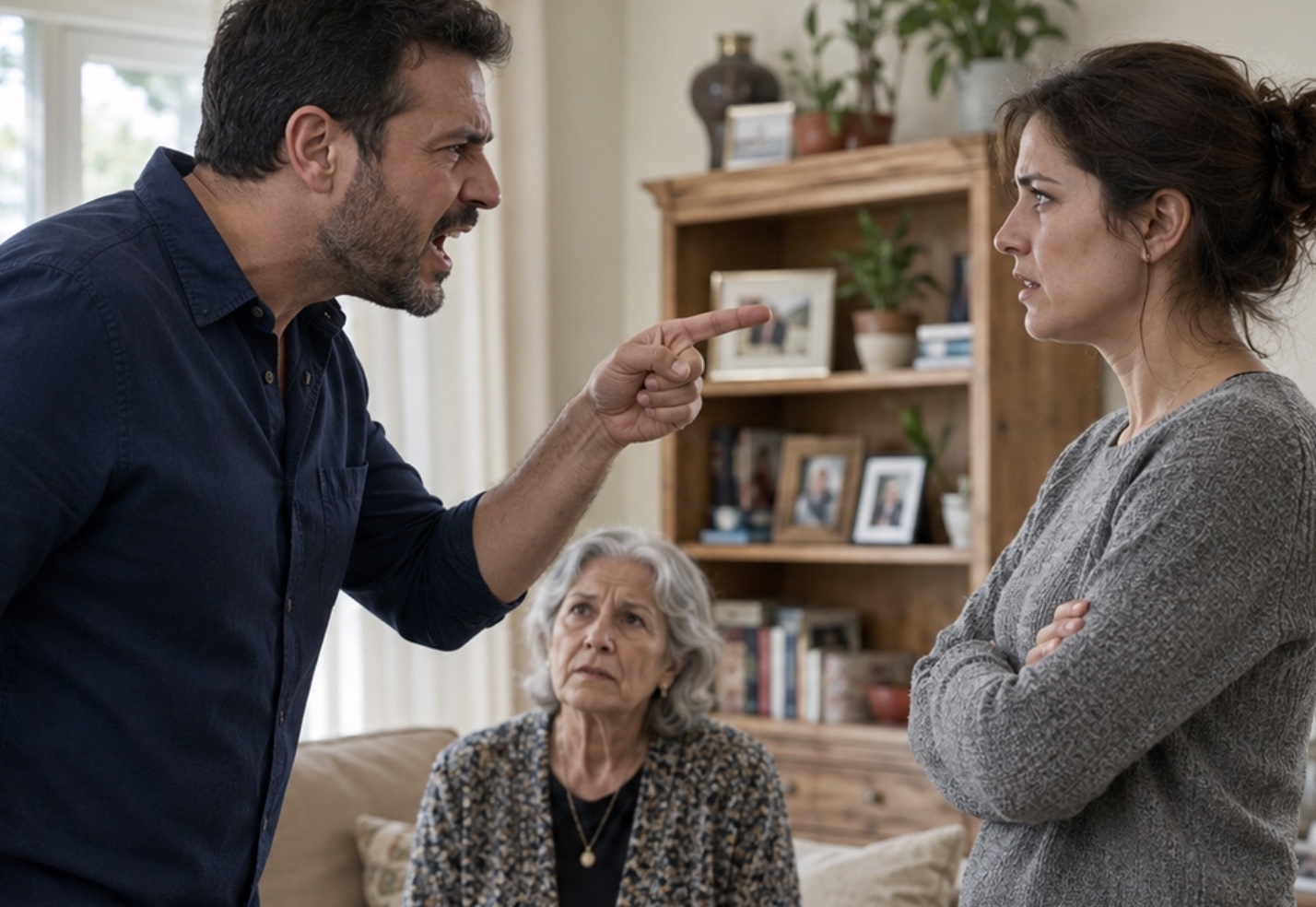
— Wait, did I hear you correctly? — Svetlana slowly lowered her cup onto the table without taking her eyes off her husband. — Do you seriously believe that my mother owes us money now just because your mother once helped raise Katya?
Dmitry stood in the middle of the kitchen with his arms folded across his chest. His entire posture reflected a strange mixture of resentment and complete certainty that he was right.
— She didn’t just “help,” she practically raised her! — he snapped. — Mom put so much effort into that girl, spent so much time on her… And now, when we’re the ones who need support, your mother won’t lift a finger for us?
Svetlana leaned back in her chair.
Fragments of the past flashed through her mind. An entire life spent beside this man suddenly looked different, as though someone had switched on a bright light and illuminated things that had always remained hidden in the shadows.
They had met twenty-two years earlier.
Svetlana had been twenty-one at the time, with a two-year-old daughter named Katya. Her first marriage had fallen apart quickly and painfully. Katya’s father had left before the child was even a year old, leaving behind nothing but promises that he would help financially. Those promises had remained exactly that—words.
Svetlana raised her daughter alone. She worked long hours, rented a tiny one-room apartment, and learned very early that the only person she could truly rely on was herself.
Dmitry entered her life unexpectedly. They met through mutual friends at a loud gathering Svetlana had almost skipped.
He was eight years older than her, calm and practical, with a stable job and an apartment of his own.
When he first met Katya, he never treated the little girl as an inconvenience or unwanted baggage.
Instead, he told Svetlana plainly:
— I’m ready for this. If you and I build a life together, I’ll raise her as if she were my own.
Svetlana wanted to believe him, but trust did not come immediately.
It grew slowly, day after day, as she watched Dmitry patiently play with Katya, read bedtime stories to her, and teach her how to tie her shoelaces.
Eventually, Svetlana became convinced that he had truly accepted her daughter.
Their wedding was modest.
Afterward, Svetlana and Katya moved into Dmitry’s two-bedroom apartment.
His mother, Galina Ivanovna, treated her new daughter-in-law with caution, though never with open hostility.
Her attitude toward Katya was more complicated.
Sometimes she could be surprisingly caring. She knitted the girl a winter hat, brought her homemade pastries, or asked about school.
At other times, she would casually make remarks such as:
— Well, she isn’t really our blood.
She always said it almost casually, but every time Svetlana heard those words, something inside her froze.
Whenever Svetlana complained, Dmitry dismissed it.
— Come on. Mom is just old-fashioned. She loves Katya in her own way.
Svetlana tried not to dwell on it.
The important thing was that Dmitry was there, the household was functioning, and Katya was finally growing up in something resembling a stable family.
Svetlana’s own mother was almost absent from her life.
Technically, she had a mother, but she lived in another city and had built a new family and a new life.
After Svetlana’s parents divorced, Svetlana stayed with her father. Her mother moved away and appeared only occasionally after that.
There were short phone calls on holidays and even rarer transfers of small amounts of money.
When Svetlana married Dmitry and later gave birth to their son, Artyom, her mother came to visit only twice.
Both visits were brief.
She arrived with predictable gifts and the usual apologies about being too busy.
Galina Ivanovna, on the other hand, was constantly around.
She visited several times a week, watched the children whenever Svetlana worked late, cooked meals, and ironed clothes.
Naturally, most of her attention went to Artyom, her biological grandson.
Still, she did not completely ignore Katya.
She picked her up from kindergarten, took her to after-school activities, and baked the sweet buns the girl loved.
— Galina Ivanovna, thank you so much, — Svetlana often told her sincerely. — I honestly don’t know what I would do without you.
— Oh, don’t mention it, dear, — her mother-in-law would reply. — I’m their grandmother. Who else should I help if not my own family?
But there was always something slightly uncomfortable in the way she pronounced the word “own,” as though Katya belonged to that category only partially.
The years passed.
Katya grew up, entered university, and eventually started working.
Artyom went to school.
Svetlana built a successful career in a large logistics company and eventually became a department manager.
Dmitry continued working as an engineer at a factory. His job was reliable and steady. There were no dramatic promotions, but there were no serious setbacks either.
Their marriage became stable in the way long marriages sometimes do—not especially warm or intimate, but familiar.
They stayed together partly because they had become accustomed to one another.
Then Artyom was accepted into medical school.
His grades were not high enough for a state-funded place, so he entered the tuition-paying program.
The cost was substantial—more than three hundred thousand rubles every year.
Dmitry immediately said:
— We have to give our son an education. That’s our responsibility.
Svetlana agreed.
Artyom was their child, and she wanted him to have the opportunity to study medicine.
They found the money.
Some came from their savings, and Svetlana covered a significant part from her salary because she earned considerably more than Dmitry.
By then Katya was already living independently.
She rented an apartment, worked as a designer, and managed her own life.
Svetlana occasionally helped her—sending money for groceries, buying clothes, or lending her money when she was short.
She never described those things as sacrifices.
Everything began to change after Dmitry and his mother decided that the apartment needed a major renovation.
The idea actually came from Galina Ivanovna.
— Artyom will graduate soon, — she said. — Maybe he’ll want to live here with his future wife. The apartment should be renovated and modernized before that happens.
Dmitry immediately became enthusiastic.
Svetlana was less convinced.
— Maybe we should wait? We’ve just spent a fortune on Artyom’s tuition, and our savings are almost gone.
— We’ll manage somehow, — Dmitry brushed her off. — Mom is right. The apartment has needed renovating for years.
The final estimate reached 1.2 million rubles.
Contractors, building materials, furniture, appliances—everything had to be expensive and high-quality because Galina Ivanovna insisted that if they were doing it, they should do it properly.
Once again, Svetlana quietly opened her bank account and began paying.
Dmitry contributed too, but his salary covered only about a third of the total cost.
Svetlana paid most of the rest.
The renovation lasted six months.
By the end, the apartment looked completely transformed—bright, stylish, with a new kitchen and a spacious modern living room.
Galina Ivanovna was delighted.
Dmitry proudly admired the result.
Svetlana simply calculated how many months she would have to work before she could rebuild even a modest emergency fund.
Then, almost as if life had chosen the worst possible moment, something happened to Svetlana’s mother.
Lyudmila Viktorovna had spent almost her entire life in a small town.
She had worked at a local factory, eventually retired, and lived quietly without asking much of anyone.
Then one day she called Svetlana, her voice trembling.
— Sveta, I have a health problem. The doctors say I need surgery. I can get it through the state system, but the waiting list is six months. They say waiting that long could be dangerous.
Svetlana immediately asked:
— How much does the surgery cost?
— Four hundred and fifty thousand, — her mother replied.
There was such helplessness in her voice that Svetlana felt her chest tighten.
After ending the call, she turned to Dmitry.
— Dima, my mother needs surgery. We have to help her.
Dmitry looked up from his phone and frowned.
— Four hundred and fifty thousand? Where are we supposed to get that kind of money? We’ve just finished the renovation. Everything is gone.
— I’ll use some of my savings. You can contribute from yours. We’ll figure it out.
— Sveta, — he shook his head, — we’ve only just recovered from Artyom’s tuition expenses and the renovation. Maybe your mother can wait. Perhaps her turn for the free surgery will come sooner.
— Dima, this is her health we’re talking about.
— And my mother spent twenty years raising your daughter, — he suddenly said sharply.
There was bitterness in his voice, as though he had been waiting years for the opportunity to say it.
— She did it for free, by the way. Never asked you for a penny. But now, when we’re struggling ourselves, your mother suddenly appears and expects money from us?
Svetlana froze.
— Hold on. Are you actually serious?
— Completely, — Dmitry replied, folding his arms. — My mother invested years of effort, time, and care into Katya. That has value too. What did your mother ever do for us? She visited a couple of times, brought some gifts, and disappeared. And now that she needs something, we’re supposed to drop everything and run to save her?
Svetlana slowly exhaled.
Something shifted inside her.
She stopped thinking like a wife trying to prevent an argument and started thinking the way she did at work.
Svetlana was good at logistics. She knew how to take a complicated system and divide it into clear, measurable parts.
That was exactly what she did now.
— Dima, let’s go through this carefully, — she said calmly. — You say your mother raised Katya. Fine. She watched her while I worked. She picked her up from kindergarten. That’s true. But she did those things voluntarily because she cared about her granddaughter—or at least that’s what you always told me. Nobody forced your mother to help. In fact, most of the time she offered.
— So what? That doesn’t change the fact that she spent enormous amounts of time on Katya.
— I agree. But time and financial support aren’t the same thing. I never asked your mother to provide for Katya. Clothes, food, school supplies, activities—I paid for all of it. Or have you forgotten?
Dmitry hesitated.
— Well… yes, mostly you did. But Mom still helped.
— She did, and I’ve always been grateful. But Katya is my daughter, and I supported her financially. Artyom, however, is our son. We raised him together. Though financially, I’ve contributed more because I earn more. His university costs three hundred and twenty thousand a year, and I paid more than half. The renovation cost 1.2 million, and eight hundred thousand came from my account. You want to start calculating contributions? Fine. Let’s calculate them.
Dmitry went pale.
— Are you seriously going to start digging through numbers now? We’re a family!
— Exactly, — Svetlana nodded. — We’re supposed to be a family. Yet somehow the support your mother gave us is sacred, while helping my mother is suddenly optional. Why?
He turned away and muttered something she could not understand.
Svetlana picked up her phone, opened her banking application, and held the screen toward him.
— Here are the statements from the last five years. Here are the expenses for Artyom. Here’s the renovation. Here are my transfers. Do you see the difference between what I contributed and what you contributed?
— Sveta, I earn less than you. You know that.
— Of course I know. And I have never used it against you. But now you’re asking me to refuse my own mother medical care because your mother once looked after Katya. That’s a double standard, Dima.
He clenched his fists and looked away.
— My mother did a lot for your daughter. That is a fact.
— And I’m grateful to her. But gratitude doesn’t mean my mother should be left to die because we supposedly have no money.
— I never said she should die!
— You said she should wait for the state-funded operation. Her doctors say waiting could be dangerous. Do you understand the difference?
Dmitry turned around and walked out of the kitchen, slamming the door behind him.
Svetlana remained alone.
She sat at the table and lowered her head into her hands.
Inside, she was boiling with anger, hurt, and exhaustion.
But worst of all was the realization that after twenty-two years together, the man she had built her life with had looked at her mother in a moment of crisis and decided she simply was not valuable enough to deserve their help.
That evening Svetlana called Katya.
Her daughter listened without interrupting.
After a long silence, Katya said:
— Mom, I can give you one hundred thousand. That’s all the money I’ve saved, but you can take it.
Svetlana struggled to hold back tears.
— Katya, thank you. But I need much more than that.
— Then take out a loan. I’ll help you repay it.
— I don’t want to drag you into this.
— Mom, she’s my grandmother too. Maybe she wasn’t involved much in my life, but she’s still your mother. And you spent your entire life supporting me. I’m helping you.
Svetlana took out a loan for three hundred and fifty thousand rubles.
Katya transferred one hundred thousand.
Svetlana also withdrew another fifty thousand from a separate savings account she had quietly maintained for emergencies.
The surgery was performed two weeks later.
It was successful.
Lyudmila Viktorovna began recovering.
When Svetlana finally returned home from the hospital, Dmitry greeted her in silence.
Galina Ivanovna was sitting in the kitchen drinking tea.
— So, did you manage to rescue your mother? — she asked with a faintly mocking tone.
— I did, — Svetlana replied briefly.
Her mother-in-law sighed.
— Interesting. You never minded spending money on us. Think of everything we put into the renovation, everything we spent on Artyom. But when it comes to your relatives, suddenly money appears from nowhere.
Svetlana looked at her for several seconds.
Her expression was calm, but her gaze was heavy.
— Galina Ivanovna, I personally paid eight hundred thousand toward this renovation. I also covered more than half of Artyom’s university tuition. That money came from my salary. And to pay for my mother’s operation, I took out a loan that I will repay myself. So I would appreciate it if you stopped making accusations about my finances.
Galina Ivanovna pressed her lips together and looked away.
Dmitry was standing near the window.
— You could have discussed the loan with me first, — he muttered.
— The way you discussed the renovation with me? — Svetlana replied evenly. — Or the new furniture your mother decided Artyom needed? Did anyone ask me before those decisions were made?
He said nothing.
Later that evening, after Galina Ivanovna had gone home, Svetlana sat across from her husband.
— Dima, there’s something I need to tell you.
He immediately became wary.
— I have lived in this family for twenty-two years. I raised our son. I put my money into our home. I respected your mother and thanked her repeatedly for helping with Katya. But today I finally understood something. To you, my family will always be second-class. My mother doesn’t deserve help because she supposedly “didn’t invest” enough in Katya. Meanwhile, your mother is untouchable because she babysat her granddaughter. Is that what you believe?
— That’s not what I said.
— It is. Maybe you used different words, but that was the meaning.
Dmitry lowered his eyes.
— So here’s how things are going to work from now on, — Svetlana continued. — We’re separating our finances. Household expenses—utilities and groceries—we split equally. Everything else is each person’s responsibility. Your mother is your responsibility. My mother is mine. Artyom is already an adult, and he can decide for himself which parent he asks for help.
Dmitry stared at her.
— You’re serious?
— Completely.
He opened his mouth to argue but stopped.
There was something in Svetlana’s eyes he had rarely seen before.
Resolve.
And behind that resolve, something even more unsettling—detachment.
Six months passed.
They continued living under the same roof, but their marriage now resembled a practical arrangement more than a relationship.
Svetlana steadily repaid the loan, helped her mother through her recovery, and stayed close to Katya.
Several times, Dmitry tried to restore the old financial system.
He complained that living separately like this was uncomfortable.
He repeated that a real family should be united.
Each time, Svetlana calmly returned to the same point.
— You want unity? Then start with respect. Respect for my mother. Respect for my daughter. And respect for everything I have contributed to this family.
After that, he usually went quiet.
Galina Ivanovna began visiting less often.
Svetlana remained polite to her, but the old warmth had disappeared.
One day her mother-in-law tried again to remind Svetlana of everything she had supposedly done for Katya.
Svetlana answered calmly:
— Galina Ivanovna, I am grateful for your help. But please stop turning that help into a bill I’m expected to repay for the rest of my life. You helped voluntarily. I financially supported Katya myself. Nobody owes anybody anything.
Her mother-in-law turned pale but said nothing.
Some time later, Katya asked her mother:
— Mom, do you regret that it took you so long to see all this?
Svetlana thought for a moment.
— I do. But understanding something late is still better than never understanding it at all.
— Then why don’t you leave him?
— Because right now, staying is more comfortable for me. But I’ve established my boundaries. That’s what matters.
For twenty-two years, Svetlana had believed that being a family meant everything should be shared.
Eventually she learned that “shared” only works when everyone contributes fairly and respects what the other person brings.
When some people constantly take while hiding behind beautiful words about family, duty, and loyalty, the idea of “ours” becomes nothing more than a convenient source of resources for whoever knows how to exploit it.
Galina Ivanovna really had helped raise Katya.
That was undeniable.
But she had done it because Katya was part of her son’s household and, in her own complicated way, she considered the girl part of the family.
There was nothing wrong with that.
What was wrong was turning twenty-year-old acts of kindness into a lifelong debt and expecting Svetlana to repay it by abandoning her own mother when she desperately needed medical care.
Svetlana stopped arguing.
She stopped defending herself.
And she stopped trying to prove that her choices were reasonable.
She simply began living by different rules—with respect for herself, her boundaries, and the people who were genuinely there when life became difficult.
Dmitry, little by little, began to understand something he had taken for granted for more than two decades.
The woman who had silently carried much of the financial and emotional weight of their family for twenty-two years was no longer willing to justify her worth.
She already knew exactly what she was worth.
And that was enough.