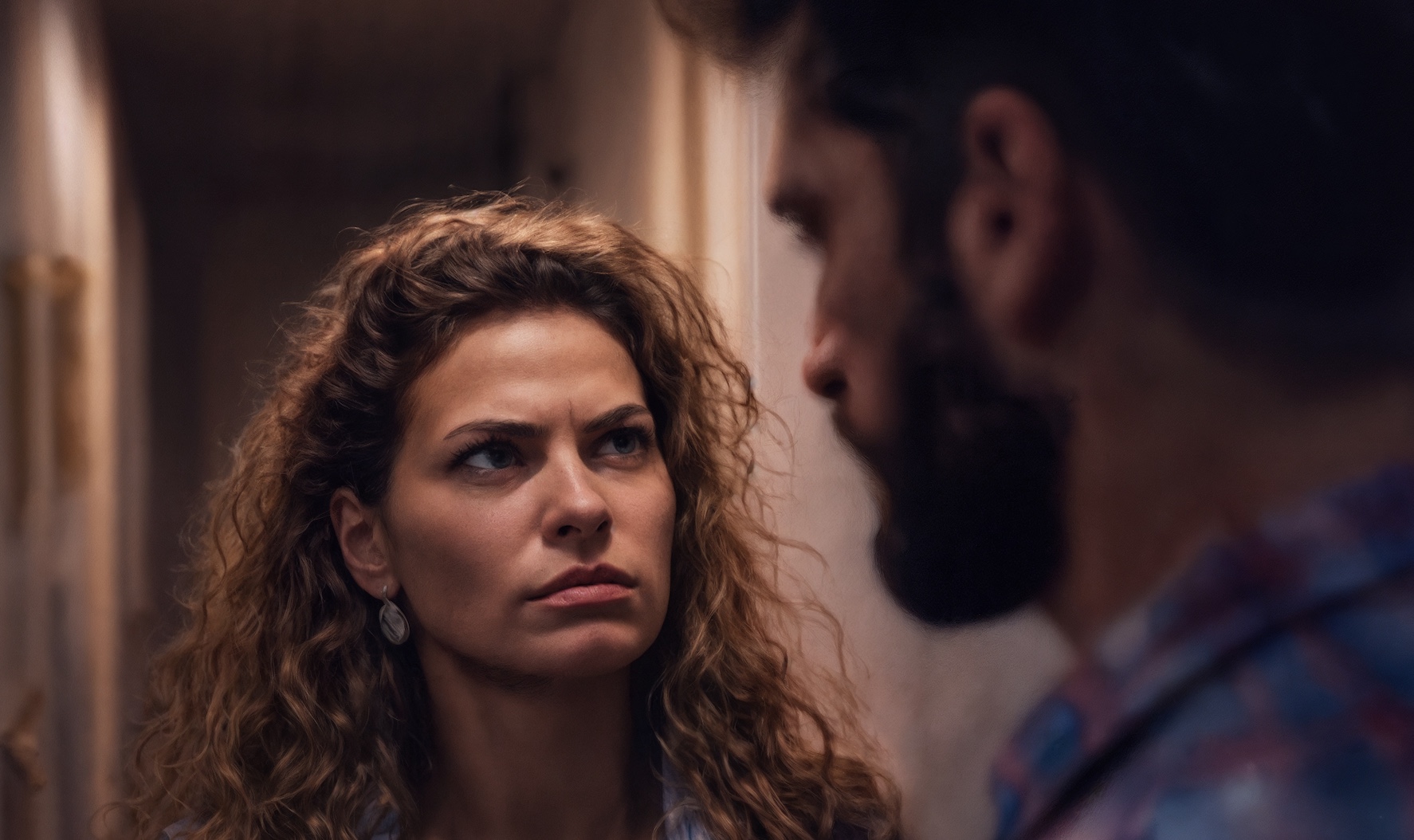
“What the hell is it so quiet for?” Victoria muttered, twisting the key in the lock.
Normally, when she got off work early, the apartment would hit her with noise—TV blaring, toys crashing around, or Maxim’s voice narrating yet another livestream. But today the silence was so unnatural it felt as if every sound in the place had been wiped out. Only the refrigerator hummed in the kitchen like always, and somewhere deeper inside the apartment there was a strange, steady splashing—rhythmic, wrong.
Vika kicked off her heels without even unbuckling them and dropped the grocery bag right onto the entryway floor. Anxiety—cold and sticky as a draft—slid over the back of her neck. She stepped into the hallway. The bathroom door was slightly open. No steam. No warm, sweet smell of baby shampoo. Instead, dampness and chill seeped out through the crack.
“Max?” she called, but her voice broke.
She pushed the door.
The scene in front of her knocked the air out of her lungs harder than a punch. The tub was filled nearly to the top. In cloudy, soapy water—no bubbles left at all—sat their one-year-old son, Misha.
He wasn’t crying. It looked like he didn’t have the strength to cry anymore.
He clung to the edge with tiny fingers turned white, shivering in quick, fine tremors. His skin had that awful bluish-marble shade people get when they’ve stayed in icy water too long. His lips were purple, and his stare was glassy, fixed on a single spot in the tile.
“Oh God,” Vika breathed.
She lunged for the bathtub, not even thinking about her office blouse and skirt. Her hands plunged into the water and she recoiled as if shocked—ice-cold. Completely cold. As if it had been drawn ages ago and left there to go dead.
Victoria yanked her son out in one sharp pull. He was heavy, slippery, and cold as a frog. Pressing his wet little body to her chest, she felt strong shudders rocking him. Misha didn’t even cling back—his muscles were stiff with cold. She grabbed a large terry towel from the warmer, wrapped him up to the top of his head, and began rubbing him hard, realizing she was shaking too—not from the cold, but from pure, animal terror.
“Where is he? Where’s Daddy?” she whispered, kissing the icy crown of his head. “Where is that—”
At that moment the front door lock clacked. The stairwell’s noise flooded in—brisk footsteps, voices—and with it a thick, spicy smell of hot dough, melted cheese, and salami.
“Vikulya! Why are you home so early?” Maxim’s voice boomed, cheerful and pleased with itself. “And look what I got—pizza! The courier got lost, I had to go meet him, but it’s hot! Pepperoni and Four Cheese, just how you like it!”
He stepped into the hall without taking his shoes off, holding two flat cardboard boxes out in front of him like trophies. His cheeks were flushed; his jacket reeked of tobacco and cold street air. He was smiling, already imagining dinner—until he saw his wife in the bathroom doorway with the baby bundled in her arms.
Vika stared at him. Her blouse was soaked and stuck to her skin, mascara slightly smeared, but her face was the truly frightening part—paper-white, eyes like dark pits. She said nothing, just kept mechanically rubbing their son’s back through the towel.
Maxim stopped, shifting his weight from foot to foot. His smile slid away, replaced by confusion and the mild irritation of someone whose evening is being ruined for no reason.
“Uh… why are you guys already out?” he asked, nodding toward the bundle in her arms. “I figured he was still splashing around. Little boats, rubber ducks, all that. I filled the tub up good so he could float.”
He set the pizza boxes on the cabinet, knocking Vika’s keys to the floor in the process, and started unzipping his jacket.
“You figured?” Vika asked quietly. Her voice sounded hollow, like it was coming from inside a barrel.
“Yeah. The courier called and said he was standing by the third entrance, clueless. I ran down. Five minutes. And then Sergei from the fifth floor came out for a smoke, and we got talking about yesterday’s Zenit match. You know Sergei—he won’t let you go until he’s told you every last detail.”
Maxim chuckled at the memory and reached for the box lid to grab a slice.
“Actually, it was a good chat. He says the ref should be—”
“You left our one-year-old alone in the bathtub so you could go downstairs for pizza, and then you talked to the neighbor for half an hour? He sat in water that kept getting colder and screamed while you debated football in the hallway?”
Maxim froze with the slice in his hand. A strand of cheese stretched from the box and hung in the air. He frowned, finally registering that his wife wasn’t simply annoyed—she was looking at him like he’d sprouted a second head.
“What’s this supposed to be?” he said, taking a bite and chewing on purpose, making a show of not seeing a problem. “What half an hour? Maybe twenty minutes. And why would he be screaming? I didn’t hear anything. The door was closed. The water was up to his waist—he couldn’t drown. He sits fine. Why are you freaking out over nothing?”
Vika felt Misha stop trembling for a moment, then begin a soft, miserable whimper, burying his nose into her neck. That sound snapped the last restraint in her mind.
“Twenty minutes?” she repeated, stepping toward him. “Max, the water is ice-cold. He’s blue. Do you understand that? He’s blue!”
“Oh, don’t start with the dramatics,” Maxim winced and waved his hand, pizza crust pinched between his fingers. “Toughening up is good. A man’s growing, not a delicate flower. So the water cooled down—so what? In summer the river isn’t boiling either. You’re always turning nothing into a disaster. Go eat while it’s hot, or later you’ll say I don’t care about you again.”
He turned and headed for the kitchen, trailing the smell of pizza—and a complete, total indifference to what had almost killed his child. Vika stood in the hallway, hugging her son tighter, watching her husband’s back as he walked away. Inside her, where love used to live—or at least routine—something black and burned-out began to spread.
She walked past the kitchen, where Maxim was already rustling cardboard, opening the second box. She carried Misha into the bedroom, laid him on the bed, and rubbed him with doubled force. His skin was frighteningly cold, as if she were touching marble instead of a living child. Misha whimpered; his teeth began to chatter in a rapid beat, but he didn’t struggle or roll away—he lay limp, drained by the long stretch in freezing water.
Maxim appeared in the doorway a minute later. In one hand he held a slice dripping grease; in the other, a can of beer. He leaned against the frame, watching with mild annoyance.
“What are you doing, honestly?” he asked through a full mouth. “Vik, stop with this one-woman theater. It’s disgusting to watch. You’ll scrub him raw with that towel.”
Victoria didn’t turn around. She pulled warm tights and a wool sweater from the dresser and began dressing her son quickly but carefully. Her hands shook, but her movements were precise.
“Do you understand that water goes completely cold in half an hour?” she asked dully, pulling a sock over his small bluish foot. “Do you understand a one-year-old can’t regulate temperature the way you can, you big healthy brute?”
“Oh here we go,” Maxim rolled his eyes and took a swig of beer. “Temperature regulation, helicopter parenting… you read those smart words on Instagram? I’m telling you again: I was gone five minutes. Maybe seven. The water was warm when I left. That means it only got cold just now. Nothing would happen in a couple minutes of cool water.”
“Five minutes?” Vika straightened sharply and turned to face him. Misha, now dressed, curled into a ball on the blanket and went still, eyes half-closed. “Max, his lips are purple. His fingers won’t even straighten from spasms. Look at him! For once, open your eyes and look at your son instead of your phone or your plate!”
Maxim flicked a lazy glance at the child and shrugged.
“So he got cold. It happens. He’ll warm up. This is your fault—you barged in, started yelling, scared him. He was calm until you burst in. Sitting there playing. And now you’re messing up his head with your hysteria. You’re raising him into some kind of weakling.”
He took a big bite, chewed loudly, and continued, gesturing with the slice like it was proof:
“A man has to toughen up. When I was his age, I bathed in a barrel at my grandma’s place—nothing happened. I grew up. I didn’t die. But you hover over him like a hen over an egg. A gust of wind—hat. Water cools—panic. He’s got to live in the real world, Vika, not a greenhouse. He needs an immune system.”
Vika listened and felt something inside her snap. Like a tightly drawn string breaking—the one holding the whole structure of their marriage together. She stared at the grease stain on his T-shirt, the crumbs stuck in his stubble, his utterly calm, satisfied face. He genuinely didn’t get it. To him, a baby turning blue from cold was just an annoying inconvenience interrupting a pleasant evening.
“This isn’t toughening up, Maxim,” she said in a voice so icy it raised goosebumps on her own skin. “This is endangering a child. You left a helpless human being in water. You locked the apartment and went to gossip with your neighbor. And if he’d slipped? If he’d swallowed water? You wouldn’t have heard. You’d have come back and he would’ve—”
“Not this ‘what if’ nonsense again,” Maxim cut her off with a grimace. “You love to blow things up. But nothing happened! He’s alive, right? Alive. Sitting there getting warm. What else do you want? I worked all day, I’m tired, I just wanted to eat in peace, and you’re ripping into me the second you walk in. You should’ve said thank you that I even watched him while you were out wandering around stores.”
“I was at work,” Vika reminded him quietly. “And I stopped by the store to buy groceries. For us.”
“What’s the difference!” he snapped, flinging his hand so a drop of sauce landed on the carpet. “The point is, you’re always unhappy. I got you pizza, I met the courier so you wouldn’t have to cook, and you look at me like I’m some kind of villain. Do you even see yourself? A hysteric.”
He turned and marched back to the kitchen, tossing over his shoulder:
“Anyway—stop whining. Come eat before it goes cold. Or later you’ll complain I ate everything. And bring the kid too—let him eat, maybe he’ll be nicer. He’s just like you—always with that unhappy face.”
Vika stood in the middle of the room. She watched the door close behind him, heard the TV click on, heard him laugh loudly at something. In the crib, Misha gave a tiny, barely audible sob.
Victoria went to her son and picked him up. He was warmer now, but still limp, subdued. She pressed him to her, breathing in the smell of baby cream and the dampness still clinging to his hair.
Her mind cleared. The fog of shock thinned, leaving a razor-clean understanding. Maxim hadn’t simply messed up. He hadn’t just been inattentive. He was a man for whom his own comfort—his slice of pizza and a chat about football—was worth more than their child’s life. He felt no remorse. He hadn’t even been scared.
She remembered how a month ago he “forgot” to close the window in winter and Misha lay in a draft for two hours. Maxim had said, “Come on, fresh air is good.” She remembered the time he left the stroller outside a shop without the brake on, and it rolled toward the road—until a passerby grabbed it. Maxim had laughed: “It wouldn’t have gone far—no license.”
This wasn’t an accident. It was a pattern. A system where she and Misha simply didn’t exist under “important.”
Vika laid her son down carefully, tucked the blanket up to his nose, then turned and went to the kitchen—not to eat pizza, and not to listen to lectures about “toughness.” She needed to ask one question. She already knew the answer, but she needed to hear it said out loud.
She walked into the kitchen and, first thing, yanked the TV cord from the socket. The screen—flashing bright ads—went black instantly, and a heavy silence dropped over the room, broken only by Maxim’s chewing.
He froze with a slice near his mouth, slowly shifting his gaze from the outlet to her. There was no fear in his eyes—just angry bewilderment, the look of someone whose favorite toy has been taken away.
“Have you completely lost it?” he asked, voice low but clearly threatening. “Plug it back in. I’m watching.”
“You’re not watching—you’re stuffing your face,” Vika shot back. Her voice was dry and rough as sandpaper. “And while you’re stuffing your face, I want you to hear me. Without football and those idiotic jokes.”
She sat down across from him. Between them lay the open pizza boxes, breathing oregano and melted grease—smells that now made her sick. She stared at her husband. Under the bright kitchen light she noticed what she’d missed in the dim hallway.
“You don’t just smell like smoke, Max,” she said, sniffing. “You smell like you went through half a pack. You didn’t just ‘get caught talking’ to Sergei. You stood there smoking. One after another.”
Maxim threw the half-eaten crust into the box. Greasy sauce splattered the tablecloth.
“Yeah, I smoked! So what?” he shouted. “Am I not allowed to unwind after my shift? I work like a damn horse so you and your precious little son have something to eat and wear. Don’t I have the right to ten lousy minutes of quiet in the stairwell where nobody whines and drills into my head?”
“Ten minutes?” Vika let out a short laugh—colder than any scream. “You left for the pizza at 7:30. I got home at 8:05. You were gone thirty-five minutes, Maxim. Thirty-five minutes your one-year-old sat in bathwater getting colder by the second. You stood out there smoking and laughing with your neighbor, fully aware he was alone. You knew.”
“I didn’t know a damn thing!” he slammed his palm on the table, making the saltshaker jump. “I thought he was playing! He was quiet! If he was screaming, I would’ve heard him!”
“He wasn’t quiet,” Vika said softly. “The downstairs neighbor—Valya—told me in the elevator that our ‘little baby has been wailing’ for half an hour. She thought I was home. But nobody was home. Nobody except you—one flight down—talking about a penalty kick. You heard him, Max. You just decided you’d finish your cigarette first.”
Maxim’s face blotched red. He leaned back, arms crossed—defensive and aggressive at the same time.
“You know what, Vika? I’m sick of you. You turned my life into a prison camp. ‘Don’t go there.’ ‘Don’t talk loud.’ ‘Watch him.’ ‘Wash him.’ I’m a man, not a babysitter! I’m allowed to have time for myself! Yeah, I stayed out longer. Yeah, I smoked. And? Is this the tragedy of the century? He’s alive, right? He gets sick—we’ll treat him. Pharmacies are everywhere. You’re blowing this up so you can make me the villain and shove me back under your heel.”
“Under my heel?” Vika slowly shook her head. “Remember three months ago when you forgot your blood pressure pills on the table? Misha almost opened the bottle—I barely smacked it out of his hands. You said it was ‘an accident.’ Remember when you left him on the changing table and went to open the door for a courier, and he fell? You said, ‘He’s the one to blame, always wriggling.’”
She spoke evenly, listing facts the way an investigator reads an indictment.
“These aren’t accidents, Maxim. It’s a diagnosis. You don’t care—deeply, honestly don’t care—about the safety of any living thing except yourself. You didn’t ‘get delayed.’ You chose your comfort and gambled with his life. You heard him crying and kept smoking because you couldn’t be bothered to put the cigarette out and go upstairs.”
“Go to hell!” Maxim sprang up, knocking his chair over. The crash echoed through the apartment. “Look at you—Saint Victoria! The perfect mother! You’re the one who needs treatment for your anxiety! You’re suffocating me! I don’t even want to come home because it’s always you with that sour face and your complaints!”
He strode to the window and yanked the handle, flinging it wide. Freezing air poured into the kitchen.
“I’m a normal father!” he screamed out into the open window, like he needed the whole courtyard to confirm it. “Normal! And just because I don’t shake over every scratch the way you do doesn’t make me a criminal! Don’t like how I bathe him? You do it! Don’t like how I watch him? You watch him! I’m done!”
Vika looked at him, and the last of her illusions fell into dust. In front of her wasn’t a husband, not a partner, not even a friend. It was an infantile, aggressive teenager trapped in a grown man’s body—someone who honestly believed the world revolved around his wants. He didn’t feel guilt. He felt only resentment that anyone had disturbed him.
“You’re right,” she said suddenly, perfectly calm. “You’re done. And you will never touch him again.”
Maxim whipped around, eyes narrowed. “What did you just say? Trying to scare me? Who do you think you are—who needs you with baggage? You think I’ll beg? I’ll be thrilled if you run off to your mommy. At least I’ll be able to drink a beer in peace!”
“I’m not threatening you,” Vika stood up. Her movements were smooth, but there was steel in them. “I’m stating a fact. You’re dangerous. You’re dangerous for a child to live with. And I’m not waiting for the next ‘accident’ to end in the ICU or the morgue.”
She left the kitchen, abandoning him among the scattered boxes, the open window blowing cemetery-cold air, the overturned chair. Maxim stood there breathing hard, fists clenched. He wanted to break something, slam a wall, prove he was right with force—since words didn’t work. He grabbed a piece of cooling pizza and bit into it savagely, tasting rancid oil and his own useless rage.
Vika went into the bedroom. Misha was asleep, drawing his legs up in his sleep as if he were still trying to get warm. His breathing was steady, though heavier than usual.
Something new switched on inside Victoria—an unfamiliar mode. Like an emergency life-support system on a submarine: every extra emotion, fear, doubt, and hope of reconciliation was sealed behind airtight bulkheads. Only one task remained: evacuation.
She didn’t pull out suitcases. That would take too long, make noise, and give Maxim another reason to mock her. She went to the closet, took the folder with documents—birth certificate, passports, Misha’s medical records—and shoved it into her large bag. In went diapers, wet wipes, two spare bodysuits, and a phone charger. That was it.
She bent over the crib. Misha stirred as she slipped him into a warm outdoor snowsuit right over his home clothes. He opened his eyes, hazy with sleep, but didn’t cry—he had no strength left for it. Vika lifted him, wrapped him in a thick fleece blanket like a cocoon, and carried him out.
When she stepped into the hallway, Maxim was standing in the kitchen doorway. He’d finished his slice and was wiping greasy hands on his pants, watching her with a crooked smirk.
“Oh, look at her,” he drawled. “Drama queen to the very end. Running to Mommy to complain? Go on, go on—just don’t forget to tell her what a hysterical mess you are.”
Vika silently put on her shoes, struggling to get her feet into them with her arms full of the heavy bundle.
“You hearing me?” Maxim’s voice sharpened, growing louder. He stepped forward and blocked the front door. His bulky body filled the narrow entryway. “Where are you going at night—with the kid? Are you insane? It’s ten below out there!”
“Move,” Vika said. Calmly. Quietly. But there was so much cold in that single word that Maxim hesitated for a split second.
“I’m not moving,” he planted his hand against the wall, cutting off the passage. “You take his jacket off right now, go back to the room, and calm down. I’m not letting you drag my son out into the мороз because of your craziness. You’re wrecking the family over nothing, Vika—over some stupid cold water!”
“Family?” She lifted her eyes to him. There were no tears in them—only a dry, scorched emptiness. “Maxim, we don’t have a family. A family is when people protect each other. And today you almost killed him. The worst part is—you still don’t even understand that.”
“Here we go again!” he barked, spit flying. His face twisted with rage. “Stop making me into a monster! I’m a normal guy! I work, I don’t go on benders, I don’t hit you! What else do you want, you ungrateful bitch?!”
“Safety,” she answered. “I want to know that if I leave you alone with him for five minutes, I won’t come back to find him dead.”
“You’re crazy!” Maxim screamed, lunging toward her like he meant to grab her shoulder. “You need help! I’ll call child services and tell them you kidnapped him! That you’re unstable!”
Vika didn’t flinch. She only held Misha tighter. He startled at his father’s yell, trembling.
“Call them,” she said evenly. “And I’ll show them the medical report for hypothermia we’re going to get in an hour at the ER. And I’ll tell them how you stood in the stairwell smoking while your son sat in ice-cold water. Believe me, Max—child services really doesn’t like ‘normal guys’ like that.”
Those words hit him harder than a slap. He went still. Fear flashed in his eyes—sticky, cowardly fear, the fear of someone caught and pinned to the wall by facts. He suddenly realized this wasn’t another fight that ends with makeup sex. This was the end. The final credits.
“You… you’re destroying everything,” he hissed, but he took his hand off the wall. “You’ll regret it. You’ll crawl back and beg to come home, and I won’t let you. You hear me? I won’t!”
“I won’t come back,” Vika said, turning the lock. The click sounded deafening in the hanging silence. “For me, you stopped existing today—as a husband. And as a father. You’re just a stranger now. A dangerous stranger.”
She shoved the door open with her shoulder and stepped onto the landing. The cold stairwell air slapped her face, but after the suffocating atmosphere of the apartment it felt like clean oxygen.
“Go on—get out!” Maxim shouted after her, standing in the doorway in his socks. “Run to your mommy! Who needs you with baggage! Idiot!”
Vika didn’t turn around. She pressed the elevator button, and as the doors crept shut with a strained squeal, she caught one last glimpse of the twisted, furious face of the man she once loved—now as чужой as a random stranger on the subway.
The doors sealed, cutting off the yelling, the smell of cheap pizza, the constant fear and guilt. The elevator began to descend.
Maxim stayed behind. He stood in the open doorway for another minute, listening to the elevator mechanism hum. Then, furious, he punched the doorframe so hard plaster dust drifted down from the ceiling.
“Psycho,” he spat into the emptiness. “She’s actually sick.”
He slammed the door and turned the lock twice.
The apartment was quiet now. Uncomfortably quiet. Only the refrigerator hummed, and somewhere water dripped. Maxim went back to the kitchen. Pepperoni and Four Cheese sat cooling on the table. The boxes were open; the sauce had congealed into a glossy skin.
He kicked the baby’s high chair that was in his way. The plastic frame clattered into the wall—but it didn’t make him feel better.
Maxim dropped into a chair and stretched his legs out. He felt like the victim. A victim of female stupidity, hormones, and insanity. He’d only wanted to eat. Only wanted to rest after work. Was that really so much to ask?
He picked up a piece of completely cold, rubbery pizza, took a bite, and chewed slowly, staring out the dark window. He still didn’t understand what had happened. In his world, nothing terrible had occurred.
His wife had simply gone crazy.
And somewhere below, in a night taxi, Vika cried for the first time all evening—quietly, without sound—pressing her cheek to her son’s warm forehead. He had finally warmed up and slept peacefully, no longer afraid…