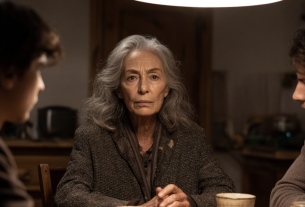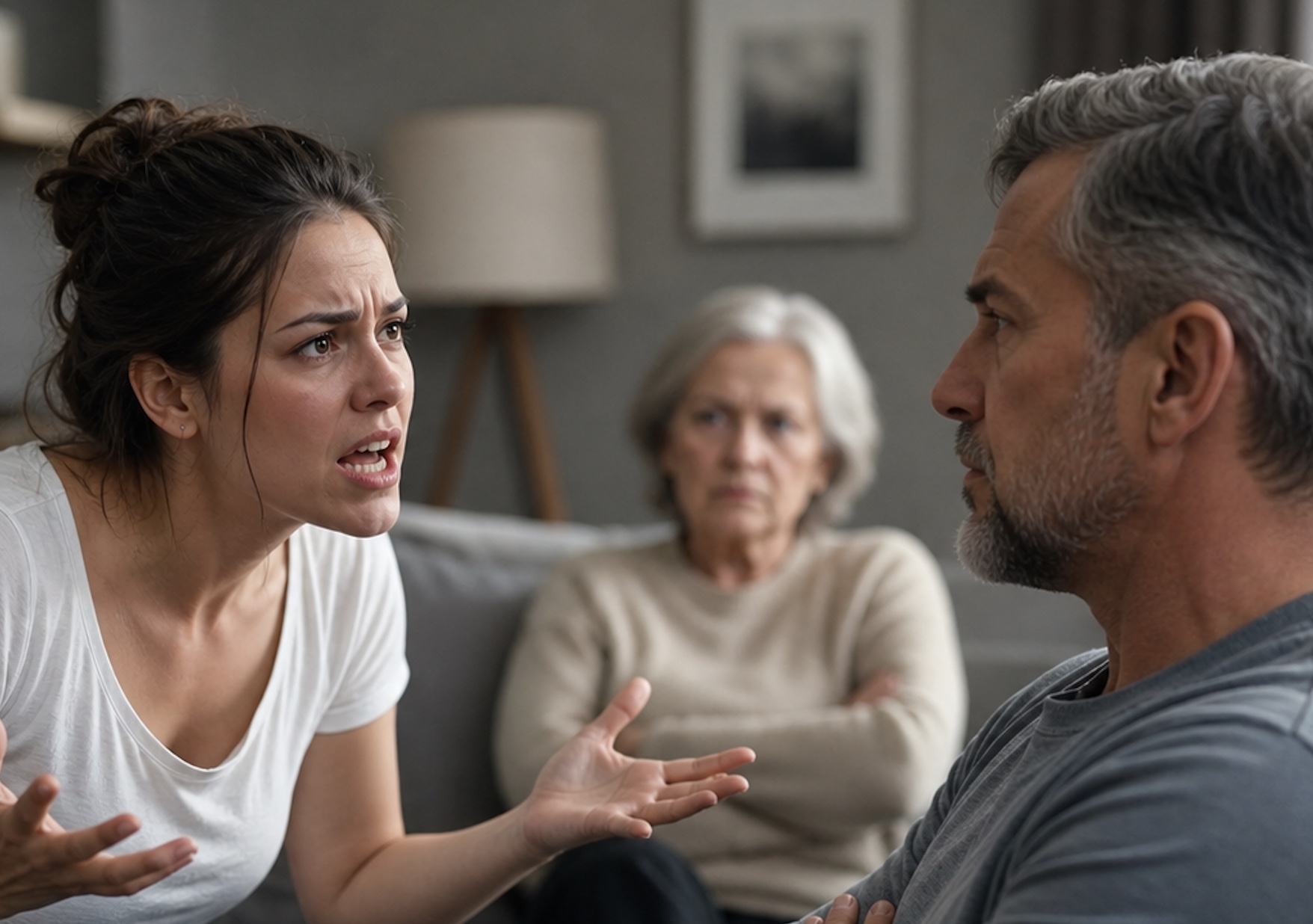
“Did you decide to open a vegetable warehouse branch in our hallway?” Veronika froze in the doorway, unable to step into her own apartment.
The key had turned in the lock smoothly, familiarly, but what opened before her eyes felt foreign and hostile. The perfectly measured minimalism of their corridor, which she had always been so proud of—the light walls, the simple coat rack, the single full-length mirror—had been destroyed. The space had shrunk into a narrow path winding between piles of cardboard boxes tied with string, checkered market bags, and wooden crates.
It no longer smelled of her favorite cotton-and-sea-salt diffuser. It smelled of damp, greasy soil, wet cardboard, and that strange, sweetish, stale odor found in the apartments of very old people who had not thrown away their old coats in years.
“Oh, you’re already home? I didn’t hear the elevator,” Pavel called from the room.
He was wearing a house T-shirt and holding a hammer, as if that tool could somehow justify the chaos. He tried to look cheerful, but his eyes kept darting away from her heavy stare.
“Careful there, on the right—those are tomatoes. Bull’s Heart variety. Mom said if they get crushed now, there won’t be any harvest.”
With slow disgust, Veronika pushed aside the edge of a dirty plastic bag with the toe of her expensive leather boot. A faded flannel blanket was sticking out of it.
“Pasha, I’m asking you once,” she said quietly, but there was steel in her voice—enough to trigger the survival instinct in any sensible person. “What is this junk doing in my home? Why does it smell like a basement vegetable storage room in here? And what the hell do tomatoes have to do with anything?”
Pavel grimaced as if he had a toothache and finally stepped into the hallway, climbing over a stack of old Health magazines tied together with laundry rope.
“Why do you have to be so harsh right away? ‘Junk’… These are things. Mom’s things. She’s starting renovations. Major ones. They’re replacing the floor screed, cutting into the walls for wiring. It’s impossible to live there—dust everywhere, workers from morning until night. I told you a week ago that she was planning it.”
“You told me she was planning renovations. You did not say our hallway would be turned into a storage unit,” Veronika snapped, throwing her handbag onto the small cabinet and somehow finding one free inch of surface. “When is all this being taken away? Tomorrow? I am not going to trip over these seedlings every morning.”
Pavel sighed, scratched the back of his head with the hammer, and drew in a breath as if preparing to jump into icy water.
“Veronik, why are you getting so worked up? Taken where? They’re seedlings. They need light and warmth. We can’t put them on the balcony—it’s still cold. They’ll stand here for a bit. They’re not bothering anyone. Come in, take off your shoes. I put the kettle on.”
He tried to smile, to smooth things over, to turn it all into some cute household inconvenience. But Veronika stood motionless. She stared at the boxes of soil sitting directly on her pale parquet floor, at the dirty streaks around them, and felt a cold, calculated rage begin to boil inside her.
This was not simply an inconvenience.
It was an invasion.
No declaration of war. No negotiation.
“Pasha,” she said, pronouncing his name slowly, syllable by syllable. “I don’t see only seedlings here. I see suitcases. I see bundles of bedding. I see boxes of dishes. Why would your mother need to bring her dinner sets here if she’s only renovating?”
Her husband shifted from one foot to the other, and the parquet board beneath him creaked as though warning of disaster.
“Well… You see, the workers said it would be better to clear out the apartment as much as possible. So nothing gets broken, nothing gets covered in dust. And Mom herself… Where is she supposed to go? A hotel is expensive, and she wouldn’t go anyway. To my aunt’s village? Too far. Her blood pressure acts up, and she needs the clinic nearby.”
Veronika felt the ground drop away beneath her feet.
The puzzle came together instantly.
The boxes. Her husband’s guilty face. His nervous fussing.
“You mean,” she lowered her voice to a whisper, “she is moving in here?”
“Not forever!” Pavel cried quickly, raising his hands in defense. “Mom will stay with us for just half a year. Maybe seven months, while the crew finishes everything. You know how renovations are—materials get delayed, something has to dry…”
The phrase hung in the air, heavy and suffocating, like the smell of old rags in a cramped room.
“Your mother will live with us for ‘just half a year’?! You decided to move your mother into our living room?! I would rather sleep at the train station than live under the same roof with her! I am not going to tiptoe around my own home and listen to her advice on how to cook borscht and iron your shirts! Choose: me or your mommy with her suitcases! I am not going to endure this hell!”
“Keep your voice down, the neighbors will hear!” Pavel hissed, glancing fearfully toward the front door. “Why are you throwing a tantrum over nothing?” he finished in a whisper, but with the kind of irritation that weak men reveal when they are pinned to the wall by arguments. “The neighbors will think I’m killing you! We’re family, Veronika. Family is supposed to help each other, not count square meters.”
Veronika looked at him and felt her anger transform into sticky, disgusted revulsion.
He was not afraid for her feelings.
Not for the crack in their relationship.
He was afraid of what Marya Ivanovna from apartment forty-five might think.
“Let them hear,” she replied in an icy tone, taking a step forward so that Pavel had to press his back against a box labeled “Books/Miscellaneous.” “Let them know their neighbor is a spineless creature who is ready to turn his wife’s life into hell just so he can be a ‘good son.’ Do you even understand what you’ve done, Pasha? You didn’t just drag things into our home. You dragged in someone else’s way of life. Someone else’s smells. Someone else’s habits.”
She stopped and sniffed.
Through the odor of damp soil, dusty cardboard, and mothballs, another smell pushed through. Something familiar and completely out of place in her sterile hallway. Valocordin. That thick, minty-herbal scent that always hung like a cloud in her mother-in-law’s apartment.
“She’s already here?” Veronika asked, her heart skipping a beat. “Is she hiding in the room?”
Pavel jerked his head from side to side, but his eyes betrayed him, flicking toward the living room.
His posture became unnatural and tense. He stood in the doorway with his elbows spread, like a goalkeeper trying to block a penalty shot.
“No! Of course not! She’s coming in the evening, by taxi… It’s just her things that smell… Medicine probably spilled in one of the bags… You know how something is always spilling on her.”
He was lying.
Veronika knew that shifting gaze, that nervous twitch of his shoulder. He was holding something back.
And whatever it was, it was worse than a blocked hallway.
If all the junk was piled here in the corridor, then why was he so desperate to stop her from going farther? Why was he standing in the entrance to the living room like Cerberus guarding the gates?
“Pasha,” she said slowly, never taking her eyes off him, making him blink more often than usual. “Why are you standing like that? Why won’t you let me into the living room?”
“There’s… there’s just a mess,” he muttered, a bead of sweat rolling down his temple and leaving a damp trail. “I haven’t had time to sort it out… You won’t like it… Let’s go to the kitchen instead. I’ll pour you tea. We’ll calm down and talk like adults…”
“I don’t need tea,” Veronika said sharply, feeling a string inside her stretch to the point of snapping. “And I am calm enough already.”
Suddenly, with terrifying clarity, she understood: what she saw in the hallway—the pathetic bags and boxes—was only the tip of the iceberg.
The real catastrophe was waiting behind him.
In the sacred heart of her home.
In her living room, which she had assembled piece by piece, matching curtains to cushions and a rug to paintings, creating her perfect world, inaccessible to chaos.
Now that world was under threat.
And judging by the horror in Pavel’s eyes, the threat had already happened.
Ignoring his pathetic attempts to block her way and his babbling about a “surprise,” she moved forward like an icebreaker, ready to crush anything in her path for the sake of the truth.
She had to see it with her own eyes.
Veronika shoved her husband aside with her shoulder as if he were not a living person, but an annoying obstacle—no different from that sack of potatoes in the hallway.
She stepped into the living room—her favorite room, her bright harbor, where every object had once stood in its place, arranged down to the millimeter. Here, she used to rest her soul after endless meetings and reports.
But now the air in the room had thickened, heavy and sticky with the sense of something inevitable.
What she saw made her stop dead.
“Pasha…” she breathed, and there was more threat in that whisper than in any scream. “Where is my armchair? Where is my floor lamp?”
The room had been disfigured.
Her cozy reading corner by the window—the beige wingback chair and elegant standing lamp—was gone. In their place stood an old, battered folding cot with sagging sides, its mattress already covered with a stack of washed-out blue-flowered bedding. Beside it, on her lacquered coffee table, rose a pyramid of ointment jars, thick-framed glasses, and crossword magazines.
Pavel shuffled after her, wringing his hands and trying to block the still life with his body.
“Veronik, please understand, it’s just logistics!” he blurted, trying to give his voice the confidence of a construction foreman. “Mom needs light. Her eyesight is getting worse. I moved your chair into the bedroom temporarily, into the corner. It’s a little tight there now, but you can pass sideways. And the floor lamp… well, I put it on the balcony for now. It’s not the season anyway. But here Mom will have space. She’s an old person—she needs air!”
Veronika slowly moved her gaze from the wretched cot to her husband.
Her face went pale. Her lips pressed into a thin line.
She felt something important collapse inside her—some foundation of their shared life that she had believed was unshakable.
“Space?” she repeated in an icy tone. “You’re talking about space in our thirty-square-meter living room, which you’ve turned into a nursing-home ward? Do you even understand what you’ve done? You didn’t simply move furniture. You destroyed my personal space. You pushed me out of my own home to make room for a person who didn’t even ask whether this was convenient for us!”
“Why do you keep repeating ‘my, my’?” Pavel suddenly exploded, red blotches spreading across his face. “This is my home too! And she is my mother! Not some stranger from the street! She can’t breathe there because of the construction dust. She could get an asthma attack! And you’re worried about an armchair? About some designer rag? Where is your humanity, Veronika?”
“Humanity?” she gave a bitter laugh, walking to the window and looking at the hateful cot. “And where is your conscience, Pasha? You talk about asthma, but you’re silent about the fact that your mother smokes like a steam engine on the stairwell, and that smell will be here—on my curtains, on my clothes. You talk about ‘staying for a while,’ but you dragged in her winter boots and enough preserved jars for three years. You do understand this isn’t for a month. The renovation is only an excuse. She’ll move in, put down roots, arrange her icons, turn on her soap operas at full volume because she ‘can’t hear well,’ and start teaching me how to live.”
She turned sharply toward him, her eyes flashing.
“How are we going to live, Pasha? Did you think about that? We have one bathroom. Do you know how long your mother spends in there in the morning? An hour? An hour and a half? I have to be at work by nine. Am I supposed to get up at five just to brush my teeth before she occupies the bathroom for her procedures? And the kitchen? You think two women running a six-square-meter kitchen is some kind of paradise? She’ll start rearranging my spices, throwing out the ‘chemicals’—that’s what she calls my food—and frying everything in lard! I don’t eat lard, Pasha! I don’t want my apartment smelling of overfried onions and Corvalol!”
Pavel shrank under the force of her words. He looked pathetic and lost, like a schoolboy who had not learned his lesson. But instead of admitting his mistake, he tried to counterattack, clinging to the straw of filial duty.
“You’re exaggerating!” he shouted, though his voice betrayed him by trembling. “Mom said she’ll help! She sees how tired you get. She’ll cook, iron, clean. It’ll be easier for you! You’ll come home from work and dinner will be hot, shirts ironed. She just wants to be useful, and you’re acting like an egoist! You only think about your own comfort!”
“Help?” Veronika burst into laughter—a frightening, angry laugh with an edge of hysteria. “Oh yes, I remember her help! Like when she washed my cashmere sweater at ninety degrees because ‘that kills germs’? Or when she threw away my documents because she thought they were trash? I don’t need her help, Pavel! I need my life! My silence! My right to walk around my apartment in underwear if I want to, instead of wrapping myself in a robe because ‘Mom is watching’!”
She walked to the coffee table and, with two fingers, picked up a small jar of Zvezdochka balm that had already left a greasy mark on the polished surface.
“You decided everything for me,” she said quietly, looking straight into his eyes. “You didn’t even consult me. You simply presented me with a fact. ‘Mom will stay.’ But did you ask me whether I want to live in a communal apartment? Whether I want to jump at every sound? I pay the mortgage on this apartment equally with you. I do not do it so I can feel like some unwanted lodger in the corner.”
“Just endure it!” Pavel pleaded, trying to take her hand, but she pulled it away as if from fire. “Only half a year! Can’t you endure it for family? For me? I’m being torn between two fires! Mom is crying over there, saying nobody needs her, and here you are making a scandal over nothing!”
“Nothing?” Veronika looked at him as if seeing him for the first time.
In front of her no longer stood the husband she had loved, the man with whom she had dreamed of a future. Before her stood a stranger. A weak man ready to sacrifice her to his own convenience and his mother’s whims.
“For you, my peace is nothing? My opinion is nothing?”
She looked around the room.
Foreign objects had already begun to take over the space like mold. A box labeled “Holiday Dishes” stuck out from under the sofa. Someone’s rough knitted cardigan hung over the back of a chair. The air was poisoned by the presence of a third person before that third person had even crossed the threshold.
“You know what, Pasha,” she said in a suddenly calm, businesslike tone that sent a chill down his spine. “You’re right. Family is important. But family was supposed to be you and me. It used to be you and me. Now it will be a little commune: you, your mother, and her endless advice. Only I won’t be part of that equation.”
She turned sharply and walked toward the bedroom.
“Where are you going?” Pavel shouted after her, panic beginning to wash over him. “Veronika, talk to me! Don’t you dare walk away from this conversation! We need to find a compromise! I can ask Mom not to go into the bedroom!”
“Compromise?” her voice came from the hallway, dull and final. “Compromise ended where boxes of seedlings began in my hallway. I’m going to find my suitcase, Pavel. Because there is no room for me in this home anymore. You gave it away. For free.”
“You wouldn’t dare!” he squealed, rushing after her. “Because of Mom? Because of renovations? You’d destroy a marriage over such a small thing? You’re insane!”
But Veronika no longer listened.
A switch had clicked inside her head.
The picture of a “happy future” shattered into pixels, revealing the ugly truth beneath: he would never choose her. He would always choose his mother, her comfort, her whims.
And those “six months” would become a life sentence if she did not break free right now.
“Put the hair dryer back! Have you lost your mind? Where are you going at this hour?” Pavel darted around the bedroom, grabbing at the bedframe, then the wardrobe door, as if he could physically hold together the household that was falling apart.
Veronika did not answer.
Her movements were frighteningly precise, almost predatory. She did not throw things around or stuff them into the suitcase in hysterics. No. She methodically, with icy calm, packed her life into an open suitcase.
First came jeans and sweaters—stack after stack, neat as if in a shop. Then silk blouses, which she pulled from hangers with a sharp crack, no longer caring whether they wrinkled. The sound of empty hangers knocking against one another in the wardrobe rang like a funeral bell.
“Veronika, stop this circus!” her husband’s voice broke into a shrill note.
He tried to snatch the cosmetics bag from her hands, but her look made him recoil.
There were no tears in her eyes. Only a dry, prickly coldness.
“You’re acting like an egoist! Because of Mom? Because a close family member asked for shelter? You’re a monster, not a wife!”
“A monster?” she froze for a second, holding a heavy orthopedic pillow. “No, Pasha. A monster is someone who forces another person to choose between self-respect and his mother’s dirty socks in my washing machine. Move. This pillow cost me half a bonus, and I am not leaving it for your mother to drool on at night.”
She threw the pillow on top of the clothes and pressed it down hard with her knee to close the zipper.
The suitcase groaned, but gave in.
Pavel stood pale, his lips trembling. He still did not believe it. He thought this was just a performance, a woman’s rebellion that would soon end in sobbing and reconciliation.
But Veronika did not cry.
She walked into the hallway, stepped over a box of seedlings, nearly brushing it with her hip, and headed for the kitchen.
“Where are you going?” Pavel ran after her, stumbling over the rug. “We’re not done talking! You can’t just take off and leave! This is your apartment too. You pay the mortgage!”
“Exactly,” she threw over her shoulder without slowing down. “I pay for comfort. For silence. For the chance to drink coffee from my favorite mug instead of searching for it among your mother’s jars of kombucha. And since there is no comfort left here, there will be no me here either. Pay for it yourself, Pasha. Pay for everything yourself.”
In the kitchen, she went straight to the counter.
Her fingers closed around the chrome body of the coffee machine—expensive, Italian, their shared pride. She yanked the cord from the socket.
“Hey!” Pavel’s eyes widened in horror. “What are you doing? What about the morning? Mom loves cappuccino! She asked me to teach her how to use it…”
Veronika spun around, holding the heavy machine to her chest like a child.
“Mom loves cappuccino?” she repeated with a poisonous smile. “Wonderful. Let Mom buy herself a coffee machine. Or let her beloved son make her coffee in a cezve while standing on one leg as she explains how to live properly. This thing was bought with my money, Pasha. And it is leaving with me. Along with the blender, the toaster, and my set of Japanese knives. I am not leaving anything here that can be ruined, smeared, or ‘accidentally’ broken in a fit of your mother’s household enthusiasm.”
She began sweeping things from the shelves: packets of expensive tea, spices in glass jars, even an opened bottle of olive oil. Everything went into a large sports bag she had grabbed from the hallway.
The clinking of glass, the rustle of packaging—it was the sound of a home being dismantled.
Before his eyes, the kitchen turned into a bare, impersonal space. Only the walls remained, and Pavel’s lone dirty mug in the sink.
“You’re petty!” he spat, staring at the empty shelves. “You’re greedy! You begrudge an old woman a piece of bread and a sip of coffee! How did I live with you for three years? I don’t recognize you!”
“You never knew me,” Veronika cut him off. “You lived with a convenient function. A woman who created comfort, paid bills, and stayed silent. Now the function is broken. The function is leaving.”
She slung the bag over her shoulder, picked up the coffee machine with her other hand, and returned to the hallway.
Among the boxes and bundles, she looked like a refugee from her own life.
Pavel blocked her path to the front door, spreading his arms like a goalkeeper.
“I won’t let you leave!” his face twisted with fear and anger. “You’re going to calm down, unpack, and we’re going to welcome Mom properly! She’ll be here any minute! You will not embarrass me in front of my mother! What am I supposed to tell her? That my wife ran away with the coffee maker?”
Veronika placed the coffee machine on the floor, right on the dirty doormat trampled by movers.
She straightened to her full height and stepped close to her husband.
“Tell her the truth, Pasha,” she said quietly, and metal rang in her voice. “Tell her what you chose. Look around.”
With a broad gesture, she pointed at the hallway buried in junk and stabbed her finger toward a cardboard box marked “Old Bedding,” from which a gray, time-worn duvet cover with a hole was sticking out.
“Do you see this?” she asked, looking straight at the bridge of his nose. “This is your life now. Not me. Not our vacation plans. Not our evenings with wine. Your life is these washed-out rags, the smell of mothballs, and your mother’s stories about sciatica. This is your future, Pavel. You dragged it into our home yourself. You traded me for a box of worn-out cloth.”
Pavel looked at the box, then at his wife.
His Adam’s apple jerked nervously.
“It’s temporary…” he whispered, but without his former confidence.
“There is nothing more permanent than your spinelessness,” Veronika said.
She kicked a bag of soil with the toe of her boot, and black dust splashed onto Pavel’s light-colored pants.
“Move away from the door. Or I’ll scream so loudly your mother will hear me from the first floor.”
She grabbed the suitcase handle.
The wheels thudded across the laminate, crossing the boundaries Pavel had erased with his betrayal.
The apartment became empty and echoing, as if all the air had been pumped out of it. Only the smell of damp earth remained, along with the fear radiating from the man who had never managed to become a husband because he had stayed an eternal son.
At that moment, cutting through the tense silence, the doorbell rang.
Insistent.
Demanding.
Three short rings and one long.
“It’s her,” Pavel mouthed, and real terror flooded his eyes.
Veronika smiled crookedly.
“Perfect. Right on time. Open it, Pasha. Your mistress has arrived.”
“Well?” Veronika smirked, watching Pavel tremble in small shivers. “Open the door. Or do you want her to start kicking it down? Judging by that ring, she’s ready.”
The bell trilled again—long, persistent, offended.
Pavel rushed to the door, nearly tripping over his own feet, and slid back the bolt with a crash.
On the threshold appeared a heavy, breathless figure in a shapeless coat. She smelled of the street, fried pies, and that same heavy, sweetish odor of old age that Veronika had sensed from the boxes.
“Good Lord, Pasha! How long can a person wait?” his mother’s voice filled the entire space, instantly pushing out the last traces of oxygen. “I barely dragged my bags up to the floor, that elevator of yours hums like a tractor, my head is splitting… Oh. What’s going on here?”
She stepped inside, surveying the cluttered hallway like a landowner inspecting property, and her gaze landed on Veronika standing with a suitcase and coffee machine.
“Hello,” the mother-in-law muttered, not even attempting politeness. “And where are you off to at this hour? A business trip? Pasha, why haven’t the boxes been unpacked? I told you the seedlings need to go straight to the window. They’ll suffocate in the dark!”
Pavel started fussing, trying at once to take the heavy bags from his mother, shield his wife with his body, and pretend everything was going according to plan.
“Mom, come in, come in… It’s just… Veronika… She…” He looked helplessly at his wife, begging her with his eyes to play along, to lie, to smooth things over.
“Veronika is making room for the main woman in your life,” she said loudly and clearly. “Don’t mind me, Mother. Come in. Make yourself at home. Over there, in the corner, I put your slippers. I found them in the box marked ‘Miscellaneous.’ Wear them in good health.”
The mother-in-law froze, her small eyes narrowing.
“Pasha, what kind of performance is this?” she turned to her son, expecting immediate explanations. “I come to you with my soul open, ready to help, and I’m insulted right at the door? You let your wife throw your mother out?”
“Nobody is throwing you out!” Pavel squealed, completely losing face.
He was pale, trapped between two fires, pitiful in his attempt to please everyone at once.
“Veronika is just… she’s overwhelmed. Renovation, stress… We’ll have tea now, calm down…”
“You’ll be drinking tea without me,” Veronika said, putting the coffee machine on the floor and taking a step back into the hallway, toward that ill-fated box of old bedding Pavel had been guarding so carefully. “I am not overwhelmed, Pavel. I have simply opened my eyes.”
She bent sharply and picked up the box.
The cardboard was soft and damp at the bottom.
Veronika walked decisively into the living room. Pavel and his mother followed her as if hypnotized.
“What are you doing?” her husband rasped when Veronika raised the box above the sofa—the very sofa where they had watched movies, planned vacations, and once been happy.
“Creating coziness,” she said coldly.
With one jerk, she overturned the box.
Its contents spilled onto the upholstery with rustling and dull thuds: gray pillowcases, stained crocheted napkins, a stack of old Healthy Living newsletters, tangled balls of yarn, and torn tights that would “still do under trousers.”
Dust—thick and gray—rose into the air, settling on the polished furniture and in their lungs.
“There!” Veronika pointed broadly at the pile of trash now sitting in the middle of their former life. “Enjoy. This is your interior now, Pasha. Your world. Your atmosphere. Isn’t this what you wanted? Mom nearby, her things everywhere? I’ve sped up the process. No need to thank me.”
“You’re sick!” his mother shrieked, clutching her heart. “Pasha, do you see this? She’s a psychopath! My things… on the sofa! These are memories!”
“This is junk!” Veronika roared so loudly that the old woman stopped short and pressed herself against the doorframe. “This is rot you dragged into my home to poison my life! But I will not allow it. Live in it yourselves. Breathe this dust. Sort through these rags. Discuss my flaws. I’m giving you this apartment. Along with the mortgage, by the way. The bills are on the table.”
She returned to the hallway and grabbed the suitcase and bag.
Pavel stood in the middle of the ruined living room, staring at the mountain of rags as if at the ruins of Pompeii.
“Veronika…” His voice sounded dull, as if coming from underground. “You can’t leave like this. Where will you go? It’s night.”
“To a hotel, Pasha. To a clean, sterile room where it smells fresh, not like mothballs and betrayal. And tomorrow I’m filing for divorce. Don’t even think about calling me. Your phone is busy with Mommy now.”
She threw open the front door.
A draft caught the smell of fried pies and pulled it out into the stairwell. Veronika stepped over the threshold, feeling as if a concrete slab had fallen from her shoulders after pressing on her for the last three hours.
“Stop!” Pavel shouted, taking one uncertain step after her, but immediately tripping over a sack of potatoes.
“Pasha, close the door, there’s a draft!” his mother commanded from the room, already rearranging rags on the sofa like the mistress of the house. “And come here, help me sort this out. These pillowcases are still good. They’ll last.”
Veronika turned around.
She saw her husband frozen in the doorway. He looked at her with the misery of a beaten dog, but he did not take a single step.
Behind him, deep inside the apartment, someone else’s old age was already taking over, devouring the space they had built for years.
“Goodbye, Mama’s boy,” Veronika said without anger, with icy indifference.
She slammed the door in his face.
The sound of metal striking metal echoed through the stairwell, placing a heavy, final period at the end of it all.
The lock clicked—not inside the apartment, but in her head.
Veronika called the elevator, adjusted the strap of the bag on her shoulder, and for the first time that evening, breathed deeply and freely.
Downstairs, a taxi was waiting.
Ahead of her was a life where she would never again have to choose between herself and someone else’s mother.