She closed the front door without slamming it, yet the sound still felt heavy. The sweltering July hallway smelled of dust, sun-heated metal, and other people’s grocery bags. Olga had not even taken off her sandals when she noticed three plaid travel bags, two thick plastic sacks filled with clothes, and an old folding stool in the entryway—none of which belonged to her.
Her mother-in-law’s voice drifted in from the kitchen.
“Sergey, clear out that narrow cabinet. I’ll put my winter things in there. I don’t need any space in the bedroom—you two have your own belongings there. The hallway will be much more convenient. And we should install another shelf for documents. I brought my folders with me.”
Sergey was standing in the kitchen doorway. He did not look guilty. He looked irritated, as though his wife had not returned to her own home but had interrupted a perfectly reasonable household operation.
“Ol, don’t start the moment you walk in,” he said. “Mom’s only staying for a little while.”
Olga slowly turned her head toward the bags.
“A little while—with a folding stool and filing folders?”
Sergey rubbed a hand over his face and lowered his voice.
“They’re renovating her house. It’s noisy and dusty, and there are workers everywhere. It’s hard for her.”
“Your mother’s house has been undergoing selective renovations for three years—whenever she decides she wants to stay with us.”
“It’s not only your home. It’s mine too.”
Olga calmly removed her sandals, placed them neatly on the mat, and walked farther inside. Her expression remained composed, but Sergey noticed the way she carefully set her handbag on the cabinet and zipped it closed.
He knew that gesture well.
Olga did that when she was no longer preparing to argue. She was preparing to establish the facts.
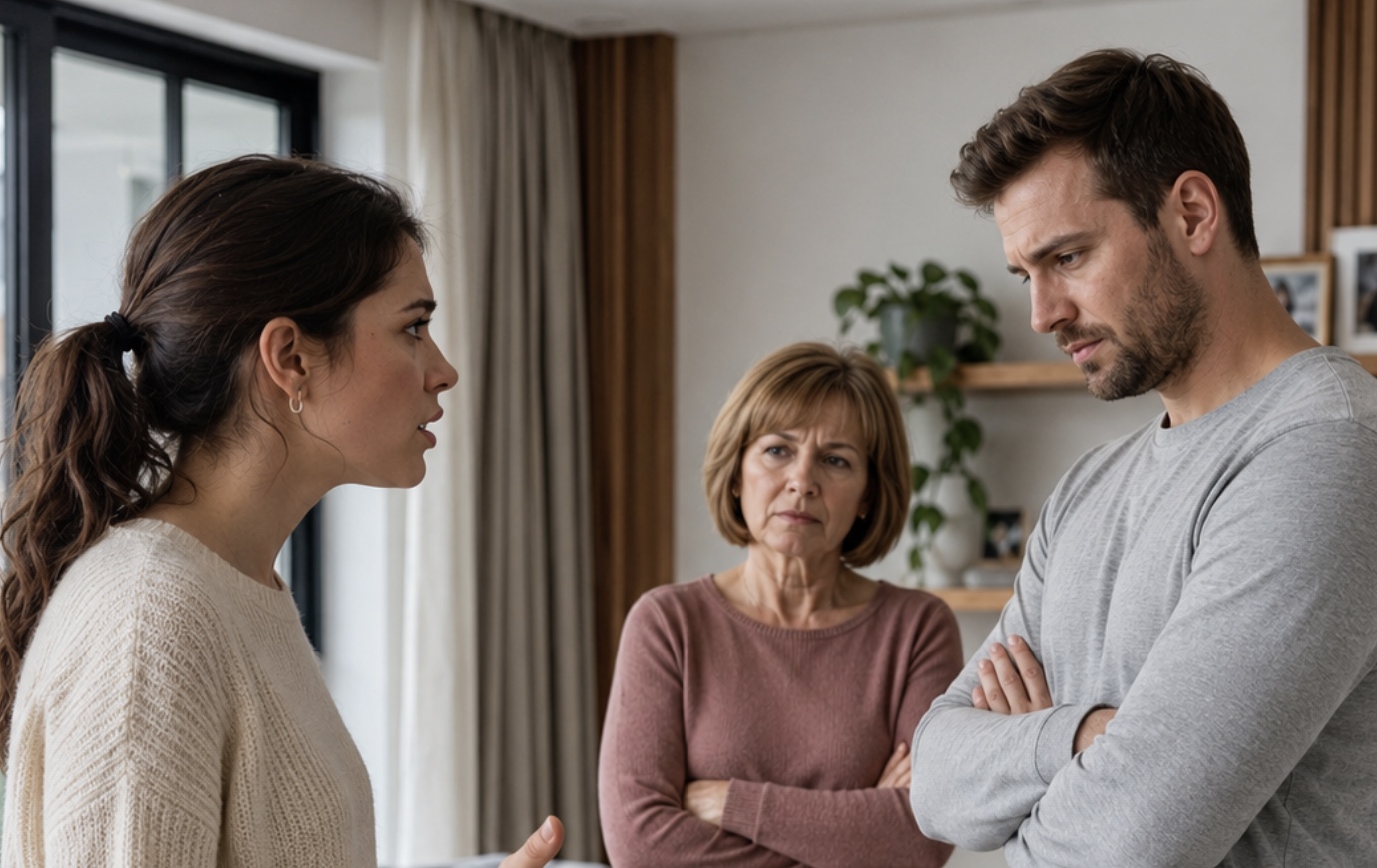
In the kitchen, her mother-in-law, Raisa Pavlovna, stood beside the window, studying the windowsill as if deciding where to place her jars. She was sixty-three, but still looked vigorous: short hair, a bright blouse, and a sharp, observant gaze.
She was holding a set of keys.
A small plastic tag bearing the apartment number dangled from the ring.
Olga immediately looked at the keys.
“Good afternoon, Raisa Pavlovna. I see you’ve already let yourself in.”
Her mother-in-law turned around without the slightest embarrassment.
“What was I supposed to do, stand outside the door? Sergey gave me the keys. I’m his own mother, after all.”
“Sergey’s mother,” Olga clarified. “Not the owner of this apartment.”
Raisa Pavlovna narrowed her eyes slightly, though she managed to hold on to her smile.
“Oh, here we go. I haven’t even hung up my coat, and you’re already checking my legal status.”
“There is no need to hang up a coat in July. But yes, we are going to look at the documents now.”
Sergey stepped forward sharply.
“Olga, that’s enough. Mom is tired. Let’s discuss this tonight.”
“No. Tonight you’ll say your head is too full. Tomorrow you’ll say it isn’t the right time. And a week from now, I’ll discover someone else’s belongings in my wardrobe, while you explain that it has already happened and it’s too late to make a fuss.”
Raisa Pavlovna placed the keys on the countertop and raised her eyebrows.
“What dramatic language. I came here to help you. You young people live as though this place were a hotel. The refrigerator is nearly empty, there are boxes all over the balcony, and half the space in the hallway is being wasted. I’ll put everything in order.”
Olga studied her carefully.
“I do not need help I never asked for.”
“Sergey asked me.”
“Sergey cannot invite someone to move into an apartment that I bought several years before our marriage and registered solely in my name.”
The kitchen fell silent.
A car rumbled past the open window. Somewhere in the courtyard, a child laughed and squealed as someone sprayed water from a garden hose. Summer carried on as though three people were not standing inside the apartment on the edge of a major confrontation.
Sergey frowned.
“You phrase everything like that on purpose, just to humiliate me.”
“I phrase things accurately on purpose.”
“Mom isn’t ‘someone.’ She’s family.”
Olga turned toward him.
“Family does not unlock my front door with spare keys without my permission. Family does not bring luggage into my home while I’m away. Family does not decide how to divide up my wardrobes.”
Raisa Pavlovna gave a quiet laugh.
“Your home. Listen to you. You sound like some grand landowner.”
“Not a landowner. The legal owner. There is a significant difference, and it would be useful for you to remember it.”
Her mother-in-law went pale—not with fear, but with anger.
She was accustomed to a very different Olga. Usually, Olga listened, paused, answered evenly, and left to attend to her work. Raisa Pavlovna had mistaken that self-control for weakness.
Sergey had mistaken it for agreement.
They had both been wrong.
Over the past few months, everything had happened gradually.
At first, her mother-in-law came over for an hour—to bring berries or collect an old saucepan she herself had once given them. Then she began appearing on weekdays while Olga was working at the transport company warehouse and could not answer her phone.
Sergey always offered a simple explanation.
His mother had been nearby. She had only stopped in to drop something off.
Then Raisa Pavlovna began leaving little things behind: a cardigan, a pair of slippers, a bag of medicine, a phone charger.
Olga placed everything into a separate bag and repeatedly asked her husband to return it to his mother.
He never did.
A week earlier, Olga had returned from a meeting with a contractor and found the kitchen cabinets open. Raisa Pavlovna was searching for a container for cereal and complaining that everything in their kitchen was arranged inconveniently.
That was when Olga first asked how she had gotten the keys.
Her mother-in-law answered casually.
“Sergey gave them to me. You never know when something might happen.”
That evening, Sergey merely shrugged.
“I didn’t think it was a problem.”
Olga did not shout.
She simply said, “Get the keys back.”
He nodded.
The next day, he said he had forgotten.
After that, he claimed his mother had gone to her country house.
Then he said it would be awkward to ask for the keys back because she would be offended.
Olga silently remembered every excuse.
Today, everything had become clear.
This was no longer a spare key “in case of emergency.”
It was an attempt to quietly transfer someone else’s authority into her apartment.
Olga left the kitchen, walked into the bedroom, and returned with a thin folder.
Sergey immediately realized this was not an impulsive reaction. The folder had been ready and within reach.
That meant his wife had already been preparing for this conversation.
She placed the purchase agreement, the property register extract, and several old payment documents on the kitchen counter.
“I bought this apartment before the marriage. Sergey is registered here because I personally agreed to it. You, Raisa Pavlovna, have no claim to this home—legally or otherwise.”
“My son lives here,” her mother-in-law snapped.
“He lives here. He does not control the property.”
Sergey gave a bitter laugh.
“So I’m nobody in this house?”
“You are my husband as long as you behave like one—not like a deliveryman bringing his mother and all her belongings into someone else’s apartment.”
Sergey’s shoulders tightened.
He was not an unintelligent man. He worked as an equipment engineer and knew how to negotiate with supervisors, contractors, and clients.
But at home, he relied on a simple arrangement: when his mother applied pressure, his wife was expected to be understanding; when his wife objected, she was accused of being too harsh.
That arrangement had saved him a great deal of effort over the years.
Today, it stopped working.
Raisa Pavlovna picked up the keys from the counter.
“I am not going to justify myself. My house really is being renovated. I’ll stay here for two weeks and then leave.”
“No,” Olga said.
Her mother-in-law did not immediately understand what she had heard.
“What do you mean, no?”
“It means you are taking your bags and leaving today.”
“Sergey!” Raisa Pavlovna turned sharply toward her son. “Did you hear that?”
Sergey now looked at his wife with open hostility.
“Olga, you’re going too far. Mom won’t be left out on the street. Her house is not fit to live in right now.”
“She has a house. She has a sister in the next district. She can rent temporary accommodation if the renovations truly make her home uninhabitable. What she cannot do is take control of my apartment.”
“You’re throwing my mother out?”
“I never invited her to move in. So I’m not throwing her out. I’m stopping an unauthorized move.”
Raisa Pavlovna grabbed one of the bags, pulled it closer to herself, and said defiantly:
“I’m not going anywhere. My son gave me permission.”
Olga took out her phone and placed it beside the documents.
“Then I will call the police and explain that someone is refusing to leave my apartment after being directly instructed to do so by the legal owner. I will also show them the property documents. Sergey can confirm that he gave you the keys without my consent.”
Sergey straightened abruptly.
“Have you lost your mind? You’re going to call the police on my mother?”
“No. I’m calling the police because a person is unlawfully remaining in my apartment after the owner has ordered her to leave.”
Raisa Pavlovna stared at the phone.
For the first time, her expression showed calculation rather than outrage.
She was thinking quickly.
She did not want a scandal involving the police. The neighbors would hear about it. Her son would look foolish. Most importantly, it would become publicly obvious that she had no rights whatsoever to the apartment.
“Olga,” Sergey said, changing his tone. “Let’s handle this calmly. I admit we should have discussed it, but there’s no need to turn this into a circus.”
“I’m not creating a circus. I’m ending one.”
She turned toward her mother-in-law.
“The keys.”
Raisa Pavlovna tightened her fingers around the key ring.
“These are my son’s keys.”
“No. They are the keys to my door.”
“Sergey, say something to her!”
Sergey looked at his mother, then at his wife.
For several seconds, he clearly searched for some compromise—a phrase that would allow everyone to preserve their dignity.
But no such phrase remained.
“Mom, give them back for now,” he said heavily.
“For now?” Olga tilted her head. “Interesting choice of words. No, not for now. Permanently. If I decide someone should have a spare set, I will give it to my mother or to a neighbor of my choosing.”
Raisa Pavlovna threw the keys onto the countertop.
They struck the tile with a sharp metallic clatter.
“Take them. I hope you choke on your precious apartment.”
“I won’t. I live here.”
Sergey grimaced.
“Olga, stop kicking her when she’s down.”
“I haven’t even started.”
She picked up the keys, removed the plastic apartment tag from the ring, put the set into her pocket, and looked at her husband.
“Now give me yours.”
“What?”
“Your set of keys.”
“You have no right.”
“I have every right to replace the lock on my own door. But first I want to know how many sets of keys are circulating among your relatives.”
Sergey’s expression changed.
He realized the situation had gone much further than he had expected.
“I didn’t give them to anyone else.”
“Prove that through your actions. Hand them over.”
“I live here.”
“Today you do. After today, we will decide under what conditions. For the time being, you are giving up control of the spare access to my front door. If you need to go outside, I’ll let you out. Tomorrow I’m calling a locksmith and replacing the lock. No police statements, no performance—just an ordinary locksmith doing an ordinary job. You will receive a new key only after we put the rules of living here in writing.”
Raisa Pavlovna gave a short laugh.
“A written agreement with your own husband? How shameful.”
“What’s shameful is a grown man secretly giving his mother keys to his wife’s apartment.”
Sergey pulled his keys from his pocket and put them on the table.
“Are you satisfied now?”
“Not yet.”
Olga took his key ring, removed the apartment key, and returned the others.
“Now we collect the bags.”
Raisa Pavlovna stood motionless.
Then she suddenly sat down on a chair.
“I don’t feel well. It’s probably my blood pressure. I’m not going anywhere right now.”
Sergey immediately hurried toward her.
“Mom, do you need water?”
Olga opened a cabinet, took out the blood-pressure monitor she had kept after her father’s illness, and placed it in front of her mother-in-law.
“We’ll check it. If the numbers are dangerous, we’ll call an ambulance. If they’re normal, we’ll call a taxi.”
Raisa Pavlovna looked at the device as though it had personally betrayed her.
“You don’t even believe this?”
“I believe numbers.”
Sergey opened his mouth to say something, but Olga had already wrapped the cuff around his mother’s arm.
Raisa Pavlovna sat with a stony expression.
The machine beeped and displayed completely ordinary numbers.
Olga turned the screen toward her husband.
“She’ll survive.”
“You’ve become so cruel,” her mother-in-law said quietly.
“No. I’ve simply stopped being convenient.”
They packed the belongings in silence.
More precisely, Raisa Pavlovna packed, while Sergey carried the bags toward the door.
Olga stood nearby, making sure none of the woman’s belongings remained in the apartment. She checked the hallway cabinet, the small chest of drawers, the kitchen, and the balcony.
In one drawer, she found a folded plastic bag containing medicine and a small cosmetics pouch.
“Take these too.”
Her mother-in-law snatched the bag out of her hands.
“How petty.”
“How observant.”
When the taxi arrived, Sergey reached for one of the bags.
“I’ll see Mom off.”
“Walk her to the car. Then come back. We need to talk.”
Raisa Pavlovna stopped at the doorway and looked at her son.
“Sergey, do you hear the way she speaks to you?”
He said nothing.
Olga stood beside the open door, holding her phone.
She did not hide it or make threats. She simply made it clear that there would be no more time for theatrical displays.
Her mother-in-law stepped outside.
Sergey carried the luggage out and accompanied her downstairs.
Olga waited until the elevator descended, locked the door, and slowly walked through the apartment.
She inspected the kitchen, the bedroom, and the hallway.
Everything appeared to be in its proper place.
Yet the feeling of intrusion remained—not because of the bags, but because of the audacity with which her home had already been mentally divided into zones of influence.
Ten minutes later, Sergey returned.
Olga opened the door herself.
He stepped inside, removed his shoes, and stopped in the hallway.
Without a key, he looked different.
He did not look like a guest, but neither did he look like the full master of the home he had become accustomed to imagining himself to be.
“You humiliated me in front of my mother,” he said.
“You humiliated yourself when you decided you had the right to give someone access to my front door.”
“I was trying to help.”
“No. You were trying to be a good son at my expense.”
He walked into the kitchen, poured himself a glass of water, and drank several mouthfuls.
Olga did not rush him.
She knew how to wait.
At work, she often negotiated with drivers, clients, warehouse staff, and people who said one thing, meant another, and later tried to blame everything on a misunderstanding.
She had learned long ago that the person who became anxious first was usually the one who lost.
Sergey finally turned around.
“What is this written agreement supposed to be?”
“Something simple. Your mother does not come here without an invitation. She does not have keys to my apartment and never will. You do not give access to anyone else. Guests are allowed only by mutual agreement. If I discover another unauthorized entry, I will change not only the lock but also the nature of our marriage.”
“Are you threatening me with divorce?”
“I am informing you of the consequences.”
He smirked, but the expression looked weak.
“And where would I go?”
“That is a question you should have asked yourself before giving your mother keys to my apartment.”
Sergey placed his glass on the counter and looked at his wife without his usual confidence.
“Are you really prepared to throw me out?”
“If necessary, yes. The apartment belongs to me. We do not have children. There is no jointly acquired property to divide here. If you refuse to divorce peacefully, it can be settled in court. If you agree and there is nothing to divide, we can handle it through the civil registry office. But before it comes to that, I hope to see an adult man standing in front of me—not a mediator between his wife and his mother.”
He remained silent for a long time.
It was growing dark outside, but the heat had not faded.
Their reflections appeared in the kitchen window: Olga standing upright, Sergey sitting opposite her, and between them the property documents and the apartment key she had removed from his ring.
“You had all this planned in advance,” he finally said.
“No. I examined the facts in advance. Those are not the same thing.”
“What facts?”
Olga opened the notes on her phone and read in an emotionless voice:
“On June twelfth, your mother entered the apartment without calling while I was in the shower. On June fifteenth, she unlocked the door in front of our neighbor and said she ‘had her own business here.’ On June twenty-second, you refused to retrieve the key because it would be ‘awkward.’ On July third, she left a bag of belongings here. Today she brought several more. That is not help. It is an attempt to establish territory.”
Sergey stared at her as though, for the first time, he was seeing not simply his wife but a person capable of arranging separate incidents into a coherent pattern.
“You were keeping records?”
“Of course. When a boundary is crossed once, it may be an accident. When it keeps happening, you need documentation.”
He leaned back in his chair.
“I didn’t think you saw me that way.”
“And I didn’t think you saw me this way.”
The words hit their mark.
Sergey rubbed the bridge of his nose, stood up, and paced through the kitchen.
He was not panicking or pretending to despair.
He was thinking.
Olga could see that, so she did not interrupt him.
“Mom believes I’m obligated to help her,” he said after a pause.
“Then help her. Use your own time, your own strength, your own money, and your own property. Do not use my home without my permission.”
“She’ll be offended.”
“She will.”
“She’ll keep calling.”
“Not me.”
He gave a bitter laugh.
“You’re made of iron.”
“No. I simply do not want to wake up a year from now in an apartment where your mother decides when I should cook, where my documents should be stored, and who is allowed into the bedroom.”
Sergey sat down again.
This time, he looked tired rather than angry.
“I honestly thought you would get used to it.”
“That is exactly the problem. You didn’t think I would agree. You thought I would eventually surrender.”
He lowered his eyes.
There was nothing he could say in response.
The following morning, Olga took the first half of the day off work and called a locksmith.
Sergey stayed home.
He watched the locksmith remove the old lock and install a new one.
There were no police statements, no special permissions, and no dramatic procedure.
It was an ordinary job: tools, a box containing the new mechanism, a receipt, and two sets of keys.
After the locksmith left, Olga put one set into her organizer and placed the second in front of Sergey.
“This one is yours. No copies.”
“I understand.”
“I’m not convinced. So I’ll repeat myself. If another key appears in your mother’s possession, you will be the one deciding where you live next.”
He picked up the keys.
“I spoke to Mom yesterday.”
“And?”
“She said you turned me against her.”
“Predictable.”
“I told her that I was the one who gave her the keys and that I was responsible.”
Olga looked at him closely.
He held her gaze.
“That almost sounds like the beginning of a real conversation,” she said.
But Raisa Pavlovna had no intention of disappearing.
Two days later, she called Olga directly.
When Olga saw the name on the screen, she activated the call recording—not because she wanted to trap anyone, but because she had developed the habit of protecting herself when dealing with people who had already revealed their methods.
“Olga, I want to collect my medicine,” her mother-in-law said coldly.
“You took all your belongings.”
“Not everything. I left a bottle in the top drawer.”
“There are no belongings of yours in the apartment.”
“I’ll come and check myself.”
“No.”
There was a pause on the other end.
“Are you forbidding me from visiting my son?”
“I am forbidding you from entering my apartment without an invitation.”
“Is Sergey home?”
“Ask Sergey.”
“You are deliberately destroying the relationship between a mother and her son.”
“No. I removed your keys from my front door. You may build your relationship with your son wherever you like—in a café, at your house, or on a bench in the courtyard. But not inside my apartment without my consent.”
Her mother-in-law hung up.
Sergey came home that evening in a dark mood.
Olga immediately understood that his mother had already called him.
“She was crying,” he said.
“That was her decision.”
“She says you record your conversations.”
“I record conversations when someone tries to enter my apartment using a medicine bottle that does not exist as an excuse.”
Sergey sat down wearily.
“I found her a small apartment for two weeks. It’s close to her house. She can stay there until the workers finish the bathroom.”
Olga did not praise him.
He was not a child who deserved a medal for making a normal decision.
“You’re paying for it yourself?”
“Yes.”
“Good.”
“You could say things more gently.”
Olga opened the refrigerator, took out a bottle of water, and poured herself a glass.
“I spoke gently for six months. The result arrived at our door in three bags.”
Sergey did not answer.
The weeks that followed became a test.
Raisa Pavlovna attempted to push through the boundaries using pity, mutual acquaintances, her son, and hints about her poor health.
Olga did not engage in lengthy arguments.
Every attempt received a brief answer.
No, today is not convenient.
No, do not come without warning.
No, there will be no spare keys.
Yes, Sergey can visit you at your home.
At first, Sergey was irritated. Eventually, he began adjusting to the new reality.
One day, out of habit, he said:
“Mom is coming over tomorrow.”
Olga looked up from her laptop.
“Are you asking me or informing me?”
He stopped beside the table, thought for a moment, and corrected himself.
“Would it be all right if Mom came over tomorrow for an hour? I’ll be home. She needs to collect some renovation documents from me.”
“Seven o’clock. One hour. No bags.”
“All right.”
Raisa Pavlovna arrived at seven fifteen.
She had no bags, but she wore a severe expression.
Olga opened the door herself and did not step aside until her mother-in-law greeted her.
“Good evening.”
“Good evening, Raisa Pavlovna.”
The visit was cold but free of open conflict.
Her mother-in-law tried to enter the bedroom, claiming she wanted to check whether she had left a hairbrush there.
Olga blocked the doorway.
“You did not leave anything in there.”
Raisa Pavlovna looked at her son.
For the first time, Sergey did not pretend he had failed to notice what was happening.
“Mom, the documents are in the kitchen. Come on.”
She turned around.
Olga could see from the tension in her back how difficult the retreat was for her.
But she retreated.
After his mother left, Sergey lingered by the door.
“I never noticed how she does that.”
“You noticed. It was simply more convenient to treat it as normal.”
He nodded.
He did not argue.
Summer slowly gave way to August.
The heat became gentler, and the evenings grew darker.
The apartment became peaceful again.
Olga restored the hallway to its previous appearance. She removed the folding stool Raisa Pavlovna had still attempted to leave behind, threw away the empty bags, and checked the cabinets.
The space felt like hers again.
Not because Sergey was absent, but because the rules were no longer being written behind her back.
One evening, they sat together in the kitchen.
The sounds of the courtyard drifted through the window. Someone was watering the flower bed beside the entrance.
Sergey turned his new key between his fingers for a long time before placing it on the table.
“I thought that if I refused my mother, it would make me a bad son.”
Olga looked at him.
“And being a bad husband was easier?”
He smiled without amusement.
“Apparently.”
“Then decide which kind of man matters more to you. Just don’t try to combine the two at my expense.”
Sergey raised his eyes.
“I want to fix this.”
“Things are fixed through actions.”
“I spoke to her. I told her she cannot come without an invitation anymore. And that she will not have keys.”
“What did she say?”
“That you changed me.”
“Convenient explanation.”
“I told her you didn’t change me. I had simply been hiding behind her for too long.”
Olga remained silent.
This was the first conversation in which Sergey did not try to shift the blame, smooth everything over, turn it into a joke, or ask Olga not to “make things worse.”
For the first time, he spoke like an adult who understood the cost of his actions.
“We’ll see,” she said.
“You don’t believe me?”
“Trust is not given in advance after someone hands out keys to my apartment without asking me.”
He accepted that.
He did not take theatrical offense, slam a cabinet door, or walk out of the room.
He simply nodded.
At the end of August, Raisa Pavlovna tested the boundaries again.
She arrived without warning on a Sunday morning and rang the doorbell.
Olga looked through the peephole and saw her mother-in-law holding a bag of apricots.
She did not open the door immediately.
Instead, she called Sergey.
“Your mother is here. We didn’t arrange a visit.”
Sergey came over, looked through the peephole, and visibly tensed.
Then he opened the door but remained standing in the doorway.
“Mom, we didn’t agree that you would come today.”
Raisa Pavlovna lifted the bag.
“I brought fruit. Is fruit forbidden now too?”
“You could have called first.”
“I’ll only stay for five minutes.”
“Today isn’t convenient.”
Olga stood slightly behind him and listened.
She did not interfere.
This was his test, not hers.
Her mother-in-law tried to look past her son’s shoulder.
“Is Olga home? Of course she is. She’s the one telling you what to do.”
Sergey did not raise his voice.
“I’m speaking for myself. Call me this evening, and we’ll arrange another day.”
Raisa Pavlovna froze with the bag in her hands.
Then she pushed it toward her son.
“Take them. Apparently, a mother is an unwanted stranger even when she’s already standing in the hallway.”
“Thank you for the apricots. I’ll call you this evening.”
He closed the door.
Not angrily.
He simply closed it.
Olga watched him for several seconds.
“Now that looks like action.”
Sergey leaned his shoulder against the door and exhaled.
“That was unpleasant.”
“People rarely applaud when you enforce boundaries.”
He gave a short laugh—for the first time in a long while, an easy one.
By autumn, the situation with her mother-in-law was no longer a daily battle.
Raisa Pavlovna remained offended, but she gradually adjusted.
Sergey visited her himself, helped with the renovations, delivered groceries, and handled issues with the workers.
Olga did not interfere.
How a son helped his mother was none of her concern, as long as that help did not turn into the occupation of her home.
From time to time, her mother-in-law still made remarks.
“People used to live more simply.”
Olga always answered:
“People used to tolerate many things. I am not obligated to continue.”
That ended the discussion.
Several months later, Sergey himself suggested writing down their household rules.
Not in front of a notary and not as some dramatic legal contract, but as a simple list they discussed together.
Who was permitted to have keys.
How visits should be arranged.
What counted as personal space.
Which decisions could only be made jointly.
Olga did not romanticize the moment.
She did not believe a sheet of paper could save a marriage.
But she knew that clear rules were better than vague hopes.
Something else mattered far more.
For the first time, Sergey no longer argued against the fact that Olga’s apartment belonged to Olga.
It was not the family’s emergency accommodation.
It was not an extension of his mother’s house.
It was not a place where a relative could be quietly moved in while everyone waited for the owner to surrender.
One warm September evening, Olga returned home from work.
The air still carried the last traces of summer, and she held a bag of peaches in one hand.
Raisa Pavlovna was sitting on a bench beside the entrance.
Olga immediately noticed that she had no luggage with her.
“Good evening,” Olga said.
Her mother-in-law stood up.
“Hello. Sergey is running late. I brought him the keys to the shed at the country house. I’ll wait for him here.”
Olga could have invited her upstairs.
In the past, she would have done exactly that to avoid appearing rude.
Now, however, she chose honesty over appearances.
“All right. He should be here soon.”
Raisa Pavlovna nodded.
Then, after a brief hesitation, she said:
“I behaved badly that day. With the apartment keys.”
Olga looked at her closely.
Raisa Pavlovna forced the words out as though removing a splinter—painfully, briefly, and without embellishment.
“Yes,” Olga replied. “You did.”
“I thought my son had the right.”
“To his own life, yes. Not to my front door.”
Her mother-in-law looked away toward the playground, where a little boy was riding his scooter in circles.
“I understand that now.”
Olga did not soften the moment.
She did not say that it had been nothing, because it had not been nothing.
She did not suggest forgetting it, because forgetting something like that would have been foolish.
She simply nodded.
“Then things will be easier from now on.”
Raisa Pavlovna gave a tired smile.
“Nothing is ever easy with you.”
“But at least everything is clear.”
And with that, they parted.
Olga went upstairs to her apartment.
Raisa Pavlovna remained outside, waiting for her son beside the entrance.
Without keys.
Without bags.
Without the right to enter a home where she had not been invited.
Later, Sergey came home carrying the keys to the country-house shed and a jar of apricot jam from his mother.
He left the jar inside the bag and asked:
“Should we keep it or return it?”
Olga looked at him and allowed herself the faintest smile.
“The jam isn’t trying to take over a cabinet. Keep it.”
He laughed, and the tension that had once hung between them like thick summer air became lighter.
But Olga did not deceive herself.
She knew that respect for boundaries was not proven through a single conversation. It was tested in dozens of small situations.
Today, someone asked permission.
Tomorrow, they gave advance notice.
The day after that, they did not take something without asking.
A week later, they personally stopped someone who tried to apply pressure.
That was how trust returned—not through beautiful promises, but through repeated actions.
The apartment remained Olga’s home.
Not simply because the ownership documents were stored in a folder.
The documents mattered, but they could not, by themselves, stop someone else’s bags from appearing in the hallway or someone else’s keys from turning in the lock.
A home is protected by more than legal ownership.
A home is protected by the person who finally decides that enough is enough.
Olga did not scream.
She did not leave.
She did not try to prove her worth or politely beg people to respect her.
She simply took back the keys, removed the luggage, replaced the lock, and forced everyone involved in the quiet occupation of her home to call things by their proper names.
Raisa Pavlovna wanted a second home.
Sergey wanted to remain the convenient, obedient son.
Olga wanted to live in her own apartment without another woman acting as its mistress.
And this time, the loudest desire did not win.
The most lawful and determined one did.