The doorbell rang sharply, slicing through the quiet of Saturday morning. Alina flinched, nearly spilling her coffee on the table. Who could it be at nine in the morning? Her friends always warned her before dropping by, and couriers usually called first.
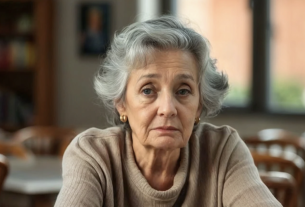
She opened the door and froze for a moment, not understanding who stood in front of her. An elderly couple—a woman in a faded jacket and a man with a weary face—looked at her expectantly. Something painfully familiar flickered in the woman’s features, in her heavy, unblinking gaze.
“Alina?” The voice was hoarse, uncertain.
And then it hit her like a blow. Mom. Dad. Ten years had passed since she’d last seen them—since the day she left her parents’ house, seven months pregnant, with two bags in her hands.
“Can we… come in?” her father shifted from foot to foot, as if he were standing not at his daughter’s doorstep, but outside some official’s office.
Alina silently stepped aside. What else was there to do? Slam the door in their faces? Maybe she should have, but she couldn’t bring herself to lift her hands. She still remembered climbing into her mother’s lap as a child, remembered how her father taught her to ride a bike in the yard of their old house.
Her parents walked into the living room, looking around. Alina saw her mother’s eyes sweep over the new furniture, the paintings on the walls, the expensive appliances—measuring, appraising. There was no pride or joy in that look, only cold calculation.
“Would you like some tea?” Alina asked, surprised by her own calm. Inside, everything was boiling over, but her voice stayed even.
“Yes, thank you,” her mother lowered herself onto the sofa as if it were the most natural thing in the world.
While Alina fussed with the kettle, her hands betrayed her and began to tremble. She could hear her parents speaking quietly in the living room, but she couldn’t make out the words. She set cups on a tray, took out cookies she’d bought for Liza. Her daughter had stayed overnight at a friend’s—thank goodness she wasn’t home for this meeting.
Back in the living room, Alina poured the tea and sat down across from them. An awkward silence settled. Her mother blew on the hot drink; her father stared out the window. No one asked how she was living, whether she was okay.
“Nice apartment,” her mother finally said. “We heard you opened your own shop. You sell clothes.”
“Yes,” Alina answered shortly. “Three years now.”
“Good for you,” her father nodded, but the praise sounded formal—like a comment about the weather.
Alina understood perfectly: this wasn’t small talk. They hadn’t shown up after ten years of silence for no reason. They wanted something. And judging by their tense faces, they were working their way toward the real topic.
“We got your address from Galya,” her mother continued, meaning Alina’s school friend she sometimes spoke to on the phone. “She says you’re doing well. Business is going.”
“It is,” Alina took a sip of tea that suddenly tasted bitter.
Her father cleared his throat and set his cup on the table.
“Alina, we didn’t come for no reason. We’ve… run into a situation. You understand,” he hesitated, glanced at his wife.
Her mother picked up the thread, as if they’d rehearsed this moment in advance:
“It’s about Kristina… your sister… she got into an accident. Totaled the car. Completely.”
Alina felt everything inside her go cold. There it was. That was why they came.
“Is she okay?” she asked automatically, even though her intuition was already whispering what came next.
“Yes, thank God, she’s fine,” her father waved it off. “She had some champagne with her girlfriends. Just a little. But she lost control and hit a pole. The car’s only good for parts now. Insurance won’t cover it because there was alcohol in her blood.”
“And now we don’t have a car at all,” her mother leaned forward, her voice turning pleading. “And we have to get to work. Into the city every day. The buses barely run—an hour each way. We’re not young anymore, you know?”
Alina understood. Oh, she understood perfectly. Her sister got away with it again. She drank, wrecked the car—and what? Her parents would rescue her again. Or rather, they would ask their older daughter to rescue them—an older daughter they remembered only now, when they needed money.
“Kristina still lives with you?” Alina asked, though the answer was obvious.
“Well, yes,” her mother shrugged. “After that incident she came back. It’s been five years at home. She works at a local store. The salary’s small.”
That incident. Alina remembered. How could she forget? Seven years ago, when Alina herself was twenty-three, when she was raising two-year-old Liza in a rented room without hot water, her parents gathered up all their savings—two hundred thousand rubles—and gave it to Kristina. Her younger sister had decided to conquer the capital, take some courses, start a new life.
The money evaporated in half a year. No courses, no new life. Kristina returned home with empty pockets and blurry explanations about how everything turned out to be harder than she’d thought.
But when Alina came to her parents at nineteen—pregnant and terrified—they told her, “Figure it out yourself. We warned you that boy would lead you nowhere. You’re an adult, so deal with it.”
There were no savings for her. Only cold words: “We can’t support you. We don’t have money as it is. Maybe you should give the baby to an orphanage? Think hard.”
Alina left then and never went back. She gave birth to Liza, got a job, rented corners, went hungry, but she held on. And a year after she left, her parents scraped together those same two hundred thousand for Kristina. So the money existed. Just not for her.
“You see, Alina,” her father spoke again, his tone almost begging now, “we really need a car. At least a used one. We did the math—four hundred thousand should be enough for a decent option. You can help now. You have a business, an apartment…”
“You need a car—what does that have to do with me?” Alina’s voice came out quieter than she expected, but steel rang inside it.
Her parents exchanged a look.
“You’re our daughter,” her mother said, as if that explained everything. “Family is supposed to help each other.”
Family. The word hung in the air—heavy and false. Alina looked at her mother, then at her father. Their faces were tight, expectant. They truly believed she would pull out her phone and simply transfer the amount.
“And you’re not interested,” Alina said slowly, “in how your granddaughter is doing?”
Her mother blinked, as if she didn’t understand the question.
“Granddaughter? Oh—right… Liza, yes? How is she?”
Ten years. In a month, Liza would turn ten. And her grandmother couldn’t even remember her name right away. Didn’t know how old she was. Hadn’t asked about her once all morning.
“She’ll be ten soon,” Alina said. “She gets straight A’s. She takes dance classes. Last year we went to the sea. She learned to swim and now wants to join a club. She has lots of friends. She’s funny, smart, kind.”
Her parents said nothing, not knowing what to answer. The information didn’t interest them. It had nothing to do with a car.
“That’s good,” her mother finally forced out. “We’re happy for her. But about the car…”
“When I was nineteen,” Alina cut in, “I came to you pregnant. Remember? Maksim dumped me as soon as he found out. I was alone. I was terrified. I needed support. Any kind.”
“We told you that boy—”
“You told me to manage on my own,” Alina cut her off harshly. “You said you didn’t have money to support me. And a year later you gave Kristina two hundred thousand for her big-city dreams. I remember that.”
Her father lowered his eyes. Her mother’s lips pressed into a thin line.
“That was different,” her mother began. “Kristina wanted to study, to grow—”
“And I just wanted to survive,” Alina’s voice trembled now; emotions she’d held back for ten years broke loose. “I wanted my child to have food. A roof over her head. I worked, carried Liza in a sling because there was no one to leave her with. I didn’t sleep at night. I didn’t have money for medicine when she got sick the first time. I cried right in the pharmacy when they told me how much the prescription cost.”
“We didn’t know it was that hard for you,” her father muttered.
“You didn’t ask,” Alina snapped. “In ten years you never called once. Not once asked if we were alive. You don’t know that Liza had pneumonia at four. That at six she learned to read. That at eight she rescued a kitten off the street and now we have a cat named Murzik. You know nothing about her. Because you didn’t care.”
Her mother stood up, her face reddening.
“But we came now! We want to fix things! And for that you need to meet us halfway—help the family in a hard moment!”
“Fix things?” Alina gave a bitter laugh. “You came for money. That’s all you need from me. If Kristina hadn’t wrecked the car, you wouldn’t have remembered I exist for another ten years.”
“You’ve always been ungrateful,” her mother blurted. “We raised you, educated you, and you—”
“And I gave birth to a child you suggested I dump in an orphanage,” Alina finished. “And I raised her myself. And I built a business myself. And I bought this apartment myself. Without your help. Without your support. Without your love.”
A heavy silence fell. Her father stood and placed a hand on his wife’s shoulder.
“Let’s go, Vera. We’re not welcome here.”
“No, wait,” Alina stood too. “I’ll tell you one more thing. You chose Kristina. A long time ago. Maybe because she’s younger. Maybe because she was more convenient, more obedient. I don’t know. But you made your choice. And now you can’t understand why I don’t want to help you.”
“We didn’t choose,” her mother grabbed her bag, her hands shaking. “We loved you both.”
“No,” Alina said calmly. “Love isn’t words. It’s actions. And your actions showed me everything I needed to know. You turned away from me when I was at rock bottom. And now you’ve come when I’m afloat. But not to be happy for me. Not to meet your granddaughter. Only to ask for money—for a car—for the daughter you preferred.”
“So you won’t help?” her father said sharply now, almost defiantly. The pretense dropped away, leaving only the raw point of the visit.
“No,” Alina shook her head. “I won’t. Kristina wrecked the car through her own stupidity. Let her deal with it herself—like I dealt with my situation once. Without anyone’s help.”
Her mother sniffled, but there were no tears. Only anger in her eyes.
“You’ll regret this. We’re your parents.”
“You were my parents,” Alina said softly. “Once, a long time ago. Now you’re just strangers who came asking for money.”
She walked them to the door. They pulled on their jackets and stepped into the stairwell. Her mother turned back one last time:
“You’re cruel. Cold-hearted. We did so much for you…”
“Goodbye,” Alina said, and closed the door before she could finish.
Leaning her back against it, Alina slowly slid down onto the floor. Her hands shook. Her heart hammered. But along with it came a strange feeling of freedom. She had finally said everything. She hadn’t snapped, hadn’t cried in front of them, hadn’t given in to the manipulation.
Her phone vibrated. A message from Liza: “Mom, can I stay at Nastya’s for another hour? We’re watching cartoons.”
Alina smiled through the tears rising in her eyes and typed back: “Of course, sunshine. Stay as long as you want. I love you.”
Her daughter would never know what it felt like to be unloved. She would never face being chosen against, never have to compete with someone else. Alina had made herself a promise years ago—on the night she held newborn Liza in a tiny hospital room, completely alone. She would be a different kind of mother. She would be the one who always chose her child.
And she had kept that promise.
Getting up from the floor, Alina went to the kitchen, poured out the cold tea, and began washing the cups. Life went on. Her life—the one she had built herself. The shop was doing well; next month she planned to open a second. Liza was growing up happy and confident. They had an apartment, stability, love.
They didn’t need anything else. And they certainly didn’t need people who showed up only when they wanted something.
That evening, when Liza came home messy-haired and cheerful, Alina hugged her tight.
“Mom, what happened?” the girl asked in surprise.
“Nothing,” Alina smiled. “I just love you very much.”
“I love you too,” Liza kissed her on the cheek and ran off to her room.
Alina watched her go and understood she’d made the right choice. Not today—the choice had been made years ago, the day she walked out of her parents’ house with two bags and the determination to survive.
She broke the chain. She didn’t repeat their mistakes. And that was the greatest victory of her life.
Her parents never called again. Never wrote. Never tried to rebuild contact. Alina knew they wouldn’t—she hadn’t given them money, which meant she was useless to them. Strangely enough, it didn’t hurt. She had lived through that pain long ago, when she realized they had chosen someone else.
Now there was only relief. The door to the past had closed for good, and ahead lay a road she was carving out herself—together with her daughter. With her own rules. With a love that was enough for two.
And that was enough.