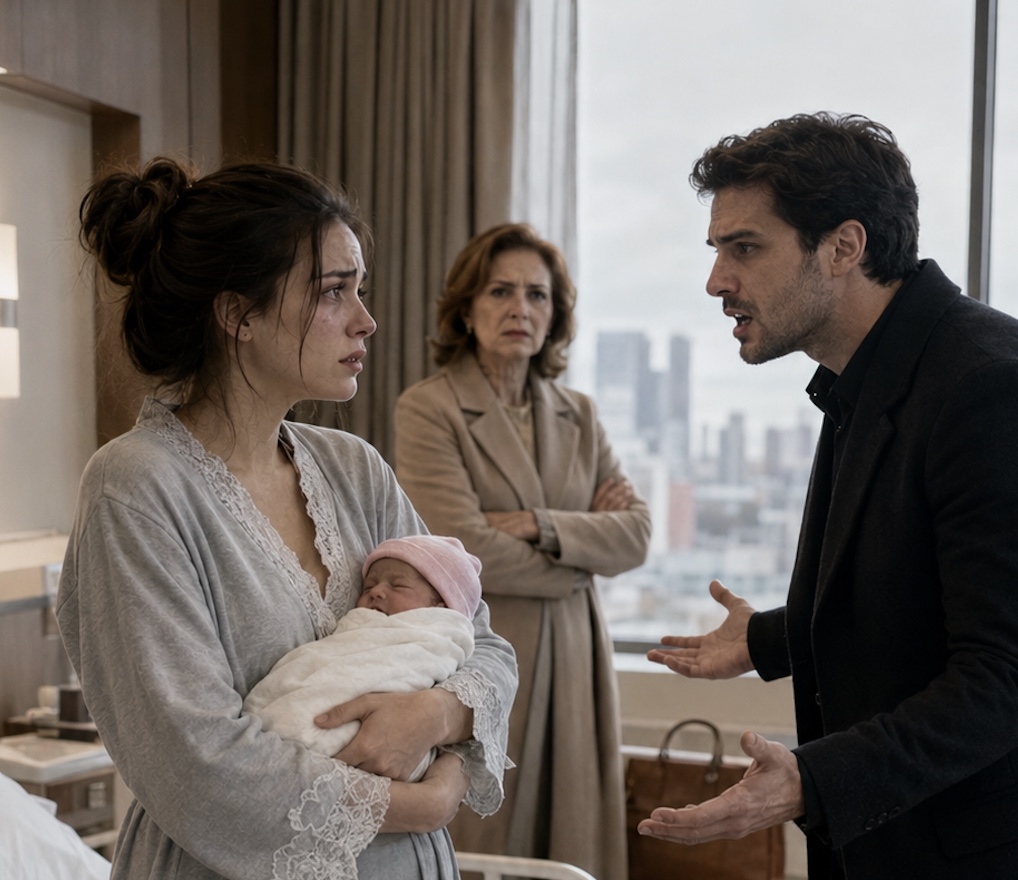
“This is not my child. Don’t bother coming home,” Gleb said at the door of the hospital room so casually, as if he were canceling a dinner delivery, not cutting me off from my family on the day I was supposed to be discharged.
I sat on the bed with Taisiya in my arms and looked at his face so calmly that, for a second, he even lost his nerve. Beside the window stood Nina Arkadyevna in her beige coat, with that same composed posture she always had when entering her curtain salon, where one glance from her was enough to make the cashiers rearrange fabric rolls by the ruler. Behind the glass stretched a gray St. Petersburg day. Cars gleamed on the wet parking lot, the wind rubbed a few scattered leaves against the window, and the room smelled of dry warmth, milk, and something sterile and hospital-clean that was already making me nauseous.
Taisiya was sleeping. Her face did not resemble anyone yet; it was so new that simply looking at her made my throat tighten. And at the door stood the man I had lived with for five years, insisting that this child was not his.
“Say that again,” I breathed quietly.
He jerked his chin. He was nervous. Far too obviously nervous for a man who was certain he was right.
“I said everything. You know why. I’ll do a DNA test if I have to. And until I come back with the result, don’t come to the apartment.”
Nina Arkadyevna immediately stepped in, not allowing the silence to become dangerous for the two of them.
“Vera, you are in no condition for scenes right now. We are shocked too. Gleb is completely on edge. If you have nothing to hide, then the test will prove it. Until then, don’t make things worse.”
It was on the word “until” that I finally understood everything.
This was not about the baby.
Not about jealousy.
Not about some sudden revelation.
They were not trying to find out the truth.
They were clearing space.
I had known it since morning, when he arrived not alone, but with his mother. When he was wearing not his usual jacket, but a new light-gray one, the kind of coat a man does not wear when he is simply coming to pick up his wife from the maternity hospital. When a payment confirmation for a trip for two flashed on his phone, and the moment he noticed my eyes on the screen, he turned it face down too quickly.
Until that minute, I had still left myself a pathetic little hope that I was wrong. That it was a business trip. That it was for one of his friends. That my head was simply spinning after giving birth.
No.
He had already paid for his escape. He only needed a beautiful excuse so he would not look like a bastard, even in his own eyes. The child was the most convenient reason. Especially with his mother standing beside him, a woman who knew how to wrap any cruelty in the thin fabric of “we only want the truth.”
I did not argue. And I think that frightened them more than if I had cried, screamed, or sworn that Taisiya was his daughter.
“All right,” I said.
Gleb blinked.
“What?”
“I heard you.”
Nina Arkadyevna frowned.
“And that’s all?”
“What did you expect? That I would beg you to believe me in a hospital room while holding a newborn baby?”
Gleb gave a crooked smirk.
“Vera, don’t pretend you’re above this. If the child is mine, you have nothing to fear.”
I looked at him and, for the first time in many months, felt neither pain nor offense. Only a very cold disgust. Because the man who, just a week earlier, had kissed my belly and said, “My daughter will be stubborn, just like you,” was now standing by the door, searching my face for panic. He did not want the truth. He wanted my fear.
“You say that so calmly,” I exhaled, “as if it won’t be at my expense. But fine. Go.”
He actually looked confused.
Nina Arkadyevna stepped closer.
“And where exactly are you planning to go?”
“Not to you, that’s for certain.”
She pressed her lips together.
“Just don’t start running to us later, demanding help.”
At that, I almost smiled. Because if she had known how little real help I would need from her now, her face would have become even harder.
The door closed behind them quietly. Not with a slam. Not dramatically. The closer simply clicked, and I was left alone with Taisiya. A minute later, Lyuba Mironova, the senior midwife, entered the room. She was short, sturdy, with quick hands and a face on which pity never stayed longer than necessary.
She looked at me, then at the door, then back at me.
“Well?” she said shortly. “What was that?”
“My husband went to check his paternity,” I replied.
Lyuba froze for a second, then placed a stack of diapers on the bedside table and snorted as if she had heard not a family tragedy, but a poorly sewn excuse.
“Is he supposed to be smart?”
“More like lazy.”
She nodded.
“All right. Then you’ll go without him. Where?”
“To Grazhdanka. To my old apartment.”
“You have the keys?”
“Yes.”
“Money?”
“That too.”
Lyuba was silent for a moment. Then she unexpectedly softened and adjusted the edge of Taisiya’s blanket.
“Then live. Don’t fall apart here. You don’t have the face of a victim. You have the face of a person who has already decided something.”
I looked at her and, for the first time that day, realized that yes, I had decided. I simply had not yet found the words for that decision.
In my hospital bag were documents, a charger, two baby undershirts, a bottle of water, and an envelope with the papers for my old one-room apartment on the outskirts of the city. The very apartment I had bought before marrying Gleb, back when I worked two shifts as a medical receptionist and lived as if sleep were a luxury meant for other people. After the wedding, we moved in with Nina Arkadyevna, into her spacious Stalin-era apartment on Petrogradskaya. She had assured us then that it was “more sensible”: why pay for separate housing when she had three rooms, high ceilings, and “a family should stay close.” I did not sell my one-room apartment. Partly out of caution, partly because I have always loved an emergency exit more than beautiful promises.
Gleb used to laugh.
“You cling to that little box as if there’s gold inside.”
Back then, I had laughed it off. Now I silently thanked my former self for that “little box.”
I left the maternity hospital alone. Lyuba called a car for me. She carried out my bag herself, helped wrap Taisiya warmly, and at the entrance leaned toward me.
“Don’t even think of running after them tomorrow with tests and tears. First go home. Eat. Sleep. Then think.”
I nodded.
“Thank you.”
“Don’t thank me,” she said. “I’ve just seen too many handsome men standing at hospital doors. First it’s love, then it’s ‘not my child.’ Their imagination is narrow.”
On the way to my one-room apartment, the city was wet, dull, and indifferent. The car was driven by a silent man of about fifty. The radio muttered about traffic jams. Taisiya breathed softly in her carrier, and I stared out the window, unable to fit one thing into my head: I was not hurting the way a woman should hurt after being thrown out of her family with a newborn daughter in her arms. I was cold. And from that cold clarity inside me, I felt almost light.
For too long, I had lived with the feeling that Gleb was not playing the role of a husband, but a beautiful version of a husband. He loved to talk. He loved to sit elegantly at the table with a glass in his hand. He loved to explain how one “should know how to live.” He loved promises. But every time life stopped being scenery and demanded real effort from him, it was as if a soft emptiness took possession of him.
Work was always “not working out” for him.
Projects “fell through.”
Clients “turned out wrong.”
Money was always “about to come in.”
And yet he dressed tastefully, told stories vividly, and knew how to look a woman in the eye in a way that was enough for the first few months of love. I worked a lot, was constantly exhausted, and once, very foolishly, believed that someone had appeared beside me with whom I could finally exhale. Instead, I got a beautiful wrapper, into which his mother kept inserting her old right to decide everything for her son.
When I reached my one-room apartment, it was cold inside. Not empty. Cold. The air in the closed apartment stood still, the windowsill had absorbed dampness, and the hallway smelled of old books, dust, and something faintly metallic. I turned on the light, placed the bag on the floor, laid Taisiya on the sofa, and for the first time all day, sat down myself.
The kitchen was exactly as it had been. The white cabinet. The small kettle. A jar of buckwheat. My old mug with a blue rim. Nothing here knew anything about Gleb, his mother, DNA, or the strange child in his tickets. This apartment was not going to pity me or save me. It simply stood there and waited for me to decide how to live next.
Gleb texted an hour later.
“Don’t make a drama out of this. We’ll do the test and decide everything.”
I looked at the screen for a long time. Then I turned off the sound and did not answer.
Ten minutes later, a message came from Nina Arkadyevna.
“You will return the keys to Petrogradskaya through the concierge. And don’t you dare take anything that we bought.”
I smiled. Not happily. Just with perfect clarity. In their minds, they had already divided the dishes and hangers, like people who were convinced they had frightened their victim into convenient silence.
There was only one thing they did not know.
Two years earlier, Nina Arkadyevna had come to me wearing the face of a woman who was “terribly embarrassed to ask.” Her curtain salon had been struggling then, the apartment needed repairs, and she explained very convincingly that if she did not urgently invest in new fabrics, the kitchen, and the windows, everything would collapse. The amount was large. For me, very large. I had just closed an old deposit I had been saving to expand my own living space. Gleb insisted his mother needed help. Nina Arkadyevna promised to return the money in six months. And for the first time in our life together, I felt not pity, but alarm.
I did not refuse.
But I also did not simply hand over the money.
We went to a notary, Arkady Melnikov. A calm, meticulous man with dry fingers and a habit of reading every line aloud. He drew up a notarized loan secured by Nina Arkadyevna’s apartment. At the time, she was offended almost theatrically.
“Vera, you don’t trust me?”
I looked straight into her eyes and answered:
“I do. I simply like large sums of money to have a memory on paper.”
Afterward, Gleb walked around displeased for a week.
“Now my mother thinks you humiliated her.”
“And I think adults don’t get offended by documents if they actually plan to return the money,” I replied then.
She did not return the money.
First, she asked me to wait.
Then she “forgot.”
Then we stopped bringing it up, because there was pregnancy, work, doctors, baby things, and everything else that is so convenient for burying a woman under so she does not reach for old folders.
That same evening, on the day they threw me out of the family, I took out that folder.
The contract.
The payment schedule.
The overdue debt.
The collateral.
The notarized clause allowing enforcement.
The papers lay in front of me while Taisiya breathed quietly in her carrier and damp November darkness crawled down the window. I ran my finger over the date and suddenly felt a very strange relief. Not because I had found a weapon. Because I was not helpless. They had grown too used to my politeness and decided that it was the same as weakness.
Lyuba called closer to night.
“Alive?” she said without greeting.
“So far.”
“Did you eat?”
“Yes.”
“Milk?”
“Yes.”
She was silent for a moment.
“Then sleep while the baby lets you. And tomorrow, don’t do what pain wants. Do what benefits you.”
I closed my eyes and understood that this was exactly what I intended to do.
In the morning, I did not go to Gleb, or to Nina Arkadyevna, or to a laboratory. I called Arkady Melnikov.
He answered quickly, as if he remembered me not only by my surname in the register.
“Vera Andreevna, I’m listening.”
“Arkady Melnikov, Nina Arkadyevna’s loan, secured by her apartment. I want to begin enforcement.”
He did not gasp or ask what had happened. That was why I liked people like him.
“The delay is significant. There are grounds. If you are ready to proceed, come with the documents. Is the baby with you?”
“Yes.”
“Bring her. The sofa on our second floor is more comfortable than the one at the bank.”
An hour and a half later, I was already sitting in his office, feeding Taisiya from a bottle and listening as he calmly explained:
“We will apply for a writ of execution. Then comes notification, collection, and interim protective measures. They are certain you won’t touch this debt?”
“Very certain.”
He adjusted his glasses.
“Then they are in for an unpleasant morning.”
Gleb called just as I was signing the papers.
“Where are you?” he began without saying hello. “Mother is furious. So am I. Have you decided to hide?”
“No,” I answered. “I’ve decided not to chase after people who have already made every decision for me.”
“Don’t get clever. Do the test and come back. Otherwise, you’ll regret it later.”
I looked at Arkady Melnikov. Without lifting his eyes from the documents, he smiled almost invisibly.
“I haven’t lost anything, Gleb. You and your mother just haven’t understood that yet.”
He exhaled something angry and shapeless into the phone, then hung up first.
By noon, Nina Arkadyevna called me herself. Her voice was trembling not from offense, but from panic.
“What have you done? My account isn’t working! My card is blocked! There is a restriction on the apartment in the property registry! Have you completely lost your mind?”
I sat by the window of my one-room apartment, wearing an old sweater, Taisiya in my arms, and looked out at the wet courtyard. There was no triumph in me, no sweet revenge. Only one very steady feeling: their plan did not work so well without me.
“No,” I said. “I simply remembered that you owe me money.”
She gasped.
“Now? When you have a baby in your arms? When the family is falling apart?”
“You destroyed the family yesterday in the maternity ward. Today, we are simply moving on to numbers.”
“We could have reached an agreement!”
“You already reached one. Without me. Now it’s my turn.”
She began speaking faster, almost choking on the words.
“Vera, you understand that Gleb has nothing to do with this. These are my obligations.”
“Strange. Yesterday my child also had ‘nothing to do with it,’ but Gleb used that phrase perfectly well.”
She fell silent so abruptly that I could hear her breathing.
Then Gleb’s voice sounded in the background. Distant, but clear:
“Give me that! What are you telling her? Have you lost it?”
And in that second, for the first time in all this, I almost smiled. Because between them, the thing that always begins among people used to living at someone else’s expense had already started, the moment that expense is suddenly cut off. Not unity. Not family. Panic and the division of blame.
An hour later, a message came from Gleb.
“You’re sick. We wanted to settle everything calmly.”
I read it and put the phone aside.
Calmly.
They especially loved that word. Calmly meant I stayed silent.
Calmly meant they declared my daughter someone else’s child, and I did not answer.
Calmly meant Nina Arkadyevna renovated her Stalin-era apartment with my money and then pretended it had always been that way.
Calmly meant Gleb had already paid for a trip with his mistress and was simply looking for a reason to leave beautifully.
No. Things would no longer be calm for us.
By evening, Arkady Melnikov sent me a short message about the progress of the case. Everything was moving steadily. The paperwork was underway. Nina Arkadyevna’s apartment turned out to be not merely a beautiful Stalin-era flat with moldings and velvet curtains, but collateral for a debt she had considered a paper formality for far too long. And formalities, as it turned out, can bite harder than emotions.
Lyuba came to see me two days later. She brought a bag with cottage cheese, baby ointment, and a small lightbulb.
“The one in your hallway is flickering again,” she said, not even taking off her shoes. “And don’t look at me like that. I’m not a nanny. I was just passing by.”
While Taisiya slept, Lyuba stood on my old chair, screwing in the lightbulb and grumbling:
“Your men love declaring a child someone else’s until they have to actually get up for that child at three in the morning.”
I sat on the sofa and, for the first time in many days, felt not exhaustion, but something like solid ground beneath my feet.
“It feels strange,” I said.
“What exactly?”
“That I’m alone. And I’m not scared.”
Lyuba stepped down from the chair and clicked the switch. The hallway filled with steady light.
“That’s because this isn’t loneliness,” she replied. “It’s the end of someone else’s rules. You were just afraid of it for too long.”
That evening, Gleb sent another message.
“I’m ready to come and talk normally. But first, the test.”
I did not answer.
Not because I was afraid of the conversation.
Because I no longer needed it.
He thought he could hold me with an accusation.
Nina Arkadyevna thought she could hold me with an apartment.
They were both wrong.
I was holding on to something entirely different.
To this small one-room apartment on the outskirts, where everything creaked, but everything was mine.
To my daughter, sleeping beside me, knowing nothing yet of adult cruelty.
To the folder of documents that had turned out to be more reliable than family vows.
To my own silence in the maternity ward, which they mistook for weakness, when in fact it had been the beginning.
That night, I got up for Taisiya, fed her, then went into the kitchen and stood for a long time by the window with a cup of warm water. In the courtyard, a lone car slowly turned between puddles. Near the neighboring entrance, someone was walking a reddish dog. In my hallway, the new lightbulb burned evenly.
I looked at that light and suddenly understood one simple thing.
Fear does not leave when someone starts saving you.
It leaves when you stop living by someone else’s conditions.
That same night, Gleb and his mother were probably still calling people, fussing, arguing, looking for a way out, blaming each other, and trying to save property they considered theirs by force of habit. And I stood in the kitchen of my old apartment with my newborn daughter and felt not disaster.
Freedom.
For the first time in my life, it was very cold, very quiet, and therefore real.