“You’re going to go there now and tell them you were the one driving,” Roman said, throwing the keys to my crossover onto the kitchen table. “The car is registered in your name, so the statement will be yours too.”
I stood in the hallway with my bag in my hand, looking from the keys to his brother.
Anton was sitting at our kitchen table in my work jacket, the one he had grabbed from the coat rack. A dark stain of mud marked one sleeve, and the car mat lay on the floor beneath his feet. He had not even taken off his boots.
“I wasn’t driving,” I said.
“Ira, don’t start,” Roman said quietly, but in that tone he used when everyone was supposed to agree with him. “There was an accident, but nothing catastrophic. The girl was taken for a checkup, the car is dented, the scooter is broken. Anton can’t be involved in this. He drives for work, he has loans, and Mom won’t survive it if this goes wrong.”
Anton lifted his head and snapped irritably:
“I barely touched her. She came flying out on that scooter like a maniac.”
“Were you driving through a red light?” I asked.
He looked away and reached for my glass of water. Even that he did as if he were in his own home.
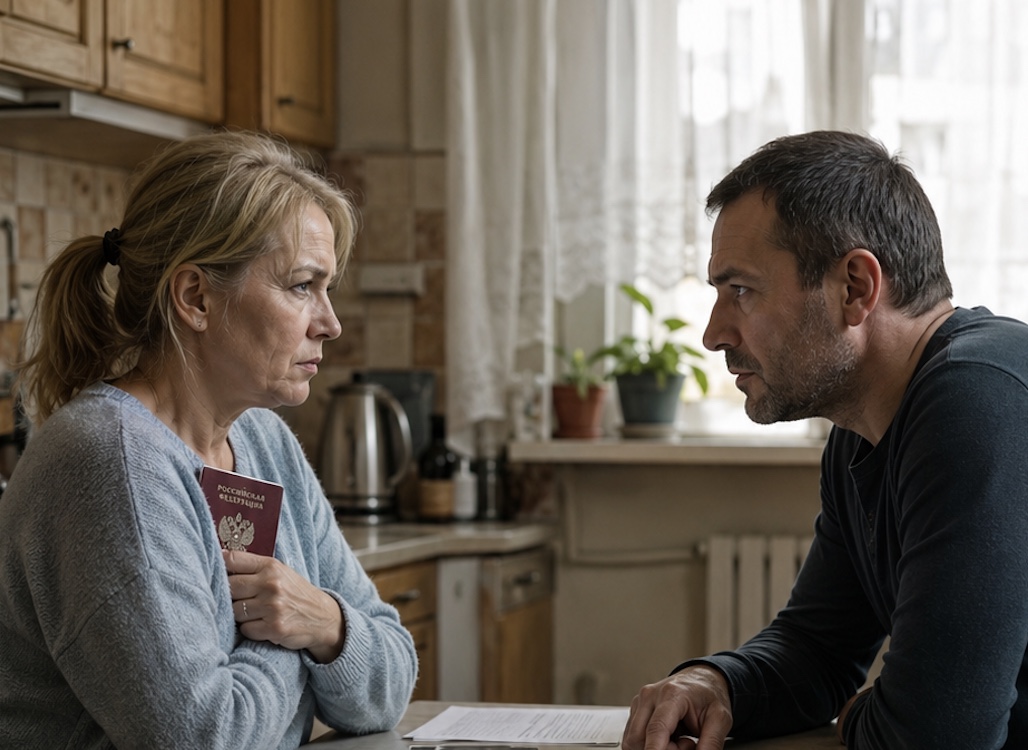
Roman sat across from me and placed his palm on my passport. It was lying on the table next to the car documents. I had not left it there.
“Why did you take out my documents?”
“So everything would be ready. Tomorrow we’ll go, and you’ll give a corrected statement. You’ll say you panicked and got confused. You’re the owner. They’ll believe you faster.”
I slowly pulled my passport out from under his hand and put it into my bag. Roman looked at me as if I had just carried a family heirloom out of the house right in front of him.
“This is my passport,” I said. “And I’m not taking someone else’s blame.”
Anton snorted.
“Rom, I told you she’d start acting all principled. It’s easier for her to drown her husband’s brother than help just once.”
Until that day, I had thought Roman and I had a normal family. Not perfect, but normal.
We had lived for eight years in my apartment, the one I had bought before marriage. He worked for a service company; I worked as a cost-estimating engineer. His younger brother Anton was always showing up with requests: borrow money, pick him up from work, lend him the car “for an hour.” Every time, Roman would say, “Come on, it’s Anton. He’s irresponsible, but he’s family.”
That evening, “family” took my crossover without asking.
Roman sent me a message: “Don’t panic, Anton urgently needs to go somewhere.” I read it only after work, when I came out to the parking lot and couldn’t find my car. Forty minutes later, Anton called and said, “Stay calm, there’s been a small problem.”
At the intersection near the Ryabina shopping center, there were traffic police officers, an ambulance, and my crossover with its front end smashed in. A girl in a green courier jacket was sitting by the curb. An electric scooter lay beside her. A paramedic was asking her questions; she answered briefly, holding her phone with both hands.
Anton stood near the inspector, talking far too quickly.
“I was just moving the car. The visibility was bad. She came out from the side.”
The inspector turned to me.
“Are you the owner of the vehicle?”
“Yes.”
“Who was driving?”
Anton immediately stepped forward, but I answered first.
“Anton Sokolov. My husband’s brother.”
Roman arrived ten minutes later. He did not ask how the girl was. He did not ask how I was. He pulled me toward an advertising stand near the entrance to the shopping center and told me I had ruined everything.
“They’re still filling out the paperwork, so it can be corrected,” he insisted. “You’ll say you misunderstood at first. That Anton was sitting next to you, and you were behind the wheel. You have driving experience, a stable job, we’ll pay the fine. At least my brother won’t lose his license.”
“And what if the girl is injured?”
“Don’t exaggerate. She was talking to the medics.”
That sentence explained a lot. To Roman, the injured girl was not a person. She was an inconvenient detail that needed to be waited out.
At home, they held a family council.
Roman sat Anton in the kitchen, placed my passport and the car documents in front of himself, and called Nina Pavlovna on video. My mother-in-law looked from the screen as if I had already been judged and only the sentence remained to be announced.
“Irina, you don’t betray family,” she said. “Anton made a mistake, and you’re setting him up.”
“He got behind the wheel of my car without permission and drove through a red light,” I replied. “I’m not the one who set him up.”
“You are technically the owner of the car,” Roman cut in. “So technically, take it on yourself. We’ll pay for everything afterward.”
“Pay for what? The fine? The repairs? The lie in the statement?”
Anton slammed his glass on the table.
“Enough acting like a saint. You’re not going to prison. You’ll just say you were driving.”
“Then say it yourself in front of the inspector first,” I suggested. “Say out loud that you want me to lie for you.”
He fell silent.
Nina Pavlovna immediately started speaking louder.
“Roman, get her out of there. She’ll say too much now. Irina, you are a wife. A wife should stand by her husband when his family is in trouble.”
Roman leaned closer to me.
“Tomorrow morning we’re going together. You’ll give a new statement. No scenes. No lawyers. No endless righteousness of yours.”
I did not argue. There was no point.
I took my passport and the car documents from the table and walked out of the kitchen. Behind me, Anton told Roman that they should have taken the memory card out of the dashcam right away.
That stopped me.
There was a dashcam in the crossover. Roman had bought it himself a year earlier after an argument with another driver in a parking lot. Anton had forgotten about it, and now he had remembered too late.
I went into the room, took a spare adapter from the cabinet, and opened my laptop. The memory card had been in the glove compartment; I had taken it at the accident scene when I was getting the insurance papers.
The recording showed the intersection, the red light, and Anton’s voice saying, “I’ll make it through, there’s nobody there.” Then came a sharp sound, people shouting, and his voice again: “She came flying out herself.”
I saved the file to a flash drive, sent it to my work email, and uploaded a copy to the cloud. Then I put the documents into my bag and set the bag beside the bed.
Roman came in without knocking.
“What are you doing?”
“Saving the recording.”
He came over to the laptop and reached for the mouse. I closed the lid.
“Delete it,” he said. “Don’t drag this into the mud.”
“The mud started when you took my passport without asking.”
Roman looked at the bag by the bed.
“So now you’re going to hide documents from your husband?”
“Not from my husband. From the person who wants me to become guilty instead of his brother, yes.”
He sat on the edge of the bed, no longer as confident as before.
“Ira, I understand how it looks. But Anton is an idiot. He won’t handle this alone. If they take away his license, he’ll lose his job. Mom will cry every day. I’ll be torn apart between you.”
“You’ve already chosen a side, Roman.”
“I chose family.”
“You chose who to use to cover the problem.”
He wanted to answer, but Anton knocked on the bedroom door. He knocked only because he was afraid of my reaction, not because he respected boundaries.
“Rom, my phone’s blowing up. Mom says Ira should write me a statement right now saying the car was with her.”
I opened the door.
“What statement?”
Anton held out a sheet from my printer. Typed crookedly on it were the words: “I, Irina Sokolova, confirm that on May 18, 2026, I personally drove the vehicle…”
“You typed this just now?” I asked.
“It’s just for backup,” Roman said quickly, but even he understood how terrible it sounded.
I took the sheet, photographed it on my phone, and put it back on the table.
“Now I have one more reason to speak calmly and in detail tomorrow.”
Anton jumped up.
“Are you insane? It’s just a draft!”
“Then don’t worry. Drafts can explain a lot too.”
The next day, I went to the traffic police department alone. Roman had planned to go with me, but I left the apartment earlier and called a taxi through an app. He called seven times. Then he wrote: “Don’t do anything stupid. Think about our marriage.” I saved the message.
In the hallway of the department sat the same courier girl. Later I learned her name was Maria Krylova. She was no longer wearing the green jacket, but a gray hoodie. A woman, probably her mother, sat beside her. Maria saw me and turned toward the window. I did not approach her or try to justify myself. She already had enough to deal with.
The inspector invited me into his office and asked who had been driving the vehicle on May 18 at 7:40 p.m.
I said: Anton Sokolov.
I explained that he had taken the car without my permission, showed Roman’s message, handed over a copy of the dashcam recording, and told him about the paper Anton had tried to get me to sign.
“Were you asked to change your statement?” the inspector clarified.
“Yes. My husband and his brother asked me to say I was the one driving.”
When I came out of the office, Roman was standing in the hallway. Apparently, he had followed me after all. His face was not angry. It was composed. That was how he looked before unpleasant conversations with clients.
“What did you say?” he asked.
“The truth.”
“Do you understand what you’ve just done?”
“Yes. I didn’t sign myself up for someone else’s accident.”
He smirked and nodded toward Maria.
“Congratulations. You chose a stranger over your husband.”
Maria heard him. Her mother lifted her head. I felt ashamed, not for myself, but for how easily Roman had turned an injured person into an obstacle.
“I chose not to lie,” I said. “Those are different things.”
At home, Roman no longer asked. He pressured.
First with silence, then with conversations with his mother behind an open door, then with threats.
“If you don’t give a corrected statement, we’re done,” he said on the evening of the third day. “I can’t be with a woman who betrayed my brother.”
I was clearing plates from the table after dinner. He had chosen to say it in the kitchen on purpose, the place where all our family matters were usually decided.
“You can’t be with a woman who refused to lie,” I corrected him.
“Don’t twist it. You could have helped without serious consequences.”
“You don’t know what the consequences would be. And you wouldn’t be the one carrying them.”
He sharply pushed back his chair.
“Fine. Then let’s talk differently. This apartment, by the way, isn’t just your life either. We’ve lived here for eight years. I did the renovations. We bought furniture together. If we get divorced, I’m not leaving just like that.”
This was no longer about his brother. This was an attempt to frighten me with what I had.
“The apartment was bought on August 14, 2016,” I said. “Before the marriage. We got married on September 22, 2018. I have the documents.”
Roman frowned.
“What, were you preparing for this?”
“No. I just didn’t throw away paperwork.”
“You think you’re the smartest one?”
“I think I’m going to speak to a lawyer tomorrow.”
He was about to say something, but at that moment Nina Pavlovna called. Roman deliberately put her on speaker so I could hear.
“Irina,” my mother-in-law began without greeting me, “I’ve spoken to Anton. He’s on edge. You’ve driven the man into a panic. Come to my place tomorrow. We’ll discuss how to fix everything.”
“There’s nothing to fix.”
“Don’t be selfish. You have an apartment, a job, a car. Anton is young. He still has to get on his feet. A woman should sometimes give in.”
“He was behind the wheel.”
“There you go again. We’re not asking you to jump off a roof. Just write a paper.”
Roman listened and did not interrupt. That was worse than anything he could have said. He had given his mother permission to finish me off where he had grown tired.
The next morning, I called Denis Arkadyevich, an auto lawyer recommended by a colleague. He listened without gasping or frightening me with horror stories, asked me to list the documents, and said briefly:
“No new statements unless you understand exactly what you’re signing. Keep the recording in several copies. Do not hand over the original memory card without proper documentation. Keep your passport and car documents out of your relatives’ reach. If there are attempts to force you to sign a false version, record everything.”
After the call, I took my passport, the apartment documents, and the original memory card to a friend’s office. She had a safe for work contracts. I told Roman only one thing: the documents were no longer at home.
That evening, he started looking for the file in the cabinet. At first, he pretended he was looking for a charger. Then he opened the drawer with papers. I stood in the doorway and watched.
“It’s not there,” I said.
He straightened up.
“Have you completely lost it?”
“After yesterday’s draft, yes.”
“This is my home too.”
“You live here. A home doesn’t become yours because you open my drawers.”
Roman slammed the drawer shut. This time, he no longer tried to look calm.
“You’re destroying everything over a principle.”
“No. I’m protecting myself from your version of events.”
A few days later, Anton was summoned again. The shopping center cameras confirmed that the driver had been a man in a black cap. Maria Krylova also gave her statement. The dashcam footage matched the timing. After that, Anton stopped pretending to be an offended relative and became an angry debtor who had been presented with the bill.
He called me that evening.
“Well, are you happy now? They’re dragging me around, asking questions about the car, the insurance. Roman is fighting with Mom because of you.”
“Did I make you get behind the wheel of my car?”
“Go to hell with your car. I’ll pay for the repairs, just take back the recording.”
“The recording is already in the case file.”
He fell silent, then asked more quietly:
“And what if I say you gave me permission?”
“Then I’ll show Roman’s message where he wrote that you took the crossover yourself.”
After that, he hung up.
Roman came home late. He sat in the kitchen, stared at his phone for a long time, and then said:
“Anton admitted he was driving.”
I did not answer. There was no victory in that news. It was only what should have happened from the very beginning.
“But he said he took the car with my permission,” Roman added. “I confirmed that I wrote to you only afterward.”
That was the first useful thing Roman had done during the whole ordeal. It just came far too late.
“Good,” I said.
“Just good?”
“Yes.”
He looked up.
“You’re not even going to ask how it was for me?”
“No.”
Roman was silent for a long time, then said:
“If you file for divorce, I’ll make a claim about the renovations.”
“Make it.”
“And the furniture.”
“We’ll make a list.”
“And the fact that I paid utilities for eight years.”
“We’ll pull up the transfers. We’ll count everything.”
He clearly wanted to see fear. Instead, he got the bookkeeping he himself had invited.
The next day, I filed for divorce. No dispute over the apartment. No children. No attempt to explain to the court that one day my husband had placed my passport on the table and decided it could be used to cover for his brother.
Then I wrote Roman a message: “Collect your personal belongings by June 10. Leave the keys on the cabinet. Documents, equipment, and items purchased by me remain in the apartment. In case of dispute, we’ll make an inventory.”
I sent it and took a screenshot.
He came on June 10.
With Nina Pavlovna.
My mother-in-law entered the apartment first, even though none of her belongings were there. She looked at the boxes in the hallway and immediately said:
“Look what you’ve done. You’re throwing your husband out, you set up his brother, and you’ve put his mother on medication.”
“Roman is collecting his things,” I replied. “The conversations about Anton are over.”
“How convenient. First you destroy the family, now the conversations are over.”
Roman silently gathered books, chargers, two jackets, a monitor, and a folder with work papers. I had prepared a list on the table in advance: what he was taking, what stayed, and which keys he was returning. It was not a beautiful gesture. I simply no longer wanted to hear later that “documents disappeared” or “you’re keeping my things.”
Nina Pavlovna saw the list and smirked.
“Already making an inventory. Not a wife, but a warehouse clerk.”
“After the incident with my passport, there’s no other way.”
Roman looked at his mother.
“Mom, enough.”
She turned sharply to him.
“Now you’re defending her too. She’s leaving you without an apartment.”
“The apartment was mine before the marriage,” I said. “And it will remain mine after the divorce.”
Nina Pavlovna went to the shelf and picked up my apartment contract. Apparently, she wanted to make sure I wasn’t just saying it.
“Put it down,” I said.
“I’ll just look.”
“No. You don’t touch the documents.”
Roman came over and took the papers from her.
“Mom, put them down.”
That was the first time he had stopped her instead of me. But it no longer changed anything. He had not protected me when I needed protection. Now he was only saving the last scraps of his own dignity.
Before leaving, Roman placed the keys on the cabinet. I checked the keyring in front of him: entrance key, apartment key, mailbox key. He grimaced but said nothing.
“Have you really decided everything?” he asked at the door.
“Yes.”
“Even if Anton loses his license?”
“That won’t be my decision.”
“Even if I don’t come back?”
In the past, that question would have knocked me off balance. I would have started explaining that I hadn’t wanted to destroy the marriage, that I was hurt, that everything could have been different.
Now I simply looked at the boxes by the elevator.
“You already chose when you asked me to become guilty.”
He said nothing. In the elevator, Nina Pavlovna loudly told someone on the phone that I had “put papers above family.” The doors closed in the middle of her sentence.
Two days later, Denis Arkadyevich sent me a message: “Your position on the accident is confirmed: vehicle owner, not driver. Keep copies of the documents. Do not react to verbal pressure.”
Maria Krylova also wrote to me. Briefly, without unnecessary words: “Thank you for not saying you were the one driving.”
I answered: “I said what I saw and knew.”
We did not write to each other again.
On the evening of June 12, Roman came alone. He rang the doorbell, though he had already returned the keys. I opened the door but did not invite him in.
“I want to talk,” he said.
“Talk here.”
He looked at the stairwell, at the neighbor’s closed door, then said tiredly:
“Anton admitted everything officially. There will be consequences for him. Mom isn’t speaking to me. Are you satisfied?”
“No.”
“Then why all this?”
“So I wouldn’t become guilty for something I didn’t do.”
He lowered his eyes.
“I went too far back then.”
“You didn’t go too far. You showed me how you intended to solve the problem: take my car, my passport, my signature, and my reputation. Then call it family.”
Roman was silent. This time, he had no mother on speakerphone, no Anton behind his back, and none of my documents on the table. Without them, he looked much less certain.
“We could try again,” he said at last.
“No.”
“Because of one accident?”
“Because after the accident, you didn’t ask how the injured girl was or how I was. You asked how to make me guilty.”
He nodded, as if he wanted to object but was too tired to argue. Then he went down a few steps and stopped.
“You didn’t have to hand over the recording.”
“I didn’t. But then you would have kept looking for someone to appoint as guilty.”
He left.
I closed the door, returned to the kitchen, and removed the empty box that had held his mugs from the table. On the cabinet lay the returned keys, next to the receipt confirming the transfer of his belongings and the notice with the divorce hearing date.
I put everything into one folder with the documents for the apartment and the car.
The crossover was still at the repair shop. Anton was dealing with statements and insurance. Roman was living with his mother.
And in my apartment, for the first time in a long while, no one opened my drawers, touched my passport, or decided for me which person’s guilt I was supposed to accept “for the sake of family.”