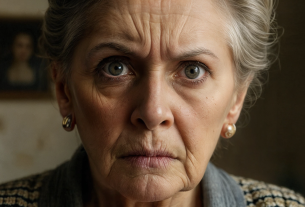
Galina Petrovna loved entertaining guests in her daughter-in-law’s apartment. She seated them, served refreshments, and proudly showed off the renovations. Until one day, Vera decided to clarify one small detail.
Galina Petrovna arranged the cups as if she were conducting an orchestra. Each cup went on a saucer, every saucer on a napkin. She had brought the napkins herself—linen, with blue cornflowers embroidered in the corners.
Vera stood in the kitchen doorway and watched her mother-in-law take command of the apartment. Her arms folded across her chest almost by themselves. It had become a habit over the past two years.
“Verochka, pass me the sugar bowl, please. No, not that one. Mine—the crystal one.”
She said “mine.”
Vera felt the word lodge somewhere beneath her ribs, just below her throat. Still, she handed over the sugar bowl.
The guests were expected at four. They were friends of Galina Petrovna: Zoya Ilyinichna and Tamara. Zoya had once worked at the same clinic as her mother-in-law, while Tamara had lived one floor above Galina Petrovna in the building where she had spent thirty years before her son got married.
Vera dried her hands on a towel and went into the bedroom. Her laptop was sitting on the bedside table. She ran a finger across the lid, wiping away a thin layer of dust, then returned to the kitchen.
The story of the apartment had begun four years earlier.
At the time, Vera worked for an architectural design firm and earned seventy-eight thousand rubles a month. She had been saving since she was twenty-four, putting aside fifteen or twenty thousand every month. She skipped vacations for two years. At work, she ate buckwheat from a plastic container while her colleagues ordered business lunches.
Alyosha, her future husband, had not yet entered her life.
He appeared later, after the mortgage had already been approved, the down payment made, and the apartment keys placed safely in the pocket of her winter coat.
They met while waiting in line at a public services center. Vera was registering her ownership of the apartment. He was updating his official address. They stood beside each other for forty minutes and eventually began talking.
He was two years older than she was, worked as an engineer at a factory, and wore glasses with thin metal frames. He was constantly touching the bridge of his nose to adjust them.
Eight months later, he moved in with her.
Six months after that, they got married.
Galina Petrovna came from Kaluga for the wedding. She inspected the apartment the way a doctor examines a patient—with scrutiny, mild disapproval, and professional curiosity.
“The wallpaper has been put up unevenly,” she said, running her palm over the hallway wall.
“It isn’t wallpaper,” Vera replied. “It’s decorative plaster.”
“Oh. Well, in that case, it’s fine.”
That phrase—“well, in that case, it’s fine”—would be repeated many times afterward, for many different reasons.
Alyosha was not a bad husband.
Vera often caught herself using that exact phrase: not bad. As though that were some kind of achievement.
He washed his own plate, sometimes took out the trash without being reminded, and cooked macaroni with cheese on Saturdays, proudly calling it his signature recipe.
The problem was not him.
The problem arrived from Kaluga once a month carrying two travel bags and a crystal sugar bowl.
Galina Petrovna usually stayed for four or five days. She slept on the sofa in the living room, even though Vera offered to set up an air mattress in the study.
“I’m used to this sofa,” her mother-in-law would say.
The sofa she had supposedly become used to was one Vera had bought on sale the previous year.
Every morning began with the kettle.
Galina Petrovna got up at six, switched it on, and loudly opened cabinet doors while searching for the tea, even though the tea was kept in exactly the same place as during her previous visit, and the visit before that.
“Verochka, where did you move my tea?”
Her tea was a packet of Greenfield Earl Grey that Vera bought especially for her visits.
“It’s on the same shelf, Galina Petrovna.”
“Oh, I see it. You should label it or something.”
So Vera labeled the shelf.
In her own apartment.
She clenched her teeth and remained silent. Not because she was afraid of an argument, but for Alyosha’s sake. He loved his mother, and that was the one thing Vera could not blame him for.
The first time she heard Galina Petrovna’s version of events, her mother-in-law was talking to Tamara on the phone in the kitchen.
“No, Tamara dear, everything is wonderful here. The apartment is cozy, two rooms. I furnished it when Alyoshenka got married. We did the renovations ourselves. Well, I helped.”
Vera was standing on the other side of the wall with a wet cloth in her hand. She had been washing the window. Water dripped from the cloth onto the linoleum, forming tiny, perfectly neat dots.
Galina Petrovna had not helped.
Not with a single ruble, and not with one useful piece of advice. There had been plenty of advice, of course, but it all began with either, “Back home in Kaluga…” or, “People never used to do it that way.”
Vera said nothing.
That evening, she asked Alyosha about it.
“Your mother tells people she helped us with the renovation.”
He adjusted his glasses.
“Well, she did come here. She helped hang the curtains.”
“I hung the curtains. She stood beside me and said the curtain rod was crooked.”
“Vera, don’t pick at everything she says. She talks like that so she won’t feel embarrassed in front of her friends. You know, because everything her son has came from his wife.”
He did not say it angrily. There was even a note of apology in his voice.
But something in that sentence caught inside Vera like a splinter—too small to see, but painful every time she moved.
Everything came from his wife.
That was what he called it himself.
Vera put the cloth beneath the sink and went to take a shower. The water was hot, almost scalding. She remained beneath it until her skin turned red.
The second time happened at New Year’s.
Galina Petrovna arrived on December twenty-eighth carrying Christmas ornaments. They were old Soviet decorations in a shoebox: glass baubles with peeling paint, a star with one broken point, and strands of tinsel that looked as though they had survived untouched since the 1990s.
“We’ll decorate the tree the way we used to at home,” she announced.
Vera had bought the tree a week earlier and decorated it in a simple style: white ornaments, warm string lights, and a wooden star.
She liked it that way.
“Galina Petrovna, we already have decorations.”
“Those aren’t proper decorations, Verochka. These are part of our family tradition. Alyoshenka loved this snowman when he was a child.”
The snowman was missing its nose.
Alyosha stood in the doorway and said nothing. Then he finally spoke.
“Mom, Vera put a lot of effort into the tree. Let’s leave it as it is.”
Galina Petrovna pressed her lips together.
She did not put away the box of ornaments. It remained in the corner of the living room throughout the holidays, like a silent accusation.
Then, on December thirty-first, when Vera stepped onto the balcony to watch the fireworks, she heard her mother-in-law talking to a relative on a video call.
“Yes, the tree in our apartment is beautiful. I chose everything myself—the white ornaments, the whole design. It looks just like something from a magazine.”
The frost stung Vera’s cheeks.
She breathed out, and the cloud of vapor hung in the air for a second before disappearing as if it had never existed.
There was a third time, a fourth, a fifth.
Eventually, Vera stopped counting.
At work, her colleague Inna once asked her what was wrong. Inna was fifty-two, wore her hair short, and had a habit of telling the truth without wrapping it in anything soft.
They were sitting in a conference room waiting for a planning meeting to begin. Behind the glass wall, people passed by carrying folders and cups of coffee.
“Vera, what’s going on with you? Your mother-in-law again?”
“She tells people the apartment belongs to all of us. That she and Alyosha bought it together.”
“And what does Alyosha say?”
“He says she doesn’t mean anything by it. She only says it so she won’t feel embarrassed.”
Inna tapped her pen against the table three times in quick succession.
“You know, Vera, my mother spent her entire life calling it ‘our vegetable garden.’ The garden belonged to my father. He dug it, planted it, watered it. My mother only showed up to take pictures with the harvest. My father stayed quiet. Then they sold the garden, and my mother kept the money. Because when she said ‘ours,’ what she really meant was ‘mine.’”
“It isn’t like that with us,” Vera said.
“Not yet,” Inna replied.
The meeting began, and the conversation ended.
But Vera spent the next two days thinking about the word yet.
It sounded like a warning.
In February, Galina Petrovna called and announced that she was coming with friends.
“Zoya Ilyinichna has wanted to see how we live for ages. And Tamara too. You don’t mind, do you, Verochka?”
How we live.
Vera squeezed the phone so tightly that her knuckles turned white.
“Of course not, Galina Petrovna. Come whenever you like.”
After ending the call, she sat on the edge of the bed.
Outside, the February sky was turning gray. A cactus stood in a clay pot on the windowsill. Vera had bought it three years earlier, when she moved into the apartment.
It had never bloomed.
Alyosha came home from work at seven. He smelled of machine oil and winter air, as he always did during the colder months. He took off his coat, hung it on a hook, and went to wash his hands.
“Mom’s coming on Saturday,” he called from the bathroom. “She’s bringing Zoya Ilyinichna and Tamara.”
“I know. She called me.”
“You’re not angry, are you?”
“No.”
He came out drying his hands on a towel. His glasses had fogged from the temperature change, so he removed them and wiped the lenses on the edge of his T-shirt.
“Vera.”
“What?”
“You’re angry.”
“I said I’m not.”
He nodded, hung up the towel, and went to the kitchen.
A minute later, the kettle began to rumble.
Vera lay on the bed and closed her eyes. She knew the ceiling by heart: the crack in the corner that had been patched twice but always returned, and the stain from an old leak hidden beneath a coat of paint.
Every centimeter of it belonged to her.
On Thursday evening, Vera opened her laptop.
A folder marked “Documents” was inside another folder called “Apartment,” which was inside a folder labeled “Important.”
Three levels of folders, as if she had been hiding the truth from herself.
The purchase agreement had been signed before the marriage.
Sole owner: Vera Andreyevna Korolyova.
There was also an extract from the Unified State Register of Real Estate, updated the previous November. She renewed it periodically out of habit.
Now that habit was about to become useful.
Finally, there was a certificate from the bank confirming that the mortgage had been paid in full. The final payment had been made in March two years earlier.
The entire amount had come from her.
Vera closed the laptop.
Her hands were steady. The calmness surprised even her.
On Friday, she went to Pyaterochka and bought chocolate-covered marshmallows, cookies, and a lemon for tea.
She sliced the lemon into thin circles and arranged them like a fan on a saucer. The apartment filled with the scent of citrus and something crisp and wintry.
Alyosha watched her prepare everything.
“You’re getting ready for them?”
“Mm-hmm.”
“Thanks, Vera. Mom will appreciate it.”
She did not answer. She put the plate of lemon slices in the refrigerator and went to iron the tablecloth.
Saturday.
Two in the afternoon.
Galina Petrovna arrived first, an hour before her friends, as usual. She needed time to inspect the apartment, move something, and begin feeling like the hostess.
“Verochka, why did you remove the vase from the dresser? My vase used to stand there.”
That vase.
Galina Petrovna had brought it a year and a half earlier. It was blue with gold swirls, heavy and ornate, like an artifact from a provincial museum.
Vera had put it in a cabinet because it did not suit any room in the apartment.
“It’s in the cabinet, Galina Petrovna.”
“Take it out. Zoya will appreciate it.”
Vera took out the vase and placed it on the dresser. Against the gray walls, the blue color seemed almost painfully bright.
Vera had painted those walls herself, applying two coats over a weekend while Alyosha was away fishing.
He sat in an armchair scrolling through his phone.
He did not look up.
At three, the guests arrived.
Zoya Ilyinichna was a short woman with a round face and a booming voice. Tamara, by contrast, was tall and quiet, with long fingers that were constantly touching something: a button on her sweater, the edge of a napkin, the handle of a cup.
Galina Petrovna opened the door herself.
With her own key.
Vera stood in the hallway and watched her mother-in-law unlock the door, swing it open, and announce:
“Come in, girls. Make yourselves comfortable.”
The girls came inside.
Zoya Ilyinichna looked around.
“Oh, Galya, your home is so cozy!”
Your home.
Not “your family’s home.”
Not “Vera’s apartment.”
Yours.
Galina Petrovna visibly blossomed. Color rose into her cheeks, and her back straightened. She led her guests around the apartment like a museum guide conducting a private tour.
“This is the kitchen. We redid everything last year. The tiled backsplash—I chose the pattern myself.”
Vera had ordered the backsplash online. She spent three evenings comparing samples and traveled to a showroom on the other side of the city before making the final choice.
“And this is the living room. The sofa is new and very comfortable. I always say a good sofa is half of what makes a home cozy.”
The sofa had cost forty-seven thousand rubles. Vera had bought it with her annual bonus.
“We put up the curtains recently. Pure linen, completely natural.”
Vera had sewn the curtains herself.
She owned a Janome sewing machine she had purchased before getting married. It stood on the desk in the study.
Once, Galina Petrovna had pointed at it and asked, “What is that? You sew?”
As if it were strange.
As if sewing curtains in her own apartment required an explanation.
Vera carried a tray of cups from the kitchen.
Her hands did not shake.
Everything was going according to plan.
“Galina Petrovna, I’ve made the tea.”
“Thank you, Verochka. Come sit with us.”
Vera sat down. She poured the tea and pushed the plate of marshmallows toward the guests.
Zoya Ilyinichna stirred her cup with a teaspoon. Tamara silently studied the walls.
“It’s a lovely apartment,” Zoya said. “Is the neighborhood quiet?”
“Very quiet,” Galina Petrovna replied. “When we were buying it, I looked at that specifically. I wanted a courtyard and a park nearby.”
Vera placed her cup on the saucer.
The sound was slightly louder than necessary.
Alyosha looked up from his phone.
“Mom,” he began.
But Galina Petrovna did not hear him. She was in her element.
“We paid two and a half million for it at the time. There was a mortgage, of course. We helped Alyoshenka with that.”
Two and a half million.
The apartment had cost three million eight hundred thousand.
Vera had taken out the mortgage herself. She had paid the down payment from four years of savings. The monthly payments, the insurance—everything had been in her name.
Every ruble.
“Mom,” Alyosha said again.
“What is it, son?”
“Nothing.”
He looked down at his phone. His glasses had slipped to the end of his nose, but he did not bother adjusting them.
Vera looked at him.
For a long four seconds.
He did not raise his eyes.
She stood up from the table calmly. Not a single muscle in her face moved.
She went into the bedroom, picked up the laptop from the bedside table, and returned.
Then she sat down, opened the lid, and waited as the screen lit up.
A flicker of confusion passed over the guests’ faces.
Tamara stopped playing with her button. Zoya Ilyinichna froze with her teaspoon halfway to her mouth.
Galina Petrovna frowned.
“Verochka, are you going to work? We have guests.”
“No, Galina Petrovna. This will only take a minute.”
Vera opened the folder.
Three clicks.
The apartment purchase agreement filled the screen.
“I only wanted to clarify something,” Vera said evenly, without raising her voice. “For Zoya Ilyinichna and Tamara. So there won’t be any confusion.”
She turned the laptop so the guests could see it.
“This is the purchase agreement. It is dated March twelfth, two thousand twenty-two. The buyer is Vera Andreyevna Korolyova. Sole owner.”
Silence settled over the kitchen like a tablecloth being spread across a table—heavy linen, smooth and without a wrinkle.
Zoya Ilyinichna slowly lowered her spoon.
“And here is the extract from the real estate register,” Vera continued, opening the second file. “It was updated in November. There is one registered owner. Me.”
“Vera,” Alyosha said.
She did not look at him.
“And this is the certificate from the bank confirming that the mortgage has been paid in full. I made every payment. I paid the down payment. Our marriage was registered a year after I bought the apartment.”
She closed the laptop.
She did not slam it shut.
She lowered the lid gently and carefully, the way someone closes a book after finishing the final page.
Then she moved the plate of marshmallows closer to Zoya Ilyinichna.
“Please, have one. They’re fresh.”
Galina Petrovna sat perfectly straight, her back as rigid as a ruler.
The cheeks that had been pink with pleasure only a minute earlier had turned pale. Her fingers tightened around the teacup, and Vera noticed that her knuckles had gone white as well.
“Verochka,” her mother-in-law said. Her voice trembled, but she quickly brought it under control. “Why would you do this?”
Vera lifted her cup and took a sip.
“You said you bought the apartment. I corrected the misunderstanding.”
“That isn’t what I meant.”
“What did you mean, Galina Petrovna?”
Tamara lowered her eyes. Her long fingers found the edge of the tablecloth and began folding it.
Zoya Ilyinichna looked from one woman to the other as if watching a tennis match.
“I meant that we are a family,” Galina Petrovna said. “Everything belongs to all of us.”
“No,” Vera replied. “Not everything.”
Alyosha stood up from the armchair.
At last, he adjusted his glasses. He approached the table but did not sit down. He remained standing like a man unable to choose between two chairs.
“Vera, did you really have to do this in front of everyone?”
“In front of whom should I have done it, Alyosha? I stayed quiet for two years. Your mother tells her friends, neighbors, and relatives that this is her apartment. You remain silent. I remain silent. Everyone remains silent. Meanwhile, the apartment becomes ‘ours,’ then ‘Mom’s.’ What comes after that?”
He did not answer.
He sat on the empty chair and rubbed the bridge of his nose, a habit that appeared only when he was deeply uncomfortable.
Zoya Ilyinichna cleared her throat.
“Verochka, I honestly… I didn’t know. Galya told us…”
“I know what she told you,” Vera interrupted gently. “That is why I showed you the documents.”
A pause followed.
Water was dripping from the kitchen faucet.
Vera got up and tightened the tap. The dripping stopped.
When she returned to the table, Tamara suddenly spoke.
“My daughter went through the same thing.”
Everyone looked at her.
Tamara rarely spoke, which gave every word she said more weight.
“My daughter bought an apartment by herself. Her husband moved in afterward. Then his mother started telling everyone, ‘The children live in our apartment.’ My daughter stayed silent for five years. Eventually, she could not take it anymore and said everything she had been holding inside. But she didn’t do it the way Vera did. She shouted. She cried. Her husband took his mother’s side. They divorced six months later.”
Tamara fell silent and took a sip of tea.
Zoya Ilyinichna placed her cup down quietly.
“Galya,” she said, “did you really tell people the apartment belonged to you and Alyosha?”
Galina Petrovna said nothing.
Her chin lifted slightly, the way it always did when she was preparing to argue.
But there was nothing to argue about.
The documents were stored on the laptop, and the laptop sat closed on the table, black and final, like a full stop at the end of a sentence.
“I never called it mine,” she finally said. “I called it ours.”
“Galina Petrovna,” Vera said, sitting opposite her, “‘ours’ and ‘yours’ sound very different when the owner is sitting in the room. Especially when the owner remains silent.”
Alyosha swallowed.
The sound was audible in the quiet kitchen.
“Mom, Vera is right,” he said. His voice was quiet but clear. “I should have said something sooner. This is Vera’s apartment. She bought it before there was an ‘us.’”
Galina Petrovna looked at her son.
Her eyebrows drew together over the bridge of her nose. For a second, it seemed she was about to say something sharp.
Instead, she exhaled and loosened her grip on the cup.
“There was still no need to do it in front of other people,” she said.
It was not a question. It was a statement.
“You said the opposite in front of other people,” Vera replied.
Zoya Ilyinichna was the first to leave.
She put on her coat and buttoned it all the way to her chin, even though the February weather was not especially cold.
“Thank you for the tea, Verochka. Your apartment is beautiful.”
She emphasized the word your.
Vera nodded.
Tamara lingered in the hallway. She leaned toward Vera and spoke quietly enough that only she could hear.
“You did the right thing. My daughter regrets not doing the same.”
Then she left, walking in long strides while fastening her buttons.
Galina Petrovna remained in the kitchen.
She did not leave.
Alyosha stood nearby, leaning against the doorframe. There was a meter and a half between them and twenty-seven years of difference in age, yet at that moment they looked remarkably alike: the same line of the shoulders, the same downward turn at the corners of their mouths.
“Mom, would you like more tea?” Alyosha asked.
“No.”
She was silent for a moment.
“Vera.”
“Yes?”
“I did not mean to hurt you.”
Vera returned to her chair and looked at her mother-in-law.
There were fine wrinkles around Galina Petrovna’s eyes, thin as pencil lines. The brooch on her sweater had shifted slightly to one side, and Vera automatically thought that it needed straightening.
“I know,” she said. “But you did hurt me. Perhaps not intentionally, but you did. And I remained silent, which was my mistake.”
“You could have told me.”
“You would not have listened. You only listen when there are witnesses.”
It was harsh.
Vera knew it was harsh.
But the words left her mouth before she could soften them, and she decided not to take them back.
Galina Petrovna stood up. She smoothed her sweater and adjusted the brooch herself.
“Alyosha, call me a taxi.”
“Mom, you were planning to stay until Monday.”
“Call me a taxi.”
He took out his phone.
His fingers tapped the screen, and the quiet clicking of the keys was audible.
Galina Petrovna left at six in the evening.
She spent the two hours between her friends’ departure and the arrival of the taxi sitting in the living room on “her” sofa with her phone in her hands.
She did not call anyone.
She simply held it.
Vera washed the cups.
Four cups, four saucers, the teapot, and the milk jug she had taken out but never used.
The water was warm. The dishwashing liquid smelled of apples. Outside, the sky grew dark.
Alyosha came into the kitchen.
“Are you happy now?”
Vera turned off the tap and placed the final saucer on the drying rack.
“No.”
“Then why did you do it?”
“Because being happy about something and knowing it was necessary are not the same thing.”
He was silent.
Then he removed his glasses, cleaned them, and put them back on. It was his familiar gesture, but this time he moved more slowly, as though he were trying to delay what came next.
“I should have been the one to say it.”
“Yes.”
“I’m sorry.”
Vera looked at him.
He stood at the kitchen entrance, and light from the hallway fell across one shoulder while his face remained in shadow.
She could not see his eyes, but she could hear from his voice that he was not merely saying the word.
He meant it.
“All right,” she said.
“All right, you forgive me?”
“All right, I hear you.”
He nodded and left.
A minute later, Vera heard the television turn on in the living room.
The sound was ordinary, and the evening was ordinary, yet something had shifted.
It was like moving a piece of furniture only a few centimeters. Everything appeared to remain where it had always been, but afterward, you walked through the room differently.
The next week was quiet.
Galina Petrovna did not call.
Alyosha called her every evening and took the phone onto the balcony. When he came back inside, he said nothing and sat down to dinner.
Vera did not ask what they discussed.
Not because she did not want to know, but because it was his conversation, his mother, and his responsibility.
On Thursday, Tamara called.
Vera did not recognize the Kaluga number, but the caller identification showed her name.
“Verochka, this is Tamara. We met at Galya’s on Saturday.”
“I remember.”
“Galina called me yesterday. She was crying.”
Vera pressed the phone more firmly against her ear. The noise from the street seemed to fade.
“I didn’t want to make her cry.”
“I know. But she isn’t crying because she is offended. She is crying because she is ashamed. And this is the first time she has ever truly felt ashamed, Verochka. She is a hard woman. She is used to having everything done her way. Then suddenly—there were the documents, the facts, and no shouting or scandal. You handled it calmly, almost like a business matter.”
“I wasn’t trying to handle it like a business matter. I only wanted it to stop.”
“And now it has stopped.”
Tamara paused.
“She said to me, ‘Tamara, I am an old fool.’ Those were her exact words. I told her, ‘Galya, you are not a fool. You are simply used to your son tolerating everything.’ Then she started crying again.”
Vera stood beside the window.
The cactus remained on the windowsill, green and stubborn, without a single flower.
“Thank you for calling, Tamara.”
“Call her yourself. Not for her sake. For yours. So you do not have to carry this around inside you.”
After the call ended, Vera remained beside the window for a long time, looking into the courtyard.
The swings moved by themselves in the wind.
There was no one there.
Vera called Galina Petrovna on Friday morning before work, while Alyosha was in the shower.
The call was answered after the fifth ring.
“Hello.”
Galina Petrovna’s voice sounded duller than usual, as though she were speaking from beneath a blanket.
“Galina Petrovna, it’s Vera.”
“I can see that.”
There was a pause.
Vera could hear a clock ticking somewhere. Probably the wall clock with the pendulum Galina Petrovna had once shown her in a photograph.
“I am not calling to apologize,” Vera said. “Because I have nothing to apologize for.”
“I know.”
“But I am calling to tell you that you can come and visit. Like before.”
Silence.
Long and heavy, filled with the ticking of the clock.
“I’m not sure that would be a good idea,” Galina Petrovna said.
“Why?”
“Because I’m ashamed, Vera. Ashamed in front of you. Ashamed in front of Zoya and Tamara. I am an old woman, and I feel ashamed. It is… unpleasant.”
“I understand.”
“No, you don’t. You are young. You do not know what it feels like to be put in your place in front of your friends and realize that you deserved it.”
“Galina Petrovna.”
“What?”
“Come and visit. Just leave the sugar bowl at home.”
Silence followed.
Then Vera heard a sound she did not recognize at first.
Galina Petrovna was laughing.
Quietly, with little gasps between breaths, as though laughter and tears were standing side by side and could not decide which one should leave.
“Without the sugar bowl,” she repeated. “All right.”
In March, her mother-in-law arrived alone.
No travel bags.
No crystal sugar bowl.
She was carrying a plastic bag from Pyaterochka.
“I brought some marshmallows,” she said from the doorway. “The chocolate-covered ones.”
Vera took the bag.
It was warm.
Galina Petrovna must have held it close to herself throughout the journey.
Nothing in the apartment had changed.
The same walls. The same decorative plaster. The same tiled backsplash in the kitchen.
The vase remained inside the cabinet.
Galina Petrovna noticed, but she said nothing.
They drank tea together.
Alyosha was working his shift.
“Vera.”
“Yes?”
“I called Zoya. I told her the apartment belongs to you. That you bought everything yourself.”
Vera looked up from her cup.
“Why?”
“Because it was the right thing to do.”
She said it simply, without drama or special emphasis, the way people state obvious facts.
The sky is blue.
Water is wet.
The apartment belongs to Vera.
Vera took a sip of tea.
Outside, the snow was melting. Drops of water slid down the window, leaving crooked paths behind them, like routes that led nowhere.
“Thank you, Galina Petrovna.”
“There is nothing to thank me for. I told the truth. For the first time in two years.”
They were silent for a while.
The kettle on the stove made faint cracking noises as it cooled.
“Vera, where do you buy these marshmallows? Just at an ordinary Pyaterochka?”
“An ordinary one.”
“That’s strange. We don’t have them in Kaluga.”
“You do. You’re just looking in the wrong aisle.”
Galina Petrovna gave a small snort.
Then she smiled.
It was not the broad, theatrical smile she wore for guests.
This smile was smaller, slightly crooked, and genuine.
Alyosha came home from work that evening.
He saw his mother sitting in the kitchen and stopped in surprise.
“Mom? I thought you were coming on Saturday.”
“I changed my mind. I missed you.”
He looked at Vera.
She was peeling potatoes. The knife moved steadily, and the peel fell into the sink in one long spiral.
“Is everything all right?” he asked.
“Everything is fine,” Galina Petrovna replied. “Vera gave me tea. And marshmallows.”
“My marshmallows,” Vera corrected.
Alyosha froze.
He looked at his mother.
Then he looked at his wife.
Both women sat there with completely expressionless faces.
“Was that a joke?” he asked.
“Yes, Alyosha,” Vera said. “It was a joke.”
He removed his glasses, wiped them, and put them back on.
“Thank God.”
He sat down at the table and reached for a marshmallow.
“Don’t touch those,” Galina Petrovna said. “They belong to Vera.”
Then she laughed, quietly and briefly, covering her mouth with one hand.
Vera began laughing too.
Not because it was particularly funny.
Sometimes laughter comes after a long silence, and when it does, it can mean more than any words.
The potatoes remained in the sink, half peeled.
The faucet was dripping slightly.
Outside, the March sky faded from pink into gray, as though even the sky could not decide what color it wanted to be.
The laptop stood closed on the bedside table in the bedroom.
Dust had not yet had time to settle on its lid.