“Another week down,” Alisa said, tossing her bag onto the coat rack and kicking off her shoes right by the door. “God, I’m exhausted.”
Friday. Finally, Friday.
Five days of presentations, meetings, and arguments with clients. Alisa worked as a manager at an advertising agency, and the latest project had drained every last bit of energy out of her. The client changed the requirements three times a day, the designers were losing their minds, and the director demanded results.
Right now, Alisa wanted only one thing: two days of silence.
To sleep until noon, watch the series she had been putting off for a month, and lie in a bubble bath. No plans. No people. No noise.
Artur came out of the bedroom, buttoning his shirt.
“Hi. How was your day?”
“I survived,” Alisa said, walking into the kitchen and opening the fridge. “Do you want dinner?”
“No, I’m going to my parents’ place. Dad asked me to help with the garage roof. Something’s leaking there.”
Alisa turned around.
“Now? On a Friday evening?”
“Yeah,” Artur shrugged. “I’ll spend the night there, help him on Saturday, and come back on Sunday.”
Something warm spread inside Alisa.
A whole weekend alone.
Without Artur, without his…
“Alright,” she said, smiling. “Go. Say hello to Nadezhda Valentinovna and Timur Olegovich for me.”
Artur’s parents lived in a village forty kilometers from the city. Nadezhda Valentinovna was a former Russian language teacher, and Timur Olegovich was a pensioner who had spent his whole life working at a factory. They were not bad people, generally speaking. They just had one particular habit.
That habit was that they treated their son’s apartment as their second home, even though officially, the apartment belonged to Alisa.
They could show up at any moment: on weekends, on weekdays, in the morning, in the evening. They never warned anyone. They never asked. They simply appeared at the door with bags of pies and the cheerful announcement, “We won’t stay long!”
“Not long” usually turned into four or five hours.
Nadezhda Valentinovna would inspect the apartment, give cleaning advice, and criticize the way the furniture was arranged. Timur Olegovich would turn the television up to full volume and watch the news. Then came conversations about Artur’s childhood, the neighbors in their village, and politics.
Alisa had tried to talk to her husband about it. More than once.
She explained that it made her uncomfortable, that she wanted to know in advance, that they should at least ask whether it was convenient to visit.
Artur would nod.
“Alright, I’ll tell them.”
But nothing changed.
Nadezhda Valentinovna and Timur Olegovich continued appearing out of nowhere, and Artur continued pretending that nothing serious was happening.
“Listen,” Artur said, pulling his keys from his pocket. “My parents are coming on Sunday. Mom wants to see the new curtains you hung.”
Alisa froze with a yogurt in her hand.
“What?”
“My parents,” Artur said, zipping up his jacket. “They’ll stop by in the morning, around ten. Mom will bake a pie, as usual.”
“Artur,” Alisa said, placing the yogurt on the table. “I’m tired. I want to rest this weekend. At home. Alone.”
“They won’t stay long,” he waved it off. “A couple of hours, no more.”
“Artur!”
“Alisa, what’s the big deal?” he frowned. “My parents will come, sit for a while, then leave. You know what my mother is like. It’s important to her to see everything and talk it over.”
“It’s important to me to rest!”
“You’ll rest,” Artur said, opening the front door. “Alright, I have to go. See you Sunday.”
The door closed.
Alisa stood in the middle of the kitchen, clenching her fists.
Again.
Once again, he had decided everything himself. He had not asked. He had not even wondered how she felt.
Sunday morning. Ten o’clock. Nadezhda Valentinovna with a pie and comments about the curtains, which would surely be “hanging a little crooked and should be straightened.” Timur Olegovich with his endless news blasting through the whole apartment. Artur smiling and saying, “Come on, Mom, come on, Dad, don’t be so picky.”
Alisa picked up her phone and wrote to her friend Vera:
“Thanks for the lawyer’s number. Looks like I’m going to need it.”
Friday evening passed in silence.
Alisa ordered pizza, turned on a comedy, and stretched out on the sofa. Nobody rang the doorbell. Nobody asked why she had not cooked a proper dinner.
Bliss.
Saturday began with a long sleep until eleven. Alisa woke up, stretched, and looked out the window. It was sunny. Perfect.
Breakfast in bed, a bubble bath, a face mask, and two movies in a row.
In the evening, she sat on the balcony with a glass of wine and watched the city. Streetlights were turning on one by one. Somewhere below, teenagers were laughing, and cars passed by.
Then a thought suddenly came to her.
What if it could always be like this?
What if there were no more unexpected visits from her in-laws? No more explanations about why she felt uncomfortable? No more husband nodding and changing nothing?
Her friend Vera had divorced a year earlier. Back then, she had said, “You know when I realized I was going to get divorced? When I imagined life without him, and suddenly it became easier to breathe.”
Alisa took a sip of wine.
Easier to breathe.
Yes.
That was exactly it.
She took out her phone and opened her contacts.
Marina Sergeevna, the lawyer. Vera had given her the number a month earlier, after Alisa had once again complained about the situation with her husband’s parents.
She typed a message:
“Hello. I’d like to get a consultation about divorce. Is it possible to make an appointment for Monday?”
The reply came five minutes later:
“Good evening. Monday, 3:00 p.m. I’ll send you the address separately.”
Alisa exhaled.
That was it.
The decision had been made.
Sunday morning was just as quiet. Alisa got up at nine, took a shower, and made coffee. She turned on some music, not loudly, just as background sound. Then she sat by the window with a book she had bought six months ago and had never managed to start.
At 9:55, she walked over to the intercom and turned it off.
She simply pressed the mute button.
The device went dark.
She placed her phone nearby and switched it to silent mode. The screen lit up several times with incoming calls. Alisa did not look to see who was calling.
At exactly ten in the morning, the phone vibrated more insistently.
Nadezhda Valentinovna.
Alisa answered.
“Hello?”
“Alisochka!” her mother-in-law’s voice sounded loud and cheerful. “We’re already downstairs! Open the door!”
Alisa took a sip of coffee and turned the page of her book.
“Nadezhda Valentinovna, I’m not home.”
There was a pause.
A long, heavy pause.
“What do you mean, you’re not home?” Her mother-in-law’s voice changed, becoming sharp. “Artur said you were home!”
“Artur was mistaken,” Alisa answered calmly. “I’m not there, and I can’t open the door. Have a good day, Nadezhda Valentinovna.”
Alisa ended the call.
She placed the phone on the table and returned to her book.
The phone vibrated again.
Nadezhda Valentinovna.
Alisa declined the call.
Another vibration.
Timur Olegovich.
Declined.
Artur was apparently out of coverage, probably driving.
Alisa kept reading.
The heroine of the novel was leaving the city, abandoning a job she hated and a man who did not value her. Alisa smiled.
Just like real life.
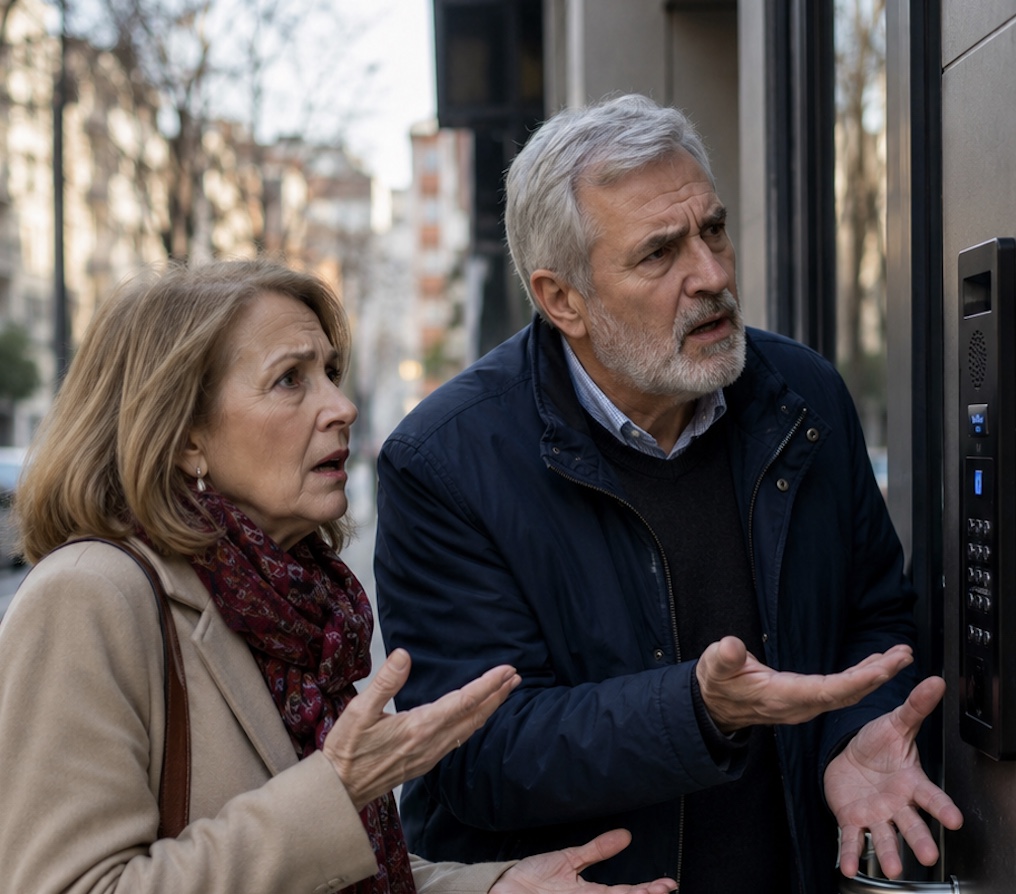
Downstairs, near the entrance, Nadezhda Valentinovna and Timur Olegovich were standing outside. Timur Olegovich held a bag with a pie inside, while his wife nervously fiddled with her handbag.
“Timur, call again!” Nadezhda Valentinovna said, nodding toward the intercom.
Timur Olegovich pressed the button.
Silence.
He pressed it again.
Still silence.
“Maybe it’s not working,” he muttered.
“It works. She just isn’t opening the door!” Nadezhda Valentinovna pulled out her phone and dialed Alisa’s number. “She’s rejecting my calls! Can you imagine? Rejecting them!”
A young woman with a dog walked past and glanced at the elderly couple. Nadezhda Valentinovna pressed her lips together.
“We’re standing here like fools. How embarrassing.”
“Maybe she really went out,” Timur Olegovich suggested, shifting the bag from one hand to the other.
“Went where? On a Sunday morning?” Nadezhda Valentinovna dialed Artur’s number. “Unavailable! My son is unavailable!”
They stood there for more than an hour.
Nadezhda Valentinovna kept ringing the intercom and calling Alisa and Artur. Timur Olegovich silently shifted from one foot to the other, staring at the locked entrance door.
“That’s it,” Nadezhda Valentinovna finally said. “We’re going home. Let her explain later what this was all about.”
“Maybe something happened to her?” Timur Olegovich said uncertainly. “Maybe she needs help?”
“What help, Timur? She’s rejecting calls! If something had happened, she wouldn’t be rejecting them!”
They got into the car and left.
Nadezhda Valentinovna complained the entire way home. Timur Olegovich remained silent, looking at the road.
Alisa had just finished the chapter when her phone vibrated again.
Artur.
This time she answered.
“Yes?”
“Alisa, what is going on?!” her husband’s voice sounded confused. “Mother keeps calling me. She says you didn’t let them in!”
“I told her I wasn’t home,” Alisa said, turning the page.
“Alisa, stop it. I know you were home. Why are you doing this?”
“Because I asked you not to have them come over,” she replied evenly. “And you didn’t hear me. As usual.”
“Alisa, they’re my parents! They wanted to see us, to talk!”
“Artur, I’m tired. I wanted to rest. I told you that on Friday.”
“So what now? You’re throwing a tantrum over one visit?”
Alisa closed the book and placed it on the table.
“Not over one visit. Over hundreds of them. Over the fact that my requests are ignored. Over the fact that my opinion doesn’t matter.”
“Alisa, let’s talk calmly…”
“Listen,” she interrupted. “Come home this evening. I’ll make dinner, and we’ll talk.”
“Great!” Artur sounded relieved. “I’m leaving now!”
“No,” Alisa said, looking out the window. “In the evening. Around seven. I need time to think.”
Artur went quiet, then asked uncertainly:
“Think about what?”
“About us,” Alisa said, and ended the call.
The day moved slowly.
Alisa cleaned the apartment, cooked, and laid Artur’s things out on the sofa in the living room. A few shirts, jeans, sneakers, a razor, and a phone charger.
The essentials.
He could collect the rest later.
At seven in the evening, a key turned in the lock.
Strange.
The key turned, but the door did not open.
Another attempt.
Again, nothing.
Artur rang the doorbell.
Alisa opened the door.
Her husband stood on the threshold with the keys in his hand, staring at the lock in confusion.
“What happened to the lock? My key doesn’t work.”
“It works,” Alisa said, stepping aside. “I just changed the cylinder.”
“Why?”
Alisa walked into the living room and pointed to the sofa with his things.
“Take them. You can collect the rest later, once we arrange it.”
Artur slowly entered and closed the door behind him. He looked at the things, then at his wife, then back at the things again.
“Alisa, what is this?”
“You don’t live here anymore.”
Her husband froze.
He opened his mouth, closed it, then blinked several times.
“Are you joking?”
“No.”
“Alisa,” Artur stepped toward her. “Because my parents came over? Seriously? You’re kicking me out because of that?”
“Not because of that,” Alisa said, sitting on the armrest of the chair. “Because you don’t hear me. You don’t hear me at all.”
“I do hear you!”
“No,” she shook her head. “You nod and say, ‘Alright, I’ll tell my parents,’ and then nothing changes. They come whenever they want, you agree to it, I get angry, we fight, you promise to fix it. And then it starts all over again.”
“Alisa, we can solve this! I really will talk to my mother. I’ll explain everything…”
“How many times have you said that?” Alisa raised her eyebrows. “Ten? Twenty? I’ve lost count.”
“But this time I…”
“Artur, enough,” she interrupted. “I’m tired. Tired of explaining the same thing again and again. Tired of being angry. Tired of feeling like a stranger in my own home.”
“Alisa,” his voice trembled. “Let’s try one more time. I’ll change. I swear!”
“Do you know what I realized this weekend?” Alisa stood and walked to the window. “When you weren’t here, I could breathe freely. For the first time in a long time. I didn’t have to justify myself to anyone, explain anything, or prove anything. I simply lived.”
“Alisa…”
“And I want to keep living like that,” she turned around. “Without constantly feeling that my opinion means nothing.”
Artur sank onto the sofa and buried his head in his hands.
“I didn’t think it was that serious.”
“You should have.”
Silence settled between them.
Artur sat staring at the floor. Alisa stood by the window with her arms crossed.
“Have you really made up your mind?” he asked quietly.
“Yes.”
“And nothing will change your decision?”
“No.”
Artur stood up and took the bag with his things. He stopped at the door.
“My mother will call you. She’ll blame you.”
“Let her call,” Alisa shrugged. “I’ll explain the same thing to her that I explained to you. Though I doubt she’ll understand.”
“She won’t,” Artur agreed. “For her, family means everyone is always together, always happy to see each other.”
“For me, family means respecting boundaries,” Alisa said, opening the door. “Apparently, we have different ideas of what family is.”
Artur stepped into the hallway and turned back.
“Can I… Can I try to change everything? Maybe you’ll give me some time?”
“How much time do you need?” Alisa asked. “Another year? Two? Five? Artur, we were married for four years. In four years, you didn’t change anything. Why should I believe you’ll change now?”
He said nothing.
“Exactly,” Alisa nodded. “Go, Artur.”
The door closed.
Alisa leaned back against it and closed her eyes.
That was it.
The end.
So why did she feel so calm?
Why were there no tears, no hysteria, no desire to take it all back?
Because she had not made this decision today. Not yesterday. Not even a week ago.
The decision had been growing inside her for months, every time Nadezhda Valentinovna and Timur Olegovich appeared at the door without calling. Every time Artur nodded and promised, but changed nothing.
On Monday, Alisa went to see Marina Sergeevna.
The lawyer listened and nodded.
“Is there any jointly owned property?”
“The apartment is mine. It was bought before the marriage,” Alisa replied. “The car is his. No loans. No children.”
“Then the divorce should be quick,” Marina Sergeevna said, writing something in her notebook. “If your husband doesn’t object, it will all be over in a month or a month and a half.”
Artur did not object.
He called several times, asking to meet and talk. Alisa agreed to meet him, but only in cafés, on neutral ground. They discussed documents, dividing belongings, and formalities.
Each time, Artur tried to bring up reconciliation.
Alisa gently but firmly stopped him.
“Artur, don’t. The decision has been made.”
Nadezhda Valentinovna called twice.
The first time, she shouted into the phone, accusing Alisa of destroying the family, of being heartless, of disrespecting her elders. Alisa listened in silence, then answered calmly:
“Nadezhda Valentinovna, if you had respected my boundaries, maybe we wouldn’t be talking about divorce now.”
“What boundaries?!” her mother-in-law gasped with outrage. “We are his parents! We have the right to see our son!”
“You do,” Alisa agreed. “But it also makes sense to warn people in advance.”
“We always did things this way! And everything was fine!”
“It was fine for you,” Alisa said, looking out the window. “Not for me.”
Nadezhda Valentinovna hung up.
The second time she called two weeks later. Her voice was quieter, almost pleading.
“Alisa, maybe you and Artur could make peace? Why divorce over such nonsense?”
“Nadezhda Valentinovna, for you it’s nonsense. For me, it isn’t.”
“But we can come to an agreement! I’ll warn you in advance!”
“It’s too late,” Alisa sighed. “I’m sorry.”
The divorce was finalized.
Alisa received the certificate and placed it in a folder with her documents. That evening, she sat on the balcony with a glass of wine and looked out over the city.
Vera called.
“How are you?”
“I’m fine,” Alisa said, taking a sip of wine. “You know, I expected it to be harder. But honestly, it feels easier.”
“I understand,” her friend sighed. “It was the same for me. When I got divorced, my first thought was, ‘Damn, this feels good.’”
“Exactly,” Alisa laughed. “It feels so good.”
Life quickly fell into place.
Alisa rearranged the furniture in the apartment, bought new pillows, and hung the paintings Artur had never liked. She signed up for yoga and started going to the theater with her friends.
On weekends, she woke up whenever she wanted and did whatever she wanted.
Nobody rang the doorbell without warning. Nobody inspected the apartment with a critical eye. Nobody turned the television up to full volume.
Silence.
Freedom.
Respect for her own space.
One day, three months after the divorce, Alisa ran into Artur at a shopping mall. He was walking with some girl and laughing. When he saw his ex-wife, he froze. The girl tugged at his hand.
Alisa nodded and smiled.
Artur nodded back, awkward and embarrassed.
They walked in opposite directions.
That evening, Artur wrote:
“Sorry about today. I didn’t want it to be awkward.”
Alisa replied:
“It’s alright. Be happy.”
And she truly meant it.
She wanted him to be happy. Without anger, without resentment.
Just not with her.
With someone who would not object to unexpected visits from in-laws. With someone for whom it would not matter.
But it mattered to Alisa.
And now she could live the way she wanted.
Without compromises. Without explanations. Without guilt for protecting her boundaries.
She sat on the balcony again, looking out at the city.
A glass of wine. A book on her lap. Silence all around.
And it felt so good.
Simply, wonderfully good.