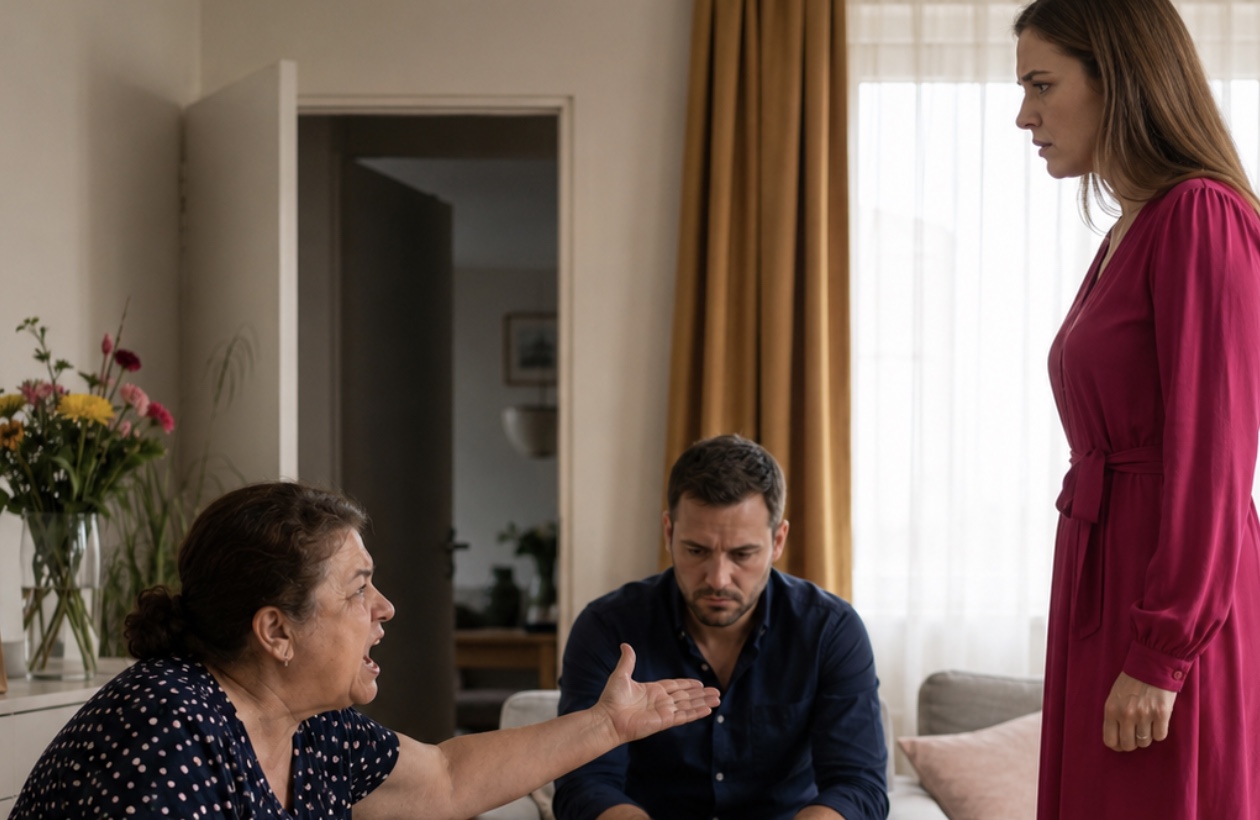
“Do you even understand that you’re nobody?” Nina Borisovna’s voice cracked through the apartment like a window slamming shut before a storm. “You came here from your little village, found yourself a comfortable place to live, and now you’ve decided to have a baby too?”
Vera stood by the window, looking down into the courtyard.
Two boys were kicking a ball across the sun-scorched pavement. One of them stumbled and fell, but immediately jumped back up and laughed.
That was the secret, Vera thought. You had to know how to fall and still laugh afterward.
She remembered the moment.
Nina Borisovna had arrived without warning. She had simply rung the intercom, and Anton—her son and Vera’s husband—had pressed the button without even thinking.
As always.
It was almost a reflex. His mother rang, and he let her in.
He was twenty-nine years old, yet nothing had changed.
His mother stormed into the apartment with the confidence of someone who believed the place belonged to her. She wore a loose linen dress with a coffee stain near the hem. Her hair had been pinned up carelessly, and three strands of heavy beads knocked against each other whenever she moved.
Nina Borisovna never looked particularly tidy. It was part of her image: she was above appearances, too busy for ordinary rules, too important to care.
No one was entirely sure what made her so important, apart from her unquestioned right to voice an opinion about everything.
“Anton, are you listening to me?”
Anton sat in the armchair, watching his mother with the expression of a man who felt uncomfortable but had no intention of intervening.
He gave a slight nod.
Vera knew that nod by heart.
Whatever his mother said, it meant the same thing:
You’re right, Mom.
Vera had discovered the pregnancy three days earlier.
First there had been one test, then a second.
Afterward, she had sat in the bathroom for a long time, listening to water drip from the faucet. She and Anton had been meaning to call a plumber for two months.
She had thought: This is good. This is right.
Eight weeks.
She had already scheduled an appointment at the local maternity clinic for the following week.
She told Anton that same evening. Carefully. Gently. With hope that the moment might become something real and meaningful between them.
He hugged her and said, “That’s wonderful.”
An hour later, he called his mother.
He never explained why.
Perhaps he simply could not stop himself. Maybe that was how he had been built.
Nina Borisovna arrived the next morning.
“Here’s what’s going to happen,” she announced, sitting on the sofa without being invited and crossing one leg over the other. “There will be no baby now. You don’t have the proper conditions, you don’t have enough money, and besides, you’ll have a child when I say you can.”
Vera slowly turned away from the window.
“Excuse me?”
“You heard me.” Nina Borisovna pulled out her phone and began scrolling through it as though the matter had already been settled. “Anton is going through an important period at work. He can’t afford distractions. A child is a burden. Maybe in two years. Then we’ll see.”
“Mom is right,” Anton said quietly from the armchair.
Vera looked at her husband.
He avoided her eyes and stared instead at the corner where a floor lamp stood with a broken bulb. They had been meaning to replace that too, for almost three weeks.
Suddenly, the apartment felt unbearably small.
They had lived there for two years. Vera had brought in her books, placed pots of geraniums on the windowsill and hung photographs from Lake Baikal in the hallway.
Now everything looked temporary, as if her belongings had been arranged inside someone else’s home.
Nina Borisovna found the number she had been searching for.
“I’m going to call your doctor,” she said, as casually as though she were ordering groceries. “I know someone at that clinic. She’ll explain everything properly.”
“What doctor?”
Vera’s voice became calm, almost detached.
That was a dangerous sign, though Nina Borisovna had never learned to recognize it.
“What do you mean, what doctor? The maternity clinic on Lesnaya Street. That’s where you made your appointment, isn’t it? Anton told me.”
She pressed the call button.
“Hello, Lyudochka? It’s Nina. Do you remember me?”
Vera left the room.
She did not slam the door. She said nothing.
She went into the kitchen, poured herself a glass of filtered water and drank it slowly while staring at the wall.
Their shared calendar hung there.
Anton had circled football matches.
Vera had marked the days she needed to take her vitamins. She had started them in April, while they were still preparing for the possibility of a baby.
From the living room, she could hear her mother-in-law’s confident, businesslike voice.
“You see, Lyudochka, we have a situation here…”
Anton remained silent.
Of course he did.
Vera took out her phone and opened her notes.
There was already a list there. She had written it the previous evening, without any particular reason. Just in case.
The address of a private clinic in the city center.
The name of a doctor recommended by a colleague.
The number of a legal advice service. She was not sure why she had saved it, but she had.
The address of the nearest government services office.
A woman who prepares herself is not the same woman as one who is taken by surprise.
From the living room came Nina Borisovna’s voice again.
“You’ll have a baby when I tell you to!”
Apparently, she was repeating the phrase for the benefit of the woman on the phone, pleased with it as though it were a brilliant saying of her own invention.
Vera closed the notes and wrote a message.
Not to a friend.
To the doctor at the private clinic.
“Good afternoon. Would it be possible to schedule an appointment for this afternoon?”
A reply came one minute later.
“Yes. I have an opening at 4:30.”
Outside the kitchen window, the linden trees rustled in the heat.
Summer hung over the city, heavy and still, carrying the smell of hot pavement and, somewhere far away, freshly cut grass.
Vera put her phone away, returned to the living room and stood against the wall.
Straight-backed.
Calm.
Her arms resting at her sides.
Nina Borisovna was still speaking on the phone.
Anton was now staring at the ceiling.
“Anton,” Vera said quietly. “I need to speak with you. Without your mother.”
For a second, Nina Borisovna stopped talking and shot her a sharp glance—the kind of look she used to silence people.
“Now is not the time,” she answered for her son.
“I asked my husband,” Vera said.
Anton looked from his wife to his mother.
His mother.
His wife.
His mother.
Nina Borisovna slowly lowered the phone from her ear.
“What did you say?”
“I said exactly what you heard.”
It was a small moment.
Almost nothing.
Yet something shifted inside it, like the first pebble slipping loose before a landslide no one else had noticed yet.
Nina Borisovna sensed it. Vera saw it in the way her eyes narrowed.
Anton did not.
He was looking at the corner again, at the lamp with the broken bulb.
Vera, meanwhile, was thinking about 4:30.
About the doctor.
About the private clinic in the city center, where she would arrive alone, without her husband and without her mother-in-law.
Just a woman in a summer dress, carrying a shoulder bag, riding in an air-conditioned taxi.
And she was thinking that the list in her phone was only the beginning.
Nina Borisovna placed her phone back into her bag with the slow dignity of someone deeply offended.
Then she stood.
That was when the real scene began.
“How dare you behave like this?” Her voice rose instantly, without warning, as though it had been boiling inside her and had finally found a way out. “I’m speaking to her, and she tries to silence me! Anton, do you see what is happening?”
Anton saw everything.
He only pretended he did not.
“Mom, please don’t shout.”
“Shout?” Nina Borisovna spun toward him. Her face had turned red and damp. “You think I’m shouting? I haven’t even started! This woman you brought into the family, this woman I helped, by the way—I chose the curtains, I recommended the refrigerator—and now she thinks she can order me around?”
The curtains were a separate story.
Nina Borisovna had arrived one day with fabric samples no one had asked for. In the end, something dark burgundy had been hung in the bedroom, looking more like a theater curtain than window decor.
For a month, Vera had looked at those curtains and wondered how she could replace them without causing offense.
She never did.
Anton had said, “Mom liked them. There’s no reason to upset her.”
“Nina Borisovna,” Vera said.
Her voice was calm. Almost tired.
“You were speaking on the phone with my doctor. Not yours. Mine. Do you understand that?”
“I’m solving problems! I’m trying to help you!”
“I never asked you to.”
Something about that short sentence—without anger, without shouting—hurt Nina Borisovna more deeply than any insult could have.
She fell silent for a second.
Then, apparently deciding that the best defense was another attack, she changed her approach.
“Fine.” She sat down again, straight-backed, like a judge preparing to announce a sentence. “I’ll tell you the truth you clearly refuse to hear. You’re not ready to have a child. You have no experience and no support from a proper family. How could you, when you grew up without a father? A child is a responsibility. It isn’t a toy.”
Vera felt something tighten inside her.
Not fear.
Anger.
Quiet, cold and precise.
“Anton,” she said, without turning toward his mother. “Tell her this conversation is over.”
Anton opened his mouth.
“Well… Mom, maybe that’s enough.”
“Enough?” Nina Borisovna jumped to her feet. Her beads clattered together. “You’ve had enough? I gave you thirty years of my life! I sacrificed everything for you, and now you tell me that’s enough? Because of her?”
“I’m leaving,” Vera said.
She went into the bedroom and picked up her phone from the bedside table.
Then she took her documents from the top drawer. She had always kept them together, just in case.
She put on her sandals in the hallway.
Nina Borisovna followed her, talking without pause.
Vera was ungrateful.
Women like her were everywhere.
Anton would regret this.
Nina Borisovna had warned him from the beginning.
Foreign blood would always remain foreign.
Foreign blood.
Vera fastened the strap of her sandal and straightened.
“You are speaking about my child now,” she said quietly. “Remember that.”
The front door slammed behind her.
Outside, the heat was oppressive.
It was the kind of Moscow summer when the air did not move and the entire city smelled overheated.
Vera walked to a bench beneath a linden tree, sat down and took out her phone.
Her hands were not trembling.
That surprised her.
The taxi arrived four minutes later.
She gave the driver the clinic’s address and spent the whole ride looking out of the window.
She watched people eating ice cream.
Children playing in the fountain outside a shopping center.
Cars waiting at intersections.
Life had not stopped.
It had not disappeared.
At the clinic, it was cool and quiet.
The doctor was a middle-aged woman with a tired but attentive face. She asked questions methodically, without unnecessary comments.
She listened.
She made notes.
At the end, she said, “Eight weeks. Everything looks fine. Here are your laboratory referrals. And this”—she handed Vera another page—“is a list of the things you need to know at this stage.”
Vera folded the papers and placed them in her bag.
She paid at reception and stepped back outside.
Her phone was silent.
Anton had not written once.
Neither had Nina Borisovna.
Perhaps they were still sitting in the apartment, discussing everything that was wrong with Vera.
Perhaps Nina Borisovna was crying.
She knew how to cry at exactly the right moment. It was a skill she had perfected.
Vera walked into a small café on the next street. It had wooden tables and smelled of coffee.
She ordered berry juice and sat by the window, watching people pass.
She thought.
She thought about the list in her phone, the one she had created the day before.
It needed one more item.
Until now, that item had seemed unnecessary, premature and even a little frightening.
But after the words about “foreign blood,” after Anton’s nod—the nod that always meant, You’re right, Mom, no matter what she said—it no longer frightened her.
She opened her notes and added a final line.
“Consult a family lawyer.”
Then she raised her eyes.
Outside, a young woman in a light dress was pushing a stroller along the pavement. She wore earphones and adjusted the stroller’s canopy as she walked.
She seemed to be humming to herself.
She smiled at something only she could see.
She was simply walking.
Simply smiling.
Simply living.
Vera finished her drink.
Anton finally wrote at half past six.
“Where are you? Mom is upset.”
Vera read the message.
Then she put the phone away and asked for the bill.
When she returned home, Nina Borisovna was gone.
The apartment was silent.
Anton sat in the kitchen with the wounded expression of someone who believed he had been treated unfairly.
“Why did you have to behave like that with her?” he asked.
Vera placed her bag on a chair and looked at him carefully, as if she were seeing him under a different light for the first time.
“Anton,” she said, “we need to have a serious conversation. But not now.”
“When?”
“When you are ready to listen instead of agreeing with your mother.”
She went into the bedroom and closed the door halfway.
Then she lay down on top of the bedspread and shut her eyes.
In the next room, Anton turned on the television, using the familiar noise like a life preserver.
Vera lay there and thought about the next morning.
She would call the number she had written at the bottom of her list.
A lawyer was not a catastrophe.
It was simply information.
And information meant strength.
Somewhere in the courtyard, boys were still kicking a ball.
Perhaps they were different boys.
Perhaps it was simply the same life, a few hours later.
Vera rested one hand gently against her stomach.
“Everything is all right,” she whispered.
Perhaps she was speaking to herself.
Perhaps not only to herself.
The television murmured through the wall.
Anton did not come to her.
The next morning began with Anton leaving for work without saying a word.
He did not kiss her.
He did not say goodbye.
The front door simply closed, and silence filled the apartment.
Vera listened to the elevator descend and heard a car start outside.
Then she got up, washed her face and made ginger tea. The doctor had told her the day before that it was safe.
At nine o’clock, she called the number from her list.
The legal consultation office was located inside a business center on Bolshaya Polyanka.
It had a glass facade, a cool lobby and the scent of fresh renovation.
The lawyer was a man of about forty-five, lean and precise, like a set of pharmacy scales.
His name was Pavel Igorevich.
He did not ask unnecessary questions.
He did not gasp or offer sympathy.
He simply listened, occasionally writing something down.
Vera told him everything.
The pregnancy.
The call to the doctor.
The words, “You’ll have a baby when I tell you to.”
Anton’s nod.
Pavel Igorevich nodded too, but not in the way Anton did.
His nod was professional and deliberate.
“A third party interfering in a patient’s medical decisions may constitute a violation if the doctor actually took any action based on your mother-in-law’s call. Do you know exactly what she told this Lyudmila at the clinic?”
“No. But I can find out.”
“Do that. It could be important.”
He folded his hands on the desk.
“Now, regarding the apartment. You said it belongs to your husband?”
“Yes. He bought it before we were married. He moved in about a year before the wedding.”
“Then it is not considered jointly acquired marital property. You need to understand that clearly.”
Vera understood.
She had always understood, but she had avoided thinking about it.
People did not like thinking about disaster while life remained bearable.
She left the consultation at half past eleven.
For a moment, she stood on the pavement, squinting in the sunlight.
Then she took out her phone and wrote to Anton.
“We need to meet at home this evening. It’s important.”
He replied an hour later.
“Ok.”
One syllable.
Not “All right.”
Not “What happened?”
Just “Ok.”
Vera put the phone away and headed toward the center—not home, but toward a small café on Pyatnitskaya Street where she used to spend time before her marriage.
They served cold lemonade there, and quiet jazz played in the background.
She sat by the window, drank coffee and wrote.
Not another list this time.
A letter to herself.
She had developed the habit at university. Whenever everything became tangled, she would write as though explaining the situation to a stranger.
What was happening.
What she wanted.
What she never wanted to experience again.
She wrote three pages.
Read them.
Then deleted them.
She already knew the most important part.
Anton returned home at eight.
Vera had prepared dinner, not because she felt obligated to, but because she needed something to occupy her hands.
Buckwheat with vegetables.
Simple and quick.
They sat at the table.
Anton ate in silence, then pushed his plate away.
“Well?” he said. “Go ahead.”
Vera looked at him.
“Anton, I need you to understand one thing. I am having this child. It is not open for discussion. Not with you, and not with your mother. It is my decision, and I have already made it.”
He was silent for a while.
“I’m not against it, really.”
“You nodded when she spoke.”
“Well, I just… She gets upset if people disagree with her.”
“And I don’t?” Vera asked quietly. “I don’t get upset?”
Anton rubbed his forehead and grimaced, not from pain but from discomfort.
“Vera, you know what she’s like. No one can change her.”
“I’m not trying to change her. I’m trying to live my own life.”
She paused.
“But I can’t keep living like this. Your mother calls my doctor. You sit there and nod. I have to leave my own home because someone is shouting in my face.”
“She wasn’t shouting.”
“Anton.”
He fell silent.
“I spoke to a lawyer,” Vera said.
That made him raise his head.
For the first time, he truly looked at her.
“Why?”
“So I would understand how my life works legally.”
Her voice remained even.
“I don’t want a divorce. I want us to have a family. But a family is you, me and our child. It is not you, me, your mother and her opinion about when I’m allowed to have a baby.”
Anton was silent for a long time.
The linden trees rustled outside.
Somewhere in the distance, a car horn sounded.
“She’ll be hurt,” he finally said.
“She has the right to be.”
He stood, carried his plate to the sink and remained there with his back to her.
Vera did not rush him.
“I don’t know how to speak to her,” he said toward the window. “I never have. She always pushes until she gets what she wants.”
“I know.”
“Aren’t you angry?”
“I am. But that isn’t the most important thing right now.”
He turned around.
He looked confused, not like an adult man but like a boy who had just been shown something obvious and did not know what to do with it.
“What do you want from me?”
“I want you beside me. Not standing between me and your mother. Beside me.”
Nina Borisovna called the next morning at ten, while Vera was in the shower.
Anton answered.
Through the bathroom door, Vera heard fragments of the conversation.
First his mother’s voice.
Then Anton’s, growing quieter and quieter.
When Vera came out wrapped in a towel, Anton was standing by the window, holding the phone.
The call had ended.
“What did she say?”
“She said you’re turning me against her. That I’m under your control. That she’s coming over to speak to you herself.”
“And what did you say?”
Anton looked at the phone, then at Vera.
“I told her not to come.”
Vera stopped.
“For the first time?”
“For the first time.”
They looked at each other.
There was something almost amusing about it.
And something extremely serious.
It was probably the first time in all three years they had been together.
“She’ll call again,” Anton said.
“Of course.”
“And she’ll come anyway.”
“Probably.”
“What do we do then?”
Vera walked to the window and stood beside him.
The courtyard below was full of summer noise—children, bicycles and someone’s dog chasing a red ball.
“Then you say no again,” Vera said. “And you say it again the next day. And again a week later. It won’t change quickly. But there is no other way.”
Anton was quiet.
Then he nodded.
This time, it was different from the nod he had given in the armchair.
Slower.
Thoughtful.
“I’ll try.”
“I know.”
She did not say that she believed him.
It was too early for that.
But she did not delete the list from her phone.
That evening, after Anton had fallen asleep, she read it again.
Then she added one more point.
The shortest and most important one.
“Watch.”
Do not rush.
Do not make conclusions too soon.
Pay attention to what happens next.
The baby was growing.
That was what mattered most.
Everything else could wait.
Nina Borisovna arrived three days later.
She rang the intercom.
Anton did not let her in.
She rang again.
Then she sent a message.
“I’m downstairs. We need to talk.”
Anton showed Vera the phone.
She shrugged.
It was his decision.
He wrote back:
“Mom, now is not a good time. Let’s meet next week and arrange it in advance.”
There was no response for ten minutes.
Then one appeared.
“Fine.”
Vera sat by the window and watched Nina Borisovna emerge from the building.
She moved slowly and heavily, her handbag hanging from one elbow.
For a second, she stopped and looked upward, as though she knew someone was watching.
Then she walked toward the bus stop.
For the first time in three years, she had left without getting what she wanted.
The meeting took place the following week.
They met in a café, not in the apartment.
Anton insisted on neutral ground, which was another first.
Nina Borisovna arrived looking prepared for war.
But there was no war.
Anton spoke briefly and without apologizing.
They were expecting a child.
They would make decisions together.
Visits would be arranged in advance.
Nina Borisovna stayed silent longer than usual.
Then she said, “I only wanted what was best.”
“We know,” Anton replied.
Vera added nothing.
There was no need.
At the end of August, Vera stood inside a children’s store, choosing bumpers for the crib.
She was alone.
Anton was at work.
She ran her fingers over the fabric, compared the colors and imagined what the room would look like six months later.
Her phone remained silent.
No one called with advice.
No one explained what she was supposed to do.
She chose for herself.
Pale green.
Calm and soft.
Like the linden trees in the courtyard.
At the register, Vera smiled.
For no obvious reason.
Or perhaps for a reason she no longer needed to explain to anyone.