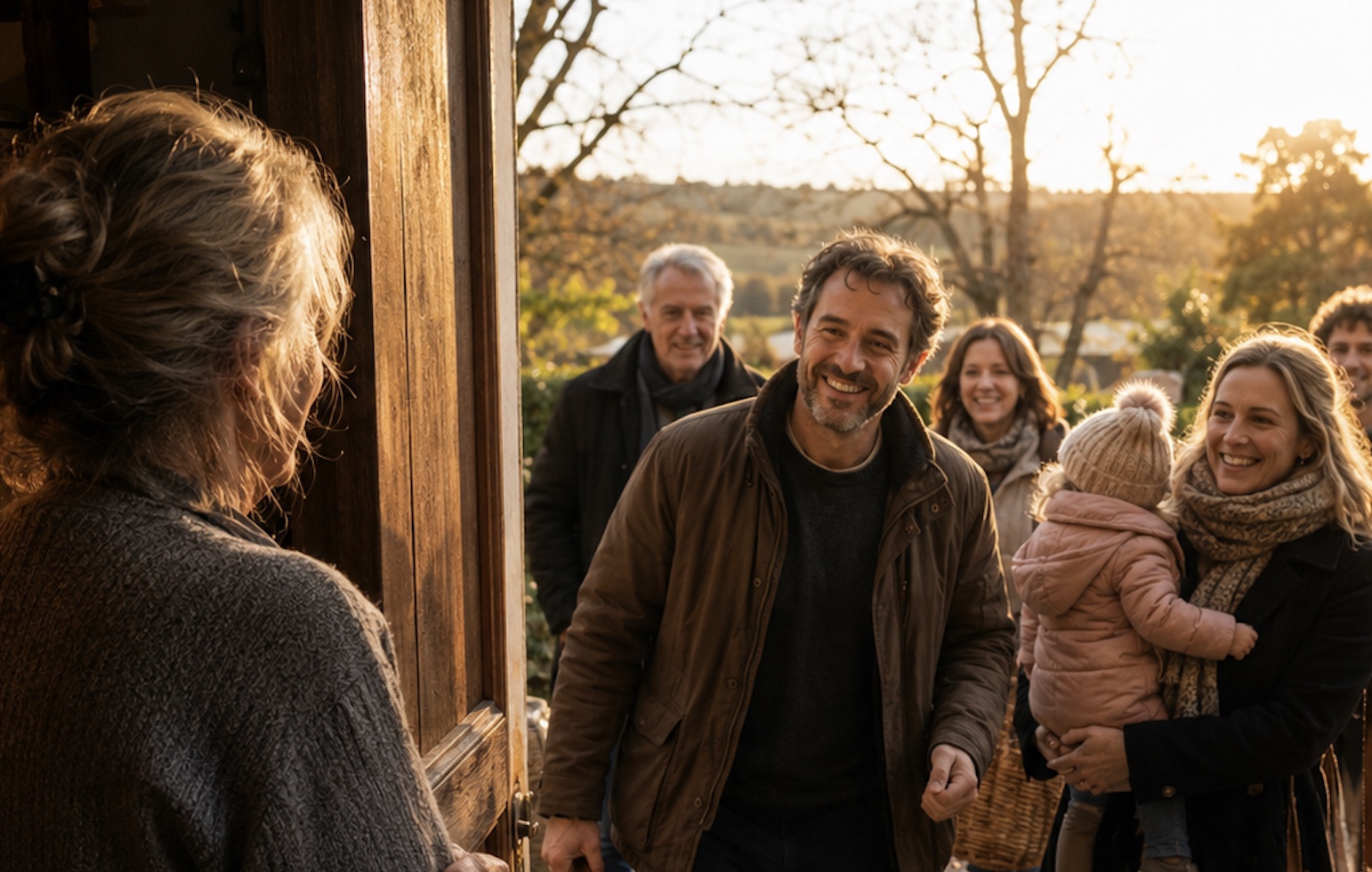
— Mom, Anya and I are going into town. You’ll watch the kids, okay?
Alexey tossed the words over his shoulder while pulling on his jacket in the hallway. He did not even turn around. The front door slammed, and a moment later gravel crunched under the car wheels outside.
Tamara Ivanovna stood by the stove with a spatula in her hand. Another pancake was browning in the pan. Behind her, a pot of borscht was cooling on the table, crowded by bowls of chopped salads. From the living room came a crash of noise — the grandchildren were jumping on the sofa, while cartoons blared from the television at full volume. In the sink towered a mountain of dishes from the previous evening’s dinner: plates, mugs, and a frying pan with dried bits of meat stuck to it.
She leaned wearily against the countertop and closed her eyes for a second. Her lower back ached, her legs throbbed — she had been on her feet since six in the morning, trying to get everything done. Then a sharp clatter came from the next room. Something had fallen and broken.
Tamara Ivanovna took a deep breath and reached for the frying pan again.
She and Viktor had built this house together thirty years earlier. Tamara Ivanovna still remembered how her husband brought the first truckload of bricks, how she mixed the mortar herself, how they raised the rafters in the autumn rain. Back then, Viktor used to say:
“The house has to be big, Toma. Big enough for the children to come, for the grandchildren to run around. Big enough for everyone.”
There was enough room. But Viktor had been gone for four years now. Since then, Tamara Ivanovna had lived alone in that spacious house with five rooms, a large kitchen, and a plot of land that stretched across half an acre.
The children came. Her son Alexey came with his wife Irina and their two boys, seven and four. Her daughter Marina came with her husband Oleg and their little girl Polina, who had recently turned three. They came often. At first, Tamara Ivanovna was happy about every visit. The house came alive, filled with voices, and it seemed to her that everything was as it should be — exactly the way it had once been imagined.
She often remembered her own mother, Zinaida Petrovna. She, too, had kept her house open. For every holiday, she gathered the family, baked pies, and set a long table in the yard. But there was one important difference.
“Come on, girls, peel the potatoes!” her mother would command. “Tamara, bring water. Lyudka, hang the laundry. No sitting around doing nothing.”
And she and her sister Lyudmila would run off without asking questions. They carried water from the pump, peeled vegetables, washed floors, and looked after the younger cousins. It was as natural as breathing. No one saw it as heroic, no one said thank you — that was simply how people lived.
Tamara Ivanovna did not notice exactly when her children’s visits became different. It happened gradually. At first, they came for the day and brought something for the table. They helped with the dishes. Then they began staying for the weekend. Then for long weekends, arriving on Friday. Once, during dinner, Irina said absently while looking at her phone:
“It’s so nice here, Tamara Ivanovna. You can really rest your soul.”
Irina rested. But after every weekend like that, Tamara Ivanovna felt as if she had unloaded a freight car.
Her back had started hurting badly the previous autumn. It did not merely ache — it shot through her so sharply that it stole her breath. After every “family visit,” Tamara Ivanovna needed three days to recover. She lay down, took pills, and bent with difficulty just to load the washing machine.
She had developed her own ritual. In the evening, when the children and grandchildren had finally fallen asleep, Tamara Ivanovna would go into the kitchen and begin washing the dishes. Quietly, so as not to wake anyone. Plate after plate. Pot after pot. Outside the window, darkness pressed against the glass, and only the lantern by the gate swayed faintly. It was midnight, and she was still standing at the sink while hot water ran over her tired hands.
In the morning, while the children were still sleeping or slowly drinking coffee in the living room, she went to the store. Two heavy bags — milk, bread, meat, vegetables, sweets for the grandchildren. Fifteen minutes there, fifteen minutes back, carrying heavy groceries along an uneven country road.
And on Monday, after they left, came the laundry. Four sets of bed linen, towels, children’s clothes forgotten in the rush. She hung it all outside in the yard, and the sheets snapped in the wind like white flags.
“Why don’t they see it?” she thought as she clipped a pillowcase to the line. “Do they really not notice?”
Her friend Galina Sergeevna, whom she had known since school, came over one Wednesday for tea. She looked at Tamara Ivanovna — at the dark circles under her eyes, at the way she rubbed her lower back — and said bluntly, the way only Galina could:
“Toma, you trained them yourself. They aren’t bad people. They just don’t know things can be different. You’ve never asked them for anything.”
Tamara Ivanovna wanted to object, but the words caught in her throat. Because Galina was right. Not once — not a single time — had she told her children, “This is hard for me.” She had never asked them to help with the dishes, to go to the store, to clean up after themselves. She was afraid. Afraid of becoming a burden. Afraid of hearing irritation in their voices. Afraid they would stop coming.
They all arrived at once for the long May holidays. Both families. Five adults and three children. The house began to buzz like a beehive.
Tamara Ivanovna started cooking on Friday morning. Alexey poked his head into the kitchen, sniffed the air, and said:
“Mom, make cutlets like you used to. And mashed potatoes. Kirill doesn’t eat fish, so make him something separate. And Polina only eats macaroni with cheese.”
Three different dishes. For eight people. She nodded.
By lunchtime, the grandchildren were out of control. Seven-year-old Denis raced through the living room with his younger brother. A glass of cherry juice tipped over onto the pale carpet, and a dark red stain spread instantly. Marina looked up from her phone and called out:
“Mom, you’ll clean it later, right? I think you need baking soda or something.”
Tamara Ivanovna said nothing. She cleaned the carpet, returned to the kitchen, and picked up whimpering Polina because Oleg had “stepped out for five minutes to take a work call.” With one arm, she rocked her granddaughter; with the other, she stirred the sauce.
By six in the evening, pain seized her back so sharply that she gasped and sank onto the stool, folding in half. The pan of cutlets remained on the stove. Tamara Ivanovna gripped the edge of the table and could neither straighten up nor stand.
For three minutes, no one came. Then Marina appeared in the doorway to ask when dinner would be ready.
“Mom? Mom, what’s wrong?”
Alexey rushed in. Everyone became alarmed, fussing around her. They brought a pillow and began talking about calling an ambulance. Tamara Ivanovna raised her hand to stop them.
“No ambulance.” Her voice was quiet, but firm. “I can’t do this anymore.”
The kitchen fell silent. Even the television in the living room seemed to go quiet. Marina and Alexey looked at each other — confused, almost guilty. No one knew what to say.
They helped her into the living room and settled her on the sofa, placing a pillow behind her lower back. The grandchildren were taken to the far room. Irina brought tea, but Tamara Ivanovna did not touch the cup.
“Sit down,” she said softly. “All of you, sit down. I want to say something.”
Alexey lowered himself into an armchair. Marina sat beside her on the sofa. Oleg and Irina remained standing near the doorway, unsure what to do with their hands.
“I’m happy when you come. Truly happy. The house is empty without you.” She paused. “But I can’t manage alone anymore. I’m sixty-three. My back hurts, my knees hurt, and after your visits I don’t sleep at night. I wash dishes at midnight because I feel ashamed leaving them until morning. I carry groceries from the store while you drink coffee. And I never once told you any of this — that is partly my fault too.”
Marina opened her mouth, but her mother raised her hand.
“My mother, your Grandma Zina, gathered everyone too. But Lyuda and I were peeling potatoes, carrying water, and washing floors from the age of ten. Nobody thought it was anything special. And I suppose I protected you from all of that — and it only made things worse.”
Alexey rubbed his face with both hands and let out a heavy breath. Marina looked at her mother — at her worn hands, at the way she instinctively held her lower back — and her eyes filled with tears.
“Mom, why didn’t you tell us earlier?” she asked quietly.
“I was afraid. Afraid you’d be offended. Afraid you’d stop coming.”
The silence lasted a long time. Then Alexey stood up and quietly went into the kitchen. Water began running in the sink — he had started washing the dishes. Marina got up after him, checked on the children, and began putting them to bed. Oleg took out the trash — three bags that had been sitting by the back door since the day before.
No one made any grand speeches. But the air in the house changed — heavy and clean at the same time, the way it feels after a storm.
Saturday morning began in an unfamiliar way. Tamara Ivanovna woke to sounds coming from the kitchen — plates clinking, oil sizzling, the smell of fried eggs drifting through the house. She came out in her robe and stopped in the doorway.
Irina was standing at the stove, flipping pancakes. Marina was chopping vegetables for a salad. Alexey was pouring juice into glasses.
“Sit down, Mom,” he said without turning around. “Today it’s our turn.”
Their movements were awkward. Irina dropped the spatula twice. Marina could not find the salt. Alexey put the plates on the wrong shelf. But they were trying, and Tamara Ivanovna quietly sat down at the table. For the first time in many months, she did not feel the need to jump up and take over.
After breakfast, Oleg took all three grandchildren down to the river. Alexey changed into old clothes and went to fix the fence at the far end of the property — three pickets had come loose back in winter, and every time Tamara Ivanovna walked past them, she felt guilty that she had not gotten around to repairing them.
She carried tea out onto the veranda and sat in the wicker chair. She simply sat. She did not cook, did not wash, did not do laundry, did not watch the children. The linden tree rustled above her head, the tea cooled in her cup, and from the river came the distant shrieks of her grandchildren.
Anxiety still sat inside her, pricking somewhere beneath her ribs like a thin needle. “Maybe they’re hurt. Maybe now they’ll come less often. Maybe I shouldn’t have said anything.” But next to that anxiety, something new appeared — lightness. As if she had been carrying a heavy sack for years and had finally set it down.
They came again three weeks later, on an ordinary Saturday, for no special reason.
Alexey entered the house first, carrying two stuffed shopping bags.
“Mom, I bought meat and vegetables. Irina says she’ll make pilaf.”
Marina arrived a little later. She placed her bag on the porch and immediately asked:
“Mom, should I make up the beds in the far room? We’ll take care of it ourselves.”
Without waiting to be asked, Oleg went to mow the grass by the fence. Irina took over the kitchen and gently but firmly sent her mother-in-law away.
“Tamara Ivanovna, go rest. I can manage.”
It was not perfect. Irina oversalted the pilaf a little, the children still scattered toys all over the house, and Marina, out of habit, forgot to wash her cup. But there was a difference — and Tamara Ivanovna felt it.
That evening, she went out into the garden. Behind her, on the veranda, they were setting the table. Alexey arranged the plates, Marina carried a salad bowl, the grandchildren got under everyone’s feet, and Oleg commanded sternly, “All right, where are the spoons? Who took the spoons?”
Tamara Ivanovna looked at them and thought that sometimes you simply have to dare to say aloud what has been building up for a long time. Not to offend. Not to accuse. But for the sake of truth.
Because family is not when one person carries everything alone while the others fail to notice.
Family is when they do notice.