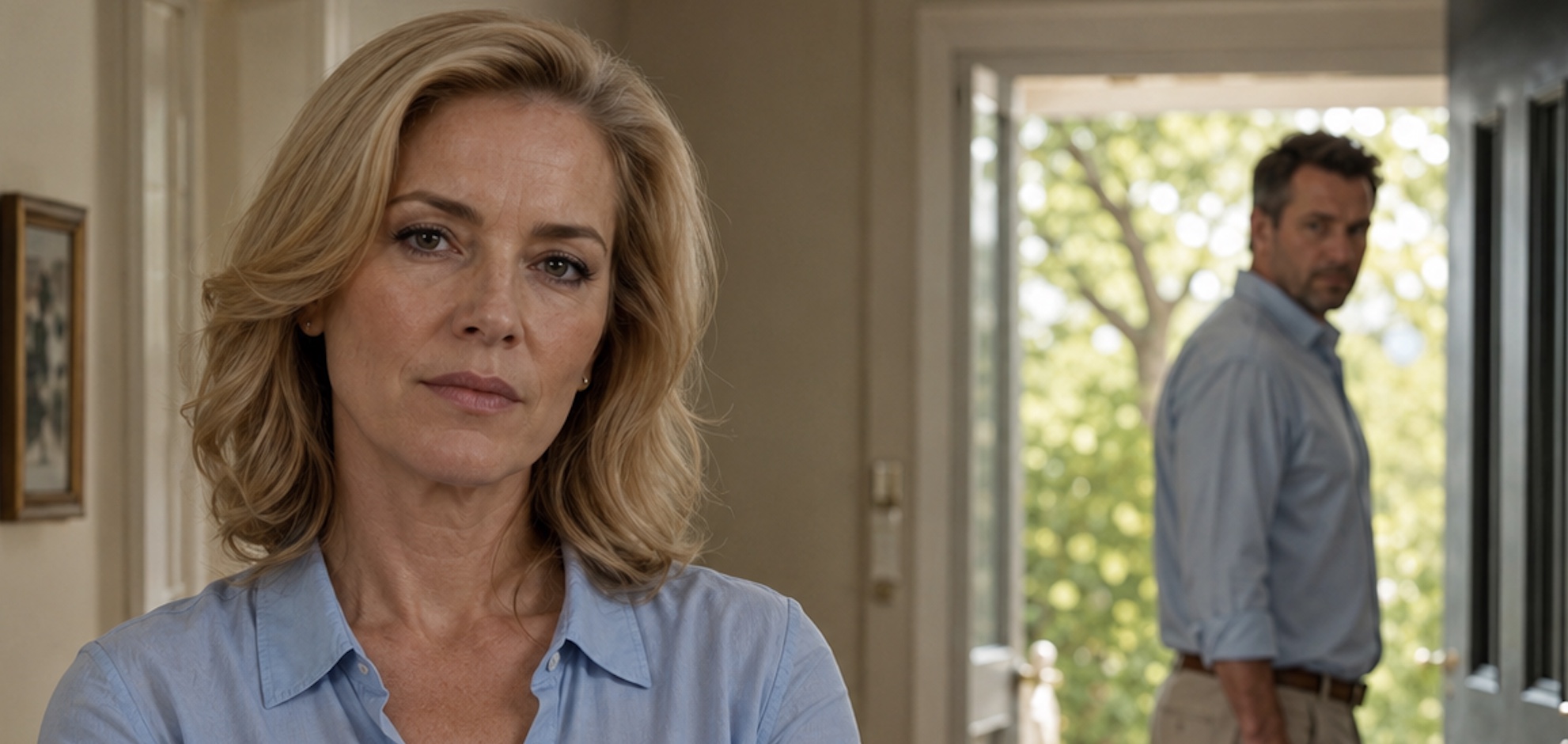
“Changed the lock, did you? And where are Mom and I supposed to live now?!” Roma kicked the suitcase, unable to believe that his wife had actually thrown him out.
His voice trembled, rising into a strained pitch, while his face twisted with genuine, almost childlike bewilderment. He truly did not understand. And that complete lack of understanding was the final note that convinced Katya she had made the right decision. She stood on the other side of the door, feeling the tension of the past months finally drain out of her, replaced by a ringing emptiness and a long-awaited calm.
But before she reached this moment, she had endured a long, exhausting marathon of psychological pressure disguised as care, love, and family duty.
It had all begun four months earlier, when Tamara Petrovna, Roma’s mother, first brought up her “temporary difficulties.” She sat across from Katya with her hands folded neatly in her lap, looking at her daughter-in-law with gentle sadness and endless motherly devotion.
“Katya, my dear girl, I understand that young people need their own space,” her mother-in-law said softly, her voice smooth and velvet-like. “I would never dare to inconvenience you. But the situation is impossible. The contractors let me down, the renovation has stopped, and with my allergies, living among concrete dust is unbearable. I’ll only stay for a couple of months, just until they finish the rough work. I’ll be quiet as a mouse. You won’t even notice me.”
Roma sat beside his mother, looking at Katya with pleading eyes. His expression carried a silent accusation: surely she would not refuse the dearest person in his life during a difficult time?
Katya had closed her eyes for a moment, tired beyond words. She was working herself to the bone, carrying the mortgage payments for the apartment she had bought before she even met her husband. Roma earned less, but Katya had never reproached him for it. She sincerely believed that marriage was not about petty calculations, but about support and understanding. And now, looking at her husband’s begging face, she simply could not find the strength to say no. Refusing felt like betraying the family.
“Of course, you can stay,” she answered, suppressing the dull resistance rising inside her. “We have a spare room.”
She did not know that in that very moment, she had willingly let a destructive storm into her life — one that would slowly, day by day, tear down every personal boundary she had.
The promise to be “quiet as a mouse” vanished by the third day. Tamara Petrovna had an extraordinary talent for filling every inch of available space — both physical and emotional. She never screamed. She never raised her voice. Her weapon was care: sticky, suffocating, and completely uncompromising.
“Katya dear, you came home after midnight again,” her mother-in-law would say sorrowfully, meeting her in the hallway. “How can you torture yourself like this? A woman is not supposed to be a workhorse. A woman must preserve her energy for the warmth of the home. Roma misses you. He needs a woman’s affection, and you come home and collapse from exhaustion. I only want what’s best for you. A family falls apart when a wife forgets her true purpose.”
Katya tried to defend herself. She explained that her project was at an important stage, that her income allowed both of them to live without constantly worrying about money. But every logical argument shattered against the impenetrable wall of “motherly wisdom.”
“Money is dust, my dear girl,” Tamara Petrovna would say with a condescending smile. “Today it’s here, tomorrow it’s gone. But health and a man’s attention can be lost forever. I can see how Roma is suffering. He doesn’t need your projects. He needs a loving wife. I am trying to help you save your marriage before it is too late.”
In these conversations, Roma always played the peacemaker — though his version of peacekeeping was strangely one-sided. Whenever Katya, unable to bear another round of moral lectures, tried to speak to her husband privately, he immediately became defensive.
“Katya, why are you getting worked up over nothing?” he would ask, genuinely annoyed, frowning at her. “Mom has lived a whole life. She’s just sharing her experience. She has no one but us. She pours her soul into this family. She cares about us. Is it really so hard to just nod and smile? You’ve become so unempathetic lately. All you think about is work. Family means compromise.”
In Roma’s understanding, the word “compromise” meant only one thing: Katya had to give in.
She had to tolerate unsolicited advice. She had to accept that the furniture had been rearranged for “better energy flow.” She had to swallow sharp comments about her appearance, all served under the sauce of concern for her health.
Time passed. The promised two months quietly turned into three, then four. Conversations about the renovation became increasingly vague and evasive. The contractors were supposedly changing constantly, prices were rising, deadlines were shifting into infinity. Katya began noticing strange inconsistencies in her mother-in-law’s stories, but she pushed her suspicions away, blaming them on exhaustion and paranoia.
She really was terribly tired. A huge, heavy apathy had begun spreading inside her. She caught herself thinking that she no longer wanted to come home in the evenings. Her own territory no longer belonged to her. Every step she took was judged. Every decision was subjected to soft but persistent criticism.
“Maybe there really is something wrong with me,” Katya thought in moments of weakness. “Maybe I’m too harsh. Maybe I don’t know how to value family ties. After all, they sincerely believe they’re doing good.”
That was the most terrifying part of Tamara Petrovna’s psychological game. She was not playing the villain. She genuinely believed she was right. She saw herself as the savior of her son’s troubled marriage, convinced that Katya was a lost sheep who needed to be guided back onto the correct path. Tamara Petrovna felt no guilt whatsoever. She simply took what she believed belonged to her by right of being a mother.
The breaking point came suddenly, in the most ordinary way.
That evening, Katya came home earlier than usual because an important meeting had been canceled. The apartment was suspiciously quiet. Roma was still at work. Katya walked deeper into the hallway and heard her mother-in-law’s muffled voice. Tamara Petrovna was speaking animatedly to someone on the phone.
Katya had no intention of eavesdropping, but when she heard her own name spoken in that familiar condescending tone, she froze.
“Don’t worry, Lena,” Tamara Petrovna cooed, apparently speaking to her younger daughter. “Live there calmly. I told you, the apartment is completely yours now. Roma knows. We discussed everything with him six months ago. You and the children need it more, and I’ll settle in perfectly well with them.”
The person on the other end must have expressed doubt, because Tamara Petrovna gave a small laugh.
“Katya? What about Katya? She won’t go anywhere. She’ll fuss for appearances, then she’ll get used to it. Where would she go? Roma will put her in her place quickly enough if necessary. The main thing is to do it gently, without scandals. Every day I remind her how grateful she should be to her husband. She’s a hardworking girl, but easy to guide. She has that excellent-student complex — she wants to be good for everyone. That’s what we’ll use. So go ahead and have the third child in peace. The space is yours now.”
The words fell like heavy, icy stones.
Katya stood motionless, feeling something vital inside her collapse. Suddenly everything made sense. There had been no endless renovation. No temporary contractor problems. There had been a clearly planned operation to hand over Tamara Petrovna’s apartment to Roma’s younger sister and move the mother-in-law permanently into Katya’s home.
And the worst part was that Roma had known everything.
He had known. He had taken part in the arrangement. He had looked into Katya’s eyes, convinced her to help his mother, accused her of lacking empathy, all while deliberately deceiving her and treating her space, her nerves, and her resources as if they were his own.
In that moment, Katya felt no rage, no hysteria. Only a cold, crystal-clear understanding. The apathy that had tormented her for months vanished, leaving behind a hard, focused calm. She quietly turned around and left the apartment before Tamara Petrovna could finish her fascinating conversation.
That evening, she had a heavy, suffocating conversation with her husband. Katya did not scream or make a scene. She simply laid out the facts and asked one direct question.
At first, Roma tried to act offended. He accused her of invading his mother’s private conversation. Then he switched to attack.
“Yes, we decided to give the apartment to Lena!” he shouted, his face reddening with indignation. “She has two children, and her husband barely earns anything. They need more space! And we’re just two people living in a big apartment. Why do we need so much room? Mom gave them her place. That was a noble thing to do. And we, as her children, are obliged to support her and take her in. That’s what family is, Katya! Helping each other!”
“You decided,” Katya repeated slowly, staring into his shifting eyes. “You decided to give her apartment to Lena. And to move your mother in with me. Into an apartment that I am still paying the mortgage on with my own money. The two of you decided all of this behind my back.”
“What difference does it make whose name is on the documents?” Roma genuinely did not understand her coldness. “We’re married! This is our shared living space. Why are you being so mercenary? Are you really sorry to give a few square meters to your own mother-in-law? She has never said a bad word to you. She cares for you like her own daughter!”
“She cares about her own comfort at my expense, Roma. And so do you. You both used me. You lied to my face for four months.”
“Nobody lied to you!” he stubbornly insisted. “We just didn’t want to upset you ahead of time. We knew you’d start doing all these calculations. We wanted what was best. Mom would have lived with us, and you would have realized how wonderful it is to live as one big, united family. You are destroying our marriage with your coldness, Katya. You need to get treated for your selfishness.”
He looked down at her with absolute confidence in his own moral purity. He truly saw himself as the victim of her heartlessness. He sincerely believed that using her property for his sister’s benefit was perfectly normal.
Tamara Petrovna, who had been watching the argument from the hallway, stepped in with her usual smooth tone.
“Roma, don’t shout at her. She simply doesn’t understand. Katya grew up differently. She doesn’t know what family duty means. My dear girl, don’t be angry. We are one team. I will help you with your future children. I will take care of the household. You’ll be able to devote yourself entirely to your work, since it matters more to you than your husband. We’ll arrange everything in the best possible way.”
Katya looked at both of them. At the woman who was certain she had the right to dictate someone else’s life, and at the man who had betrayed his wife’s trust for the convenience of his relatives without even realizing what he had done.
“You’re right,” Katya said in a flat, emotionless voice. “I really don’t understand that kind of family duty. And I don’t want to.”
The next day, Katya took a day off from work. She acted quickly and methodically, without unnecessary emotion, as if completing a difficult professional task. She did not need scandals, explanations, or attempts to re-educate grown adults. She simply removed them from her equation.
She packed all of her husband’s and mother-in-law’s belongings. She did not throw them around carelessly — she folded everything neatly into suitcases and placed them outside her territory. Then she called a specialist. The mechanism that guarded the entrance to her life was replaced with a new, reliable one, leaving no chance for unwanted guests.
Katya understood that her action was harsh. She knew that many acquaintances would judge her, call her hysterical, heartless, or cruel. But for the first time in a long while, she did not care at all. She had the right to this harshness. She had earned the right to protect herself in whatever way she considered necessary, especially since the person who should have been her support had become the main threat.
And now, this moment had arrived.
“Changed the lock, did you? And where are Mom and I supposed to live now?!” Roma kicked the suitcase, unable to believe that his wife had actually thrown him out.
His voice echoed through the hallway. Tamara Petrovna stood beside him, and for the first time, the mask of saintly gentleness had fallen from her face. Her features had sharpened, turning hard and angry.
Katya stood on the other side of the barrier. She felt unbelievably light.
“You are free people, Roma,” she answered calmly, without raising her voice. “You can live wherever you like. With Lena, perhaps, since you were so noble.”
“You have no right!” Roma shouted. “We are husband and wife! I’ll sue you! You can’t just throw us out onto the street! Mom feels ill. Her blood pressure is up! You’re a murderer, Katya!”
“We are husband and wife until next Tuesday, Roma. I have already filed the paperwork. As for rights… my territory, my rules. You played benefactors at my expense for far too long. The game is over.”
“My dear girl, you are making a terrible mistake,” Tamara Petrovna said, trying to return to her signature patronizing tone, though her voice trembled with barely restrained fury. “Pride is a terrible sin. You will end up alone. No one will need such a hard, cold woman. Roma will find himself a normal wife who values family. And you will sit alone with your money.”
“Maybe,” Katya agreed, with no desire whatsoever to argue. “But at least I’ll sit in silence, without unsolicited advice.”
She did not listen to another speech from her husband about how ungrateful she was and how deeply disappointed he felt. She simply ended the conversation, physically cutting them out of her world.
Katya walked back into the apartment. An unfamiliar, almost deafening silence filled the rooms. There were no more moralizing sighs. No need to tense up in anticipation of another passive-aggressive comment. No need to justify her desire to rest, her career, or her choices.
She sat down and wrapped her arms around herself. For a moment, weakness washed over her — the aftershock of adrenaline. Her eyes stung with tears: tears for the wasted time, for the shattered illusions, for the fact that the man she had loved had not been capable of basic honesty. She allowed herself that brief weakness because she knew these were tears of cleansing, not despair.
Outside the borders of her personal space, Roma and Tamara Petrovna continued to rage for a long time, throwing threats and curses, sincerely unable to understand how this obedient, convenient woman had dared to rebel. They left fully convinced that they were victims of monstrous injustice, taking their version of the truth and their manipulations with them.
And Katya sat in silence, realizing the most important thing.
She was not perfect. She had made mistakes. She had allowed her boundaries to be violated. She had endured too much for too long and had cowardly avoided direct conflict. But today, she had finally made the right choice.
She chose herself.
And that was the best investment she had ever made in her future.