Here is a natural, human-style English translation based on your text.
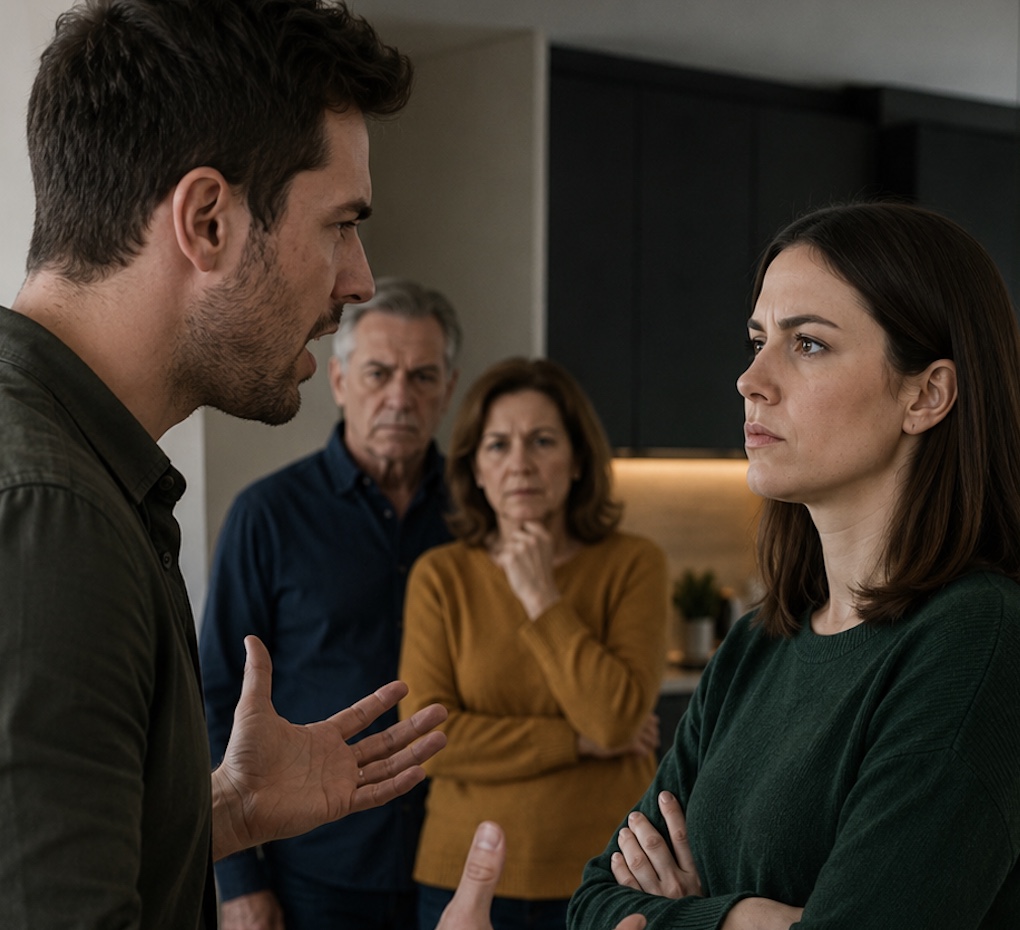
— Since when did my apartment become a den for your shameless, eternally hungry relatives? — Valeria did not say it loudly, but she said it so clearly that even the teaspoon struck the edge of a mug and, after that, no one moved.
She stood in the entryway without taking off her coat. In one hand she held a grocery bag, in the other — her keys. On the mat by the door, someone else’s boots, sneakers, and children’s little shoes were crammed together, even though there were not supposed to be any children in the apartment. From the kitchen came the smell of fried onions and something meaty. The television was on in the living room. Someone had just been laughing loudly, but after her words, the laughter stopped so suddenly it was as if it had been cut off with a knife.
Oleg was sitting at the table with his back to the hallway. Beside him, his cousin Stas had sprawled out comfortably. His sister Lida had settled by the window, and on the sofa, with her legs tucked beneath her, sat Oleg’s aunt — Nina Petrovna. Someone’s sweater lay over the armrest, an open bag of apples stood on the floor, and on Valeria’s favorite light tablecloth sat a plate marked with greasy fingerprints.
Lida was the first to turn her head and raise her eyebrows, as if Valeria had interrupted a perfectly legitimate family evening.
— Lera, why are you starting from the doorway? — Oleg said, trying to make his voice sound lazily casual. — We just dropped by to sit for a while.
Valeria slowly moved her gaze from him to the table, then to the pot on the stove, then to the half-open refrigerator. The door had not been shut properly. On the top shelf, the container with the baked fish she had prepared for two days was empty. The salad she had chopped that morning was gone too. Someone had even taken her ceramic baking dish from the bottom cabinet and filled it with sliced bread, although no one in this home had ever gone farther than the tea mugs without asking.
She remained silent for several seconds. Not because she was lost. Quite the opposite. It was as if the past few months had lined themselves up in front of her without her help and had finally met at one single point.
Back in autumn, everything had seemed different. So harmless that it had never even occurred to her to stop it immediately.
Oleg had said then:
— Lida will be nearby. She’ll come in for ten minutes to pick up some documents.
Valeria remembered that evening down to the smallest detail. She had come home late, tired, her hair tangled by the wind, and found Lida in the kitchen already drinking tea, wearing Valeria’s home T-shirt over her turtleneck.
— Oh, I spilled something on myself, Lera, — Lida explained when she noticed Valeria’s look. — Oleg said I could take something dry.
At the time, Valeria had only nodded. It felt awkward to make a scene over the very first small thing. Later, after seeing his sister out, Oleg put an arm around Valeria’s shoulders and said with a smile:
— Why were you looking like that? It’s Lida. She’s not a stranger.
Not a stranger — fine. Valeria swallowed it. Besides, his sister really did live on the other side of the city, had come on business, and had been caught in the rain. Things happened.
Then came Stas. He was “passing by” and stopped in for half an hour. Half an hour turned into three. Valeria set the table that time, took out vegetables and cheese, warmed up dinner. Stas ate as if he had not had lunch in a week, praised her cooking with his mouth full, and dropped crumbs straight onto the table. Oleg laughed loudly, remembering school fights and fishing trips with his cousin, while Valeria, clearing the table, noticed that almost all the pickled cucumbers she had been saving for the weekend had disappeared from the jar.
The next time Stas came not alone, but with a friend. No one had warned her about the friend in advance.
— This is Dimon, — Oleg waved his hand, as if he were introducing not a person but a sack of potatoes brought from the market. — He’s with Stas.
Dimon held out his hand, glanced around the hallway without even taking off his jacket, and immediately went into the living room.
Even then, Valeria felt something unpleasant stir inside her — not fear, not anger, but a steady, dry irritation. Like a tiny pebble inside a shoe: easy enough, it seems, to shake out, yet somehow it stays there, reminding you of itself more sharply with every step.
She tried to talk to Oleg calmly.
— I don’t like it when people are brought here without warning.
He brushed her off before she could even finish.
— Lera, don’t start. They won’t be here long.
The phrase “not for long” then stuck to their home. It was used to cover everything.
They would drop by not for long. Leave a bag not for long. Spend the night not for long because it was too late to travel. Bring a child not for long while Lida ran some errands. Take over the kitchen not for long. Put a bag in the closet not for long.
Only “not for long” never ended.
A couple of weeks later, Valeria opened the shoe cabinet and saw someone else’s slippers at the bottom. Not guest slippers. Not something accidental. New ones, with the label already cut off with scissors.
She lifted them with two fingers and placed them on the small cabinet.
— What is this?
Oleg looked up from his phone, glanced briefly, and said:
— Oh, those are for Mom. It gets hot for her here in boots.
— You bought slippers for your mother and put them in my cabinet, as if she lives here?
He snorted.
— You’re being dramatic again.
Valeria did not argue then. She simply put the slippers in a bag and placed them in the storage closet. The next day, they were back in the shoe cabinet.
She did not even ask who had taken them out. It was obvious enough.
The presence of strangers spread through the apartment not suddenly, but stubbornly and stickily. Like dampness that first appears in a corner, then blooms into a stain on the wall, until you no longer understand how you once lived there when the air had been dry.
At first, she thought only the visits annoyed her. Then it turned out the visits were only the surface.
Valeria began noticing things she never would have noticed before. A cup with a chipped handle left on the coffee table. A pot moved to another burner. A towel in the bathroom, damp and twisted in a way she herself never hung it. Her hand cream standing not on the shelf, but near the mirror. An open packet of cookies, though she clearly remembered putting it away in the drawer.
One evening she came home and saw a child’s jacket on the back of a chair. Bright blue, with a dinosaur on the pocket.
She went into the kitchen. Oleg’s nephew — Lida’s son — sat at the table, smearing ketchup across his plate. Lida herself stood nearby, scrolling through something on her phone, and without looking up said:
— Hi, Lera. We’ll stay here for a bit. Our water’s been turned off.
“Here.” As if she had already decided where Valeria’s home ended and where a convenient transit point for their entire family began.
— Where’s Oleg? — Valeria asked.
— He went to the store for bread.
Valeria slowly placed her bag on a stool and looked at her kettle. A pot lid was hanging on it — someone had adapted it as a hot pad.
She removed the lid, put it on the table, and only then answered:
— Next time, call first.
Lida finally looked up and twisted her lips.
— Come on, we’re not strangers.
The phrase sounded casual, but Valeria turned toward her so sharply that Lida fell silent. Valeria hated that formula. It always seemed to her that other people’s shamelessness hid behind it.
When Oleg came back, Valeria led him into the room.
— I don’t like people entering my apartment when I’m not here.
— Oh, stop it, — he muttered. — It’s my sister.
— I don’t care who it is. This is my home. I want to know who comes here and when.
He smirked as if she had said something ridiculous.
— You talk as if you’re renting a hotel room, not living with your husband.
She raised her eyes.
— I talk like a person who never gave permission for her home to become a public passageway.
Oleg only waved his hand and went back to the kitchen. He never returned to that conversation.
But Valeria returned to it in her thoughts many times.
The apartment was hers. That was not a figure of speech, not an insult thrown in anger. She had bought that two-room apartment several years before the wedding. She had spent a long time living in rented corners, saving money, choosing the district, rushing from one viewing to another. She remembered how, after all the papers had been signed, she opened the door for the first time and simply stood in the empty room, listening to the hollow sound of her own steps. There was no luxury there, but everything was hers. Every shelf, every hook in the bathroom, every lamp. She had chosen the kitchen table carefully so it would not block the walkway. She had ordered the hallway wardrobe to exact measurements. She had learned the morning light in the room and the way the kitchen became especially quiet in the evenings.
When Oleg moved in after the wedding, Valeria had honestly tried to make the home comfortable for him too. She cleared half of the closet for him, gave him space on the shelves, agreed to his massive armchair, which she herself did not like. But she had not invited everyone else in along with him.
Gradually, it became clear: Oleg did not simply fail to see the problem. He liked that his relatives felt free there. As if their constant presence made him the owner of her apartment no less than her documents did.
The most unpleasant thing Valeria did not understand right away. Oleg’s relatives were not merely dropping by when he was home. They had begun using the apartment as a spare room.
Lida could leave her child there “for an hour.” Stas could wait there before a meeting. Nina Petrovna could sit there after visiting the clinic. The nephew could eat there after school. No one asked Valeria directly whether it was allowed. Every question was handled through Oleg, and he answered for her so easily, as if he were not managing her home but a shared courtyard.
One day she came out of the shower early and heard movement in the entryway.
Not Oleg — he was at work.
Someone inserted a key into the lock.
Valeria stood barefoot on the bathroom mat, her hair wet, and listened as the door opened. Then Lida’s voice rang out:
— Tyoma, come in, take off your jacket.
Valeria came out in her robe and saw Lida already leading her son toward the kitchen.
Both women froze.
— You have a key? — Valeria asked.
Lida blinked, then, as if nothing special had happened, took out a key ring.
— Oleg gave it to me. Just in case.
— In case of what exactly?
— Well, you never know. If I need to come in.
Valeria took a towel from the radiator and slowly blotted her hair. Her movements were precise and careful. The calmer her voice became, the paler Lida’s face turned.
— People are not given keys to my apartment “just in case.”
— Oh God, Lera, why are you so—
— The key.
Lida did not give it back. She only looked away and mumbled that she was in a hurry, then grabbed her son and left. But she closed the door behind her with far less confidence than she had entered with.
That evening, Valeria placed Oleg’s key ring on the table in front of him and asked:
— How many copies of the keys have you made?
At first, he did not even understand the question.
— What do you mean?
— Exactly what I said. How many people can enter here without my knowledge?
Oleg shrugged.
— You’re making a scandal out of nothing.
— Answer me.
— One set is mine, one is yours. And one spare is in the drawer.
— Lida came in today with her own key.
He rubbed his neck and looked away. That was enough for her.
— You gave my sister-in-law a key to my apartment and didn’t even think to warn me?
— It’s just a key, not a safe full of secrets.
— No, Oleg. It is not just a key. It is the entrance to my home.
He lost his temper.
— How many times do I have to repeat the same thing? You’re always unhappy with everyone. My relatives bother you, my sister bothers you, the child bothers you…
Valeria looked at him and suddenly understood with painful clarity: he was not trying to hear her. He was defending not people, but his right to decide for her.
She did not continue the conversation. She simply took the spare set from the drawer, put it in her bag, and the next day changed the cylinder in one of the locks. She did not have to call a locksmith — her neighbor from the landing, Alexey Ilyich, had once shown her how it was done. But Oleg did not notice immediately. And when he did, he became so angry it was as if something legally his had been taken from him.
— What are you doing?
— Taking back control of my front door.
— I should have known!
— So should I.
After that, he walked around gloomy for a couple of days and hardly spoke to her. Valeria decided that at least now things had become clearer. But it was only a pause.
Then Nina Petrovna began her endless trips to doctors, and after each one, she started appearing at their place. Valeria endured it. Not out of love for her mother-in-law — their relationship was cool, but not openly hostile. Nina Petrovna, at least, did not rummage through cabinets or open the refrigerator without invitation. She sat in the kitchen, described who had said what at the clinic, and sighed for a long time.
But even there the boundaries quickly shifted. Nina Petrovna began bringing bags, jars, and containers with her. She left medicines on the windowsill. She asked Oleg “not to put them away, she would take them later.” Once Valeria opened the bottom kitchen drawer and found a piece of lard wrapped in a plastic bag. She did not even eat that kind of thing, and she certainly did not buy it.
— Whose is this? — she asked.
— Mom’s, — Oleg answered carelessly. — She put it there so she wouldn’t have to carry it back and forth.
— Is our home a food storage unit?
— Lera, don’t start.
She almost wanted to laugh at how often he repeated that phrase. As if every attempt she made to defend her own boundaries was a whim that simply had to be waited out.
Valeria began spending less time at home. Not because she intended to give in. It was simply hard to come back to the apartment and check every time who was there now. More than once, she deliberately delayed going up, sitting in the car outside the building, finishing coffee from a paper cup and gathering her thoughts before entering.
That was the most hurtful part: she entered her own home as if it belonged to someone else.
One evening, she wanted to cook dinner and discovered that her good knife had disappeared from the kitchen drawer. Not a cheap one, not a random one — the very knife a friend had given her as a housewarming gift. She searched the shelf, the dishwasher, the drying rack. The knife was gone.
Two days later, she saw it in Lida’s bag when Lida stopped by with pies for Oleg. Valeria noticed the familiar handle sticking out of the plastic.
— That is my knife.
Lida froze, then laughed.
— Oh, I didn’t even notice I took it. We used it to cut a watermelon.
Didn’t notice. Someone else’s knife. Someone else’s home. Someone else’s kitchen. Everything was already happening automatically.
That evening, Valeria did not shout. She took the knife back, washed it, dried it, and put it in its place. Then she sat opposite Oleg and asked:
— Do you understand what is happening?
He was chewing a sandwich and looking past her.
— Nothing special is happening.
— Then I’ll say it. Your relatives have stopped behaving like guests. And that didn’t happen by itself. You are the one who made them understand they could do anything.
Oleg put down the bread and frowned.
— They’re not your enemies.
— I am not obliged to love people just because they are your relatives.
— And I’m not obliged to push my own family away.
— No one is asking you to push them away. I am asking you not to let them live through my apartment.
He smirked.
— Again with your favorite “my apartment.”
She sat straight, palms on the table. Then she slowly stood up.
— Yes. Mine. And that is exactly why I am warning you one more time: no one comes here without my consent anymore. Not with keys, not with bags, not “for half an hour.”
He did not answer. And three days later, Lida appeared in the apartment again, then Stas, and in the evening Nina Petrovna came with containers.
After that, Valeria stopped warning. She began observing.
Who came first. Who stayed after Oleg left. Who used what. Where the spare keys were kept. What disappeared and what appeared.
That was when she realized the issue was no longer only disrespect. It was convenience. For Oleg’s relatives, her apartment had become something between a dining room, a storage unit, a waiting room, and a place where one could always sit out the time, rest, leave a child, eat someone else’s dinner, and discuss personal matters.
And in that arrangement, Valeria herself had become the person who only got in the way when she objected.
The decisive day came on Friday.
Valeria left early that morning. Before going out, she looked into the refrigerator, checked the containers, put meat in to cool so she could quickly bake it in the evening, and left a to-do list on the table. Not for Oleg — for herself. After work, she wanted to stop by the store, then go home, and finally calmly sort through the box of winter things.
The day turned out difficult. By evening, wet snow began to fall, and traffic came to a halt. Valeria was so tired she dreamed of only one thing — closing the door behind her, taking off her boots, and sitting in silence.
She opened the door and immediately understood: there would be no silence.
Voices came from the room. In the kitchen, someone struck a lid against the stove. In the entryway stood an unfamiliar down jacket, beside it two supermarket bags, one of which was leaking. Wet footprints marked the mat. The smell of someone else’s food mixed with the smell of her perfume, and that combination felt especially disgusting.
She took another step and saw everyone at once.
Lida was cutting something on Valeria’s cutting board. Stas sat at the table in a T-shirt, as if he were at home. Nina Petrovna was pouring tea into mugs — not the ones they usually gave guests, but Valeria’s favorites: large ones with a thin blue rim. Children’s mittens were drying by the radiator. On the sofa lay the throw blanket Valeria had neatly folded into the armchair that morning.
Oleg turned toward her last.
And that was when she said the words.
Not emotionally, not shrieking, not hysterically — which was exactly why they sounded more frightening.
— Since when did my apartment become a den for your shameless, eternally hungry relatives?
Nina Petrovna placed the kettle back on its stand with such care that it seemed she was afraid to drop it. Lida froze with the knife in her hand. Stas snorted, but quickly choked on the sound when he noticed Valeria’s face.
Oleg stood up.
— Lera, what are you saying?
She entered the kitchen, placed the bag on the windowsill, and only then removed her gloves.
— I want an answer.
— This is my family.
— And this is my home.
Stas tried to insert himself:
— Come on, we were just—
Valeria turned toward him.
— I was not speaking to you.
He stopped and looked away.
Lida clinked the knife against the board and, trying to speak more softly, said:
— Lera, don’t get worked up. We really aren’t here for long. There’s a plumber at our place, Mom came from the clinic, the child needs to eat…
— Children need to be fed at home, — Valeria answered. — Not in my kitchen, out of my pots and with my food.
Nina Petrovna flushed.
— What do you mean, your food? I bring things too, by the way.
Valeria looked at her calmly.
— I never asked you to bring lard for my drawer or medicine for my windowsill.
Oleg stepped closer and lowered his voice, the way people do when they hope to crush someone’s resolve by pretending to be reasonable.
— Stop turning this into a marketplace scene in front of everyone. We’ll talk later.
— No, — Valeria said. — Later you will all leave and pretend nothing happened. But something did happen. And we are ending it right now.
She approached the table, took a napkin, and wiped a greasy stain from it. The movement was simple, almost domestic, but there was more clarity in it than in any scream.
— Everyone stands up. Everyone gathers their things. Everyone leaves.
No one moved.
She repeated:
— Now.
Lida looked at Oleg. Stas did too. They were all waiting for him to do what he usually did: smirk, devalue her words, turn everything into a joke, and then Valeria would either go into the room or fall silent.
But Valeria did not look away.
Oleg tried again:
— You’re going too far.
— No. I have tolerated too much for too long.
— This is not normal.
— What is not normal is strangers having keys to my apartment. What is not normal is people entering when I’m not here, eating here, storing their things here, and acting as if this place belongs to them. What is not normal is that for months you pretended this was how it should be.
Nina Petrovna pressed her hands to her chest.
— Oleg, do you hear how she is speaking to us?
— He hears, — Valeria answered without taking her eyes off her husband. — He hears perfectly well.
Then she suddenly pulled out her phone and unlocked the screen.
— You have two minutes. Either you leave on your own, or I call the police and explain that there are people in my apartment whom I did not invite and who refuse to leave.
Stas scoffed.
— You’ve gone crazy, calling the police over this…
— Shall we check? — Valeria raised an eyebrow.
He fell silent.
Lida was the first to break. She quickly wiped her hands, grabbed her son’s jacket, and gathered the mittens.
— Mom, let’s go, — she threw toward Nina Petrovna. — They’ll sort it out later.
— I didn’t even finish my tea, — the older woman muttered, but she too was already getting up fussily.
Stas grabbed his sweater from the armrest, shoved his phone into his pocket, and muttered to Oleg:
— Deal with it yourself.
A minute and a half later, the kitchen was empty. Only Oleg and Valeria remained in the entryway.
She waited until the door slammed behind the last guest, and only then turned the inner lock.
Oleg stared at her as if he still could not believe she had really done it.
— You humiliated me in front of everyone.
Valeria placed her phone on the small cabinet.
— No. You humiliated yourself. When you decided that my home could be used as a transit station for your entire family.
— You’ve completely—
— The keys.
He blinked.
— What?
— All the apartment keys. Now.
Oleg smirked, but the corner of his mouth twitched.
— Are you out of your mind?
— Completely in it. The keys.
— I’m your husband.
— And that is exactly why you knew my boundaries better than anyone. But you chose to erase them. You cannot. The keys.
He did not move.
Valeria lifted the phone.
— Then I will call the local police officer right now and report that you refuse to leave an apartment that belongs to me. If that’s how you want it, that’s how it will be.
She spoke without stumbling. Not because she enjoyed the situation. Simply because everything inside her had fallen into place. She was even surprised by her own clarity.
Oleg looked at her for several seconds, then reached into his jacket pocket. He pulled out his key ring and tossed it onto the cabinet with irritation.
— You’ve taken this to the point of absurdity.
Valeria picked up the keys, counted them, and asked:
— Who has the spare ones?
He was silent.
— Oleg.
— Lida had a set. And Mom has one.
Valeria nodded, as if this was exactly what she had expected to hear.
— Call them. Now. Tell them to bring the keys back.
— You’re mocking me.
— No. I am doing what I should have done a long time ago.
He exhaled heavily, took out his phone, and called his sister. Valeria stood beside him and listened. Not to every word — only to what mattered: Oleg had to say out loud that the keys had to be returned today.
At first, Lida protested so loudly that her voice could be heard even without speakerphone. Then, judging by her tone, she realized this was not a joke. She said her husband would bring them in forty minutes.
Oleg called Nina Petrovna with a stone face. She gasped for a long time, asked what had happened, and then also began protesting. Valeria did not interfere. She simply stood with her arms crossed and looked out the window.
When the calls ended, she said:
— Now pack your things.
— I am not going anywhere.
— You are.
— And where, in your opinion, am I supposed to go in the evening?
— To your relatives, who feel so free in my apartment.
He looked at her from under his brows. On another day, that look might have hurt her. Today, it did not.
— Lera, let’s not be stupid. You’ll cool down, and we’ll talk.
She did not even sit down. She stood straight, one palm resting lightly on the back of a chair.
— There will be no “you’ll cool down.” For years you believed I would put up with it. Today I won’t. Pack.
He did not move.
Then she opened the hallway closet, took out his travel bag, and placed it on the floor.
— I will not touch your things without you. But in ten minutes, either you pack them yourself or I call the police, and then the conversation continues differently.
Oleg took a sharp step toward her.
— Have you lost all decency?
She did not retreat even a centimeter.
— And you lost respect a long time ago. This is where it ends.
Something in her face must have convinced him more than any threat. He cursed under his breath and went into the room.
While he was packing, Valeria opened the kitchen window. Cold air quickly pushed out the smell of someone else’s food. She removed the tablecloth from the table, folded it, and carried it to the laundry basket. She returned, placed mugs into the sink, brushed children’s crumbs from the sofa, and picked up a little toy car someone had forgotten under the radiator.
Each movement calmed her.
Twenty minutes later, the doorbell rang. Lida’s husband came, silently handed over a set of keys, and did not even look at Valeria, as if he were afraid of being pulled into the conversation. Ten minutes later, Nina Petrovna appeared. She stood on the threshold with an offended face, her scarf tightened under her chin.
— Are you satisfied? — she asked, pulling the key out of her wallet.
Valeria took the key, examined it, and answered evenly:
— Yes. Because my keys should only be held by people I give them to myself.
— This is not how people treat family.
— And this is not how people treat the owner of an apartment.
Nina Petrovna opened her mouth, but Oleg, standing in the hallway with his bag, said:
— Mom, let’s go.
And that was perhaps the most unexpected part of the whole evening. Not protection, not remorse, but emptiness. As if all his confidence had rested only on the fact that Valeria would once again remain silent. And when she did not, he had nothing left to oppose her with.
He left with his bag, his coat unbuttoned, without looking back. Nina Petrovna followed him. Valeria closed the door, turned the key, then the second one.
Immediately, she called a locksmith. He did not answer the first time, but within an hour the master was there.
— Changing both locks? — he asked, taking off his jacket.
— Both, — Valeria answered.
He worked calmly and efficiently. Metal clinked, tools rustled across the floor. Valeria held the flashlight when he asked. She watched the old cylinders go into the box and the new ones take their place. When the locksmith handed her two fresh sets, she even felt her shoulders lower by themselves.
— Check them, — he said.
She inserted the key and turned it. The lock worked smoothly, without sticking.
When the door closed again after he left, the apartment suddenly became unusually quiet.
Not hollow. Not dead. Just quiet.
Valeria went to the kitchen, picked up a forgotten mitten from the floor, looked at it for a second, and threw it into a bag. Then she opened the refrigerator. The top shelf was empty. No fish, no salad, no yogurt she had left for the morning. A jar of mustard stood lonely in the door.
She gave a tired, humorless smile.
And suddenly she felt not weakness, not pity for herself, but anger — clean, cold, useful anger. The kind that does not destroy everything around it, but helps you understand exactly what to do next.
She made a list. What to buy tomorrow. What to throw away. Which of Oleg’s things were still left and how to give them to him later without new visits to her home. Which neighbors to tell not to let anyone in out of old habit. Where to keep the second set of new keys.
Then she took a bag and gathered everything that was not hers: the mitten, the plastic toy car, a cheap hair clip, patterned napkins, the jar Nina Petrovna had never taken back. She tied the bag and placed it by the door.
In the room, the throw blanket lay rumpled on the armchair after someone else’s child. Valeria straightened it, folded it neatly, and put it back in its place.
A stranger’s towel hung in the bathroom. She took it down and sent it to the wash.
In the kitchen, she washed the table, the stove, and the cutting board. Not out of disgust. She simply wanted to see the space the way she was used to seeing it.
Closer to midnight, Oleg texted her.
“You made a disgrace of everything. We should have talked normally.”
She read the message twice, then placed the phone face down. A minute later, another message arrived.
“I’ll come by tomorrow.”
At that, Valeria smiled for the first time that evening — briefly, without joy.
She turned the phone over and replied:
“You will not come by. Write when you are ready to pick up the rest of your things. I’ll gather them. You will not enter the apartment.”
Oleg did not answer for a long time. Then he sent:
“It is my home too.”
Valeria looked at that line and remembered how he had said the same thing before — lazily, confidently, like a ready-made formula meant to shame her and make her retreat.
She typed:
“No. It is a home where you lived while you respected my rules. You trampled them.”
She sent it and turned off the sound.
In the morning, she was not awakened by noise in the kitchen, not by the refrigerator door slamming, and not by someone else’s child running down the hallway in socks. She was awakened by silence.
She lay there, looking at the ceiling, and for the first time in a long while she did not listen for who might already be awake, did not try to guess by footsteps how many people were in the apartment, did not mentally check whether the closet was closed.
Light slowly filled the room. Valeria sat up, threw on her robe, and went into the kitchen.
Nothing extra on the table. By the sink — only her cup. The refrigerator was rather empty, but that could be fixed. The main thing was that no one had decided for her how things would be here.
She brewed herself tea, sat by the window, and only then allowed herself to feel everything that had been pushed aside by action the day before.
Her hands trembled, not much, but noticeably. She wrapped her palms around the mug and exhaled. Faces rose before her eyes — Lida with the knife, Stas in her kitchen, Oleg saying “don’t start,” Nina Petrovna with the key in her wallet.
Valeria did not cry. She frowned, sometimes shook her head, sometimes gave a bitter little smile, remembering how many times she had given them another chance to “understand peacefully.” What shocked her most was something else: how long she herself had persuaded herself to tolerate what had been wrong from the very beginning.
Not out of weakness. Out of the habit of keeping peace. Out of the desire not to become “that scandalous wife” everyone in the family would whisper about. Out of the hope that grown people would see a boundary if it were stated calmly.
They had not seen it.
Because they had mistaken calmness for consent.
And that was exactly what had ended yesterday.
During the day, Oleg wrote again. First, he dryly asked when he could pick up what remained. Then he tried to steer the conversation into a more convenient direction: let’s avoid extremes, let’s cool down, let’s discuss it, everyone got carried away.
Valeria read the messages and felt not the old resentment rising in her, but a firm unwillingness to fall back into the same circle.
She answered briefly: she would hand the things over outside the building; he would not enter the apartment.
He called. She did not answer.
Then Lida started writing. Then Nina Petrovna. Then Stas sent a voice message in which he first laughed, and then said that “families don’t fall apart over such nonsense.”
Valeria deleted everything without listening to the end.
By evening she packed a box: Oleg’s clothes, charger, razor, documents, and his favorite mug, the one he had once brought back from some trip. Everything was neat. Not out of spite, not in a rush. Simply because she no longer wanted a single reason to see him in her hallway and listen as he once again tried to convince her that she had exaggerated.
When he arrived, she carried the box out herself.
The yard was damp, and children were kicking a ball between puddles. Oleg stood near the car, hands shoved into his pockets. When he saw the box, he took a step toward her.
— Can we talk?
— No.
— Lera, I didn’t think you would take it like this.
She placed the box on the bench.
— That is exactly the problem. You never thought I felt anything at all.
His cheek twitched.
— You could have said it more firmly earlier.
For a moment, Valeria could not even find a response. Then she said slowly:
— I did say it. Calmly. Normally. Several times. You only heard me when I stopped being convenient.
He reached for the box.
— So that’s it?
— For my apartment — yes. As for us, you ended that yourself long before yesterday.
He looked at her for a long time, as if searching her familiar face for the old Valeria, the one who could still give in, soften, look away. But another woman stood before him now. The one who, yesterday, had not pleaded, had not justified herself, and had not stepped back.
Oleg picked up the box.
— You’ll regret this.
Valeria shrugged.
— No. I only regret not stopping it sooner.
She turned and walked toward the entrance. Not quickly, not theatrically. She simply went home.
As she climbed the stairs, she suddenly noticed that the familiar inner tension before reaching her door was gone. She no longer had to guess who might be inside. She no longer had to prepare herself in advance for someone else’s laughter, scattered shoes, polite but shameless faces.
She opened the door with her new key.
The apartment smelled of cleanliness and lemon floor cleaner. In the kitchen, the washed cutting board was drying. In the room, her throw blanket lay on the sofa — exactly as she had left it. In the hallway stood only her boots.
Valeria walked deeper into the apartment, stopped in the middle of the room, and slowly looked around.
That was when the real change happened. Not in the second when she threw everyone out. Not when the new lock clicked. But now.
She no longer felt like a guest in her own home.
Her apartment was hers again not because others had left on their own. But because she had finally stopped allowing them to occupy space there — with their bodies, bags, voices, habits, and чужая certainty that they had the right to use what did not belong to them.
She went to the window, reached for the tulle — and suddenly gave a short laugh. There was no tulle. She had replaced it long ago with Roman shades in the kitchen and blinds in the room, because she loved clean lines and light without extra fabric. The laugh fit the moment: even in her thoughts, she now wanted to put everything in its proper place, without confusion or чужие layers.
Valeria opened the window. From the courtyard came the smell of spring dampness, wet asphalt, and someone’s dinner from a neighboring entrance.
She rested her palms on the windowsill and said aloud, quietly, not to anyone else, but to herself:
— Enough.
The word was neither dramatic nor loud. But it contained everything — the exhaustion of the past months, the hurt, the anger, and the clarity that had finally arrived.
After that, she closed the window, switched on the kitchen light, and took a clean large plate from the cupboard.
She placed cheese, an apple, and bread on it, then sliced a tomato. She sat at the table alone.
No one reached across the table for her food. No one rummaged in the refrigerator. No one told her she was exaggerating.
She ate slowly and, for the first time in many months, felt not emptiness after a scandal, but order.
That was how everything changed.
Not because Oleg’s relatives suddenly came to their senses. Not because Oleg himself understood the first time. But because Valeria stopped being silent at the moment when silence was already working against her.
Her apartment became hers again.
Not on paper — it had always been that.
Truly. In feeling. By the right she had finally taken back for herself.