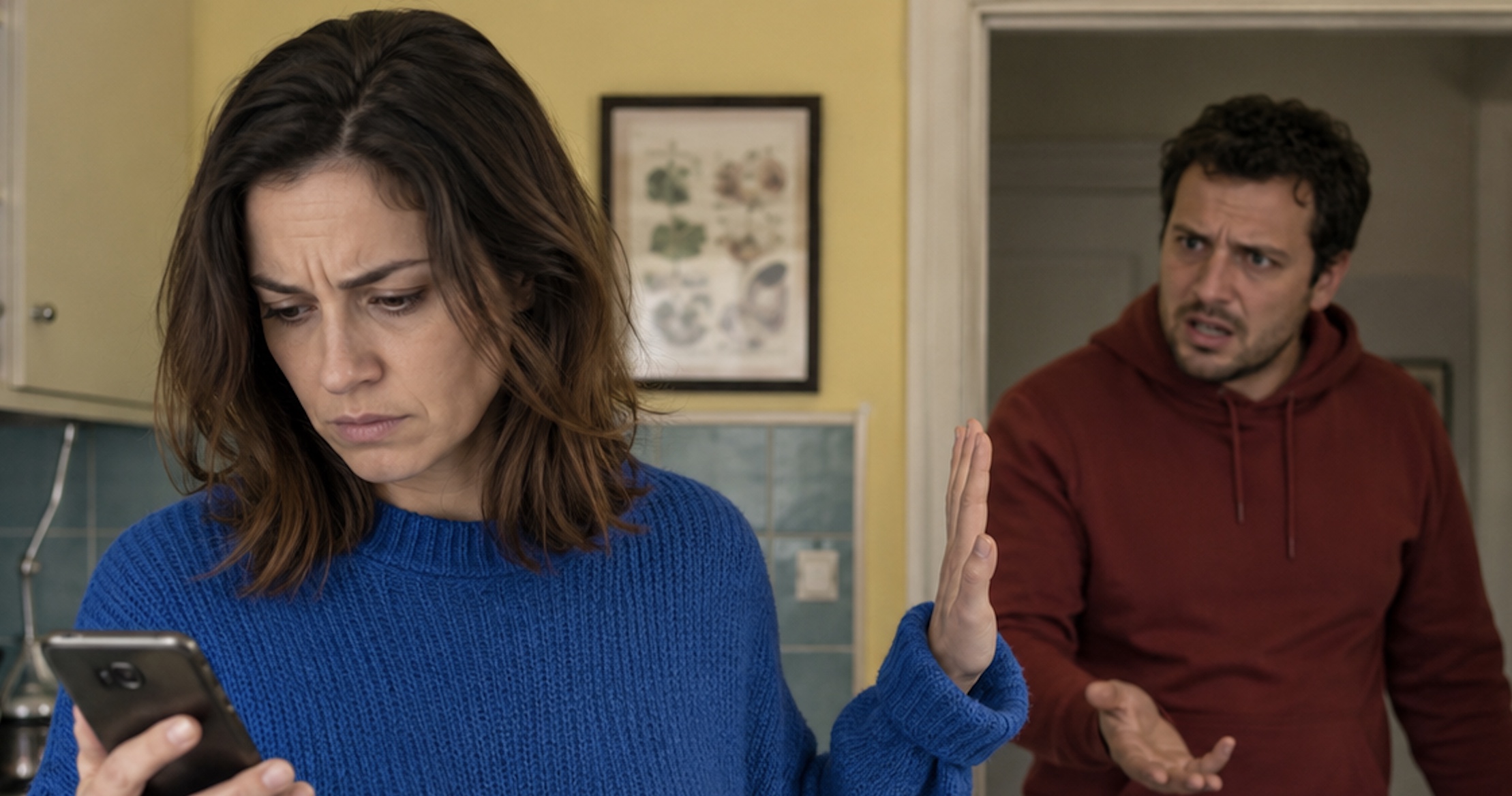
“Sergey, is eight thousand to your mother now part of our utility bills, or did I miss something?”
Marina stood by the kitchen table in an old T-shirt, her hands still wet from washing the frying pan after dinner. Her phone lay in front of her, the banking app glowing white on the screen like an interrogation lamp.
Sergey froze by the door without even taking off his jacket.
“What eight thousand?”
“This eight thousand. Vera Ilyinichna Gromova. Yesterday at 9:47 p.m. No comment. Very touching, of course, but I haven’t yet learned to read bank notes with my eyes.”
“Oh… I sent it to Mom. Dad had a toothache. It was urgent.”
“Nikolai Semyonovich?”
“Yes.”
“Sergey, he has dentures.”
“Marina, please don’t start.”
“I’m not starting. I’m clarifying. Maybe medicine has advanced, and they’re filling cavities in removable jaws now.”
“She said it was the dentist. I didn’t ask details.”
“Wonderful. So we’re saving for a down payment, I haven’t bought myself winter boots for two months because ‘winter will pass, but a mortgage matters more,’ and you send eight thousand without even asking what for?”
“She’s my mother.”
“And I must be the neighbor from the rented apartment who just happens to stand near the sink.”
“Marina, why do you immediately get sarcastic? They asked for help, so I helped. It’s not like I gambled it away.”
“We agreed that no one touches the joint savings account without discussing it. No one. Not for your mother, not for your father, not even to save endangered raccoons.”
“I forgot to tell you.”
“You didn’t forget. You decided I’d stay silent.”
Sergey took off his jacket, threw it over the back of a chair, and rubbed his face tiredly.
“Listen, I just got back from work. My boss ate my brain with a spoon today. Can we not do this now?”
“You could have not made the transfer yesterday.”
“Marina.”
“Sergey.”
They stood facing each other. Outside, traffic hummed beyond the window, and something clicked inside the radiator. On the stove, a pot of soup was cooling, with more potatoes than meat in it, because even meat had become something “after the mortgage.”
“Fine,” he said. “I’m guilty. Next time I’ll tell you.”
“You won’t tell me. You’ll ask me.”
“Yes, I’ll ask.”
“Not ‘Mom, of course, right away,’ but first me.”
“I said I got it.”
“Are you sure?”
“Yes.”
Marina looked at him carefully. Sergey had a way of saying “yes” like he was closing a tab on a computer: not solving the problem, just removing it from the screen.
“All right,” she said. “Do you want dinner?”
“I do. And let’s not sit here with sour faces.”
“This isn’t a sour face. It’s the face of a woman trying to understand why she got a financial circus without a ticket.”
He smirked, came closer, and tried to hug her. Marina didn’t pull away, but she didn’t lean into him either. Something dry and unpleasant had already begun scraping inside her.
A week later, she opened the banking app again.
“Sergey, come here.”
“What now?”
“I haven’t even started, and you’re already saying ‘now.’ That’s a promising sign.”
He came out of the room with his phone in his hand.
“What happened?”
“Twenty-two thousand to Oksana. The day before yesterday. Your sister.”
“Yes, I sent it.”
“You’re not even going to say, ‘What twenty-two thousand?’ You’re growing.”
“She had car trouble. The gearbox, I think. Or the clutch. I’m not a mechanic.”
“She was selling that car three months ago.”
“She didn’t sell it.”
“She was selling it. She wrote a post: ‘My little swallow is looking for a new owner, urgent sale, bargaining by the hood.’ I remember thinking the little swallow looked more like a battered pigeon.”
“Well, she didn’t sell it, then.”
“And of course, you didn’t ask details again.”
“Marina, why are you on my back? A person had a problem.”
“We have a problem too. We live in a one-room apartment with wallpaper that remembers the prime minister Kiriyenko. Our washing machine jumps around the bathroom like a goat at a wedding. Our fridge hums at night like it’s receiving aircraft. And we’re saving, Sergey. Saving. Not playing at saving. Actually putting money aside.”
“Twenty-two thousand isn’t the end of the world.”
“Of course not. The end of the world begins when I buy coffee for one hundred eighty rubles. Then you give me a lecture on financial discipline.”
“You’re exaggerating.”
“I’m calculating. Those are different kinds of creativity.”
“Oksana will pay it back.”
“When?”
“When she can.”
“So never, but softer.”
Sergey shoved his phone into his pocket.
“You’ve become so angry lately.”
“I’ve become attentive. It’s just more convenient for you to call me angry.”
“Listen, this is my family. I can’t tell my sister, ‘Sorry, my wife counts every penny.’”
“Say it differently: ‘Sorry, my wife and I are saving for a home, and we can’t pay for your clutch, which may have already been sold together with the little swallow.’”
“Are you mocking me?”
“Yes. Because if I don’t mock you, I’ll have to scream.”
“Don’t scream.”
“I haven’t even raised my breathing yet.”
He stayed silent. Marina opened the transaction history and slowly ran her finger down the list.
“Look. Eight to your mother. Twenty-two to Oksana. Three thousand to your mother a week ago. Five thousand to Oksana at the beginning of the month. Four and a half to your mother for ‘medicine.’ Two thousand seven hundred for a taxi from the clinic. Sergey, forty-five thousand in one month.”
“We’ll save later.”
“Later when? When we’re both fifty and take out a twenty-year mortgage so the bank can bury us with the payment schedule?”
“Don’t dramatize.”
“You say that word every time I hit the truth.”
“Marina, I work, I earn money, I have the right to help my loved ones.”
“And what am I?”
“You’re loved too.”
“Too. Wonderful. A seat on the stool by the door.”
“Don’t cling to words.”
“I’m not clinging to them. I’m holding onto them so I don’t drown in your family swamp.”
He slapped his palm on the table. Not hard, but the cup still trembled.
“That’s enough. I said I won’t do it again without discussing it.”
“You already said that.”
“So what now? Are we holding a trial?”
“If it were a trial, I’d come with bank statements. I already almost have a folder.”
“God, Marina, it’s become impossible to talk to you.”
“It’s possible to talk to me. Lies just don’t pass through very well anymore.”
He went into the room and turned the TV louder than usual. Marina stayed in the kitchen. A spoon lay in the sink, one she had forgotten to wash. Such a small thing, yet it made her feel sick with hurt: she saved on taxis, dragged groceries home from the discount store, chose chicken only when it was on sale, while his family lived in the mode of “Sergey will transfer it.”
The next three weeks turned into a fine, sticky rain. Not a storm, not a disaster, but the kind of rain that soaks your sleeves and your mood.
“Sergey, another transfer.”
“Medicine for Mom.”
“She gets medicine free through her benefits.”
“Not all of it.”
“Which ones exactly?”
“Marina, am I a pharmacist?”
“No, you’re an ATM with a tired face.”
“Careful.”
“I’ve been careful for two months.”
“It’s five thousand. Five. You’re going to ruin the whole day over five thousand?”
“No. You ruined the day. I’m just reading the report.”
“Oh my God.”
“He has nothing to do with this. I think even He feels awkward.”
Then there was more.
“Ten thousand to Oksana?”
“My nephew’s jacket tore.”
“For ten thousand?”
“A decent winter jacket costs that much.”
“Does your nephew have a father?”
“Yes.”
“Is he planning to participate in the jacket?”
“His salary is delayed right now.”
“Everyone’s salary is delayed when it comes to your account.”
“Marina, you’re being disgusting right now.”
“And you’re being convenient.”
He began getting angry faster and faster. Before, he would justify himself, then become irritated. Now he attacked immediately.
“You just don’t understand normal family relationships.”
“If normal family relationships mean one family eating another family’s savings, I’m glad to be abnormal.”
“You grew up without a father. That’s why you think like this.”
Marina fell silent. It was said in the kitchen, beside the trash bin, between a bag of buckwheat and expired kefir. Said casually, almost accidentally. But it struck directly.
“Repeat that,” she said quietly.
“I didn’t mean it that way.”
“No, repeat it. I want to understand how low you’re willing to dig.”
“Marina, enough.”
“My father died when I was twelve. You know that. My mother worked two shifts so I wouldn’t go to school in torn boots. And yes, I understand family relationships very well. It’s just that in my family, money wasn’t pulled out with pliers and called love.”
Sergey lowered his eyes.
“I lost my temper.”
“You didn’t lose your temper. You pulled out what had been sitting inside you.”
“I’m sorry.”
“Noted.”
“Marina…”
“Don’t touch me right now.”
She went into the bathroom, locked the door, and sat on the edge of the tub for a long time. The neighbor upstairs was drilling into the wall. Someone in the stairwell was arguing about a bicycle. Something important in her life was collapsing, while the building continued its ordinary panel-block existence: the smell of fried onions, doors slamming, an elevator that got stuck between the fourth and fifth floors.
On Friday, Sergey came home almost cheerful.
“We’re going to my parents on Sunday.”
“Why?”
“Mom invited us. Dad’s birthday was during the week, so we’ll celebrate.”
“He doesn’t like celebrating.”
“We’ll just sit together. Why do you react like that immediately?”
“I’m not reacting. We’ll go.”
“Just please, no attacks.”
“What kind? Financial or orphan-related?”
He grimaced.
“I apologized.”
“And I remembered.”
“You remember everything.”
“A useful habit when you live next to someone whose memory only turns on for his mother’s card number.”
On Sunday, they rode the bus to the suburbs. Marina looked out the window: dirty snow along the roadside, a tire shop, a stall called “Shawarma 24,” a woman with two bags and the expression of someone who only wanted to make it home. Sergey was silent. He had bought a bouquet of chrysanthemums because Vera Ilyinichna believed “a home must look beautiful,” although their own home contained one cactus, and even that seemed to regret its registration.
His mother opened the door.
“Sergey, finally! One could forget one has a mother, couldn’t they?”
“Mom, we came.”
“Hello, Marina. Come in, since you made it.”
“Thank you, Vera Ilyinichna. I’m glad to see your consistency too.”
“What?”
“I said I’ll take off my shoes.”
In the kitchen, Nikolai Semyonovich and Oksana were already sitting. Oksana was scrolling through her phone with the look of a person who believed the whole world owed her a charger. On the table were herring under a fur coat, mashed potatoes, roasted chicken, pickles, a bowl of “Lastochka” candies, and a bottle of cognac that Sergey’s father, judging by the dust, took out only for guests and his own courage.
“So, young people,” Vera Ilyinichna said, serving salad. “How’s life? Still buying an apartment in your dreams?”
“We’re saving,” Sergey answered.
Marina looked at him and smiled.
“Yes, we’re saving. Very actively. The whole family is participating.”
Oksana snorted.
“Here we go again.”
“You already know the beginning?”
“Sergey said you nag him over money.”
“How nice that your cultural program was agreed in advance.”
Sergey leaned toward Marina.
“I asked you.”
“And I haven’t said anything yet.”
Vera Ilyinichna put a plate in front of her son.
“Eat, Sergey. You’ve gotten so thin. At home they probably feed you nothing but spreadsheets.”
“Mom, stop.”
“What do you mean, stop? A man should eat properly. Marina, do you cook soup at all?”
“I do. Just without financial gravy.”
“I don’t understand.”
“It’s a family dish. Never mind.”
Nikolai Semyonovich coughed.
“Let’s drink to health first, and then you can argue politely.”
“Dad, no one is arguing,” Sergey said.
“Of course,” Marina nodded. “This is just the warm-up.”
After the toast, conversation crawled along its usual tracks: prices, clinics, roads, bosses. Marina barely spoke. She listened as Vera Ilyinichna complained about expensive medicine, then two minutes later talked about the new multicooker she had bought “for a ridiculous price, only seven thousand nine hundred.” Oksana complained about her son’s school, her ex-husband, gasoline, and “awful people who don’t understand how hard it is for a woman alone.”
“Oksana,” Marina asked, “did you repair the car?”
Oksana looked up.
“What car?”
“Your little swallow. The gearbox or clutch. I’m vague on the details, just like Sergey.”
“Oh, that one. No, I sold it.”
Sergey froze with his fork in his hand.
“What do you mean, sold it?”
“I mean sold it. Last week.”
“And the money for repairs?”
“Sergey, it wasn’t just repairs. I paid off a few debts. What difference does it make?”
Marina slowly placed her napkin on the table.
“The difference, as it turns out, costs twenty-two thousand.”
“Marina, don’t start in front of everyone,” Sergey hissed.
“Everyone participated. In front of everyone is more honest.”
Vera Ilyinichna put down her cup sharply.
“I’m curious, Marina, do you have your own relatives? Do you help them?”
“I have my mother. She works as a nurse. And do you know what’s amazing? When she’s short on money, she says, ‘Daughter, don’t, I’ll manage. You and Sergey are saving for an apartment.’ Imagine that. Such a rare species of mother exists.”
“So I’m a bad mother?”
“You said that.”
“I raised my son. I didn’t sleep nights!”
“Most mothers raised children and didn’t sleep. But not all of them later issue invoices with interest.”
“How dare you?”
Sergey exhaled sharply.
“Marina, enough.”
“All right. Enough means enough.”
Vera Ilyinichna leaned back in her chair, then suddenly changed her tone. Her voice became soft, almost pitiful.
“Sergey, sweetheart, I actually wanted to talk. Our balcony is falling apart completely. The frame is old, there’s a draft, your father’s back hurts from the cold. I asked around — glazing and insulation will cost one hundred ten thousand. If we order now, there’s a discount. Could you help? Not the whole amount, at least eighty thousand. We’ll pay it back somehow later.”
The kitchen went quiet. Even the refrigerator seemed to stop humming so it wouldn’t miss the performance.
Sergey slowly reached into his pocket.
“Mom, eighty all at once…”
“I’m not asking for myself, son. Your father is freezing. And besides, you still have a long way to save. We’re old already.”
Marina watched Sergey’s hand, the phone, his unlocked screen. Something inside her clicked. Not loudly, not with movie music. Just click — and it became impossible to endure anymore.
“Put the phone down,” she said.
Sergey didn’t even understand at first.
“What?”
“Put the phone down.”
“Marina, don’t.”
“Yes. I very much will.”
Vera Ilyinichna straightened.
“You’re going to give orders to your husband at my table?”
“No. I’m going to remind him that he is married, not registered as a free add-on to your pension.”
“You little…”
“There will be no eighty thousand,” Marina said. “Not today, not tomorrow. And from now on, not one more kopeck from the joint account will go to your family.”
Oksana slapped her palm on the table.
“Who are you to decide?”
“The person who puts money into that account.”
“Oh really? Sergey supports you, and you sit here acting like you have rights!”
“Oksana, don’t make me laugh. Twenty-two thousand went to your ‘repair’ and disappeared into thin air. You’d better stay quiet in this financial theater.”
“Sergey, do you hear how she talks to me?”
Sergey stood up.
“Marina, stop. This is my family.”
“And what am I?”
“You’re my wife, but…”
“Stop. That ‘but’ is our whole married life. ‘You’re my wife, but Mom asked.’ ‘You’re my wife, but Oksana is struggling.’ ‘You’re my wife, but I earn more.’ Go ahead, say the full version. Don’t be shy.”
“Don’t make a scene.”
“The scene started before me. I just stepped into the light.”
Vera Ilyinichna stood up, her face turning red.
“You ungrateful girl! We accepted you like family!”
“You accepted me as an obstacle between you and Sergey’s card.”
“My son has the right to help his parents!”
“He does. From his personal money. After he has paid his part of rent, food, and savings. Not from a joint account where I transfer half my salary.”
Sergey said sharply:
“What half? I earn more. Most of it is mine anyway.”
Marina looked at him. No anger now. Almost calm curiosity, as if she were looking at a person who had finally taken off his mask and become exactly who she had feared he was.
“Repeat that.”
“Marina…”
“No, repeat it. Everyone here is family. They’ll like it.”
“I didn’t say it right.”
“You said it perfectly. Most of it is yours. That means my money doesn’t count. My savings don’t count. My late-night report work doesn’t count. The new boots I didn’t buy don’t count either. Because the main thing is your salary and your mother’s balcony.”
“You’re twisting it.”
“No. I’m straightening it.”
She took out her phone. Her hands were not shaking, and that surprised even her. She opened the banking app, the savings account, the statement. The total balance was three hundred fourteen thousand. It should have been almost five hundred, if the family pumping station hadn’t been working around the clock.
“What are you doing?” Sergey asked.
“Math.”
“Marina.”
“The account is in my name. You have additional access. In seven months, I deposited two hundred ten thousand. You deposited one hundred ninety-six. From the joint account, one hundred eighty-four thousand six hundred went to your family. Part of your deposits you already successfully gave away. So I’m taking my money and the amounts you promised to return after previous ‘little things.’”
“Don’t you dare.”
“Listen to how beautiful it sounds when a person suddenly remembers boundaries.”
She entered the amount: two hundred thirty thousand. Confirmed the transfer to her personal account.
Sergey stepped toward her.
“Marina, cancel it.”
“Too late.”
“You have no right!”
“I do. It’s my money. My salary. My bonuses. My account. And my head finally waking up.”
Oksana jumped up.
“She’s a thief!”
“Careful,” Marina said. “I’ll print out the statements, and then everyone can try on the word ‘thief’ one by one. It would fit you quite nicely, by the way.”
Vera Ilyinichna was choking with outrage.
“Sergey, why are you just standing there? She robbed you!”
“Mom, be quiet!”
“Don’t tell me to be quiet! She came into our house, disgraced us, and took family money!”
Marina put her phone into her bag.
“Family money ended the moment I was excluded from the family. You all did it together, almost in chorus. I could even thank you.”
Nikolai Semyonovich spoke firmly for the first time.
“Marina, you are going too far.”
“No, Nikolai Semyonovich. I simply stopped bending.”
Sergey stood pale.
“Marina, let’s go outside and talk.”
“About what?”
“Not here.”
“We started here. We’ll finish here.”
“I didn’t mean to say you were nobody.”
“But you said it.”
“I snapped.”
“That’s the second time today you’ve snapped so conveniently that the truth fell out.”
“Don’t leave in this state.”
“I’m in an excellent state. For the first time in a long time, I have money and no desire to explain to anyone why my boundaries are not a tablecloth for your family table.”
She picked up her bag.
“Where are you going?” he asked.
“Home. To pack.”
“I’m coming with you.”
“No. You stay. Your mother has a balcony, your sister has debts, your father has a bad back, and you have the role of provider. The show will collapse without you.”
“Marina!”
“And one more thing. Don’t call me for an hour. I want to get there without your voice.”
She went into the hallway, put on her shoes, and threw on her coat. Vera Ilyinichna was shouting from the kitchen:
“Give the money back, do you hear me? Give it back before it’s too late!”
Marina opened the door.
“It was too late when you asked for eight thousand for a tooth in a removable jaw.”
The door closed softly. Even too softly for a scene like that.
At home, she took out a suitcase. At first, she packed neatly: jeans, a sweater, documents, a hairdryer. Then she began throwing things in randomly. A framed wedding photo fell to the floor. Sergey smiled widely in it; she smiled a little tiredly, because even then his mother had told the photographer, “Take Sergey from his good side, and Marina can move over.”
Sergey arrived an hour and a half later. He rushed into the apartment and saw the open wardrobe.
“Are you serious?”
“Completely.”
“Over money?”
“Not over money. Money just showed who everyone really is. In that sense, it’s more honest than people.”
“I said something stupid.”
“You lived something stupid. The words simply caught up.”
“Marina, I’ll talk to Mom. I’ll stop everything.”
“You’ll stop it because I took the money. If I hadn’t, you’d be glazing a balcony right now.”
“I wouldn’t have transferred eighty thousand.”
“You would have. Maybe you’d have bargained down to sixty so you could still feel like a man.”
“You’re cruel.”
“No. I’m tired.”
“Let’s start over.”
“From what? A new account that your mother will find in two weeks?”
“I love you.”
“That isn’t an argument, Sergey. Love without respect is like soup without a pot. The idea exists, but you can’t eat it.”
“I can fix this.”
“Can you give me back two years of trust?”
He sat down on a chair.
“I didn’t understand that it hurt you so much.”
“I told you.”
“You talked about money.”
“Because through money, you heard me worst of all.”
“Where will you go?”
“To Lena’s for a couple of days. Then I’ll rent something.”
“With what?”
“With my own money. The same money that wasn’t ‘the main part.’”
“Marina…”
“Don’t. Tomorrow I’m filing for divorce.”
He lifted his head.
“You can’t decide that so quickly.”
“I didn’t decide quickly. I decided slowly. I’m only telling you today.”
“Mom was wrong. Oksana too. I understand.”
“You understand that you lost control over the account. That is not the same thing.”
“What if I return everything? All the transfers? I’ll find it, borrow it, pay it back.”
“Then you’ll have debt and the same mother.”
“You want me to abandon my parents?”
“I want you to finally understand: help is when you can and want to help, not when your wife is turned into the enemy so it becomes easier to ask.”
He was silent for a long time.
“Can I go with you to Lena’s?”
Marina actually laughed. Short and hoarse.
“Are you serious? You want to leave home with me, but I pack the suitcase alone and make the decision for both of us?”
“I just don’t want to lose you.”
“You should have protected me while you had me.”
She zipped the suitcase. Sergey didn’t help. He only watched, as if the suitcase itself were an act of betrayal.
At Lena’s apartment, it smelled of coffee, cat food, and someone else’s peace. Lena opened the door, saw Marina with the suitcase, and immediately stepped aside.
“Come in.”
“I’m getting divorced.”
“Tea, wine, or should we start swearing right away?”
“Tea. I’m too tired to swear.”
“Then sit down. Just don’t kick the cat. He’s a man too, but so far without financial demands.”
Marina sat in the kitchen and cried for the first time that day. Not beautifully, not cinematically. She simply covered her face with her hands, and her shoulders began to shake.
Lena quietly put a cup in front of her.
“Did he hit you?”
“No.”
“Cheat?”
“I don’t know. Worse. He erased me but kept sleeping next to me.”
“I understand. You know, that’s also a kind of betrayal.”
The following days passed in tasks. The application, work, apartment searches, Sergey’s calls, messages from Vera Ilyinichna that Marina read at first, then stopped reading.
“You ruined my son’s life.”
“Return what you stole.”
“God punishes wives like you.”
“Sergey is sick because of you.”
Marina showed Lena.
“Should I answer?”
“Of course,” Lena said. “Write: ‘Let him drink Nikolai Semyonovich’s free medicine.’”
“You’re a terrible adviser.”
“But a cheerful one.”
Marina rented a studio apartment on the outskirts. Ninth floor, windows facing the railway, a kitchen so small the kettle had to stand almost in the hallway. But the landlady didn’t pry into her soul, the sofa wasn’t sagging, and the entrance didn’t smell of cats and despair. For a beginning, it was almost luxury.
Two weeks later, Sergey came to see her without warning. She didn’t open the door immediately.
“Why are you here?”
“To talk.”
“I’m getting ready for work.”
“Five minutes.”
“All your important conversations begin with five minutes and end with someone’s eighty-thousand-ruble kitchen.”
“Marina, please.”
She let him in, but stayed standing by the door.
Sergey looked bad: unshaven, gray, red-eyed.
“I went to my mother’s.”
“Congratulations.”
“Not like that. I went to demand statements. I asked where the money went.”
“And?”
“Father said he didn’t know about half the transfers. He didn’t know about the teeth either. Nothing hurt.”
Marina stayed silent.
“Oksana took microloans. Mom was covering them for her. Then they decided it was better not to tell me the truth because I’d ‘get upset.’ And apparently they couldn’t tell you because you were ‘greedy and would take me away from the family.’”
“How convenient their accounting is.”
“Wait. That’s not all.”
He took out his phone.
“Yesterday Mom accidentally sent me a screenshot. She meant to send it to Oksana, but sent it to our chat. It was their conversation. She wrote: ‘We need to keep Sergey on a short leash while that calculator is around. If they buy an apartment, he’ll break away completely. Better to keep the money coming to us, then we’ll help Oksana with a down payment.’ Marina, I… I read it and felt like I’d been hit in the face.”
“Sometimes the face is a better place to be hit than family values.”
“She was saving for Oksana’s down payment. From my transfers. From ours.”
“I’m not surprised.”
“I am. Like an idiot. I sat in their kitchen and looked at that balcony. By the way, it’s fine. Just a rubber strip came loose on the window. Dad already glued it himself.”
“The great insulation project for one hundred ten thousand.”
“Mom said I was obligated. That a son is support. That a wife is here today and gone tomorrow, but a mother is one.”
“She almost guessed right. The wife really is gone tomorrow.”
Sergey gripped his phone.
“I argued with them. For the first time. I yelled so loudly the neighbor came over. Oksana said you turned me against them. Mom cried. Father stayed silent. Then he caught up with me near the entrance and said, ‘Son, you didn’t lose your mother. You lost your illusions. That hurts more, but it’s more honest.’”
Marina turned toward the window. A train passed outside, and the glass trembled.
“You have a good father.”
“I want to return the money. To you. Everything that went out.”
“I don’t need someone else’s heroic installment plan.”
“It isn’t heroism. It’s a debt.”
“The debt is to yourself. Deal with that first.”
“I understand what it looked like. How you lived. I thought I was helping family, but really I was buying myself the title of good son. With your money too.”
“That’s closer to the truth.”
“Come back?”
Marina looked at him. He stood in the middle of her tiny studio, where there were no curtains yet, where mugs stood in a shoebox, where the only furniture was a sofa, a stool, and an ironing board. Before, she probably would have rushed to save him, the marriage, the shared meaning, the framed photograph. But now inside her, it was quiet.
“No.”
“Forever?”
“Sergey, you finally saw your family without the pretty lighting. That’s good. But I don’t have to be the prize for your awakening.”
“I love you.”
“I know. But now I love myself no less.”
He nodded, as if he had expected exactly that and still hoped for a miracle.
“I’ll sort out the debts. And I’ll transfer you part of it when I can.”
“Transfer only what you consider fair. Don’t buy forgiveness. It isn’t for sale.”
“Can I write to you sometimes?”
“About practical things, yes. About the weather, your mother, or missing me — no.”
“I understand.”
At the door, he paused.
“You know what’s worst? I was angry at you for counting money. But I should have thanked you. You were the only one counting not even the money, but our life. And I was giving it away in pieces.”
Marina smiled faintly, without poison.
“Too late, of course, but the wording is good. Keep it. It may be useful.”
He left. The door closed quietly.
Marina put the kettle on the tiny stove. Outside the window, another train passed; somewhere below, the entrance door slammed; behind the wall, a neighbor’s child was learning a poem and stumbling on every line. Life had not become beautiful. The walls were bare, money would have to be counted even more strictly, the divorce had not disappeared, and ahead were queues, signatures, conversations, and other people’s advice delivered with expert faces.
But Marina stood by the window and suddenly understood: the world had not collapsed. Only the stage set had fallen, the one that had been hiding the truth.
And truth, strangely enough, left more room to breathe.