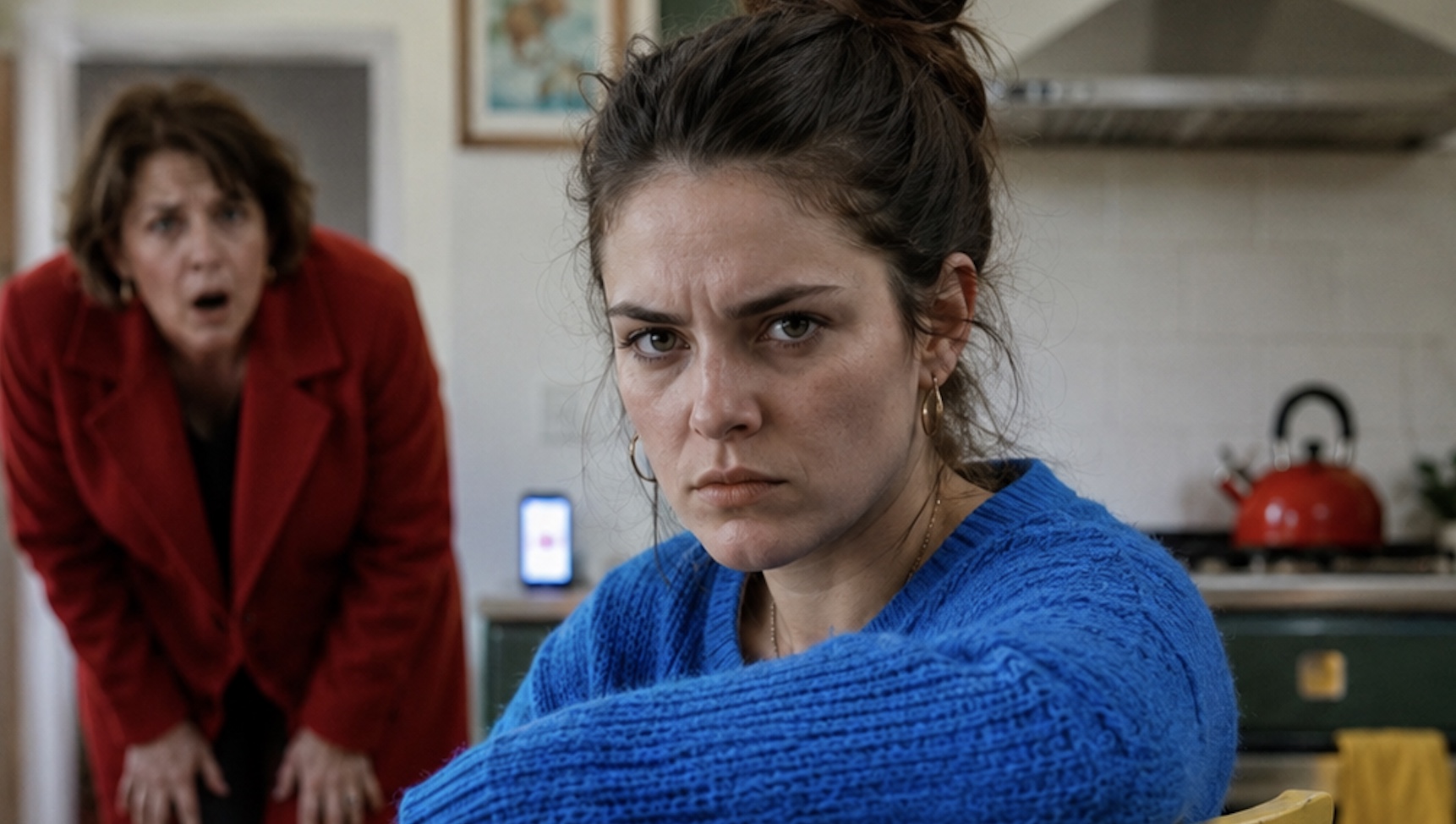
“Lena, are you going to pour me some soup, or should I open the fridge myself?” Svetka shouted from the kitchen without even taking off her boots. “I’ve had nothing but coffee since morning. My stomach is practically glued to my spine.”
Elena set the pot on the table and looked at her sister-in-law.
Svetka’s wet coat was thrown over the back of a chair. Dirty water dripped from her boots onto the linoleum. She placed her phone beside her plate like a regular customer in some cheap cafeteria.
“Don’t open the fridge,” Elena said. “It isn’t your wallet, and it isn’t a free food pickup point.”
“Oh, here we go,” Svetka said, reaching for the bread. “Why are you so prickly today? Just pour me some. You always cook extra anyway.”
“Extra for whom?”
“For family, Lena. Denis likes it when things feel normal at home.”
“Denis likes it when ‘normal’ happens at my expense.”
“What’s that supposed to mean?”
“It means I made this soup for two people. For myself and my husband. Not for you, not for your containers, and not for your mother’s friend Lyuda, who last Sunday carried off my baking dish with the words, ‘I’ll bring it back later.’”
“Lyuda felt awkward carrying meat in a plastic bag.”
“And I’m supposed to feel comfortable buying a new dish? Very family-like.”
“So now you’re counting every bite? Disgusting, Lena.”
“No, disgusting is spending two years silently chopping salads, washing trays, buying discounted meat, and listening to everyone praise me as a wonderful housewife because I can feed your entire bloodline up to the seventh generation with one chicken.”
“Our bloodline,” Svetka corrected her. “You’re Denis’s wife, so you’re one of us.”
“I’m Denis’s wife, not a cafeteria attached to your surname.”
“I came to my brother’s home.”
“This apartment is mine. My grandmother’s. Denis came here with a backpack, fishing rods, and the habit of throwing socks near the sofa. Your brother’s home is on Molodyozhnaya Street, at your mother’s place. Go there without calling.”
Svetka pushed her plate away, but she was in no hurry to leave.
“So now you’re going to throw square meters in my face?”
“No. I’m just reminding you whose door this is.”
“You’ve become greedy.”
“No. I’ve become tired. That’s a different condition. And it isn’t treated with borscht, but with the end of shamelessness.”
“I’ll tell Denis.”
“Tell him. Just don’t forget to add that you still ate the soup.”
“Go to hell.”
“Don’t pass the trash bin on your way out. Your jars from last week are in there.”
Svetka grabbed her bag, pulled on her boots, left two wet horseshoe marks on the floor, and slammed the door.
Elena didn’t move.
Her phone was already flashing: Denis.
In this family, news traveled faster than the smell of fried onions through an apartment block.
“What did you say to Svetka?” Denis didn’t even say hello. “She’s crying. She says you kicked her out.”
“I didn’t kick her out. I explained that free entry is closing.”
“She came in hungry.”
“For some reason, your whole family is always hungry near my apartment. Is your mother’s stove broken? Have the stores been canceled?”
“Don’t be sarcastic. Sveta is going through a hard time.”
“She got divorced three years ago. In that time, she could have learned how to boil buckwheat.”
“She’s my sister.”
“And I’m your wife.”
“Exactly. A wife should understand.”
“A wife should understand that when your mother comes on Saturday ‘for an hour’ and leaves at ten at night with a bag of cutlets, that isn’t family closeness. That’s a food raid. When your cousin sleeps in our living room for five nights and asks for ‘just another cup of tea,’ that isn’t a visit. That’s an unpaid hostel. When your mother takes half the aspic ‘because of her blood pressure,’ that isn’t medicine, Denis. That’s gastronomy.”
“You’re talking nonsense.”
“I’m finally saying what I should have said after the first Easter, when I dyed eggs at four in the morning and your mother said at noon, ‘Lenochka, there aren’t enough Easter cakes.’”
He was silent for a moment. Then a lighter clicked.
“We’ll talk tonight. Just don’t wind yourself up.”
“I’m not winding myself up. I’m unwinding everything.”
That evening, Denis came home with three supermarket chrysanthemums. The price tag, “199,” was still sticking out of the plastic wrap.
He held the bouquet out as if it were a pass back into comfortable silence.
“Here. Let’s not have hysterics. I understand you’re tired. But Mom is Mom, and Svetka is my sister. In our family, we stick together.”
“In your family, people come without calling and eat someone else’s dinner.”
“There you go again with ‘someone else’s.’ We’re family. What’s mine is yours, and what’s yours is mine.”
“Then where is your salary?”
“Oh, here we go.”
“No, this is where it continues. Utilities are nine thousand. Groceries for the month are forty. Plus your mother’s medicine, Svetka’s cake, meat for the May holidays. In two months, you contributed twelve thousand and a heart emoji in the comments. A heart emoji, Denis, doesn’t fry well in a pan.”
“You were keeping records?”
“Yes. The accounting department woke up late, but with enthusiasm.”
“Normal people don’t count who ate what.”
“Normal people ask whether they can come over.”
“What do you want?”
“I want your relatives to come only after calling. I want to be able to say no. I want holidays not to be automatically assigned to our apartment. I want you to transfer twenty thousand for shared household expenses. And I want you to stop promising people my apartment, my food, and my weekends.”
“Twenty thousand? I have a car loan.”
“The car is yours.”
“I drive you to the store in it.”
“When you need beer on sale.”
“You’re spitting poison today.”
“I swallowed it for two years. My body is returning it.”
“Lena, I’m a man. I have obligations to my mother.”
“And none to your wife? To the woman who cuts salad after work because your mother says, ‘Lenochka, Lyuda and I will drop by’? Who is Lyuda to me? An aunt? A neighbor? An honorary devourer of herring under a fur coat?”
“She’s my mother’s friend. She’s known me since childhood.”
“She doesn’t know me. But she knows where I keep my teaspoons.”
“You want to destroy the family over a pot of soup?”
“I want to stop destroying myself over a pot of soup.”
Denis paced around the kitchen, then suddenly said:
“Artyom is coming from Nizhny tomorrow. I told him he could stay with us. He’s coming for courses, hotels are expensive. He’ll sleep in the living room. You’ll just cook a little more.”
Elena slowly lifted her eyes.
“After all this, you’re telling me you’re moving your brother into my apartment tomorrow?”
“Cousin. And I’m not moving him in. I’m helping him.”
“When did you promise him?”
“Last week.”
“And you’re telling me today?”
“I didn’t know you were going to start a revolution.”
“And I didn’t know I had married the manager of a free hotel.”
“Don’t start.”
“I’m finishing. Artyom is not coming here.”
“He is. I already told him.”
“In this apartment, you don’t ‘tell’ anyone anything without me.”
“You’re humiliating me.”
“I’m returning you to your real size.”
He stepped closer. He smelled of cigarettes and anger.
“A wife shouldn’t shame her man in front of his relatives.”
“A man shames himself when he makes decisions about someone else’s home.”
“Someone else’s?”
“Mine. According to the documents, the bills, and the number of dishes washed.”
“Then I’m going to my mother’s. Think about it. You’ll call me yourself later.”
“I won’t.”
“We’ll see.”
“Look from the other side of the door.”
He slammed the door.
The chrysanthemums stayed on the table. Elena placed them in a pickle jar. The flowers weren’t to blame for being bought instead of respect.
In the morning, Tamara Sergeyevna wrote in the family chat:
“Lenochka, a home rests on a woman. When a woman starts counting plates, the home turns into a railway station.”
Elena replied:
“We had a railway station here for two years. The schedule is now canceled.”
Then Svetka wrote:
“Mom didn’t sleep all night. Denis didn’t either. Do you feel better?”
Elena typed “yes,” deleted it, and wrote:
“For the first time, I feel quiet.”
The chat exploded.
“Gotten too proud,” “humiliating your husband with housing,” “that’s not how you build a family.”
Elena wanted to turn off her phone, but then a separate message came from Artyom.
“Hi, Lena. Denis said you had an emergency, so I’ll rent a place. No hard feelings. I just wanted to ask: will he give you the money for my stay, or should I ask him to send it back?”
“What money, Artyom?”
“I transferred him twelve thousand. He said you don’t like taking money directly, but you needed to buy groceries and bedding. If I’m not coming, should he return it? Or should I leave it since you already bought everything?”
Something clicked inside Elena like an old lock.
“Please send me a screenshot.”
“Of course. I thought you knew.”
The screenshot arrived immediately:
“Denis P. — 12,000. Comment: lodging/food.”
Then Artyom wrote again:
“And my father sent him five thousand for Mom’s anniversary. Denis said you were barely managing and felt uncomfortable asking. Sorry if I’m interfering.”
Elena sat down right on the hallway floor.
She remembered that anniversary: her advance payment, two nights of cooking, twenty-seven thousand spent on the table, and Denis smiling at the guests: “It’s fine, we’ll manage.”
It turned out “we” meant she paid, while he quietly collected a tax from the relatives on her labor.
That evening Denis came with his mother and Svetka.
Tamara Sergeyevna held a bag of mandarins like a flag of truce. Svetka looked hostile, but she took off her boots at the door.
“We came to talk,” her mother-in-law said. “As a family. Without barbs.”
“Come in. I’m not promising tea. I no longer serve conflicts with boiling water.”
“See, Mom?” Denis spread his hands. “It’s impossible with her.”
“It’s possible if you answer questions. Denis, where are the twelve thousand from Artyom?”
He blinked.
“What?”
“The money for lodging and food. He transferred it to you because you told him I don’t accept money directly.”
Svetka sharply turned toward her brother.
“What twelve thousand?”
“Artyom offered it himself. I was going to tell you.”
“When? After I’d fed him for a week with my own money?”
“The money is on my card.”
“Show me.”
“What are you, an investigator?”
“Today, yes.”
“Denis, show her,” Tamara Sergeyevna suddenly said in a firm voice. “If the money was for Lena’s table, she should know.”
He unlocked his phone.
The screen showed transactions: gas station, car parts, sports bar, transfer to Roman for a debt. Balance: 426 rubles.
Svetka said quietly:
“Well, you housed Artyom nicely.”
“I’ll pay it back.”
“With what? Air from the balcony?” Elena asked. “And will you pay back the five thousand from Artyom’s father for your mother’s anniversary too?”
Tamara Sergeyevna went pale.
“What five thousand?”
“The ones he took supposedly for me. Because I was allegedly too embarrassed to ask.”
“Denis, is that true?”
“Mom, it was complicated. Lena was stressing about expenses, so I decided to back things up.”
“Back things up?” Elena gave a bitter smile. “That’s when you buy groceries. Not when your wife takes an advance to buy meat and you spend other people’s transfers at a sports bar.”
Svetka slowly sat down.
“Wait. What about Easter? I sent you three thousand. You said, ‘Lenka is stubborn, but she’s struggling. Just don’t tell her.’ Did you give it to her?”
Denis said nothing.
“I see.” Svetka covered her face with her hand. “And I even took an Easter cake home. I thought everything had been paid for. Lena, I really thought you knew.”
“I only knew that after Easter I had four hundred rubles and a pack of rice left until payday.”
Tamara Sergeyevna took off her glasses.
“Denis, how many times did you take money from us supposedly for Lena’s table?”
“Not supposedly! It was still for the family! The car is for the family too, debts need to be paid. What am I, a thief?”
“Yes,” Elena said.
“Have you lost your mind?”
“No. I called things by their proper name. You stole my money and my time. You stole money from your relatives. And on top of it all, you made me look like a greedy woman who, for some strange reason, was tired of feeding everyone for free.”
“I did what I could!”
“No, son,” Tamara Sergeyevna said quietly. “You got used to everyone else doing things around you.”
“Mom, you’re against me too?”
“I’m against lies. I sent you ten thousand for New Year’s. From my pension. You said Lena wanted to gather everyone, but she was proud and wouldn’t accept help. So she was buying everything alone and also listening to my advice. God, I’m ashamed.”
Elena hadn’t expected that.
In her mind, her mother-in-law had always been the commander of the food invasion. But it turned out the commander had also been paying for the war — only the cashier had been Denis’s pocket.
“I’m no better,” Svetka said hoarsely. “I took food because I thought we had contributed. I thought I wasn’t eating someone else’s food for free. But I was. Lena, forgive me. Late and badly, but forgive me.”
“Thank you,” Elena replied. “It doesn’t fix it, but the air feels cleaner.”
Denis slammed his palm against the table.
“Wonderful. All of you. Lena turned you against me.”
“Lena kept silent for two years,” his mother said. “You turned yourself against everyone.”
“You have until the end of the week to pack your things,” Elena said. “Leave the keys. Return the money to everyone you took it from ‘for the table.’ You will repay me half of the household expenses for the last three months. If you don’t, I’ll take the screenshots to the police. You took money from relatives by deception. This isn’t just kitchen drama anymore. This smells like a criminal case.”
“You want to put me in prison?”
“I want you to finally pay for your appetite. Not the stomach kind. The life kind.”
“We’re husband and wife.”
“We were. Back when I thought we were arguing about boundaries. Now it turns out the argument is about honesty.”
“Mom, say something to her!”
Tamara Sergeyevna stood up.
“Pack your things. You’re staying at my place tonight. Not as an offended little boy, but as a grown man who starts looking for extra work tomorrow. And don’t you dare call Lena greedy again. The greedy one here is you. Not for food, but for other people’s labor.”
Svetka sniffed.
“And you’ll return my three thousand too. I want to see you transfer money to someone other than yourself.”
“You’ve turned some cutlets into a tragedy,” Denis hissed.
“Not cutlets,” Elena said. “You were eating my life in small portions and asking for seconds.”
Denis packed angrily. He threw T-shirts around, cursed into the wardrobe, dropped chargers. At the door, he turned back.
“You’ll regret this. You’ll be left alone with your apartment and your rules.”
“That sounds better than being with you and your debts.”
“No one needs a woman with a character like yours.”
“My apartment and I are a good match.”
Tamara Sergeyevna lingered behind.
“Lena, I’m ashamed. Denis told me you liked gathering everyone yourself. May I call you tomorrow? Not to eat. To return what I owe and bring records of the transfers.”
“Call in advance. I’ll tell you whether it’s convenient.”
“That’s fair.”
Svetka stopped too.
“I’ll bring the containers back. All of them. And I’ll buy new ones. And… I really didn’t know everything.”
“Not knowing doesn’t erase the fact that you demanded soup today.”
“It doesn’t. I’d sink through the floor, but the linoleum is too nice. Good linoleum.”
When the door closed, the apartment didn’t become empty.
It became hers.
Elena opened the window. The smell of wet asphalt, fried onions, and gasoline drifted in from the courtyard.
An ordinary evening in a panel apartment block: someone upstairs was drilling, someone downstairs was arguing over parking, and life continued, even though a marriage had just gone off the rails.
The divorce didn’t happen quickly.
There were late-night messages from Denis: first, “I understand everything now,” then, “You destroyed me,” then, “No one will ever want you.”
There were apologies from relatives and silence from those who didn’t want to return money.
Denis didn’t pay back everything, but he paid back enough for the fear of a police report to start curing his forgetfulness.
Two months later, Elena was sitting in the kitchen with Tamara Sergeyevna.
Her mother-in-law had come after calling first and had brought a bag of buckwheat and a receipt.
“Don’t look at me like that,” she said. “Buckwheat was on sale. I bought some for myself and some for you. I’m leaving the receipt so we never have underground economics again.”
“Impressive progress.”
“I’m shocked myself. I discovered that one can visit someone and not expect a feast. I sit at home and eat my own soup. Still alive.”
“How is Denis?”
“He works as a courier after his job at the service center. Angry, thinner, but paying money back. He grumbles that you turned everyone against him. I tell him, ‘Son, you simply heard the sound of the feeding trough closing.’ He doesn’t like my poetry.”
“You’ve changed.”
“No. I just saw that I raised not a provider, but a consumer with pretty words. That hurts more than blood pressure. You can lower blood pressure with a pill. But this… you sit at night and wonder where you patted him on the head when you should have smacked some sense into him.”
The doorbell rang.
Elena tensed.
“Don’t open it if you’re not expecting anyone,” Tamara Sergeyevna said. “A great rule. Shame I only learned it at sixty-two.”
Through the peephole, Svetka stood with a bag.
“It’s me! Not a hungry visit. I brought the containers. Two new ones too. One is ugly and blue, but airtight. And I’m not asking for soup. I made my own at home. The potatoes fell apart, but I’m calling it an author’s presentation.”
Elena opened the door.
“Come in for ten minutes. Take off your shoes.”
“Already did. And I brought mandarins. Sweet ones. I checked. Not like Mom’s sour symbols of repentance.”
“I can hear everything,” Tamara Sergeyevna said.
“Good, Mom. We’re all about transparency now.”
Svetka put the bag on a chair.
“Lena, I really am ashamed. Not just about the money. About deciding that your time belonged to no one. After my divorce, I was furious whenever my ex came ‘for the drill’ and ate dinner. And then I was doing almost the same thing. It’s convenient to be a victim until you catch yourself holding someone else’s cutlet.”
“The cutlet was mine.”
“I know. A historic cutlet.”
Elena looked at them and understood: the unexpected ending wasn’t that Denis had turned out worse than she thought. In everyday life, betrayal often walks around in slippers and asks you not to make a fuss.
The unexpected part was something else.
The two women she had considered the enemy camp had also been living inside his convenient lie. They took because they had been told everything was paid for. They became shameless because they had been allowed to believe Elena had agreed. And when the truth came out, not everyone rushed to save Denis.
Someone looked at the plate for the first time and asked whose it was.
“You know what’s funny?” Elena said. “I cook less now, but the food tastes better.”
“Because there’s no resentment in it,” Tamara Sergeyevna said.
“And because my face isn’t hanging over the pot,” Svetka added. “My face is appetizing, but shameless.”
They laughed without hugs or sugary music.
Just three women on old stools in an ordinary two-room apartment, where a note hung on the fridge:
“Without an invitation — do not enter.
Without contribution — do not demand.
Without honesty — not family.”
When the guests left exactly forty minutes later, Elena locked the door.
Not out of fear.
Out of the habit of protecting what had finally become hers not only on paper.
She placed a small pot on the stove, poured in enough water for one portion of pasta, thought for a moment, and added a little more.
Not because someone might show up.
Because tomorrow she would take the leftovers to work and calmly eat them herself.
The free cafeteria had closed.
The home remained.
And for the first time in a long while, it smelled not of someone else’s appetite, but of freedom, onions frying in butter, and a normal adult life where every plate doesn’t always have to be paid for with money — but always with respect.