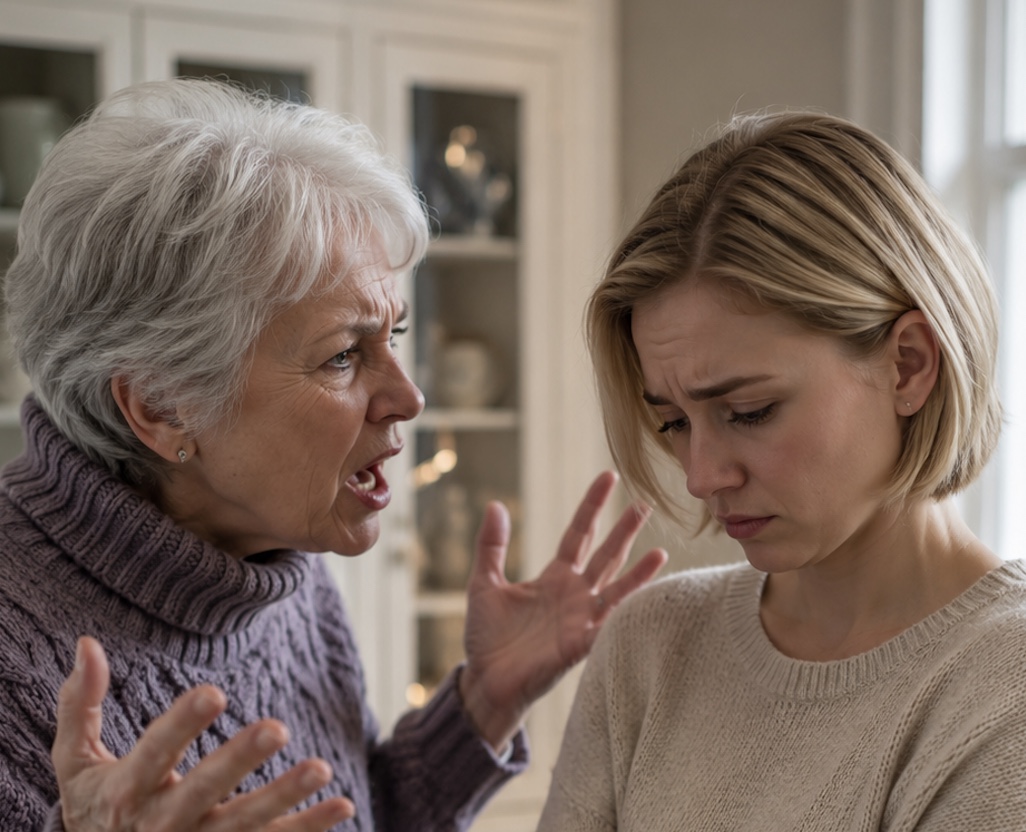
December settled over the city with wet snow and early darkness.
Nina was standing at the kitchen table, dividing dinner onto plates, when Dmitry’s phone suddenly rang. He answered, listened for a minute, nodded, and said only one word:
“Fine.”
“My mother called,” he said, without looking up from his screen. “We’re celebrating New Year’s at our place. Everyone’s coming.”
Nina slowly set the frying pan back on the stove. Something unpleasant stirred inside her, but she forced herself to stay calm.
“Dmitry, was anyone planning to discuss this with me? We could have decided together where and how to celebrate.”
“What’s there to discuss?” He shrugged. “We have the most space. Mom said it, so that’s how it’s going to be. It’s not hard for you. You always cook so well.”
“Not hard?” Nina breathed out quietly. “Twelve people, Dmitry. Three days of cooking. Gifts for everyone. Decorations. Cleaning before and after. That’s what you call ‘not hard’?”
“Well, Alla will help. Probably.” He waved vaguely and went back to his phone.
Nina sat across from him and folded her hands on the table. She looked at her husband — this grown man who turned into an obedient little boy whenever his mother was involved. She wanted to believe he simply didn’t understand how much work this would be.
“All right,” she said at last. “But let’s at least divide the responsibilities. You handle drinks, salads, and cleaning the living room. I’ll take care of the main dishes and desserts. Deal?”
“Mm-hm,” Dmitry muttered, without lifting his eyes from the screen.
The next day, Tamara Sergeyevna called. Her voice sounded as if she were commanding an army unit.
“Nina, I sent you a list. Everything we need is there. Olivier salad is a must, aspic is a must, duck is a must. And put up a proper Christmas tree, not that plastic stick of yours.”
“Tamara Sergeyevna, maybe everyone could bring one dish? It would be fairer that way,” Nina suggested carefully.
“What do you mean, fairer?” outrage rang through the phone. “You’re the hostess of the house, so you cook. Alla will buy pastries, don’t worry. Pavel will bring wine. That’s it, I have to go.”
The call ended.
Nina looked at the phone and slowly placed it on the table.
Patience. That was what she needed now.
Just patience.
That evening, she tried to talk to Dmitry again.
“Have you seen your mother’s list? There are twenty-three items on it. Twenty-three, Dmitry. Including homemade bread and pickled mushrooms.”
“Well, she likes things to look nice,” he said, reaching for the TV remote. “You’ll manage. I believe in you.”
“I’m not asking you to believe in me. I’m asking you to help.”
“I will, I will. Later.”
That “later” hung between them like a bridge that would never be built. Nina closed her eyes and counted to ten. She was still hoping he might hear her.
Two days later, Nina was sitting in a café with Zhanna and Kira. Zhanna was stirring her cappuccino with sharp, energetic movements, while Kira thoughtfully twisted a napkin between her fingers.
“Wait,” Zhanna raised her palm. “So you’re supposed to set a table for twelve mouths all by yourself, buy gifts for his entire family, decorate the apartment, and smile while doing it?”
“Something like that,” Nina nodded.
“And what is Dmitry doing?”
“Dmitry will ‘help later,’” Nina said, making quotation marks with her fingers. “That’s his universal answer to everything.”
Kira put the napkin down and looked at her friend seriously. Kira always thought three steps ahead.
“Nina, why are you exhausting yourself at all? Every year it’s the same thing: you work yourself to the bone, they come, eat, criticize everything, and leave. Then they discuss until March how the salad wasn’t salty enough.”
“Because that’s what people do. Because I’m Dmitry’s wife.”
“No,” Zhanna slapped her palm against the table. “What people do is help each other. When one woman serves an entire crowd, that’s called something else.”
“So what are you suggesting? That I refuse?”
“Not refuse,” Kira smiled faintly. “Set priorities. Tell me this: has anyone in his family ever sincerely thanked you? Has anyone ever given you something from the heart?”
Nina thought about it.
For a long time.
“My mother. My own mother. You, Zhanna. And you, Kira. That’s it.”
“There you go,” Kira raised a finger. “Now listen. You have a gift budget. You are not obligated to buy gold earrings for Tamara Sergeyevna, who didn’t even unwrap your present in front of you last year.”
“She did unwrap it later…”
“A week later, Nina. A week. And Alla? Remember when you bought her perfume? Expensive French perfume?”
“I remember.”
“And what did she say?”
Nina fell silent. Alla had turned the bottle in her hand, sniffed dismissively, and said, “I don’t use things like this.”
“Exactly,” Zhanna slapped her own knee. “So here’s the plan. His family gets symbolic gifts. Nice, neat, but no self-sacrifice. Mittens, mugs, magnets — whatever. Your mother, us, yourself — you buy what you actually want to buy. Love isn’t measured by price, but respect must go both ways.”
“They’ll be furious,” Nina said, nervously running her fingers along the rim of her cup.
“So what?” Kira shrugged. “They’re unhappy every year anyway. The difference is that this time, you’ll save both your nerves and your money.”
“And Dmitry?”
“Dmitry will receive exactly as much attention as he invests himself. Not one gram more.”
Nina sat in silence for a full minute. Then she slowly nodded.
“All right. I’ll try.”
“You won’t try,” Zhanna squeezed her hand. “You’ll do it. We’re with you.”
On her way home, Nina stopped by a gift shop. She wandered between the shelves for a long time. For her mother, she chose a silver necklace with turquoise — Zinaida Pavlovna adored that stone. For Zhanna, a set of rare spices with a handmade card. For Kira, a leather notebook with engraving.
Then she went over to a stand with knitted little things. She picked up a pair of mittens with reindeer on them — soft, funny, three hundred and twenty rubles. She turned them over in her hands. Smiled. And put them in her basket.
Perfect for Tamara Sergeyevna.
On December twenty-ninth, Nina was cooking.
Alone.
Dmitry had promised to buy groceries, but he brought only half the list and a bag of chips “for himself.”
“Dmitry, where is the duck?”
“The duck? What duck?”
“The one you promised to buy. Three days ago. I even sent you the address of the farm.”
“Oh, I forgot. Fine, I’ll buy it tomorrow.”
“Tomorrow is the thirtieth. The guests are coming the day after tomorrow.”
“Then the morning after tomorrow,” he said, collapsing onto the sofa and turning on the television.
Nina felt something inside her begin to cool. It wasn’t anger — anger would have been hot. This was something else. Cold and clear, like a winter sky.
Alla called.
“Nina, hi! Listen, I won’t have time to buy the pastries. I have things to do. Can you get them? I’ll pay you back later.”
“No,” Nina replied.
A pause.
“What do you mean, no?”
“I mean no, Alla. You promised, so you buy them. If you don’t have time, then there won’t be any pastries. I’m already cooking for twelve people by myself.”
“Well, you’re at home anyway, it’s easier for you…”
“I am not sitting at home, Alla. I have been standing by the stove for three days. Goodbye.”
Nina ended the call and felt a strange pleasure. Small, but distinct. Like the first sip of water after a long thirst.
On the evening of the thirtieth, her mother called.
“Ninochka, how are you? Are you managing?”
“I’m managing, Mom. I’m just tired.”
“My dear girl, don’t forget yourself in all this fuss. You are more important than any Olivier salad.”
“Thank you, Mom. I love you so much.”
“I love you too. I’ll come early tomorrow and help however I can.”
Nina put down the phone and, for the first time that week, felt warmth. Real warmth, not forced politeness. Zinaida Pavlovna always knew how to find the right words. Not orders, not demands — just love.
On the morning of the thirty-first, Ruslan arrived. He brought a crate of mandarins and a pack of sparklers.
“Nina, hi! I know I’m early. But I thought maybe you needed help?”
“Ruslan, you are the only normal person in my husband’s circle,” Nina burst out laughing.
“Well, Dmitry isn’t too bad either when he’s not asleep,” Ruslan winked and rolled up his sleeves. “Come on, give me orders. What do I chop?”
Together, they set the table in three hours. Dmitry woke up around noon, saw the almost finished table, and raised his eyebrows in surprise.
“Oh, already done? I was thinking of helping…”
“You were ‘thinking.’ That’s the key word,” Nina said quietly, turning back toward the oven.
By six in the evening, the guests began to arrive.
Zinaida Pavlovna came first — quiet, smiling, carrying a box of homemade sweets. Then came Dasha, the neighbor from the third floor, who had been invited for company.
“Nina, everything looks beautiful!” Dasha looked around the living room. “The tree, the garlands, the table — wonderful.”
“Thank you, Dasha. Come in, make yourself comfortable.”
Then Pavel arrived — loud, confident, carrying one bottle of champagne for the entire group. Alla came after him — without pastries, of course. Lyosha arrived with a girlfriend whose name no one had properly remembered. And finally, Tamara Sergeyevna swept in last, wearing a burgundy dress and a hairstyle worthy of a formal reception.
“Well, we’ll see,” she said, scanning the table. “No duck?”
“Dmitry was supposed to buy the duck,” Nina answered calmly.
Tamara Sergeyevna turned her gaze to her son. He lowered his head into his shoulders.
“I forgot, Mom.”
“Forgot?” She pressed her lips together. “Fine. Nina, why didn’t you check?”
Nina silently placed a dish of roasted beef on the table.
She didn’t answer.
She simply didn’t answer.
And that silence was louder than any shout.
The clock struck midnight. Champagne had been poured, the chimes had rung, everyone had kissed and settled around the tree. It was time for presents.
“So, shall we begin?” Pavel rubbed his hands together. “Who’s first?”
“I’ll start,” Nina said, standing up and handing out the packages.
Lyosha received a travel mug with the words “Don’t boil over.” He turned it in his hands, snorted, and set it aside. His girlfriend quietly thanked Nina for a small box of chocolate truffles.
Pavel got a book of quotes about patience. He flipped through it, smirked, and put it down.
Dmitry opened his little box and took out a key-shaped keychain — small, metallic, engraved with the word “Home.”
“Is this… symbolic?” he asked, raising his eyes.
“Exactly,” Nina nodded. “A symbol that a home is a shared responsibility. Not only mine.”
Dmitry swallowed and put the keychain in his pocket.
Alla received a scented candle and twisted her mouth, but said nothing.
Then Nina walked over to Tamara Sergeyevna and handed her a neatly wrapped parcel.
Tamara Sergeyevna unwrapped it slowly and ceremoniously, as if expecting diamonds.
A pair of knitted mittens slipped out of the wrapping paper.
Soft, rust-colored mittens with cheerful reindeer on the back.
Silence.
“What… is this?” Tamara Sergeyevna lifted the mittens with two fingers, as if they were something filthy.
“Mittens,” Nina smiled. “Handmade. Very warm.”
“Mittens,” her mother-in-law repeated. “You are giving me mittens. And your mother gets that?”
She pointed toward Zinaida Pavlovna, whose silver turquoise necklace shone around her neck.
“Yes,” Nina said without looking away. “My mother gets a necklace. You get mittens. Everyone receives what they have earned.”
“What they have earned?!” her mother-in-law’s voice shot up an octave. “How dare you? I am your husband’s mother! I deserve respect!”
“Respect is not the price tag on a gift, Tamara Sergeyevna.”
“Alla!” the older woman turned to her daughter. “Do you hear this? Do you hear how she’s speaking to me?”
Alla switched on instantly, as if she had been waiting for her cue.
“Nina, you’ve completely lost your mind. Mom waited all year for this holiday, and you give her mittens? This is humiliation!”
“Humiliation is when someone cooks alone for three days and then gets scolded for the absence of a duck that someone else was supposed to buy,” Nina said, looking directly at Alla.
“You didn’t buy us pastries either, by the way,” Pavel added.
“Alla was supposed to bring the pastries. That was her only task. One task out of twenty-three.”
“Girls, maybe some tea?” Dasha timidly rose from her chair. “I have gingerbread, if needed…”
“Sit down, Dasha,” Tamara Sergeyevna snapped. “This is a family matter.”
Ruslan cleared his throat.
“People, let’s breathe. It’s New Year. Maybe we should dance?”
“What dancing?!” Tamara Sergeyevna threw the mittens onto the sofa. “I have just been publicly humiliated! My son married a woman who cannot show basic gratitude!”
“Gratitude for what?” Nina’s voice became quiet and steady. “What exactly should I be grateful for, Tamara Sergeyevna? For the fact that I serve your family every holiday? For the fact that I buy you expensive gifts, which you then give away?”
A short pause.
Her mother-in-law flinched.
“What nonsense are you talking about?”
“The bracelet I gave you for March eighth,” Nina turned to Alla. “Alla, show everyone your right wrist.”
Alla instinctively hid her hand behind her back.
But everyone had already seen it — a thin silver bracelet with amethysts. The same one Nina had bought for Tamara Sergeyevna in the spring.
“This… she gave it to me. Voluntarily,” Alla stepped back.
“Of course. Voluntarily,” Nina nodded. “Just like the earrings two years ago. And the shawl the year before that. You accept gifts, pass them to your daughter, and then complain that I don’t respect you. A perfect circle, Tamara Sergeyevna.”
“Dmitry!” his mother turned to him. “Say something! Your wife is interrogating me on New Year’s Eve!”
Dmitry slowly stood up.
Everyone looked at him.
Nina did too.
She was waiting.
Maybe for the last time.
“Mom,” he cleared his throat. “Well, I mean… Nina is probably tired. Let’s just…”
“Probably tired?” Nina turned sharply toward her husband. “Seriously? That’s all you can say?”
“What do you want from me? To choose between my mother and you?”
“I want you to be honest. At least once. To actually think with your own head.”
Alla stepped forward and jabbed a finger toward Nina.
“You know what? You’ve always been an upstart. You came into this family with nothing and now you’re giving orders!”
Nina looked at the finger pointed at her face. Then she looked at Alla — at her contemptuously pursed lips, at the bracelet she wore as if it were her own.
And something clicked.
Not anger.
A decision.
Nina caught Alla’s hand, moved the finger aside, and slapped her hard across the face.
Once.
Clear and sharp.
Like a period at the end of a sentence.
Alla stumbled back, clutching her cheek. Her eyes went round, her mouth fell open.
“You… you hit me?” she whispered.
“I put an end to it,” Nina answered. “No one. Ever. Will point a finger in my face inside my own home.”
The room froze.
Lyosha sat gripping the armrest of his chair. His girlfriend stared at everything with wide eyes. Zinaida Pavlovna sat quietly in the corner, not interfering — she knew her daughter and trusted her.
“This is my apartment,” Nina continued. “It is registered in my name. Bought with my money before the wedding. Everyone sitting at this table is here because I allowed it. Not because anyone has a right to be here.”
“Dmitry!” Tamara Sergeyevna grabbed her son by the sleeve. “Get this… this…”
“This what?” Nina took a step forward. “Finish the sentence, Tamara Sergeyevna. But choose your words carefully — you are still a guest here.”
Her mother-in-law opened her mouth and closed it. Then opened it again.
For the first time in many years, she had nothing to say.
In the silence that followed, Lyosha’s girlfriend spoke softly. She had been sitting in the corner and had not said a single word until then.
“Excuse me,” she raised her hand like a schoolgirl. “I probably shouldn’t get involved. But I think Nina has the right to know.”
“To know what?” Lyosha went pale. “What are you doing?”
“Lyosha, be quiet,” the girl said, taking out her phone. “Nina, come here.”
Nina walked over.
A conversation was open on the screen. A group chat called “Family.” Participants: Tamara Sergeyevna, Alla, Pavel, Lyosha.
And Dmitry.
The girl scrolled through messages from the last two months. Nina read in silence.
Tamara Sergeyevna: “Nina will probably be cheap with the gifts again. Dmitry, hint to her that I need a fur coat. At least a mink vest.”
Alla: “She has no idea how to behave. She needs to be kept under control. Dmitry, you’re spineless.”
Pavel: “Let her cook, let her buy everything. She’s the only one with a decent income anyway. She won’t go broke.”
And Dmitry.
His message.
One short line:
“Fine, I’ll handle it.”
Nina lifted her eyes from the screen. She looked at her husband. Then at her mother-in-law. Then at Alla, who was still holding her cheek.
“So. ‘I’ll handle it,’” Nina said.
“Nina, it’s not what you think,” Dmitry jumped up. “It’s just chatter. Mom writes things, and I answer just to keep her quiet…”
“To keep her quiet,” Nina repeated. “You write that while your mother and sister discuss how to squeeze more out of me. And you stay silent. As always. Silence means agreement. Spineless.”
“This is private correspondence!” Alla shrieked. “That girl had no right to show it!”
“She did,” Lyosha’s girlfriend stood up. “Because it disgusts me to sit at the table of a person who is being discussed behind her back like a cash cow. One family dinner was enough for me to understand everything.”
“Lyosha! Remove her!” Tamara Sergeyevna barked.
Lyosha said nothing.
Then he quietly spoke.
“No, Mom. She’s right. We all know it. No one just said it out loud.”
Tamara Sergeyevna turned crimson. She looked at Pavel, searching for support. Pavel lowered his eyes.
“Ruslan,” Nina turned to the family friend. “Call taxis for Tamara Sergeyevna, Alla, and Pavel. Three different addresses.”
“Already doing it,” Ruslan said, taking out his phone without a second’s delay.
“You’re kicking us out?!” Tamara Sergeyevna gasped. “On New Year’s Eve?!”
“I am releasing you,” Nina said, taking their coats from the rack. “You are free. You no longer have to endure my cooking, my gifts, or my home. Consider it my New Year’s present.”
“Dmitry!” Tamara Sergeyevna called out one last time.
Dmitry stood in the middle of the room. The keychain lay in his pocket. A symbol of a home he had never learned to value.
“Nina, let’s talk,” he took a step toward his wife.
“No,” she raised her hand. “The talking is over. You chose your side long before tonight. You simply didn’t have the courage to tell me.”
Dmitry froze.
He understood that the look in her eyes was not hurt and not anger.
It was indifference.
The most frightening thing that can happen between two people.
Tamara Sergeyevna silently put on her coat. Alla, still pressing her hand to her cheek, grabbed her bag. Pavel slipped out first without saying goodbye.
“You will regret this,” her mother-in-law threw over her shoulder from the doorway.
“Maybe,” Nina nodded. “But not today.”
The door closed.
Left in the apartment were Nina, Zinaida Pavlovna, Ruslan, Dasha, Lyosha with his girlfriend.
And Dmitry — confused, pitiful, not knowing what to do with his hands.
Zinaida Pavlovna came up to her daughter and silently embraced her. Dasha quietly poured tea. Ruslan turned on music — low and calm. Lyosha looked at Nina and said:
“I’m sorry. For all of us.”
“You don’t have to apologize for other people, Lyosha,” Nina answered. “Everyone answers for themselves.”
Lyosha’s girlfriend touched Nina’s hand.
“You are very strong.”
“No. I just got tired of being convenient.”
Dmitry was still standing in the middle of the room. Nina approached him and said quietly:
“Take your things. Spend the night at Ruslan’s, at your mother’s, wherever you want. We’ll talk in the morning. But not now.”
“Nina…”
“Not now, Dmitry.”
He slowly picked up his jacket and left. Ruslan silently followed him — to drive him, and to make sure he didn’t do anything stupid.
Nina sat down at the table. Poured herself a glass of champagne. Raised it.
“Happy New Year,” she said. “To a new beginning.”
Zinaida Pavlovna raised her glass.
“To you, my daughter.”
Dasha clinked glasses quietly from the edge of the table.
“Are there any other gifts?” she whispered. “Because I still haven’t managed to grab a mandarin.”
Nina laughed.
Honestly, from the heart, without looking over her shoulder.
In that moment, she understood: the room had not become emptier.
It had become freer.
Three days later, Nina learned something else.
Dasha called and told her that Tamara Sergeyevna had been renting out her three-room apartment for two months — the very apartment that was supposedly “cramped and cold” — to acquaintances at an inflated price. She had been planning to move in with Dmitry and Nina after New Year’s “until spring.”
Because there had been one more message in the family chat, one Lyosha’s girlfriend hadn’t had time to show:
“After the holidays I’ll tell Nina a pipe burst. Dmitry has already agreed.”
Nina reread the forwarded message, put down the phone, and walked to the window. Outside, snow was falling — quiet, peaceful, indifferent to all human schemes.
She dialed Zhanna.
“Happy New Year, Zhanna.”
“Happy New Year! So how did it go?”
“You know, I gave out mittens with reindeer. And it turned out to be the best gift I’ve ever given.”
“Mittens?”
“Yes. They showed me who everyone really was. It’s a shame it took five years.”
“At least it wasn’t ten. You did well, Nina.”
“I know,” she said.
And ended the call.
Tamara Sergeyevna never moved in. Alla stopped calling. Pavel disappeared as if he had never existed.
And Dmitry stood at the doorway a week later — with flowers, apologies, and promises.
But the lock on the door was already different.
New.
Shining.
Like a new life.