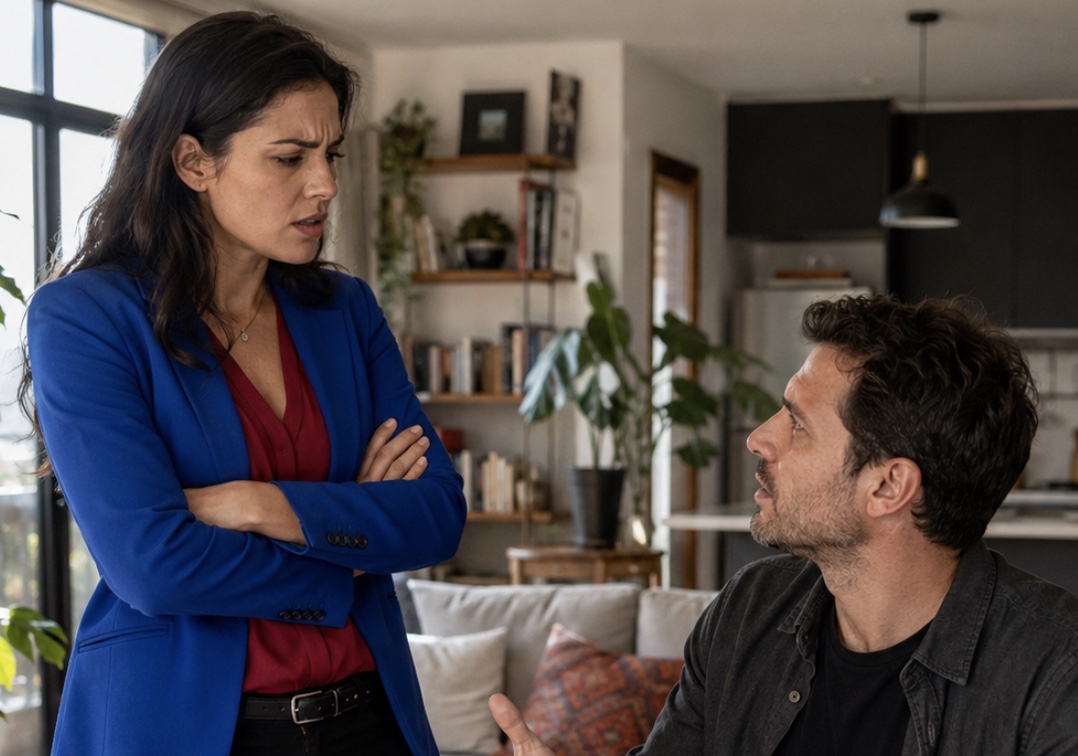
“Sveta, can you please explain to me like a normal person why you need a third pair of winter boots? They all look exactly the same!” Denis stood in the bedroom doorway holding a large shopping bag with the logo of an expensive shoe boutique. He stared at his wife with that peculiar mixture of confusion and irritation people get when they genuinely cannot understand someone else’s happiness.
Svetlana, sitting on the ottoman in front of the mirror, merely sighed. She had just come home after a ten-hour workday and hadn’t even had time to make herself a cup of coffee, and now she was already being interrogated. She hadn’t bought the boots simply because she “wanted something new.” Last year’s pair had cracked at the bend and started leaking. Besides, she had received a good quarterly bonus. Surely she was allowed to treat herself once in a while.
“Denis, first of all, they’re not my third pair. They’re my second,” she said, removing the clip from her hair and slowly combing through the tangled strands. “Second, it’s my money. I earned it. We’ve had this conversation a thousand times.”
“Oh, come on, this isn’t about ‘your money’ and ‘my money’!” Denis tossed the bag onto the bed as though it contained evidence from a crime scene. “There’s something else going on. I promised Mom I’d help her. Her kitchen faucet is leaking. She needs a new mixer tap, and we’ll have to pay a plumber too. Meanwhile, you’re spending sums that could finance a small town.”
Svetlana froze, the hairbrush suspended in her hand.
So that was what this was about.
Olga Borisovna’s faucet.
Her mother-in-law, whose life was always supposedly more difficult than everyone else’s. The same woman Svetlana already transferred money to every month “for household expenses.”
“What about your sister?” Svetlana asked quietly. “Karina lives nearby. Couldn’t she contribute toward the faucet? Why are we automatically expected to pay for everything?”
Denis snorted.
Whenever the conversation touched his family, he had a habit of avoiding direct answers. He would wave his hand, walk toward the kitchen and mutter something about how “you can’t compare situations” or “they don’t have a family that can afford to chip in.”
Svetlana knew the performance by heart.
For seven years, she had been playing the role of sponsor.
She had met Denis when she was twenty-seven. By then, Svetlana was already firmly on her feet. She worked as a senior accountant for a large logistics company, rented a good apartment and later took out a mortgage on a place of her own.
At the time, buying that apartment had felt like an impossible achievement. Years later, the two-bedroom flat in Butovo remained one of her proudest accomplishments. She had organized the renovation herself, hired the construction crew, chosen the bathroom tiles and laminate flooring, and even assembled much of the kitchen according to the plans because a fully installed version had been ridiculously expensive.
Denis had entered her life at exactly the right moment.
He was pleasant, attentive and generous with kind words. He worked as a manager at an auto repair shop. His salary was average, but dependable. He wasn’t dazzling or ambitious, but he knew how to listen.
And Svetlana, exhausted from years of loneliness, had wanted exactly that: someone warm, simple and reliable beside her.
They married quickly and without any grand celebration. They registered the marriage officially and then had dinner with a few friends at a café.
That was when Olga Borisovna first revealed what she was really like.
She spent the entire evening wearing a sour expression and later loudly remarked that the wedding could have been “a little more respectable, so people wouldn’t be embarrassed for them.”
But that was only the beginning.
The real problems came later.
A year after the wedding, Svetlana’s father died suddenly from a heart condition. He left her his two-bedroom apartment in Altufyevo. It was old but solid, with a huge enclosed balcony overlooking a park.
Svetlana loved that apartment deeply.
It was where she had grown up. Her mother had baked pies there. The bookshelves still seemed to carry the faint smell of her father’s tobacco.
She couldn’t bring herself to sell it, so she rented it out instead. The rental income went toward paying off the mortgage on the Butovo apartment, making their finances considerably easier.
And that was exactly when Olga Borisovna seemed to lose all restraint.
At first, the comments sounded almost harmless.
“Svetochka, don’t you think this is somehow… not very Christian?” her mother-in-law once asked over dinner while spearing a pickle with her fork. “You own two apartments, while Denis doesn’t really own anything in either of them. Isn’t it strange to keep your husband living on borrowed rights?”
Svetlana laughed it off at the time.
Borrowed rights? They lived together. They were married. Everything was fine.
Still, the remark left an unpleasant aftertaste.
Then the hints became more specific.
Olga Borisovna’s household consisted of herself, her perpetually unemployed daughter Karina—who alternated between calling herself a massage therapist, a tarot reader and some new profession every few months—and Karina’s teenage son from a failed first marriage.
The three of them lived in a run-down Khrushchev-era apartment on the outskirts of the city, where the plumbing was constantly blocked and wallpaper peeled from the walls.
And somehow, without anyone ever officially saying it, it became understood that successful Svetlana was supposed to rescue her husband’s relatives.
“Sveta, they need a new refrigerator. The old one died,” Denis would say in the evening while wiping fingerprints from his phone screen. “I can pay for it from my salary, but then we won’t be able to go on vacation this year.”
And Svetlana would transfer the money.
Forty thousand rubles for a refrigerator.
Twenty thousand for a washing machine.
Ten thousand for Karina’s latest “coaching course.”
Another fifteen thousand because she needed “just a little help until Wednesday.”
It felt like trying to swim through a swamp. The harder Svetlana struggled, the deeper she sank.
She tried talking to Denis. She explained that she was tired of being treated like a cash machine.
Denis became offended.
He accused her of being spoiled because she had apartments and an office job. He said she had no idea how difficult life was for “ordinary people.”
And almost every conversation ended with the same phrase:
“My mother already doesn’t like you very much, and you don’t even try to improve your relationship with her.”
That was the most destructive part.
The guilt.
Mother and son cultivated it together.
The breaking point came in November.
Svetlana received a promotion. She was appointed financial director of her branch, and to celebrate, she bought herself a car.
It wasn’t brand-new, but it looked nearly perfect: a three-year-old silver Korean crossover. She had already imagined taking Denis on a road trip around Russia’s Golden Ring in it.
She financed the car, but the down payment came entirely from a bonus she had saved.
Olga Borisovna and Karina arrived the very next day, almost as though they had a tracking device monitoring Svetlana’s purchases.
Officially, they had come to congratulate her.
They sat around the table drinking tea.
Karina, well groomed but covered in cheap gold-colored jewelry, kept glancing at the new vase on the dresser.
Olga Borisovna soon began one of her favorite routines.
“Nice car, Svetochka. Must have been expensive. Bought it on credit?” she asked, blowing on her tea while studying Svetlana with cold, calculating eyes.
“Partly. I’ve already worked everything out. I should be able to pay it off in about eighteen months,” Svetlana replied, cutting the sponge cake.
“Mom and I came here by bus today,” Karina added with a theatrical sigh. “Packed like sardines. Hot, crowded. Some women really have a talent for dragging everything into their own little nest.”
Svetlana felt her shoulders tense.
But she desperately wanted peace.
She looked at Denis, hoping he would say something.
As usual, he buried himself in his phone and pretended not to hear.
And that was when Svetlana decided to make a genuine gesture of goodwill.
She pulled the new car keys from her handbag and placed them on the table.
“Olga Borisovna, why don’t I drive you and Karina to the country house this weekend? I know you wanted to bring back those jars of preserves. There’s no reason to struggle with them on the bus. I can take you in the new car, get some driving practice, and we can sit on the veranda and make barbecue.”
She smiled.
She truly meant it.
She thought it was the kind of simple gesture that might soften years of tension.
Silence fell over the room.
Olga Borisovna carefully placed her cup back onto its saucer.
The thin clink of porcelain suddenly sounded strangely sharp.
Her wrinkled face went still. Then it twisted into an expression Svetlana initially mistook for hurt.
But it wasn’t hurt.
It was fury.
“What exactly was that supposed to mean?” her mother-in-law demanded, her voice turning metallic. Svetlana had only heard that tone before when Olga Borisovna argued with neighbors at the country house. “Have you decided I’m some helpless old woman who needs a chauffeur? Or do you just want an excuse to parade your new toy in front of us poor, miserable creatures?”
“What?” Svetlana stared at her.
The keys lay innocently on the tablecloth.
“I was only offering to help. You said yourself that—”
“Help!” Karina cried dramatically, throwing up her hands so that her bracelets jingled. “We know what your kind of help looks like. You throw us scraps like beggars outside a subway station, and then congratulate yourself for being so generous.”
Denis finally looked up from his phone.
But he wasn’t looking at his wife.
He was watching his mother, and there was more fear in his expression than any desire to understand what was happening.
“Sveta, why did you have to say it like that?” he muttered. “It does sound awkward.”
“What sounds awkward?”
“Denis, explain to your wife how ordinary people live!” Olga Borisovna snapped, pushing back her chair.
She was short, yet in that moment she seemed to fill the entire kitchen.
“You think we don’t see what’s going on? You think we’re blind? You rent out Daddy’s apartment and pile up money! You buy cars, clothes, whatever you want. And what does my son have? He stands in your life like an old piece of furniture shoved into a corner!”
“Stop,” Svetlana said softly.
A lump rose in her throat.
It wasn’t anger anymore.
It was exhaustion.
“No, I will not stop!” her mother-in-law shouted, pointing at her. “You don’t see us as people! You spend your life doing accounting, counting every little thing. You think you can buy our respect by driving us to the country house? You’re like a cat bringing home a dead mouse and expecting applause! We’re just another project to you. You help because you think you’re morally obligated to. Deep down, you despise us because we don’t have fancy apartments and cars. But remember this, sweetheart—money doesn’t buy happiness!”
Svetlana stared at her mother-in-law’s flushed face and hardly recognized the woman.
Something had finally burst.
This wasn’t really about the car keys.
These words had been accumulating for years.
This was envy in its purest form, finally given permission to come out.
“You’re wrong,” Svetlana said, her voice trembling despite her attempt to remain composed. “I have never looked down on you. Never. I simply work hard. And yes, I own two apartments. I didn’t steal them. One came from my father, who worked twelve-hour shifts at a factory. I help you because you are my husband’s family. But I am not obligated to be your ATM.”
“Oh, so now we’re bankrupt parasites?” Karina laughed sharply. “Did you hear that, Mom? She thinks we’re freeloaders. Saint Svetlana works so hard while the rest of us do nothing. If you were a normal wife, Svetochka, you would have sold your father’s apartment years ago and put the money into shared property. Then at least my brother would own something. As it is, you’re the owner of everything and Denis is just your dependent.”
That was too much.
Svetlana turned sharply toward her husband.
Now.
Surely now he would finally stand up and say it wasn’t true.
That he loved her.
That his mother and sister had crossed every possible boundary.
But Denis sat hunched over, staring at the table.
Silent.
Like a beaten dog.
And that silence was louder than anything his mother had said.
It meant agreement.
“You know something, Sveta,” Olga Borisovna said, putting on her glasses as she prepared to leave. Her voice had become almost calm, which somehow made it worse. “My daughter may have nothing, but at least she has a heart. She’s kind. Warm. You’re calculating and cold. I always told Denis not to marry a woman who thinks she can do everything herself. Men start drinking around women like you. Strong, independent women are empty inside. And your children, if you ever have any, will grow up just as selfish.”
Something broke inside Svetlana.
She had always been the person who avoided shouting. She solved disagreements through conversation. She negotiated, compromised and tried to remain reasonable.
But not this time.
“GET OUT!” she screamed so loudly the glasses inside the cabinet rattled.
She snatched the car keys from the table and threw them against the wall.
“GET OUT OF MY HOME! BOTH OF YOU!”
Olga Borisovna and Karina backed toward the hallway.
Yet they left almost triumphantly, like people who had accomplished what they came for.
They had finally made Svetlana lose her composure.
As Karina pulled on her coat, she glanced back.
“Hysterical woman. And we actually thought you were normal.”
The door slammed.
Svetlana remained standing in the middle of the kitchen, trembling from head to toe.
Tears ran down her cheeks, smearing her mascara.
She turned toward Denis.
Surely now he would hold her.
Surely he would say, “I’m sorry. I was an idiot. I’ll deal with them myself.”
Instead, he stood up.
His expression wasn’t apologetic.
It was angry.
“Why did you throw them out?” he asked coldly as he began collecting cups from the table. “That’s my mother and my sister. Couldn’t you have stayed quiet for my sake?”
“Stayed quiet?” Svetlana could barely breathe. “Denis, they just humiliated me in my own home. They called me a cold, selfish woman while you sat there doing absolutely nothing!”
“What was I supposed to do? Hit my mother?” His voice rose. “She’s elderly. She has high blood pressure. Couldn’t you just nod and smile? You know she says these things because she’s jealous. She’s hurting. But you’re too proud to let anything go.”
“Jealous?” Svetlana gave a bitter laugh and wiped her face with a paper towel. “So you know she’s jealous of me? You’ve known this all along? And you still think I’m supposed to apologize for working hard?”
“Sveta, why don’t you just transfer the Altufyevo apartment to them?” Denis suddenly blurted out, his eyes lighting up with an unsettling intensity. “We can live here in Butovo, and Mom and Karina can have that apartment. Then everything would be fair. They’d stop complaining. Mom would finally respect you.”
Svetlana recoiled as though he had slapped her.
She stared at the man she had shared a bed with for seven years and suddenly did not recognize him.
A stranger stood in front of her.
He had just suggested she give away her inheritance to the very people who had humiliated her minutes earlier.
Why?
So they would “leave them alone.”
So they could buy peace.
“That apartment belongs to me, Denis,” she said slowly, as though explaining something to a child. “My parents bought it. I grew up there. And you’re suggesting I give it to your sister, who refuses to hold down a job?”
“Because you’re obsessed with property!” he exploded. “You cling to those walls like they’re sacred. Some things matter more than money—family, relationships! They told you exactly what you’re doing wrong, and you didn’t even listen. You’re selfish, Sveta. Mom is right.”
He turned and walked into the bedroom, leaving her alone in the ruined kitchen.
And that was the moment everything changed.
Svetlana didn’t run after him.
She didn’t collapse onto the bed and cry.
Instead, she slowly picked up the pieces of a broken saucer, wiped down the table and sat in a chair.
Her mind felt completely empty.
And then one thought became painfully clear.
He did not love her.
Maybe he never had.
He loved the comfort she provided.
He loved having a reliable home, a full refrigerator and a woman who solved problems.
But he had never seen her as an equal.
To him, she was simply a resource selfish enough to refuse to share herself with his “real” family—his mother and sister.
The week after the argument was unbearable.
Denis refused to speak to her.
He dramatically lived on frozen dumplings, slammed kitchen cupboards hard enough to shake the walls and constantly exchanged messages with Karina.
Svetlana knew they were discussing her.
She could practically feel the hostility in her own home.
She tried one more time to talk.
She even suggested couples counseling.
Denis responded with the sentence that finally buried their marriage.
“Go to a therapist yourself if you can’t understand that you owe my mother an apology. She’s sick with high blood pressure because of you. If you want peace, go to her, get down on your knees and ask her forgiveness. Tell her you’ll transfer the apartment to Karina. Then maybe we can still save this marriage.”
He said it casually while adjusting the collar of his shirt in the hallway mirror, as though reminding Svetlana to pick up bread from the store.
“And what if I don’t?” Svetlana asked.
Something inside her seemed to fall away.
“Then I don’t know, Sveta.”
He shrugged without turning around.
“You’re the one destroying our family. Think about that.”
Svetlana barely slept that night.
She lay on the edge of their enormous bed, listening to her husband breathing evenly beside her.
Her body ached with exhaustion, yet her mind was terrifyingly clear.
She replayed their entire relationship.
And suddenly she could see the same pattern everywhere.
Someone attacked her.
She defended herself.
Denis betrayed her.
It happened over movies, vacation destinations, money, household decisions.
He was always on someone else’s side.
And somehow, she was always the guilty one.
The next morning, after Denis left for work, Svetlana packed a small sports bag and drove to her university friend Lena, who lived outside the city in a quiet townhouse.
She needed space.
She needed air that didn’t contain Denis.
Two days among snow-covered pine trees were enough to put everything into perspective.
Lena listened without gasping or shouting. She simply poured more tea and nodded.
“Sveta, you’re an intelligent woman,” she said on the second evening. “You’re a financial director. At work, you calculate risks five years ahead. Why on earth don’t you do the same thing in your personal life? Your husband is bankrupt. Emotionally bankrupt. He will never stand beside you because he’s terrified of losing Mommy’s approval. Do you really need that?”
Svetlana looked through the window at the heavy snow drifting down.
She didn’t need to answer.
The answer was obvious.
She returned home on Saturday.
The apartment smelled of dust and men’s deodorant.
Denis sat in the living room watching television. An unwashed mug stood on the table.
He glanced at her briefly, then turned back toward the screen.
“Finished wandering around?” he muttered.
Svetlana didn’t even remove her shoes.
She walked into the room and stood directly in front of the television, blocking his view.
“Denis, I’m filing for divorce.”
He froze.
Then he switched off the television and looked up at her.
The corner of his mouth twitched in a nervous smirk.
“Seriously? Because of what? Because I asked you to behave like a decent human being?”
“Because you were never really my husband,” Svetlana replied calmly, surprising even herself with the steadiness of her voice. “You were a tenant. You were your mother’s son. But you were never my partner. I’m tired of carrying everything on my shoulders and then being made to feel guilty for being successful.”
“You’ll be nothing without me!” he suddenly shouted, jumping to his feet.
Panic and fury mixed in his eyes.
“Who’s going to want someone like you? Bitter, obsessed with your apartments, completely crazy!”
“Maybe I am.”
She nodded.
“But I’d rather be crazy alone than normal by your standards. Pack your things, Denis. You have one week. You can complain to Olga Borisovna. I’m sure she’ll be delighted that our ‘abnormal family’ is finally over.”
He continued shouting behind her, threatening lawsuits and property division, but Svetlana no longer listened.
She went into the bedroom and closed the door.
She didn’t even have the energy to cry.
There was only relief.
Enormous, overwhelming relief.
It felt as though someone had lifted a concrete slab from her shoulders.
The divorce was surprisingly straightforward.
There was almost nothing to divide.
The apartments either belonged to Svetlana before the marriage or had come to her through inheritance. Denis made a lot of noise at first, but eventually understood that taking on Svetlana’s lawyers would cost him more than he could possibly gain.
Olga Borisovna called a few more times, accusing her former daughter-in-law of every imaginable sin and even demanding some sort of “compensation.”
Svetlana simply blocked her number.
Six months later, in spring, Svetlana sat drinking coffee on the enclosed balcony of the Altufyevo apartment.
She had decided to move back there and rent out the apartment in Butovo.
The park outside was turning green again when a message appeared on social media.
It was from Karina.
The message was short.
“Hi, Sveta. I’m not going to ask you to forgive me. I just want to tell you I was an idiot. Mom is ill now, and Denis and I are taking care of her. Do you know who helps us? Nobody. Denis asks me to lend him money for her medication. It’s embarrassing, but only now do I understand that all those years, it wasn’t your money feeding us. It was your kindness. You were right. And he’s weak. You were simply strong. I’m sorry. We lost everything.”
Svetlana read the message several times.
She felt no satisfaction.
No triumph.
Only a faint sadness.
Then she blocked Karina too.
She placed her coffee cup on the windowsill and looked out at the park, where the trees were filling with fresh green leaves.
For the first time in years, she felt peaceful.
And genuinely happy.
She finally understood that the argument over the car keys had never really caused the divorce.
It had simply shone a bright light on a truth she had spent years refusing to see.
Real love does not demand payment for another person’s happiness.
And when someone does demand that payment, it is no longer love.
It is extortion.
And Svetlana had finally stopped paying.