When I woke up after the anesthesia, the first person I saw in the hospital room was not my husband, but my mother-in-law. Valentina Semyonovna was sitting on a chair, straight as a ruler, knitting a sock. “I’ve moved in with you for a month,” she said without even looking up. And my stomach twisted harder than the stitches in my abdomen.
I remember that moment so clearly, as if it happened yesterday and not two years ago. I had just been wheeled out of surgery. My body felt foreign, heavy and numb, and my head was still floating somewhere in the fog of anesthesia. I tried to move my hand, but it would not obey me. Somewhere nearby, an IV machine was beeping. From the hallway came the muffled voices of nurses. And in the middle of that sterile, faceless hospital room — there she was. My mother-in-law. With knitting needles in her hands and a ball of gray yarn on her lap.
As if she were not sitting in a hospital at all, but on the veranda of her summer cottage.
I looked at her and could not understand whether this was reality or some bad dream. No, worse than that. It was a nightmare mixed with reality.
A month.
An entire month under the same roof with a woman who, in fourteen years, had never once truly smiled at me. A woman who, as far as I was concerned, had always treated me as if I were nothing.
“Where is Maxim?” I whispered. My mouth tasted of cotton and metal.
“I sent him home,” my mother-in-law replied sharply, still not looking up from her knitting. “He hasn’t slept for two days. He has work tomorrow. I’ll stay.”
She said it as if there could be no other option. She did not ask. She did not offer. She simply informed me.
As always.
Valentina Semyonovna never asked anyone anything. She simply did what she had decided to do. And before, that had always irritated me. But in that hospital room, I did not even have the strength to argue. I closed my eyes and sank back into sleep.
Three days later, I was discharged.
Everything at home felt different.
Not the way I had left it before the surgery.
My apartment, my kitchen, my towels — everything carried the trace of someone else’s hands. Valentina Semyonovna had already settled in. Her gray coat was hanging in the hallway. In the bathroom, on the shelf, stood her chamomile-scented hand cream. The refrigerator was lined with containers of soup. On the windowsill stood a geranium I had not planted.
They put me to bed, tucked the blanket around me, and left me in silence.
For the first few days, I could barely move. I got up only to go to the bathroom and back, holding on to the walls. Every step sent pain through my abdomen. From the bedroom, I could hear my mother-in-law clattering pots in the morning, telling the children not to forget their indoor shoes and hats, switching on the vacuum cleaner at exactly ten, and dusting by eleven. She had her own rhythm, her own order, and I did not fit into it.
I lay there staring at the ceiling, feeling like a stranger in my own home.
And I was afraid.
Not because of the illness. No.
I was afraid she would say something.
A reproach. A remark. Something like, “You ran yourself into the ground, now lie there,” or “A woman must take care of her health for her family,” or that eternal passive-aggressive phrase: “Well, now do you understand?”
But she said nothing.
She simply stayed silent and worked.
And somehow, that silence made me even more anxious. I did not know what she was thinking. I was used to my own mother saying everything out loud: if she was worried, she said it; if she was angry, she exploded. But my mother-in-law… she was like a closed book. And honestly, I was afraid to open that book.
I remembered the first time we met.
Fifteen years ago, Maxim brought me to their old apartment with high ceilings and bookcases that reached almost to the ceiling. Back then, I was a thin, enthusiastic girl with a thick chestnut mane of hair. I prepared for that meeting as if it were an exam: I bought a new dress, baked my signature apple-and-cinnamon pie, and rehearsed a few phrases about the weather and how much I loved their son.
Valentina Semyonovna met us in the hallway — dry, slender, with perfectly arranged gray hair. She looked me up and down, and I immediately felt like a bug under a magnifying glass.
“Hello,” she said evenly.
No hug. No smile. Just a slight nod.
I handed her the pie. She thanked me and put it in the refrigerator without trying it in front of me.
We went into the living room. The table was already set: borscht, cutlets, mashed potatoes, Olivier salad. Everything looked like it had come from a restaurant — only better. I sat down, swallowed nervously, and blurted out the first thing that came into my head.
“Oh, borscht! I love borscht. Only my mother makes it differently — hers has a more delicate taste. This one is… a little salty, isn’t it?”
A pause fell over the table.
Maxim choked.
My mother-in-law pressed her lips together and said nothing.
Later, when we were leaving, I overheard her say to him in the hallway, “Maxim, your girlfriend is sweet, of course, but she is a little too spontaneous.”
I remembered that word.
Spontaneous.
It rang inside me like a verdict.
I decided then that my mother-in-law had not accepted me. And from that day on, I started building a defense. I was polite, proper, respectful — but always on guard.
At our wedding, she sat with a stone face.
When Varya was born, she came to the maternity hospital, stood by the door, handed over an envelope, and left. No “congratulations,” no “what a beautiful baby.”
When Kostya was born, it was the same.
I got used to thinking she did not love me or my children. That to her, we were a burden — an unavoidable addition to her son.
Maxim tried to convince me otherwise.
“You know my mom,” he would say. “She’s just like that. She shows love through actions, not words.”
I would brush him off.
What actions? Money in an envelope? Keys to the summer cottage? Dry greeting cards without a single warm word?
To me, that was not care. That was compensation.
And now, fourteen years later, I was lying in bed while she ran my household.
She cooked, cleaned, drove the grandchildren to school, checked homework, and washed the curtains.
The curtains.
To be honest, I myself had not touched them in three years. But she took them down, washed them, ironed them, and hung them back up.
I did not notice at first. Only on the fourth day, when the room suddenly seemed brighter. Soft September light poured through the freshly cleaned tulle. I lay there watching dust particles dance in the sunbeam, and suddenly I realized something: she had not asked for help. Not once. She had not complained, sighed, or hinted that she was tired. She just kept doing things, as if that was simply the way it had to be.
The first week passed.
I could already sit up in bed and even walk a little around the room, leaning against the wall. Valentina Semyonovna brought me food three times a day. Breakfast was porridge or an omelet, always with herbs. Lunch was soup and a main dish. Dinner was something light — cottage cheese or fish. Everything was bland and diet-friendly, but somehow surprisingly delicious.
I ate and could not understand why this woman, who I believed could barely stand me, was trying so hard.
Was she trying to prove something? To show that she was the perfect homemaker? Was she trying to make up for all the previous years?
I did not know.
And I was afraid to ask.
On the eighth day, the first small miracle happened.
I was sitting in the kitchen for the first time since the hospital, drinking tea and watching my mother-in-law wash the dishes. She was wearing her usual apron — old, faded, with tiny blue flowers. The apron had clearly been washed a hundred times, but it was clean and neatly ironed.
I watched her hands. Large hands, with swollen veins, but still quick and precise. She washed each plate slowly, rinsed it with hot water, then dried it with a linen towel.
I was watching silently when she suddenly turned around and said:
“Would you like more tea, Anna?”
I flinched in surprise.
She never called me simply “Anna.” It was always formal — “you” and “Anna.” But this time, I thought I heard something softer in her voice.
Or maybe I imagined it.
Before I could answer, she had already poured me fresh tea, placed two sugar cubes on a saucer, and pushed it closer to me.
I thanked her.
She nodded and returned to the dishes.
And then I noticed the schedule on the refrigerator.
In her neat handwriting, she had written out the days of the week, and beside each day — who ate what. Varya had lactose intolerance. Kostya was allergic to citrus. Maxim did not like fish.
Everything was accounted for.
I stared at that sheet of paper and felt something inside me tremble, like ice cracking on a river in spring.
Had she always been this way?
And had I simply refused to notice?
By the tenth day, I was recovering faster than the doctors had expected. I could go to the kitchen by myself, sit with the children, and help a little with homework. But my mother-in-law would not let me near the housework.
“It’s too early for you,” she would say, gently but firmly sending me back to the bedroom.
I obeyed, though inside I was boiling from the unfamiliar feeling of helplessness. I was used to carrying everything myself: work, home, children. And now I was lying there like some useless lady of leisure, feeling unnecessary.
One evening, after the children had gone to bed and Maxim was still at work, I went to the bathroom. On my way back, I heard a low voice from the kitchen.
Valentina Semyonovna was sitting there, speaking to someone on the phone.
I stopped in the hallway, leaning against the wall because walking was still difficult. And then I heard words I will never forget.
“No, what burden? Of course not,” she said into the receiver. Her voice was quiet, tired, but firm. “It is my duty and my joy to help. She is like a daughter to me. I always wanted that, I just never knew how to show it. And now… now I am needed. And that makes me happy. Yes, I get tired. But it is a pleasant kind of tiredness. You understand, don’t you, Klavdia Petrovna? When you do something for family, it is not work. It is life.”
I froze.
I was afraid even to breathe.
I stood barefoot on the cool linoleum, pressing one hand to the bandage on my stomach, and listened.
Daughter.
She had said “like a daughter.”
In fourteen years, she had never called me Zhenya, or Anya, or anything affectionate. Only by my full name. And now, in a conversation with a friend, she had said, “like a daughter.”
A hot tear slid down my cheek.
These were not the tears I had cried before — bitter tears filled with resentment toward her coldness. These were tears of relief and shame.
Shame that I had disliked her for so many years.
Shame that I had built a wall where we could have simply had a conversation.
Shame that I had seen her as an enemy while she had, all this time, thought of me as a daughter — even if only privately, even if only when talking to a friend.
I backed quietly into the bedroom, lay down, and stared at the ceiling for a long time, unable to take it all in.
The next evening, my mother-in-law brought me dinner.
She placed the tray on the bedside table. I lifted the cover from the plate automatically — and froze.
Borscht.
The same borscht.
I recognized the smell immediately: beetroot, tomato, dill, garlic. And potatoes cut into thin half-moons, exactly the way Maxim liked them.
I took a spoonful and tasted it.
The flavor was… perfect.
Not too salty. Not bland. Deep, warm, homemade, comforting. Like childhood, when my grandmother used to cook borscht in the old stove.
I swallowed and began to cry, unable to hold back anymore.
Tears rolled down my face.
Valentina Semyonovna stood in the doorway with her arms folded. She looked at me silently. Then she slowly came closer, placed a glass of water on the bedside table, and said:
“I used less salt than that time. You said it was too salty. I remembered.”
I put the spoon down and covered my face with my hands.
Fourteen years.
She had remembered that stupid, thoughtless comment I had made all those years ago. She had remembered it and had not taken revenge. She had simply changed the recipe.
She had carried my words inside her and never shown it.
And now, when I was weak and helpless, she had come and made that borscht — not to hurt me, not to remind me of my tactlessness, but to show me: I heard you. I remembered. I changed something for you.
“Forgive me,” I whispered through my tears. “For everything. For that borscht. For my thoughts. For believing you did not love me.”
She was silent for a while.
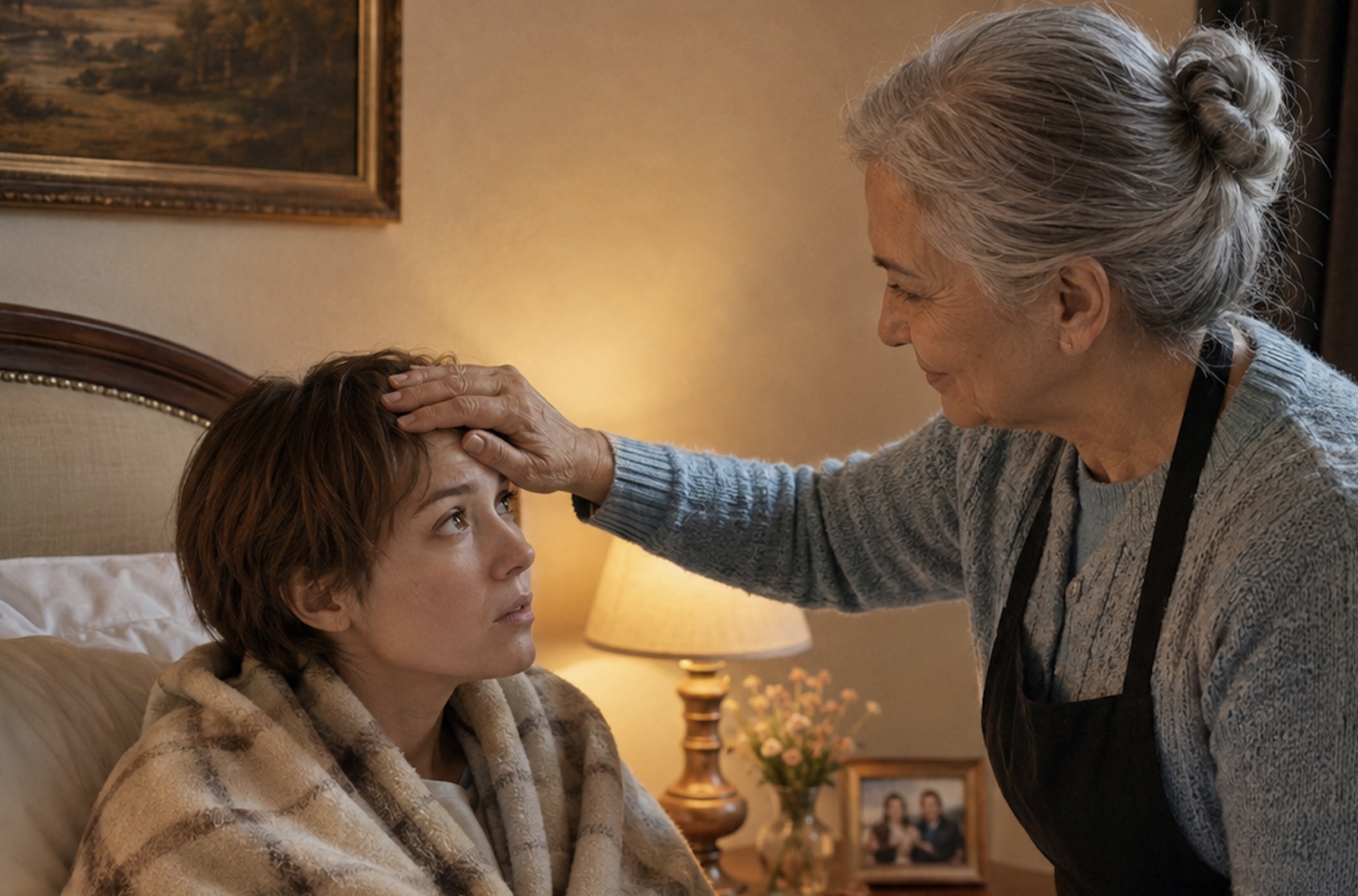
Then she sat down on the edge of the bed and stroked my hair.
Her hand was dry and warm. It smelled of chamomile cream and something else — something cozy and home-like. She stroked my head silently, rhythmically, as if I were a child.
And suddenly I understood.
She did not know how to speak about love.
No one had taught her.
She had grown up with a strict father, without a mother, in postwar poverty. She had learned to prove love through work. And all this time, she had been proving it to me.
But I had refused to accept it.
“You should not ask for forgiveness,” she said at last. “I am also to blame. I should have said it earlier. But I don’t know how. It is difficult for me. I was always afraid that if I said it, you would not believe me. Or you would laugh. Or…” She paused, searching for words. “Or you would think I was pretending.”
I took her hand and squeezed it.
Her palm was rough, hardened by knitting needles and kitchen work. But in that touch, there was so much unused tenderness that my eyes filled again.
We sat like that without moving, while the borscht cooled on the bedside table.
But it did not matter.
More important than the borscht, more important than the illness, more important than all my old resentment was that quiet moment, which somehow contained fourteen years of misunderstanding.
After that, I finished the borscht.
My fingers were still trembling, but my appetite had returned. Valentina Semyonovna sat beside me and watched me eat. There was no reproach in her pale eyes, no judgment. Only peace and a quiet kind of joy.
During the second week, I began coming to the kitchen to drink tea with her.
We still did not talk much, but the silence had changed. It was no longer tense. It had become shared, comfortable.
I began watching her with curiosity.
What had she been like when she was young? What had she dreamed about? Why had she become the way she was?
I asked carefully — and she answered.
At first, briefly. Then more openly.
I learned that her husband, Maxim’s father, had died when Maxim was fifteen. That she had worked at a factory, then later at a school as a handicraft teacher. That she had dreamed of becoming a doctor, but life had turned out differently — she had to feed her family. That her own mother-in-law, her husband’s mother, had never accepted her and had never helped her. When Valentina Semyonovna gave birth to Maxim, that woman did not even come to the maternity hospital.
“I promised myself then,” she said, stirring her tea, “that if I ever had a daughter-in-law, I would never abandon her in trouble. I would never reproach her. I would be there. Only I did not know how to do it without causing harm. I saw that you were distancing yourself…” She stopped, choosing her words. “I thought you did not want to see me. So I did not impose myself.”
I listened, and the puzzle finally began to come together.
So that was why she had not come into the maternity room. Not because she did not love her grandchildren, but because she was afraid of becoming like her own mother-in-law. Afraid of being intrusive.
And because of that fear, she had become a stranger.
We talked until midnight.
For the first time in fourteen years.
I told her about my childhood, about how my own mother always reacted to my illnesses with panic, shouting, and reproaches. And how, without realizing it, I had expected the same from my mother-in-law — criticism, judgment, blame. And when I did not get it, I became confused and decided she must simply be indifferent.
“My mother,” I said, “always told me, ‘If someone doesn’t scold you, it means they don’t care about you.’ Do you understand? I grew up with that. And then I projected it onto you.”
Valentina Semyonovna nodded.
And suddenly, she smiled.
Truly smiled — with her lips and her eyes at the same time.
It was so unexpected that I nearly choked on my tea.
She smiled, and her face, usually so strict, seemed to light up from within.
“You did everything right,” she said softly. “Even when you made mistakes, they were your mistakes. I had no right to interfere.”
I looked at her in amazement.
How had I failed to see this before?
How had I allowed my own insecurity to distort reality so completely?
And I also thought about how much strength it must have taken for her to silently carry that burden — a love she did not know how to express in words.
By the third week, I was already walking around quite well and helping her with small things. We cooked together. We washed dishes together. I learned to cut vegetables the way she did — thin, even, almost transparent.
I asked her for the borscht recipe.
She dictated it, and I wrote it down in my old notebook with the torn cover. Every word, every detail: “stew the beetroot separately, add the vinegar at the very end, slice the cabbage into very thin strips.”
I wrote it all down and felt that something greater than a recipe was settling onto the pages with the ink.
Connection.
Continuity.
History.
By the fourth week, Valentina Semyonovna began preparing to go home. I was almost fully recovered, the children had grown used to her routine, and Maxim had finally relaxed.
On the last evening, we sat in the kitchen again. I drank tea. She finished hers. On the table lay the neatly folded apron — the very same one with the tiny flowers.
I picked it up and held it in my hands.
It was warm and smelled of laundry powder and chamomile.
“Leave it here,” I said. “At least until next time.”
She shook her head.
“It is old. Why would you need it?”
“I need it,” I said firmly. “As a reminder.”
She understood.
And she did not argue.
The apron stayed hanging on the back of the chair.
In the morning, Maxim drove her home.
I stood by the window and watched her get into the car. Straight back, proud tilt of the head. Not really an old woman yet — just tired and lonely.
In her hand was a bag, almost empty. She had taken almost nothing with her except her own things.
But she left us order.
Warmth.
The same borscht in the refrigerator, enough for two more days.
And the apron.
Later, I sat in the kitchen for a long time, drinking tea and rereading the recipe I had written down.
Between the lines, I no longer saw beetroot and cabbage. I saw her face — focused, stern, but no longer foreign to me.
I thought about how much depends on our ability to hear. How often we hear only what our fears want to say, instead of what another person is truly trying to tell us.
My mother-in-law had been speaking to me through actions.
And I had been waiting for words.
Only illness had finally forced me to be quiet and listen.
I recovered.
Life returned to its usual rhythm.
But something had changed.
We began calling her every week, inviting her over. Sometimes I visited her with the children, and we baked pies together. She never became talkative or sentimental. But now I could see clearly: when she handed me a cup of tea, when she adjusted Varya’s scarf, when she sat silently beside me — that was her way of saying, “I love you.”
And it was more than enough.
I still make borscht using her recipe.
All I have to do is close my eyes, and I hear her voice: “Stew the beetroot separately. Add the vinegar at the very end.”
And in that borscht, there is an entire life.
An entire lesson in how to love without words.
How to stay close when things are hard.
How not to reproach someone, even when you want to.
How to simply do what needs to be done — and trust that one day, someone will finally hear you.