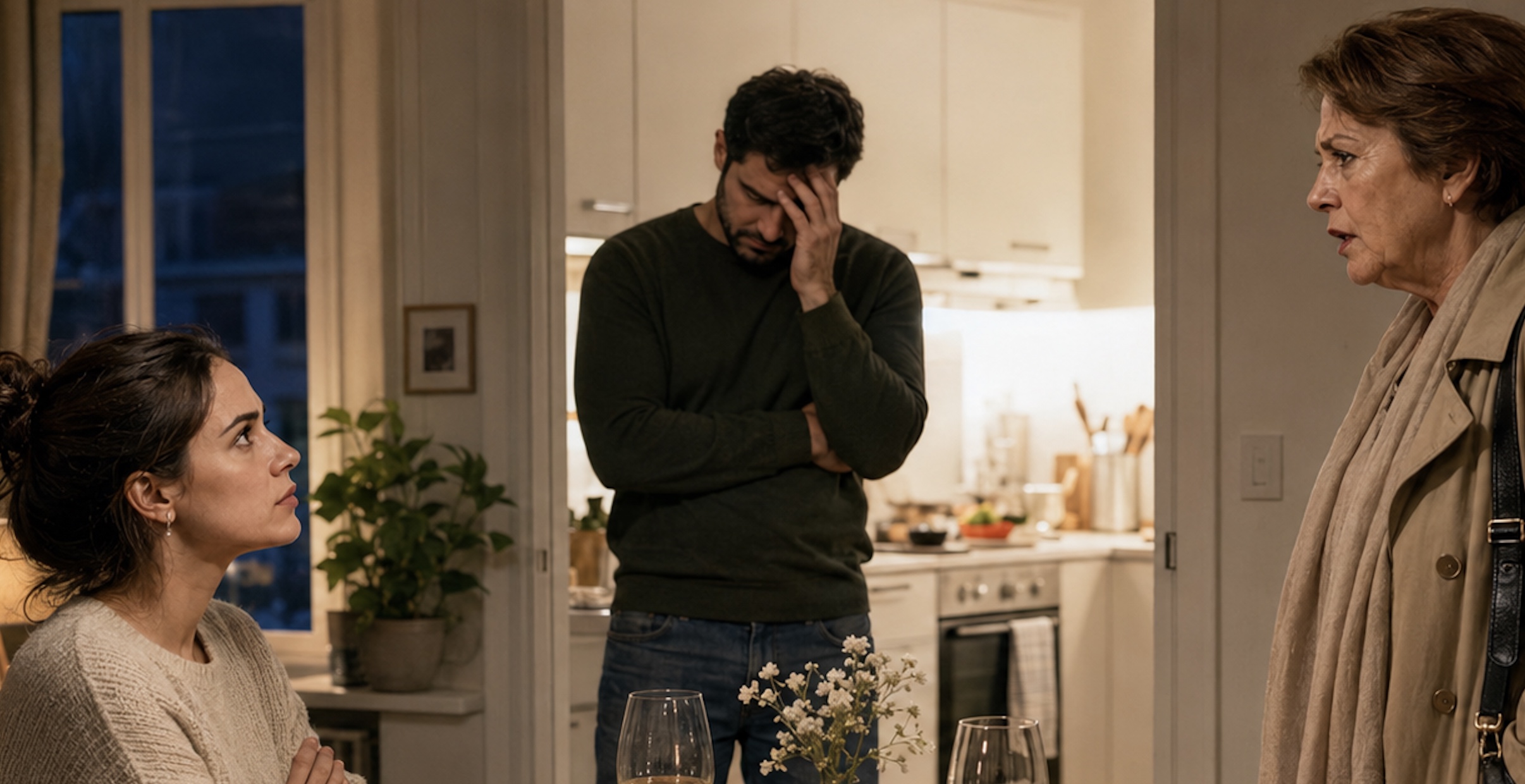
Marina’s mother-in-law called at half past six, just as Marina was standing by the stove, trying not to think about work. It had been the kind of day after which you do not want to talk, explain yourself, or be convenient for anyone. You just want to chop vegetables, set the plates, sit across from your husband, and hear not “Where’s the salt?” or “Did Mom call?” but at least a simple, “How are you?”
“We were just driving past with Dad,” her mother-in-law said in a cheerful voice. “I’ll stop by for five minutes. I’ll drop off a jar of pickles.”
Marina looked at the frying pan, at the two plates, at the little candle she had placed on the table herself, as if that tiny flame could somehow protect the evening from someone else’s intrusion.
“For five minutes?” she clarified.
“Oh, of course. Do you think I don’t understand that you have your own things to do? I’ll pop in and leave.”
Marina wanted to say, “Let’s do it tomorrow.” She really wanted to. She even opened her mouth. But at that moment, Igor came out of the room and asked:
“Mom?”
Marina silently handed him the phone. He listened for two seconds, smiled his usual son’s smile — guilty even before there was anything to be guilty about — and said:
“Of course, Mom. Come in.”
That was how things were often decided in their home. Not through a shared conversation. Not through, “Marina, is that okay with you?” But through that short masculine “of course,” after which Marina automatically became the hostess.
Ten minutes later, her mother-in-law was already standing in the hallway.
Without the pickles.
“Oh, I forgot them in the car. I’ll get them later,” she said, and immediately walked into the kitchen without taking off her scarf. “What smells so good? Fish? Are you making it in the oven? My little Igor loves fish with a crispy crust.”
Marina stood by the table with a knife in her hand, carefully chopping herbs. The knife tapped against the cutting board too evenly. That is how people chop when, inside, they are already tired of explaining.
“We’re just having dinner tonight,” she said.
“I’m not getting in the way,” her mother-in-law smiled. “I’m only here for five minutes.”
Marina had heard those “five minutes” many times before. Five minutes usually meant taking off a coat and hanging it over the back of a chair because “I won’t be long.” Then walking into the kitchen to check what was in the pot. Then asking why Igor had lost weight — or, on the contrary, why he looked somehow swollen. Then mentioning that the neighbor’s son had bought an apartment, while Igor was still moving “somehow too slowly for a man.” Then sitting down. Then remembering the news. Then asking for tea. Then saying, “Oh, come on, pour me some too, since you’ve already made it.”
Before, Marina used to fuss around. She would set out a third plate, bring out bread, warm up whatever she had cooked for two, smile, and listen to stories about blood pressure, the summer house, prices, and “our Larisa’s daughter-in-law, now she’s truly golden.” After those evenings, she was left with a strange feeling. Technically, no one had argued. No one had shouted. No one had insulted her directly. And yet it felt as if she had disappeared from her own kitchen.
Her mother-in-law did not come as a guest.
She entered like an inspector.
“What are these paper napkins?” she asked, already opening a cabinet. “I always put cloth ones out for Igor. A man should see a proper table.”
Marina placed the herbs into a bowl and said quietly:
“Please don’t open the cabinets.”
Her mother-in-law did not even understand at first that this was being said to her. She turned slowly, with the surprise of a person who had heard a foreign word.
“What cabinets?”
“The kitchen cabinets. Please don’t open them.”
At that moment, Igor was taking out the glasses. He looked at Marina, then at his mother, then back at the glasses. His face carried the expression Marina knew painfully well: “Let’s just not have a conflict.”
But the conflict was already there. It had simply lived inside Marina before, while on the outside it was called a family evening.
“Oh, dear Lord,” her mother-in-law gave a short laugh. “It’s not as if I’m in a stranger’s house.”
Marina wanted to answer, “You are.” But she did not. Because that would have been too harsh. And she was still trying not to be harsh, even though her boundaries had long since been trampled by size-forty-one house slippers.
“This is our home,” she said. “And I don’t like it when people open cabinets without asking.”
Her mother-in-law looked at her son. Not at Marina — at her son. As though he was supposed to translate his wife’s oddness into normal family language.
“Igor, do you hear this?”
Igor placed the glasses on the table.
“Mom, well, Marina is asking…”
“Marina is asking,” his mother repeated. “Fine. So now I’m not even allowed to open a cabinet. What a world we live in.”
She did not leave.
Of course she did not.
People who say, “I’m only here for five minutes,” rarely leave on the fifth minute if there is still a chance to prove that they should be begged to stay.
She sat down on a chair. Not on the edge. Not in the hallway. Not as someone who had only come to drop off a jar. She sat down at the table. Took off her scarf, placed her phone beside her, and asked:
“Will there be tea?”
Marina froze by the stove. The fish was ready. So were the potatoes. The salad sat in its bowl. The dinner she had mentally pieced together all day like a tiny island of peace was no longer dinner. It had turned into an exam on being a good daughter-in-law.
Igor said quietly:
“Mom, we were actually about to have dinner.”
“So have dinner. Am I stopping you?” his mother sounded almost genuinely surprised. “I’ll sit with you. I don’t need much.”
That “I don’t need much” always meant that everything would be needed: a plate, a fork, tea, attention, patience, a place in the conversation, and the right to comment on someone else’s life.
Marina took two plates from the cabinet. She placed one in front of Igor and the other in front of herself. She poured water into two glasses. She laid out the cutlery.
Two sets.
Her mother-in-law watched this calmly at first. Then her face began to change. First, the smile disappeared. Then her eyebrows rose. Then her lips pressed into that thin line which, in some families, replaces the direct question: “Who do you think you are?”
“What about me?” she asked.
Marina sat down.
Very calmly.
Even too calmly for herself.
“You said you were only here for five minutes.”
Igor stopped chewing before he had even started. He sat with his fork in his hand and stared into his plate, as though the answer to surviving between his mother and his wife was lying there.
His mother leaned back in her chair.
“I see.”
One phrase. But there was so much accusation in it that Marina felt the familiar stab in her chest. Now she was supposed to jump up. Say, “Oh no, of course, I’ll get one right now.” Apologize. Explain that she had misunderstood. Turn it into a joke. Do everything so that the grown woman sitting across from her would not have to face one simple fact: she had arrived uninvited and expected to be served.
But Marina did not stand up.
“What do you see?” she asked.
Her mother-in-law laughed shortly.
“Oh, I see everything. People used to be happy to see family. But now, apparently, I’m the extra one here.”
“You came without proper notice during a dinner we planned for the two of us.”
“I called.”
“Ten minutes before.”
“What was I supposed to do? Book an appointment with my own son a month in advance?”
Marina looked at Igor. He was still silent. And that silence was not neutral. It was already working against her. In families where one person violates boundaries and another “doesn’t want conflict,” the one who finally says out loud, “You can’t treat me like this,” almost always ends up being the problem.
“Not a month in advance,” Marina said. “Just ask whether it’s convenient for us.”
“I asked Igor.”
“And both of us live here.”
Her mother-in-law stood up sharply.
“Thank you. Very hospitable.”
“You’re not a guest,” Marina replied. “Guests are invited.”
That sentence hung so heavily in the kitchen that Igor finally looked up.
“Marina…”
He said her name like a warning. Not “Mom, stop.” Not “Marina is right, we really wanted to spend the evening together.” But “Marina” — as if she were the dangerous one.
His mother quickly wrapped her scarf around her neck, grabbed her bag, and walked into the hallway. The door did not slam very loudly, but it was loud enough for even the neighbors to understand: a family tragedy had just taken place in that apartment.
Marina remained seated at the table. The fish was cooling. The candle was burning down, small and helpless. Igor stayed silent for another minute, then said:
“You could have been gentler.”
Marina nodded. Not because she agreed. But because she had expected exactly that phrase.
“I could have,” she said. “And you could have asked me whether I was okay with it before inviting your mother in.”
Igor rubbed his face tiredly.
“She wasn’t going to stay long.”
For the first time, Marina could not help letting out a bitter little laugh.
“Igor, your mother never comes for a short visit. She comes to check whether everything here still belongs to her.”
He looked offended.
“She’s my mother.”
“I know. But I’m not her staff.”
The phrase came out rougher than Marina had intended. Not because of the words themselves, but because of the truth inside them. Truth often sounds rude in family systems, because everyone has grown used to speaking in hints, smiles, and bowls of soup.
They finished dinner almost in silence. Then Igor went into the room, and Marina began clearing the dishes. Two plates. Two glasses. Two forks. Strangely enough, that calmed her. For the first time after one of her mother-in-law’s sudden visits, she did not have to wash a third plate and feel angry at herself for giving in again.
The next day began with messages.
First, her mother-in-law wrote: “I understand now that I’m not welcome in your home. I won’t bother you again.”
Then Igor’s sister wrote: “Marina, Mom didn’t sleep all night. You could have fed a person.”
Then Igor’s aunt, whom Marina had seen twice in her life, wrote: “Elders must be respected. Today you refused to seat your mother-in-law at the table, tomorrow your own children will throw you out the same way.”
By lunchtime, the story had already grown. Apparently, Marina had “sent her husband’s mother away hungry.” Then she “refused to let her eat.” Then she “forbade her from visiting her son.” By evening, her mother-in-law wrote in the family chat: “I never thought I’d live to see the day when I became a stranger in my own child’s apartment.”
Marina reread that sentence several times.
My own child.
Not a grown man. Not Marina’s husband. Not a person who had a family, a home, an evening, plans, and exhaustion.
A child.
That was where the main pain lived. Her mother-in-law had not necessarily meant to ruin the dinner. Perhaps she truly did not think she was doing anything terrible. She lived inside her familiar picture of the world: her son was an extension of herself, his home was an expansion of her territory, and his wife was someone who was supposed to be happy about her presence — because otherwise she was not a wife, but a threat.
For Marina, it looked different.
She was not forbidding them from communicating. She was not demanding that he choose between her and his mother. She was not starting a war for influence. She had simply refused to set out a third plate for someone who had come “for five minutes” and then decided on her own to stay.
But it is often these small domestic scenes that expose the biggest family rules. Not the ones people say out loud, but the ones they live by for years.
In this family, the rule was simple: Igor’s mother could come whenever she wanted, stay as long as she wanted, comment on whatever she wanted, and everyone else had to pretend it was warmth. If Marina felt uncomfortable, it was her personality. If she was tired, she was ungrateful. If she asked someone not to open cabinets, she was pushing a son away from his mother. If she did not set a plate, she was destroying the family.
That evening, Igor came into the kitchen by himself. Marina was sitting with a cup of tea, not answering any messages. He sat across from her.
“Mom says she won’t come anymore.”
“That’s her choice,” Marina said.
“She’s hurt.”
“So am I.”
He looked surprised. As though his mother’s hurt was an event, while his wife’s hurt was background noise.
“About what?”
Marina looked at him calmly, but something inside her trembled. Not from weakness. From the exhaustion of explaining the obvious.
“About the fact that in our home, I have to defend my right to one evening. About the fact that your mother asks your permission, but I’m the one who ends up serving the consequences. About the fact that you call my refusal a conflict, but not her intrusion.”
Igor wanted to object. Marina could see the familiar phrases rising in him: “Don’t exaggerate,” “She’s an older woman,” “You could have been patient.” But for some reason, he stayed silent.
Marina continued:
“I’m not against your mother. I’m against her suddenness being more important than my peace.”
It was a very simple sentence. Almost dry. No hysteria. No beautiful drama. But sometimes simple sentences are the hardest to hear. Because they give the other person nothing to grab onto. They cannot say, “You’re shouting.” They cannot accuse you of being disrespectful. All that remains is the meaning.
Igor looked at the table for a long time.
“I really didn’t think,” he finally said.
Marina nodded.
“I know. That’s the problem.”
Then they made an agreement. Not immediately. Not beautifully. Not like in smart books. At first, Igor got irritated. Marina did too. Several times, the conversation slipped back into the old pattern: “She’s my mother.” “And I’m your wife.” “You’re putting me between you two.” “No, you put yourself there when you refuse to speak to her directly.” But by the end of the evening, the first adult rule had appeared: guests come by agreement with both of them.
Not “I’m nearby, I’ll drop in.”
Not “I’ll just come for a minute.”
Not “Well, I’m already downstairs.”
But: “Is this convenient for you?”
And if it is not convenient, that is not an insult. It is an answer.
Three days later, his mother called again. This time, she called Igor.
From the room, Marina could hear only his replies.
“Mom, not today… Yes, we’re home… No, that doesn’t mean you can come over… Because we have plans… No, Marina has nothing to do with it… Mom, I decided this myself.”
The last phrase sounded uncertain, but it was said. Marina did not even realize at first that she had been holding her breath.
After the call, Igor came into the kitchen and said:
“She said you turned me against her.”
Marina gave a faint smile.
“Of course.”
“And then she asked what we’re having for dinner.”
Unexpectedly, they both laughed. Not joyfully, but with relief. That is how people laugh when they see a family mechanism from the outside for the first time and understand that it is huge, old, and noisy — but still not sacred.
His mother stayed offended for a long time. She sent short messages with long subtext. She passed along through relatives that she “didn’t want to bother the young couple.” At a holiday gathering, she dramatically asked, “Am I allowed to sit down, or am I only here for five minutes again?” Igor blushed. At first, Marina tensed. Then she stopped playing the game of justifying herself.
One day, she answered calmly:
“If you came as a guest, please sit down. If you came for five minutes, I won’t be setting dinner.”
Her mother-in-law looked at her as if Marina were not a daughter-in-law, but a new door with an unfamiliar lock. Then she sat down. Without comments about napkins. Without checking the pots. Without opening the cabinets.
It was not a victory. In family boundaries, there are rarely victories. There are small changes that at first look like scandals.
Later, Marina’s therapist told her something she remembered for a long time:
“Boundaries are often perceived as coldness by those who are used to having access without asking.”
For the first time, Marina stopped feeling cruel. She understood that she did not have to prove love with an extra plate. She did not have to prove respect by tolerating intrusion. She did not have to turn every evening of her life into a stage for someone else’s convenience.
Her mother-in-law had come “for five minutes” and did not understand why no one expected her for dinner anymore.
Because before, what they had been expecting was not really her for dinner.
They had been expecting the old habit of giving in. The automatic plate. The silence. The womanly ability to pretend that nothing had happened.
But that evening, something had happened.
Marina did not throw her mother-in-law out of the house.
For the first time, she simply left exactly as many plates on the table as there were invited guests.