Alena had been working in a restaurant since she was twenty-two, and over the course of ten years she had worked her way up to sous-chef. That meant arriving at nine in the morning, leaving around eleven at night, and spending nearly every hour in between standing over hot stoves until, by the end of the shift, she could barely feel her legs below the knees. It was real work—hard, noisy, exhausting, with the smell of broth permanently clinging to her hair. Alena loved it in the way people love something they have invested too much of themselves in to simply walk away from.
At home, however, she hardly ever cooked. Not because she couldn’t—obviously, she could—but because after ten hours beside blazing burners, the only thing she truly wanted was to sit down and not move.
Roman understood that. Or at least he acted as though he did.
He wasn’t much of a cook himself, but he managed. Scrambled eggs, pasta, sometimes something ready-made from the store. For the first two years of their marriage, that arrangement seemed perfectly normal. Neither of them questioned it.
Then came the weekends.
At first, it seemed harmless.
One Saturday morning, Roman’s mother, Elena Viktorovna, called and asked whether she and her husband could come over for lunch. Alena agreed. Why not? If people were coming over, naturally they should be fed.
She made soup, chopped a salad, and fried cutlets. Her mother-in-law praised the borscht, her father-in-law asked for seconds, and Roman laughed as he said:
“You’re the best cook I know.”
Alena laughed too.
Two weeks later, it happened again.
Then again.
By autumn, it had somehow become a routine. Every weekend meant family. And every weekend meant Alena in the kitchen.
Sometimes Roman’s brother came with his wife and children. Sometimes Elena Viktorovna’s aunt from the neighboring district joined them. The table grew larger, the number of dishes increased, and not once did anyone ask whether Alena was comfortable with it, whether she was tired, or whether she might want to spend one Sunday lying on the sofa with a book.
One day Roman said:
“Alena, you have no idea how happy Mom is when you cook. It means a lot to her.”
“Some things mean a lot to me too,” Alena replied.
“Oh, come on,” Roman said, patting her shoulder. “You do it better than anyone. Isn’t it nice to be appreciated?”
Alena didn’t continue the conversation.
She put the pot away and went to wash her hands.
Birthdays, New Year’s Eve, Easter, the May holidays—somehow all of them ended up becoming her responsibility too.
She planned menus, went shopping at the market, and spent hours at the stove. Everyone else arrived around three, sat down at the table, ate, praised the food, and watched television.
Alena cleared the dishes, washed the plates, and thought about how she had to go back to work the next morning.
Once, she tried to explain it to Roman.
She chose a quiet evening when they were alone in the kitchen.
“Roman, I want to talk about the weekends.”
“What happened?”
“Nothing happened. I’m just tired of cooking every Saturday and Sunday. I spend the whole week standing at a stove at work. I need rest when I’m home.”
Roman looked genuinely surprised. Not offended or defensive—truly surprised, like someone hearing an idea that had never occurred to him before.
“But you’re a professional. It’s easy for you.”
“Something being easy and wanting to do it are two different things,” Alena said.
“Well, Mom can’t cook like you. It wouldn’t be the same.”
“Roma.”
“What?”
“You’ve just explained why I’m supposedly obligated to cook simply because I’m good at it. Do you understand how that sounds?”
Roman was silent for a moment.
Then he said:
“Don’t make such a big deal out of it. They’re family, not strangers.”
That was where the conversation ended.
Alena didn’t start a fight. She didn’t have the energy, and she didn’t see much point in it. She mentally postponed the issue, just as she had already done several times before.
Then Elena Viktorovna began talking about the anniversary.
Not directly at first. Just casually over tea.
She and her husband would be celebrating forty-five years of marriage in February. She thought they should arrange something special instead of simply sitting around with family. Their country house would be perfect—the living room was large, and if the weather allowed, they could set up another table on the terrace.
Alena listened without interrupting.
She already knew where the conversation was heading.
She simply waited.
A week later, Elena Viktorovna came over again.
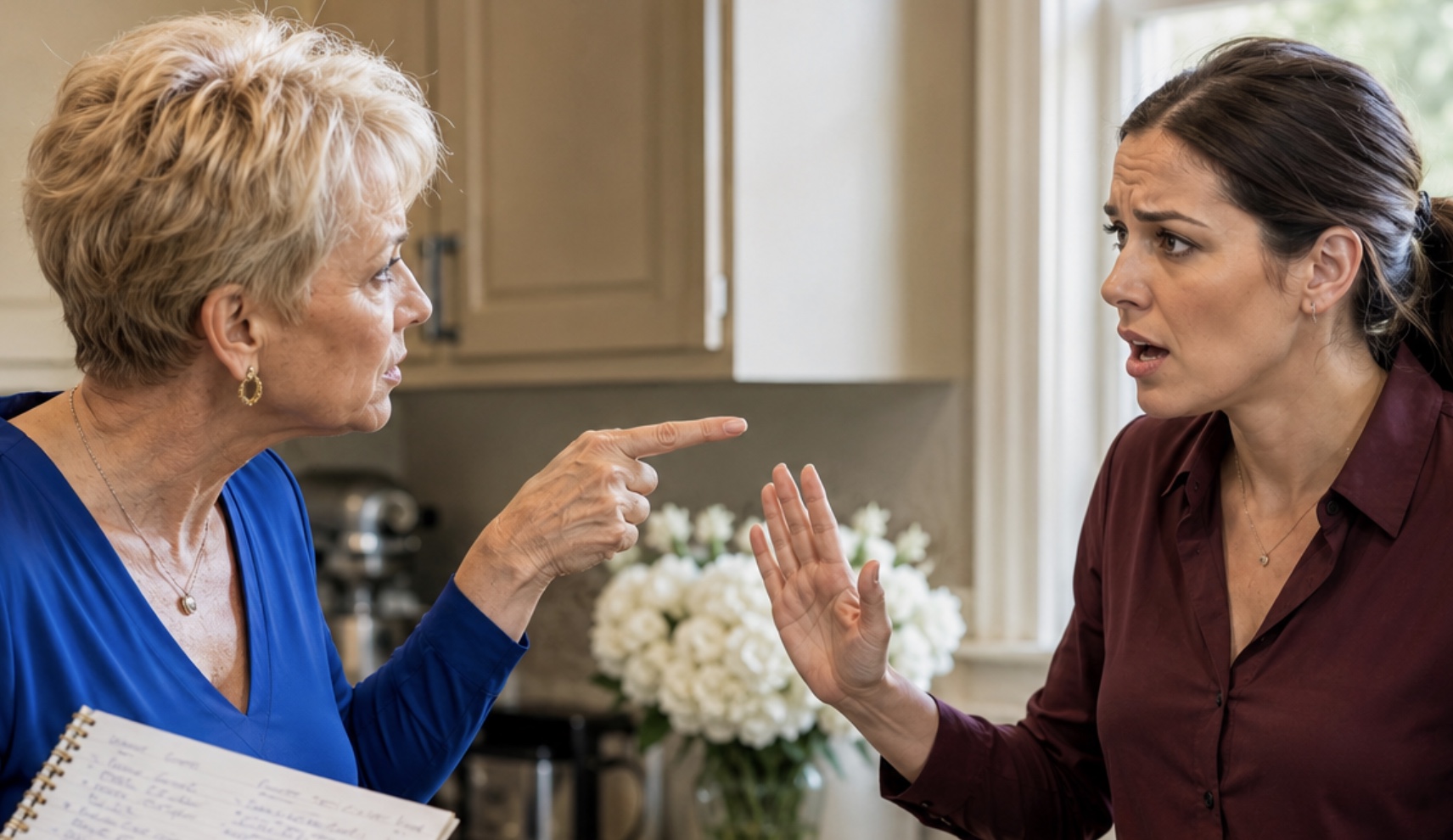
This time, she brought a notebook.
Alena let her in and put the kettle on. Roman had not yet returned from work. Later, Alena wondered whether her mother-in-law had deliberately chosen a time when he wouldn’t be there, though she never found out.
Elena Viktorovna settled at the kitchen table and opened her notebook.
The pages were covered in neat, compact handwriting.
“Alenochka, I’ve been thinking about the anniversary,” she began. “Vitya and I are thinking around forty people. Maybe thirty-five. The living room at the country house is big, and we can put a table on the terrace if the weather is nice. What do you think?”
“I think thirty-five people is a fairly large celebration,” Alena replied carefully.
“Exactly!” Elena Viktorovna brightened. “Exactly. That’s why everything has to be done properly. I’ve made a rough menu.”
She turned the page.
“Cold appetizers, of course. Meat and cheese platters, fish assortment, Olivier salad, herring under a fur coat. For the main course, something with meat—I was thinking duck, unless two different options would be better? And fish too, obviously. Maybe some kind of hot soup, since it’s winter. Three or four salads. Side dishes. And cake, of course, a large one for everyone. What do you think—two cakes or one multi-tiered cake?”
Alena stared at the notebook.
At the neat lines.
At the word “duck,” which had been underlined.
“Elena Viktorovna,” she said slowly, “who is supposed to cook all of this?”
Her mother-in-law blinked.
“Well, you, Alenochka. You’re a chef.”
“I’m a sous-chef at a restaurant. That’s a little different.”
“All the more reason,” Elena Viktorovna said with a smile. “You’re used to this kind of thing. Of course we’ll help. We can chop things and set the table.”
Alena removed her hands from the tabletop and placed them in her lap.
“Do you understand that this is several days of work? A menu for thirty-five people, several hot dishes, appetizers, a cake—it isn’t just ‘cooking dinner.’”
“Well, you don’t have to do everything at once,” Elena Viktorovna said with a slight frown. “Some things can be prepared beforehand. You can make the components in advance. You know how these things are organized.”
“I do,” Alena replied. “That’s exactly why I’m saying this.”
At that moment, the front door opened.
Roman had come home.
He took off his coat, entered the kitchen, saw his mother with the notebook, and kissed her on the cheek.
“Oh, you’ve already started discussing it?” he asked, reaching for the kettle. “Mom, did you show Alena the menu?”
“I did,” Elena Viktorovna said.
Roman turned toward his wife with an expectant expression—the kind that already assumed the answer would be, “Of course, we’ll manage.”
Alena looked at him.
Then at her mother-in-law.
Then back at the open notebook filled with careful plans in which no one had bothered to ask her opinion.
“I’m not going to cook all of this,” Alena said.
The kitchen became silent.
Elena Viktorovna stopped turning the pages.
Roman froze with a mug in his hand.
“Alena…” he began.
“Wait,” Alena said, without raising her voice. “Elena Viktorovna, I respect you. But I work as a chef six days a week. It’s physically exhausting work, and by the weekend I’m sometimes so tired I can barely sleep properly. For several years now, I’ve cooked for every family celebration—not because I wanted to, but because that became the expectation and nobody ever asked whether it was convenient for me. A banquet for thirty-five people means two or three full days of nonstop work. I am not willing to take that on for free and by default.”
Elena Viktorovna looked at her daughter-in-law as though Alena had suddenly spoken in a foreign language.
“But you know how to do it,” she finally said. “It’s your profession.”
“My profession is what I get paid to do,” Alena replied. “At home, I’m not at work.”
Her mother-in-law slowly closed the notebook, the way people close something they no longer have any use for.
“Well,” she said, clearly offended. “I didn’t expect this.”
Roman put his mug down.
“Alena, why do you have to say it like that? This is Mom. It’s their anniversary. Can’t you make a little effort for the family?”
Alena looked at her husband.
“Roman, I’ve been making an effort for your family every weekend for three years. Did you ever notice?”
He opened his mouth and then closed it again.
“Please don’t ruin the mood,” he finally said. “Mom came here specifically to discuss everything, and you…”
“And I what?” Alena asked quietly.
Something in her tone made Roman stop talking.
Outside, darkness was already settling in.
The kettle on the stove had long since stopped hissing. Elena Viktorovna stared at the table, Roman looked away, and Alena suddenly realized that this silence had been present for a long time.
Before, it had simply been drowned out by voices, kitchen smells, the clatter of plates, and conversations around the table she kept setting again and again.
Her mother-in-law was the first to speak.
She waited a moment, lifted her head, and folded her hands on the table.
“Alena, I didn’t expect this from you. We’re family. I thought you understood that.”
“I do understand,” Alena said. “That’s exactly why I’m saying it.”
“What do you understand?” Elena Viktorovna’s voice became firmer. “Do you understand how much we’ve done for the two of you? How many times we’ve helped?”
Alena looked calmly at her.
“Elena Viktorovna, let me remind you what I’ve done. New Year’s—I cooked. Roman’s birthday—I cooked. Your birthday last year—I cooked. Easter, the May holidays, Women’s Day. Every weekend for the past three years, I’ve prepared lunch for the whole family, sometimes with additional guests. I never refused once. I never even asked anyone to help with the shopping or the dishes. I simply did it.”
“So what?” Elena Viktorovna spread her hands. “You love cooking.”
“I love my profession,” Alena replied. “When I’m paid for it and when I get to choose what and when I cook. Not when everyone assumes it’s simply my duty.”
At that moment, Pyotr Alexeyevich appeared in the doorway.
Alena’s father-in-law had apparently arrived with Roman and had been sitting in the living room. Judging by his expression, he had heard the entire conversation.
He entered the kitchen, stood beside his wife, and crossed his arms.
“So that’s how it is,” he said. “We’re a burden now?”
“Nobody said you were a burden,” Alena replied.
“Then what are you saying?” he asked, raising his voice. “That you don’t want to help your husband’s parents? That we don’t deserve a celebration?”
“I said I will not cook a banquet for thirty-five people for free and as though it is automatically my responsibility,” Alena answered without moving from her place. “That is real work. It takes several days. Any other chef would charge for it.”
“Any other chef!” Elena Viktorovna exclaimed. “You’re not some other chef! You’re our daughter-in-law!”
“Yes,” Alena said. “I’m your daughter-in-law. Not your staff chef.”
“Ungrateful,” her mother-in-law said sharply.
That single word carried everything—hurt, certainty, and something close to contempt.
“We accepted you into this family. We treated you well. And this is how you repay us.”
Alena felt something tighten inside her and then suddenly release.
It wasn’t anger.
It was something colder.
“Elena Viktorovna, I work as a chef six days a week. I come home at eleven at night. For three years, I spent almost every weekend standing at this stove for your family—not because I wanted to, but because nobody even thought to ask whether I wanted to. That isn’t appreciation. That’s taking advantage of someone.”
“Taking advantage!” Pyotr Alexeyevich gave a short, humorless laugh. “Do you hear that, Lena? Apparently we’ve been taking advantage of her.”
“Dad,” Roman finally spoke. He was standing by the window, looking from one person to another. “Everyone needs to calm down.”
“You tell your wife to calm down!” Pyotr Alexeyevich snapped.
“Alena,” Roman turned toward his wife, his voice pleading, almost childlike. “Please. It’s an anniversary. Forty-five years is important. You understand that. Just apologize and let’s talk normally.”
Alena looked at him.
“Apologize for what?”
“For… the way you said it. It came out harsh.”
“I said exactly what I think,” Alena replied. “Calmly and clearly. There’s nothing to apologize for.”
“Alena,” Roman stepped closer. “You’re ruining everything right now. We can’t leave the anniversary like this. We’ve always celebrated this way. It’s tradition.”
“A tradition where I’m the only one who cooks,” Alena said. “Notice that, Roman. Not you and me together. Not your parents. Me. For three years.”
Roman said nothing.
“All right,” Alena continued. “I have another suggestion. Book a banquet at a café or restaurant. Or hire a private chef. It’s completely possible and fairly reasonable for an event of this size. You’ll still have the celebration, the food, the guests—just without me spending several days at the stove.”
The silence that followed was different.
This time, it wasn’t confusion.
It was outrage.
“Pay a stranger?” Elena Viktorovna said as though Alena had suggested something indecent. “For something a daughter-in-law should be doing? Absolutely not.”
“So I should be doing it,” Alena said. “You just said it out loud.”
“That’s not what I meant…”
“I heard exactly what you meant.”
Pyotr Alexeyevich spoke again, quieter now, in the particular tone that could be worse than shouting—slow, deliberate, and heavy with authority.
“Remember this, Alena. In our family, this isn’t how things are done. If someone has a skill, they help. Not for money. Not according to a schedule. They simply help. That’s what family means.”
“And what if that person is exhausted?” Alena asked.
“Everyone gets tired,” he snapped.
“Then why am I the only one who keeps working?”
Pyotr Alexeyevich had no answer.
Elena Viktorovna picked up her notebook and put it back into her handbag.
The gesture said everything.
It wasn’t conciliatory.
It was final.
“Roma,” she said to her son, “talk to your wife. Explain to her that this isn’t acceptable. The anniversary is in two months. We need to make plans.”
“Mom, I…”
Roman rubbed his forehead.
“Explain it to her,” Elena Viktorovna repeated.
Roman looked at Alena.
There was something pleading in his eyes, almost apologetic—but not enough for him to say the one thing that actually needed to be said.
“Alena, just do this for me,” he said. “One time. After that, I promise, that’s it.”
“One time,” Alena repeated. “You’ve been saying ‘one time’ for three years.”
Roman fell silent.
And that silence was enough.
His parents left twenty minutes later. Elena Viktorovna said goodbye stiffly. Pyotr Alexeyevich didn’t say goodbye at all.
Roman walked them to the door, returned to the kitchen, and sat down.
For a long time, neither of them spoke.
“You really aren’t going to cook?” he finally asked.
“No.”
“And you don’t feel bad?”
Alena thought for a moment.
“I regret not saying this three years ago. That’s all I regret.”
The following days passed in a strange, strained silence.
Roman barely spoke. He wasn’t openly angry, but he also made no attempt to meet her halfway.
Elena Viktorovna called twice. The first time, she tried to persuade Alena again. The second time, she spoke in a wounded voice about how she had “never expected such a thing.”
Alena answered briefly and politely.
She never raised her voice.
A few days later, she and Roman had another conversation late in the evening, when both of them were too tired to keep pretending everything was fine.
“Alena, I don’t understand what you want,” Roman said.
“I want people to ask me before making decisions for me.”
“You were always appreciated.”
“My work was appreciated,” Alena replied. “Was I?”
Roman had no answer.
And Alena understood that there wasn’t one—not because Roman was a terrible person, but because in three years he had never learned to see the difference between valuing what she could do and valuing her as a person.
She filed for divorce at the beginning of December.
Roman didn’t fight it.
He seemed confused and kept saying he didn’t understand how things had reached this point.
Alena didn’t explain again.
Everything that needed to be said had already been said in that kitchen, beside the tea that had gone cold.
They had been renting their apartment together, so Alena found a place of her own.
It was a small studio fifteen minutes from the restaurant. Bright, with a large window and a separate kitchen area that she arranged exactly the way she wanted.
Very little clutter.
A good stove.
Sharp knives in a holder on the countertop.
Tools she had chosen for herself.
Elena Viktorovna and Pyotr Alexeyevich’s anniversary was eventually held at a café.
Alena found out by accident when Roman mentioned it while they were exchanging their belongings.
They had booked a private room for around forty people, ordered a modest menu, and everything had gone perfectly well.
Alena simply nodded.
So it had been possible all along.
One Saturday, Alena finished work at half past eleven at night and went home.
She took off her shoes in the hallway.
The kitchen was quiet.
No one was waiting for lunch.
No one had made a list of dishes for her to prepare.
Alena put the kettle on, sliced some bread, and took cheese from the refrigerator.
Then she sat down by the window.
Outside, snow was falling in large, slow flakes.
Alena watched it while drinking her tea.
She wasn’t thinking about anything in particular.
She was simply watching the snow.
For the first time in a very long while, Saturday belonged entirely to her.