The smell of reheated pasta drifted from the kitchen. Danila, the eldest, ten years old, was sitting at the table doing his homework. Sonya was drawing beside him, sticking out her tongue in concentration. Little red-haired Varya was asleep in the bedroom, her blanket kicked aside.
“Is Dad home?” Marina asked her son quietly.
“Yeah. He’s in the living room. Watching TV.”
Marina slipped off her sneakers, went into the kitchen, and began unpacking the groceries. Ten minutes later, Andrei appeared — rumpled, sleepy, wearing a stretched-out T-shirt.
“Hi. Why are you so late?”
“I had two deliveries after my shift. One on Sadovaya Street, the other on Ryabinovaya. There was traffic.”
“Oh. All right.”
He took a carton of kefir from the fridge, poured some into a glass, and went back to the television. Marina silently arranged the jars on the shelf. Her hands moved automatically. She had long ago stopped expecting questions like, “How are you?” or “Need help?”
That evening, after putting the children to bed, she sat at the table and opened her order notebook. Seven items for tomorrow. Wake up at four in the morning, knead the dough by five, first batch into the oven by six. Then get the children ready by eight. Then back to deliveries.
“Andrei,” she called softly.
“What?”
“Can you pick Varya up from kindergarten tomorrow? I need to manage three deliveries after work.”
“I can’t tomorrow. My shift starts at two.”
“And before two?”
“Marina, I start at two. I still need to get ready and eat properly.”
“Fine. I’ll ask my father.”
She didn’t argue. Thirteen years together had taught her to save her strength. Thirteen years felt like a long road where, at every turn, you think: maybe now it will get easier. But it never does.
They had met when she was twenty-one. Andrei had come from Voronezh. Tall, cheerful, with a broad smile. She was standing behind the counter; he came in to buy bread. Six months later, they were married. A year after that came the mortgage and Danila.
In the beginning, she cooked soups, made dumplings, baked cherry pies, and Andrei would come home from work and say, “Marinka, you’re my treasure.”
Then Sonya was born. Then Varya. Money began disappearing faster than they could earn it. Andrei’s salary, never large to begin with, shrank shamefully after he was moved to shift work.
“Maybe you could look for something extra?” Marina asked him then. “You have free weekends. You could find something.”
“So I don’t work enough, is that it?”
“That’s not what I mean. We just don’t have enough. You can see that yourself.”
“Marina, I’m not an oligarch. I have two hands and one back. What do you want from me?”
“I want us to cope together. I can’t do it alone.”
After that, he didn’t speak to her for three days. He walked past her like a stranger. Eventually, he started giving people rides in their old car on his days off. The family breathed a little easier. But that relief was as thin as early winter ice.
The call from the local police officer that evening changed everything. After his shift, Andrei drank a beer, took a nap for a couple of hours, and got behind the wheel. He was stopped. His license was taken away for a year and a half.
“Have you lost your mind?” Marina stood in the middle of the kitchen, pressing her hands to her temples.
“Oh, come on. It was one bottle.”
“One bottle? We have three children. You were the only one who could drive. How am I supposed to deliver orders now?”
“Take the bus.”
“The bus? With three boxes of baked goods? Across the whole city?”
“Marina, stop yelling. The kids are asleep.”
“I’m not yelling. I’m talking. Do you hear the difference?”
He didn’t hear it. For a long time now, he had stopped hearing anything except the television and the voice of his mother, Tamara Pavlovna, who regularly comforted him over the phone.
“Andryusha, don’t worry. Everything will work out. You’re hardworking. Marina has just become too nervous.”
Marina got her driver’s license in a month. She placed the younger girls in daycare and went back to work. In the evenings, she kneaded dough, rolled out fillings, packed orders. On weekends, she made dumplings and vareniki to sell. Two years without rest. Without days off. Without sleep.
“Mom, when are you going to rest?” Danila once asked, watching her shape pies at one in the morning.
“Soon, sweetheart. Just a little longer.”
“You always say that.”
Marina looked at her son. His gaze was serious, too grown-up. Ten years old, but his eyes already belonged to someone who had seen too much. She kissed his cheek.
“Go to bed. Everything will be all right.”
Marina’s father, Gennady Stepanovich, came from the village every two weeks. He brought meat, potatoes, carrots, onions. He couldn’t help with money — his own household and large family swallowed everything down to the last coin.
“Marina, maybe you should move in with us? You and the children?” he asked once while unloading sacks in the hallway.
“Dad, my orders are here. My clients are here. I can’t just drop everything.”
“And what about your husband? Is he just sitting around?”
“He works at the factory. Shifts.”
“Shifts. And when he isn’t on shift, is he also on shift?”
“Dad.”
“I’m quiet. But look at yourself. You’re walking around like a shadow.”
Gennady Stepanovich left, but before he did, he silently fixed the bathroom faucet, glued down the peeling wallpaper in the hallway, and tightened the loose door handle. Andrei had ignored all of it for months.
“Doesn’t it bother you that my father repairs this apartment instead of you?” Marina asked that evening.
“He offered. I didn’t ask him.”
“You shouldn’t need to ask. You should see it yourself and do it.”
“Marina, I’m tired after work. Let me at least rest at home.”
“And what am I tired after? A holiday?”
He turned away toward the wall. Marina stood in the doorway and felt something inside her slowly harden. Not anger yet. More like a stone, growing layer after layer, day by day.
The breaking point came on an ordinary Tuesday.
That morning, Marina had baked a large closed pie with mushrooms and chicken for her regular customer, Lyudmila Fyodorovna. She stuck a label with the customer’s name on it and placed it on the shared shelf in the refrigerator because the small work fridge had no space left. Then she rushed off to work.
She returned at seven in the evening. She entered the kitchen. Opened the refrigerator.
The pie was gone.
Or rather, it wasn’t gone. It was on the table. Cut open. A piece taken out. Crumbs on a plate, a greasy knife beside it.
Marina went into the living room. Andrei was lying on the sofa.
“Where’s the pie?”
“What pie?”
“The mushroom pie. The one that was in the fridge.”
“Oh, that. I ate a piece. It was good, by the way. You haven’t baked anything for us in ages, everything goes to other people now.”
“It had a label on it.”
“What label?”
“With the customer’s name. Lyudmila Fyodorovna. She paid yesterday. Fifteen hundred rubles.”
“So what? Bake another one.”
“Another one? With what money? With what flour? At what time? I need to deliver it in two hours!”
“Marina, don’t shout.”
“I’m not shouting! I’m asking you — have you forgotten how to read? Her name was written there in plain Russian!”
“I didn’t look. I opened the fridge, saw it, took it. I was hungry.”
“You were hungry? And the pasta on the stove is what? And the soup in the pot? You walked past all that and took someone else’s order?”
Andrei sat up on the sofa. He looked at Marina from below and said:
“Shut your mouth! Why are you screaming? I was hungry, so I ate it!”
Marina froze.
One second.
Two.
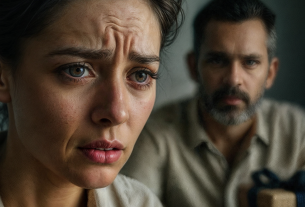
Then the tears burst out of her — not quiet, delicate tears, but the kind that catch in the throat and crush the chest. She sobbed standing up, gripping the back of a chair, unable to stop.
In those tears was everything: four in the morning every day, flour under her nails, the smell of yeast in her hair, endless lack of sleep, loneliness beside a man who lay on the sofa and chewed someone else’s order.
“Stop crying! It’s just a piece of dough!” Andrei stood up, waving his hand in irritation.
“A piece of dough?” Marina lifted her face. “That is my money. My money, do you understand? The money I earn while you lie here like a log!”
“What did you just say?”
“What you heard. A log. A useless, heavy log in the middle of my life!”
“Oh, really?”
“Yes, really! I know everything now! I know I’m carrying three children, this apartment, the loan, and you! And you — you ate my order and told me to shut my mouth?”
“Why are you making such a big deal out of nothing?”
“Get out.”
“What?”
“Get out of my house. Now. Immediately.”
Andrei smirked. He didn’t believe her. He was used to Marina shouting and then calming down. She would cook dinner, put the children to bed, sit down with her order notebook. That was how it had always been.
“Marina, stop it.”
“I said get out!”
She walked up to him, grabbed him by the sleeve, and pulled him toward the door. Andrei was so stunned that he didn’t resist. He simply didn’t understand what was happening. Marina opened the front door, pushed her husband onto the landing, and locked it.
“Hey! Marina! Are you crazy? Open the door!”
She didn’t answer. She leaned against the door and closed her eyes. Danila was standing in the hallway, watching her silently.
“Mom, are you all right?”
“Yes, sweetheart. Go to your sisters. Everything is fine.”
Danila left. Marina took out her phone and dialed a number.
“Valery Nikolaevich? This is Marina from apartment twenty-seven. I need to ask you a favor. Can you come now and change the lock? Yes, right now. I’ll pay whatever you say.”
The lock was changed within an hour. Valery Nikolaevich, an elderly, quiet neighbor, didn’t ask a single question. He took the money, nodded, and left.
Marina sat down at the computer. She went to the government services portal. Found the necessary section. Filled out the divorce application. Sent it.
Then she drafted a petition for child support — a fixed monthly amount. She printed it, signed it, and placed it in a folder.
Her phone kept ringing nonstop. Andrei. His number. Once, twice, five times, ten. Marina declined every call without looking.
Then a message came from Tamara Pavlovna:
“Marina, what is going on? Andrei is at my place, completely shaken. Call him.”
Marina didn’t reply.
At exactly eight the next morning, the doorbell rang. Marina looked through the peephole. Her mother-in-law. Alone. Lips pressed together, wearing the expression of someone who had come to restore order.
Marina opened the door.
“What do you think you’re doing? You threw your husband out in the middle of the night!”
“Good morning, Tamara Pavlovna.”
“What’s good about it? My son is sitting in my kitchen white as a sheet! Have you lost your mind?”
“I’ll ask you one question. Just one. And I want you to answer honestly.”
“Well?”
“How have you helped our family in thirteen years?”
“What?”
“How exactly? With money? With time? Did you ever take the children when I was working three shifts? Did you ever tell Andrei, ‘Son, help your wife, she’s collapsing from exhaustion’?”
“I’m a grandmother! Your financial problems are your business, not mine!”
“Exactly. Your business is giving advice over the phone and telling Andrei I’m nervous. My business has been dragging everything alone and staying silent. Well, I’m not staying silent anymore.”
“Marina, let’s talk calmly…”
“This conversation is over. Leave.”
“You have no right!”
“This apartment belonged to my grandfather. I have every right.”
Marina took Tamara Pavlovna by the shoulder and gently, but firmly, turned her toward the door. Then she closed the lock. Her mother-in-law knocked for another three minutes before finally leaving.
At nine fifteen, Andrei came to the door. His key didn’t fit. He twisted it, pulled it, pushed it — the lock wouldn’t open. Marina called him herself.
“Open the door. Let’s talk normally. I lost my temper yesterday.”
“Andrei, listen carefully. You will not enter this home again. I have filed for divorce. The child support petition for a fixed amount is already prepared. Find yourself a job — extra work, any work — because you will pay.”
“Marina, are you serious?”
“Completely.”
“Because of a piece of dough?”
“Because of thirteen years, Andrei. The piece of dough was just the final drop.”
“Let’s meet and discuss this.”
“There’s nothing to discuss. I’ll pack your things and call you when you can pick them up. Goodbye.”
She ended the call.
A strange calmness spread through her whole body — the kind that comes when you finally make a decision that has been ripening for years.
Two hours later, Andrei called. His voice was different — tight, frightened.
“Marina. My mother had a heart attack. They took her to the hospital. This is because of you.”
“I’ll come.”
She arrived forty minutes later. Tamara Pavlovna was lying in a hospital ward — pale, connected to tubes, a monitor beside her bed. Andrei sat in the hallway, staring at the floor.
“How is she?” Marina asked.
“They stabilized her. They said it was mild. But still.”
“I feel sorry for Tamara Pavlovna. Truly. She doesn’t deserve illness.”
“Then maybe you’ll change your mind?”
“No.”
“Marina…”
“Andrei, pity for your mother does not erase what happened. I’m sorry she is unwell. I brought fruit. Give it to her when they allow it. But the divorce will happen.”
He looked at her as if he were seeing a stranger.
Maybe he was.
Maybe he had never really known the Marina who had endured for years, kneaded dough, shaped dumplings, drove around the city, counted every coin, slept three hours, and got up again.
“You’ve changed,” he said quietly.
“No. I just stopped waiting for something better.”
Two months after the divorce, Marina noticed something strange.
There was more money.
Not a lot more, but enough to feel it. She recalculated expenses three times. The food cost about the same — the children ate the same. Utilities hadn’t changed. But by the end of the month, almost twelve thousand rubles remained in the account.
That had never happened before.
“Strange,” she told her father over the phone. “Everything seems the same, but there’s more money.”
“Count how much he ate. And what he spent money on.”
“Dad, he didn’t eat that much.”
“I’m not talking about food, daughter.”
The answer came on Saturday. Marina was packing Andrei’s remaining things — he had asked for them to be sent through Danila. An old sports bag, a winter jacket, a box of tools. At the bottom of the box, under the wrenches, she found an envelope.
Inside was a bank statement for an account she knew nothing about. The account had been opened three years earlier. In Andrei’s name. The deposits were regular, small — two or three thousand rubles a month.
Total balance: one hundred forty-one thousand rubles.
Marina sat down on the floor.
Three years.
She had worked herself nearly unconscious, counted every hundred, reshaped the budget, refused the children sweets — and he had been saving money.
Quietly.
Carefully.
For himself.
She dialed Andrei’s number. He answered immediately.
“Marina?”
“I found the statement. From the account you never told me about.”
“What account?”
“Don’t. One hundred forty-one thousand. Three years of deposits. While I was kneading dough at four in the morning, you were putting money aside for yourself.”
“That’s… those are my personal savings. For emergencies.”
“What emergency, Andrei? In case your wife breaks down? In case the children need winter boots and you say, ‘There’s no money, be patient’?”
“Marina, every man has the right to a stash…”
“A stash? You call this a stash? While Danila wore torn sneakers until November? While I borrowed money from my father for Varya’s medicine? That’s a stash?”
He was silent. She could hear his breathing. Heavy. Guilty. But there were no words, because no words existed.
“You know what, Andrei? Thank you. Now I truly mean it. Thank you for showing me who you really are. Not yesterday, not because of a piece of dough. Now. This statement is you. All of you. You can take your box of tools. I’ll keep the statement. You can transfer the money to my account voluntarily, or we can handle it through court. Choose whichever suits you.”
She hung up.
That evening, Tamara Pavlovna called. Her voice was weak — she was still recovering.
“Marina, Andrei told me everything. About the account.”
“And?”
“I didn’t know. I swear. I thought you simply didn’t know how to manage money.”
“Tamara Pavlovna, I have nothing to say to you right now. Get well. I’ll bring the grandchildren on the weekend, as promised.”
“Thank you.”
Marina called Lyudmila Fyodorovna — the very customer whose pie had been eaten. On that terrible Tuesday, Marina had called her herself, apologized, and delivered a new pie at her own expense, late at night, at eleven.
“Lyudmila Fyodorovna, I wanted to ask you something. You once mentioned you had acquaintances who needed regular baked goods for events. Is that still relevant?”
“Marinochka, of course! I was just about to call you. A friend of mine runs a cafeteria at a company, and she’s looking for a supplier of homemade food. Your pies are absolutely incredible. I’ve already told her all about you.”
“I’m ready. Let’s discuss it.”
That evening, Danila helped set the table. Sonya arranged the plates. Varya, red-haired and restless, reached for the bread basket.
“Mom,” Danila said, “Dad won’t come back anymore?”
“Dad will come to visit you. Whenever you want.”
“And you won’t cry at night anymore?”
Marina crouched down in front of her son and looked into his eyes.
“No, Danila. I won’t cry anymore.”
A week later, she received her first large order — forty portions for a corporate event. A month later, the second one came. By autumn, she had six regular clients and a stable income three times higher than Andrei’s salary had ever been.
Andrei, meanwhile, moved back to his mother in Voronezh. The factory where he worked announced it would close at the end of the quarter. The savings he had hidden for three years instead of helping his family disappeared in two months — on room rent and food while he searched for any kind of job in an unfamiliar city.
His last message came in November.
It was short:
“Marina, can you lend me some money until payday? Things are hard here. At least 15 thousand.”
Marina read it. Smirked. Typed a reply:
“No. Take it from your stash.”
Then she blocked his number.
In the kitchen, the dough was rising. Varya was laughing in the room. Sonya was singing something unclear but very earnestly. Danila was reading a book on the sofa — the very book Marina had bought him for his birthday, back when Andrei had said there was no money for gifts.
Marina looked at her children.
She exhaled.
And for the first time in a long, impossibly long time, she smiled.
THE END