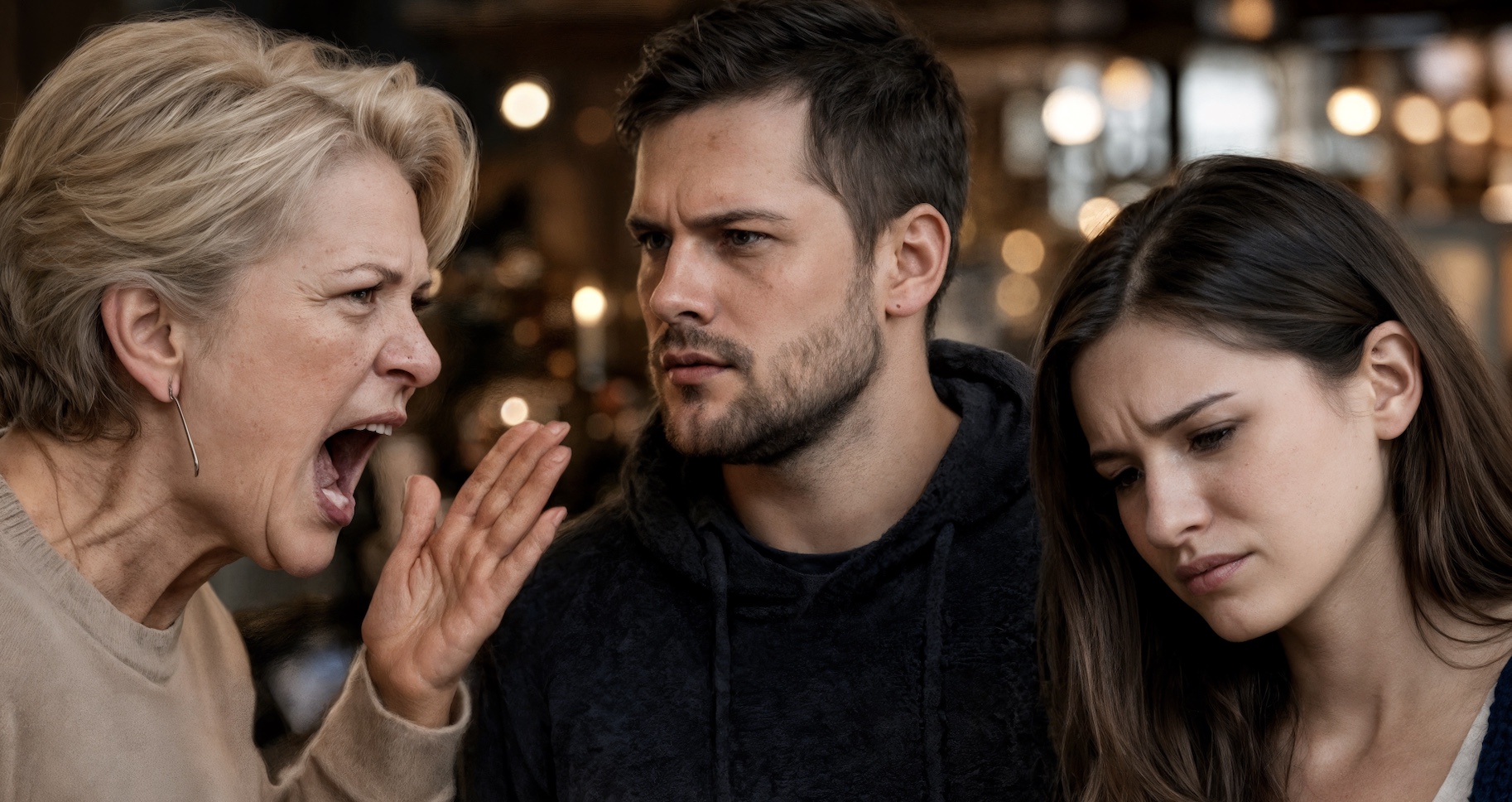
“I refuse to let that little parasite ruin my evening!” Kira Stanislavovna’s voice rolled through the foyer of the Imperial restaurant with such force that the waiters in the lobby froze, trays suspended in their hands. “Turning sixty is an occasion! Not some pathetic family supper with beggars!”
Her son stood opposite her, gripping his phone so tightly his knuckles had gone white. Anton had long ago learned not to react to his mother’s emotional eruptions, but today something inside him had stretched to its breaking point.
“Mom, Dasha is my wife. She belongs here too.”
“Belongs?” Kira Stanislavovna turned so sharply that the emerald necklace at her throat flashed under the crystal chandeliers. “Her place is back where she came from! In that miserable communal flat with peeling wallpaper and roaches! This is where respectable people gather!”
She spoke quietly, but each word landed like a lash. Anton knew the technique well—his mother had mastered the art of humiliation without ever raising her voice. Five-star restaurants did not tolerate scenes, and Kira Stanislavovna hated appearing vulgar.
“Dasha and I have been together for three years…”
“Three years of a mistake,” she cut in, smoothing her hair. Every strand was flawless, as if she had just stepped out of a salon. “I kept silent. I waited for you to come to your senses. But no—you keep dragging this poverty along behind you as though we’re some charity organization!”
Guests were already gathering in the hall. Through the glass doors, Anton could see his aunt Lyudmila, dripping in diamonds, greeting his mother’s friends with air kisses. All those women in couture gowns, all those men in tuxedos—it was a world Dasha truly did not fit into. Not because she was less than them, but because she was different.
“I don’t care about your wife! I don’t want her in this restaurant!” Kira Stanislavovna snapped, and Anton went cold.
He didn’t know Dasha had been standing behind a column. He didn’t know she had arrived early because she wanted to be there for him, to support him. He didn’t know she had heard every word.
Dasha stepped out from behind the marble pillar, pale, wearing the same black dress they had chosen together a week earlier. She had spent half her salary on it. The dress was simple and elegant, yet beside the luxury of the place it looked… cheap.
“I understand,” she said softly.
Anton moved toward her, but Dasha lifted a hand to stop him. Her eyes were full of tears, though she did not cry. She only looked at her mother-in-law—long and carefully, as though seeing her clearly for the first time.
“Dasha, don’t listen…”
“It’s alright,” she said with a smile, and that smile was more frightening than any scream. “I truly don’t want to spoil the celebration.”
She turned and walked toward the exit. Her heels clicked against the marble floor in a steady, measured rhythm. Anton rushed after her, but his mother grabbed his arm.
“Stop! Do you realize there are guests in there? People are waiting!”
“Let go.”
“Anton, I’m your mother!” Panic broke through her voice for the first time. “You can’t humiliate me! Not on a day like this!”
He pulled free and ran to the doors. Dasha was already gone. Only the icy January air swept into the foyer when he flung the doors open. She was standing on the steps outside, wrapping her arms around herself. Her coat was still in the cloakroom.
“Dasha…”
“Don’t,” she said, turning toward him, and Anton saw the tears freezing on her cheeks. “Just… not right now.”
“I’ll leave with you.”
“And what would that change?” she said with a bitter laugh. “Tomorrow will be the same. And the day after that. Your mother will never accept me.”
“I don’t care what she thinks.”
“That’s a lie,” Dasha said, shaking her head. “You do care. Your whole life you’ve been trying to prove to her that you’re good enough. And I’m just one more attempt. You chose a girl from a simple family to show your mother that you’re independent, that you belong to yourself. But I’m not a prop in your rebellion, Anton. Do you understand?”
Her words hurt more than his mother’s because they were true.
“That’s not what it is…”
“Go back to your mother, Anton. It’s her birthday. I’ll take a taxi.”
She walked down the steps, and he did not follow. He simply stood there, feeling the frost creep under his shirt, feeling his fingers grow numb. Behind him, the door swung open—his mother had come outside.
“She left? Good. Excellent.” Kira Stanislavovna draped a shawl over her shoulders. “Then at least she has a shred of self-respect. Now come along. Everyone is already in the hall. They’re asking for you.”
“You did this on purpose?”
“What nonsense are you talking about? I only told the truth.” She looked at him with cold detachment. “You are my only son, Anton. My only one. And I will not let some girl from nowhere destroy what I have spent my whole life building. Our family, our status, our connections—these are not toys.”
“And what about my life?”
“Your life is part of this family.” She turned back toward the doors. “I expect you in the hall in five minutes. You’ll be giving a toast.”
Anton remained alone on the steps. Inside, music thundered and laughter drifted through the walls. His mother’s world—perfect, polished, ruthless. And in that moment he understood that he had always been part of it. That all his attempts to break away had been an illusion.
He pulled out his phone and typed a message to Dasha: I’m sorry. I don’t know what to do.
There was no reply. Only the three dots—she was typing something, then they vanished. The screen went dark.
Inside the restaurant, champagne was already being poured. Kira Stanislavovna stood in the center of the room, radiant as she accepted congratulations. No one seemed to notice that her son never came back in. Or maybe they did notice and chose not to say anything—in their circle, family troubles were never discussed in public.
Anton returned to the lobby. He took his coat, walked past the astonished coat-check attendant, and headed straight for the exit. His heart hammered as though he were committing a crime.
His mother appeared in the doorway to the hall. Their eyes met.
“So you really mean to ruin everything?” Her voice was ice-cold.
“I want to be honest. Just once.”
“Honesty is a luxury for the poor,” she hissed. “Because they have nothing to lose.”
Anton walked out into the street. The cold struck his face, but he breathed in the freezing air deeply. And suddenly he felt something strange—relief.
His phone exploded with messages. Aunt Lyudmila, family friends, business partners—everyone was asking where he was, whether everything was alright.
He muted the phone.
And went to find the taxi that had taken his wife away.
But he didn’t know the most important thing.
He didn’t know that earlier that morning, Dasha had learned something that changed everything. And that she had come to that cursed birthday not simply to support her husband.
She had come to tell him she was pregnant.
Dasha sat in the taxi, staring out the window. The city passed in streaks of light—shop windows, streetlamps, billboards. Everything blurred into a single smear. Her hand drifted to her stomach. There, inside her, was a tiny life. Eight weeks.
She had found out three days earlier. She had been sitting in the doctor’s office, looking at the ultrasound screen, unable to believe it. A tiny flicker, beating. Their child.
Dasha had wanted to tell Anton right away. She had imagined his face lighting up with joy, imagined him pulling her into his arms and spinning her around. But then she had thought—no. It had to be beautiful. She would tell him at his mother’s birthday dinner. Let it become their news for the whole family.
How foolish she had been.
“Miss, we’re here,” the driver said, glancing back.
Dasha blinked and looked up. Their building. A drab nine-story apartment block on the outskirts. Forty minutes to the center by metro. An entire universe away from the Imperial restaurant.
She climbed to the fifth floor on foot. The elevator was broken again. The stairwell smelled of cats and cigarette smoke. On the third-floor landing, their neighbor Maxim was smoking and gave her a small nod. Ordinary life. Her life.
The apartment greeted her with silence. Dasha switched on the light and kicked off her shoes. Her feet throbbed—the heels had been beautiful, but mercilessly uncomfortable. She went into the kitchen and put on the kettle.
Her phone vibrated. A message from Anton: I’m sorry. I don’t know what to do.
Dasha stared at the screen for a long time. Her fingers hovered above the keyboard. She wanted to tell him—about the baby, about how everything had changed, about how they were no longer just husband and wife.
But instead, she locked the phone.
No. Not like this. News like that was not meant to be sent in a message after a scandal.
Then came a knock at the door. Sharp. Insistent.
Dasha froze. Anton? Already?
She opened the door—and went still in shock.
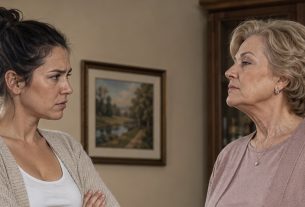
Kira Stanislavovna stood on the threshold. Mink coat. Perfect makeup. Behind her loomed the driver, grim-faced and silent.
“May I come in?” her mother-in-law asked. Her voice was even, almost polite.
“How… how did you get my address?”
“I have ways of learning whatever I need to know.” Kira Stanislavovna stepped inside without waiting for an invitation. Her gaze moved around the apartment—the tiny six-meter kitchen, the old refrigerator, the worn linoleum. “So this is how you live. Interesting.”
Dasha shut the door. Her heart was pounding wildly.
“What do you want?”
“To talk.” Her mother-in-law removed her gloves and set them on the table. “No witnesses, no hysteria. Like adults.”
“I’m not the one having hysterics.”
“That’s true.” Kira Stanislavovna smiled unexpectedly. “You left quietly. With dignity. I appreciated that.”
Dasha had no idea where this was going. Her mother-in-law was in her kitchen, in the middle of the night, after everything that had happened.
“How much?” Kira Stanislavovna asked suddenly.
“What?”
“How much do you need to leave?” She took an envelope from her handbag and placed it on the table. “There’s five hundred thousand in here. Cash. Count it if you like.”
Dasha stared at the envelope as if it were an explosive.
“You must be joking.”
“I never joke about money.” Kira Stanislavovna sat down and crossed her legs elegantly. “You’re a smart girl, Dasha. You understand this isn’t love. Anton is simply rebelling against me. He’s thirty years old and still trying to prove that he’s independent. And you—well, you’re a convenient tool.”
“That isn’t true.”
“It is.” There was no anger in her mother-in-law’s voice now, only tired certainty. “In a year, he’ll be exhausted by this performance of living in poverty. By your parents showing up in their shabby old jackets. By having to pretend he likes this…” She gestured around the kitchen. “…coziness.”
Dasha felt something tighten inside her. Because Kira Stanislavovna’s words hit the exact fears Dasha herself had been too afraid to name in the middle of the night.
“Five hundred thousand,” Kira Stanislavovna continued. “You could rent a better place. Help your parents. Start over. And Anton… he’ll find a more suitable match. Someone from our world.”
“And the divorce?”
“We’ll handle it quietly. No scandal. I’ll make sure Anton doesn’t suffer. He’ll even believe it was his own decision.”
Dasha looked at the envelope. Five hundred thousand. For her family, it was a huge amount of money. Her mother could finally get the dental work she had postponed for years. Her father could buy a decent car instead of the wreck he kept repairing.
And Dasha could raise her child peacefully. Alone, without a mother-in-law who would spend the rest of her life reminding her she was never good enough.
“You don’t even know…” Dasha began.
“I know what matters,” Kira Stanislavovna said, rising to her feet. “You’re a good girl. Just not for my son. Think it over. You have three days.”
She slipped her gloves back on and turned toward the door.
“And if I refuse?”
Her mother-in-law looked back. In her eyes, Dasha saw cold, unwavering resolve.
“Then I will make your life unbearable. Believe me, I have enough connections to ensure you never find work at a decent company in this city. Your parents rent their flat, don’t they? I could have a conversation with the landlady. And your father works at a factory… I believe there are layoffs coming.”
“You wouldn’t dare…”
“I would dare a great deal for my son.” Kira Stanislavovna opened the door. “Three days, Dasha. Money or war. Choose.”
The door shut behind her.
Dasha stood in the middle of the kitchen, staring at the envelope. Her hand drifted once more to her stomach.
I’m sorry, little one, she thought. I’m sorry you were born into a family like this.
The morning of the third day.
Dasha sat in a café across from the office where Anton worked. The envelope was in her bag—untouched, still sealed. For three days she had neither slept nor eaten properly. She had only thought.
Anton appeared at exactly nine o’clock. He saw her and stopped short. Then he approached slowly, like someone trying not to frighten a wounded animal.
“Dasha…”
“Sit down.”
He sat. He looked awful—crumpled shirt, dark circles under his eyes. He clearly hadn’t been sleeping either.
“I wanted to come to you, but you wouldn’t answer my calls…”
“Your mother came to see me,” Dasha said calmly.
Anton went pale.
“What?”
“She offered me money. Five hundred thousand for a divorce.” Dasha took the envelope from her bag and laid it on the table. “Here. Want to see?”
His hands began to shake. He snatched up the envelope, tore it open, and flung it down. Banknotes scattered across the café floor. People at nearby tables turned to stare.
“I’ll tell her exactly what I think,” he whispered. “I swear, I…”
“Don’t.” Dasha placed her hand over his. “Listen to me. I’m pregnant.”
Silence.
Anton stared at her without blinking. Then, slowly—very slowly—a smile began to spread across his face. A real smile. The first one in three days.
“Really?”
“Eight weeks. I wanted to tell you at the birthday dinner. I thought it would change everything.” Dasha gave a faint, bitter laugh. “I was so naive.”
Anton pulled her into his arms right there in the middle of the café, among the tables and the scattered money. He held her so tightly that she could feel his heart pounding against her.
“We’re leaving,” he said quickly, almost breathlessly. “We’ll get out of this city. I’ll find work somewhere else. My mother won’t know where we are. We’ll start over from scratch.”
“Anton…”
“I mean it.” He leaned back and looked her in the eyes. “Forgive me. For everything. For not protecting you. For letting her…”
“You did protect me.” Dasha smiled. “You walked out of that birthday dinner. That means more than you know.”
They left a week later. Anton found a promising job in Saint Petersburg. Dasha took a remote position. The apartment they rented had old furniture and nothing special about it, but it was their home. No Kira Stanislavovna. No poison.
Anton called his mother once. Just once. He told her they were leaving. That she would never see him or her grandson again.
Kira Stanislavovna was silent for a long time. Then she said:
“You’ll regret this.”
“No,” Anton answered. “You will.”
And he hung up.
Two years passed.
Kira Stanislavovna sat in her enormous apartment on Kutuzovsky Avenue. Five rooms. Designer renovation. A view over the Moscow River. Everything perfect. Everything empty.
Anton did not call. He did not write. He had vanished as though he had never existed.
At first she was furious. Then she tried to find them—she even hired a detective, but her son had been careful. He changed his number, deleted his social media, disappeared into the shadows.
Her friends drifted away little by little. It turned out their friendship had been held together by money and influence. When Kira Stanislavovna began to grow older, when her power started to fade—they disappeared, one by one.
Aunt Lyudmila died of a stroke. Ten people came to the funeral.
Kira sat by the window, looking out at the city. No one called. The housekeeper came twice a week—silently cleaned, silently left.
One day, while rummaging through old things, she found a photograph. Anton was about five years old in it. He was sitting on her lap, laughing. She was smiling too—a real smile, not the polished mask she wore for society.
When had everything broken? When had she decided that power mattered more than love? That status mattered more than her own son?
Kira traced the photograph with her finger. Then she put it back in the box. Closed the lid. Locked it away.
Her phone lay on the table—black, silent. She could have called. She could have asked for forgiveness. She could have tried to get her son back.
But pride would not let her.
And so she remained in her perfect apartment, surrounded by expensive furniture and crystal chandeliers.
Alone.
In Saint Petersburg, snow was falling. Dasha pushed a stroller along the embankment. Their son, Mark, slept inside, wrapped in a warm snowsuit. Anton walked beside her, holding her hand.
“Do you think she ever…” he began.
“I don’t know,” Dasha said with a shrug. “And honestly? I don’t care. We have each other. That’s enough.”
Anton nodded. Then he bent over the stroller and adjusted the blanket.
“Mark looks like you,” Dasha said.
“No. Like you. He has your eyes.”
They laughed. And there was no bitterness in that laughter. Only relief. Freedom.
Somewhere far away, in Moscow, an old woman sat alone in an empty apartment, staring out the window. She had won every battle for control.
But she had lost the war for love.
And now there was no one left to blame but herself.