Irina shut the car trunk and breathed out a small cloud into the freezing air. It was December 29th, and for the first time she genuinely felt the New Year approaching. Sergey came down from the building with the last bag—bottles clinked inside.
“That everything?” he asked, scanning the loaded car.
“Everything,” Irina smiled. “Let’s drive far, far away from them.”
Sergey chuckled—he knew exactly who she meant. For five years straight, every New Year’s had been a trial. His parents, his brother Oleg with his wife Sveta, and their two kids would all troop into Irina and Sergey’s apartment. They’d show up with a bargain bottle of champagne and a small bag of mandarins, then spend hours wiping out the holiday spread Irina had cooked for two full days. His mother, Lyudmila Petrovna, always found something to pick at—salad too salty, meat too dry, music too loud. And his father, Viktor Ivanovich, would get drunk by midnight and launch into the same stories about his youth, year after year.
This time, they’d decided to change the rules.
“You think they’ll be upset?” Sergey asked, turning the key in the ignition.
“Did anyone ever ask if we wanted to host a twelve-person dining hall every December?” Irina shook her head. “Sasha and Katya are celebrating with friends—and good for them. They’re in their twenties. They’re grown. So why don’t we get to have our own holiday?”
Sergey didn’t answer, but his face showed he agreed. For years he’d been pulled between his wife and his parents, but this time it was him who предложил the escape: the dacha. Quietly. Without telling anyone.
Their place was about 120 kilometers from the city, in a calm settlement near the forest. In summer they came for weekends, but in winter it sat empty. Still, the house had a wood stove, there was plenty of firewood, and Sergey had arranged with a neighbor to clear the road to the gate.
They reached the village sometime after two. The snow lay smooth and untouched, the evergreens stood thick and fluffy—like a picture-book winter. Irina was already imagining the evening: sitting together with mulled wine, watching old movies, no interruptions.
“We should chop wood right away,” Sergey said, opening the gate. “So we’re not dealing with it later.”
The house met them with cold air and the smell of old timber. Irina immediately opened vents and windows to air it out, while Sergey went to light the stove. Within an hour, warmth began to crawl into the rooms, logs crackled, and their familiar pre-holiday rhythm took over.
Irina hung string lights around the house, set out candles, and covered the table with a linen cloth—the one from her grandmother, saved for special occasions.
“Think this is enough?” Sergey asked, nodding toward the boxes of ornaments.
“More than enough,” Irina said, hugging him from behind. “You know… I forgot the last time I prepared for a holiday like this. Usually I just make a giant bowl of Olivier and wait for everyone to demolish it.”
“Ira… don’t say that.”
“But it’s true. Your mom didn’t thank me last year even once. She did have time to say my aspic needed more garlic.”
Sergey went quiet, guilty. He knew she wasn’t wrong—yet family was family. You didn’t get to choose your parents.
They spent December 30th cooking. Irina made two salads—mimosa and a shrimp Caesar—roasted a duck with apples, and baked meat “French-style.” On the fridge shelf sat a jar of red caviar: 200 grams for two thousand rubles—ridiculously expensive, but worth it. Next to it was a container of sliced cheese—Dorblu and Parmesan—bought at a specialty shop.
“Finally,” Irina said, admiring the spread, “we’ll eat like people.”
“We should send the kids a photo,” Sergey said, pulling out his phone. “So they don’t worry.”
Sasha replied with a Christmas tree and champagne emoji. Katya sent a photo from a friend’s apartment—young people gathering, dressed up, smiling. Irina smiled back at the screen. At least the kids weren’t repeating their mistakes. They knew how to say “no.”
New Year’s Eve arrived clear and bitter cold. The moon hung bright, snow squeaked underfoot, and smoke rose from chimneys nearby. Sergey carried in a huge armful of firewood—enough for the whole night. Irina set the table, arranged plates and glasses, lit the candles.
“Looks gorgeous,” Sergey said, wrapping his arms around her. “Like a restaurant.”
“Better,” Irina corrected. “Because it’s just us.”
By 8:45 they were already seated. They opened a bottle of prosecco and poured two glasses.
“To us,” Sergey said, raising his glass.
“To us,” Irina echoed.
They drank—and then someone knocked at the door. Quiet at first, then more insistent. They exchanged a look.
“Neighbors?” Sergey guessed.
“At this hour?” Irina frowned.
Sergey went to the door. Irina stayed seated, a bad feeling rising—and she wasn’t wrong.
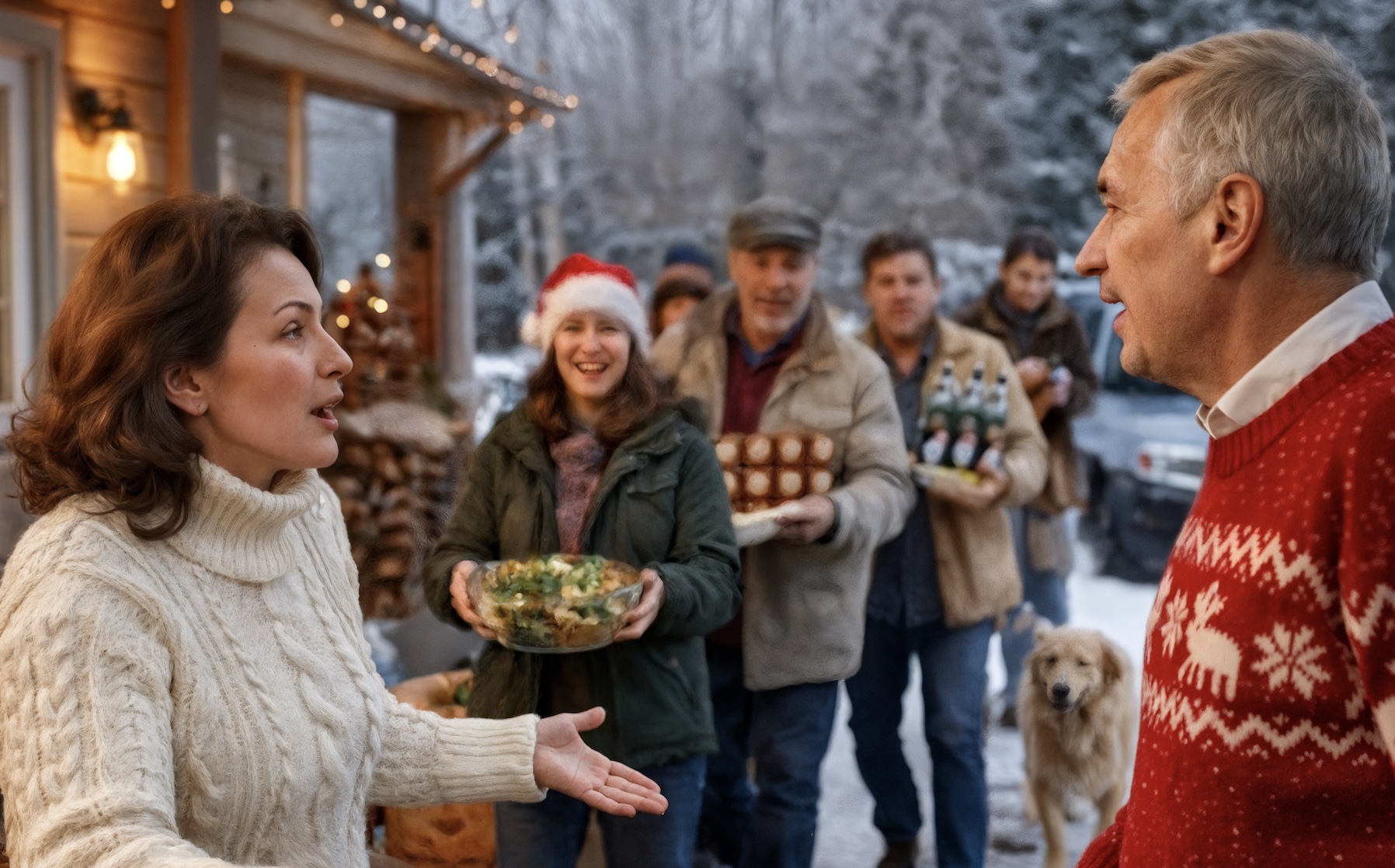
On the porch stood his parents. Behind them were Oleg, Sveta, and their two teenagers—Maxim and Kristina. Everyone was bundled in puffer jackets and hats, faces red from the frost. Bags and bottles in hand.
“Surprise—we made it!” Lyudmila Petrovna announced cheerfully. “You thought we wouldn’t find you? Katya gave us the address. Smart girl.”
Irina felt her stomach drop. Katya—her own daughter—had given them up.
“Mom… Dad…” Sergey stared at them, stunned. “But we didn’t invite you…”
“And why would you need to?” Viktor Ivanovich pushed past him, shaking snow off his boots. “We’re family. We’re keeping it simple. You really think we’d leave you alone for the holiday?”
Oleg came in next with a bag of bottles. Sveta followed with a plastic container, the kids with backpacks. The little entryway filled instantly—with noise, cold air, and the smell of someone else’s food.
“Well? Feed the guests,” Lyudmila Petrovna said, slipping off her coat and shoving the container into Irina’s hands. “I brought pickles—cucumbers and tomatoes. And I picked up sausage too, the one from Pyaterochka, it was on sale. Because you probably made your little salads, but where do you get real snacks out here?”
Irina took it without a word. Her fingers tightened until her knuckles turned white.
“And don’t forget vodka on the table,” Viktor Ivanovich added. “That champagne of yours is just bubbles—no point.”
Oleg set his bag down and pulled out a bottle of cognac. The label was familiar: the cheapest kind, around six hundred rubles.
“I was worried you wouldn’t have anything to drink,” he said. “So I brought this, just in case.”
Sveta had already walked into the kitchen, staring at the table.
“Oh wow, you’ve got a whole restaurant here!” she whistled. “Oleg, look—duck! Meat! Ira, how many days did you cook?”
“Three,” Irina answered on autopilot.
“Well done,” Lyudmila Petrovna said, stepping into the kitchen and inspecting everything like a judge. “Although that tablecloth is kind of old. I’ve got a new one—I’ll give it to you next time. This is embarrassing.”
The kids made themselves at home by the TV, playing something on a phone. Viktor Ivanovich sat down, rubbing his hands.
“Seryozha, get the shot glasses,” he ordered. “Why are you standing there like a stump?”
Sergey stood in the middle of the kitchen, his face showing he couldn’t even process what had happened. One minute ago it was just the two of them—happy, free—about to welcome the New Year together. Now the house was packed with relatives who’d already settled in, unpacked their things, and started issuing requests.
Irina looked at the table—her beautiful table, set for two. Food that might have lasted four people if everyone ate lightly. And there were eight of them.
“Ira, can you get napkins?” Sveta asked, already moving the salads into different dishes. “These bowls are awkward.”
“It’s so nice here,” Lyudmila Petrovna said, sitting beside her husband. “We did the right thing coming. Otherwise you’d sit here alone, bored. A holiday is for family, right?”
“Right, Mom,” Oleg murmured, pouring cognac into shot glasses.
“And we’ll do proper toasts,” Viktor Ivanovich nodded. “Like we’re supposed to. You probably planned to just drink and that’s it? That’s not right—no holiday without toasts.”
Sveta cut herself a chunk of duck. Lyudmila Petrovna piled salad onto her plate. Viktor Ivanovich reached for the meat. The kids wandered over and grabbed sausage sandwiches their grandmother had brought. Oleg finished pouring and waited for everyone to sit so they could clink glasses.
Irina watched and felt anger, hurt, and rage rising all at once. She watched чужие hands grabbing the food she’d cooked. She watched cheap sausage and plastic-bottle cognac invade her table. She watched people force their way into her home—into her holiday—without asking whether they were wanted.
“Irina, why are you just standing there?” Lyudmila Petrovna looked up. “Sit down—the chimes will start soon.”
And that’s when Irina realized she couldn’t watch it anymore.
“ENOUGH!” she shouted so loudly everyone froze.
Silence dropped over the house. Sveta stopped mid-bite, fork suspended in the air. Viktor Ivanovich choked on his drink. The kids popped their heads out from behind the TV.
“Ira…” Sergey started, but she lifted her hand.
“No. I’m speaking. I’m finally going to say what I think.”
She looked at each of them in turn.
“Have you ever asked—ever—whether we actually want you here for the holidays? Even once? Or do you just come every year, eat everything we make, criticize it, get drunk, and leave us with mountains of dirty dishes and trash?”
“Ira, not in front of the children…” Sveta tried to stop her.
“Let the kids hear it,” Irina snapped, unable to stop now. “Let them learn that this isn’t normal! You don’t show up without an invitation. You don’t barge into someone’s house and demand to be fed. That’s freeloading. That’s nerve.”
“How dare you?!” Lyudmila Petrovna went red. “I’m your mother!”
“You’re my mother-in-law,” Irina corrected coldly. “And in five years you’ve never once thanked me for a holiday dinner. Not once. But you’ve had plenty of criticism.”
“We’re family,” Viktor Ivanovich muttered. “It’s normal for family to gather…”
“Family gathers when they’re invited!” Irina felt tears sting, but she held them back. “We came here on purpose to be alone. Just once—to celebrate the way WE want. Without critiques, without overeating, without drunken speeches about your youth. We wanted quiet and peace. Is that really too much?”
“But we didn’t know…” Oleg began.
“You didn’t want to know,” Irina cut him off. “Katya gave you the address—fine. But did it never occur to you to ask why we didn’t invite you ourselves?”
Lyudmila Petrovna stood, lifting her chin in outrage.
“So that’s how it is. Fine. We understand—we’re not welcome. Viktor, get your things. Oleg, Sveta, kids—we’re going home.”
“Mom, maybe don’t…” Sergey tried, but she stopped him with a look.
“Your wife made it perfectly clear. We’re in the way. Good. You’ll celebrate alone.”
Oleg silently began gathering the bottles. He packed up the cognac, the wine, even a spare vodka they hadn’t opened.
“If we’re not wanted, then you don’t need our treats either,” he grumbled.
Lyudmila Petrovna took her pickles back and, for good measure, grabbed the sausage off the table too—dramatically, like it was a statement.
“Eat your duck,” she snapped.
Viktor Ivanovich stood, swaying slightly—the cognac had already hit him. The kids hurriedly pulled their backpacks on. Sveta threw on her jacket without even fastening it.
At the door Lyudmila Petrovna turned back.
“Seryozha—remember this New Year. Remember how your wife kicked your family out into the мороз half an hour before midnight.”
“Mom, please…” Sergey whispered helplessly.
But they were already gone. A car door slammed, an engine started. A moment later, their red taillights disappeared around the bend.
The house went quiet. Sergey stood at the window, staring into the dark. Irina sank into a chair, her hands trembling. The adrenaline drained away, leaving only emptiness.
“Do you understand what you just did?” Sergey asked softly.
“I do,” Irina answered just as quietly. “And I don’t regret it.”
He looked at her.
“They came to be with us…”
“They came to eat and get drunk,” Irina corrected, exhausted. “I’m tired, Seryozha. Tired. I wanted to feel like the хозя́йка in my own home—not a cafeteria cook.”
He stayed silent, not knowing what to say. On TV, the clock was already counting down to midnight.
“Happy New Year,” Irina said, raising her glass of now-warm prosecco.
“Happy New Year,” Sergey repeated.
They drank—awkwardly, sadly, with none of the joy they’d planned.
“I’ll go check if they closed the gate,” Sergey said, and stepped outside.
Irina was left alone. She looked at the table—beautiful, festive, now half-destroyed. Sveta had eaten half the duck. Viktor Ivanovich had nearly finished the Caesar salad. The French-style meat had been picked at, the mimosa salad smeared across plates.
And then a thought hit her.
Where was the caviar?
Irina went to the fridge and opened it. The shelf was empty where the jar had been. The cheese container was gone too.
“Sergey!” she called.
He came back in, brushing snow from his jacket.
“They stole the caviar and the cheese.”
“What?”
“The jar—two thousand rubles. And the cheese. Parmesan and Dorblu. I bought it for the holiday.”
Sergey walked to the fridge, looked inside, then looked at the table, then back at the fridge again. Finally he turned to Irina.
“Your mother stole food from us,” Irina said slowly. “While they were leaving. Or Sveta did.”
Sergey opened his mouth, closed it, then opened it again.
“Two thousand, you said?”
“Just for the caviar. The cheese was another thousand.”
“Three thousand,” Sergey calculated. He paused—and then suddenly snorted.
“What’s funny?” Irina blinked.
“It’s just…” He snorted again. “The nerve. To get offended, make a scene—and on the way out still steal something!”
Irina let out a short snort too. Then she smirked. Then she laughed.
“Oh my God,” she said, wiping sudden tears. “They took their Pyaterochka sausage back—and stole our caviar!”
“And the cheese!” Sergey added, already laughing.
They laughed until their cheeks hurt—laughing at the absurdity, at the relief, at how years of tension suddenly broke and poured out in one wave.
“Want me to drive after them and take it back?” Sergey asked, catching his breath.
“No,” Irina shook her head. “Let them eat it. At least their visit accomplished something.”
She went to the table and picked up the dish of French-style meat—exactly half was left.
“You know what?” she said, turning to her husband. “This is still more than we’d have if they’d stayed. We would’ve ended up with nothing.”
“And zero peace,” Sergey added. “Right now Dad would be telling us how back in 1982…”
“…he was the first in the workshop to beat the plan,” Irina finished, and they burst out laughing again.
Sergey fetched a second bottle of prosecco from the pantry—an extra they’d bought just in case. He opened it and poured two fresh glasses. The firewood crackled, the candles melted down, and snow drifted outside the windows.
“Happy New Year, Ira,” Sergey said, kissing her.
“Happy New Year,” she smiled. “And thank you for not trying to stop me.”
“Honestly, I wanted to do it five years ago,” he admitted. “I just never had the guts.”
“Do you think they’ll forgive us?”
“By March they’ll forget,” Sergey said with certainty.
“At least they’ll be full of caviar and cheese,” Irina took a sip. “Maybe they’ll remember me kindly.”
They sat wrapped in each other’s arms, watching the stove flame dance. There was still plenty of food left—more than enough for two. The house was warm and quiet. Their phones stayed silent: the kids had sent their midnight wishes, and the relatives were clearly sulking.
“You know,” Irina said, resting her head on Sergey’s shoulder, “this is the best New Year’s we’ve had in five years.”
“Even with the stolen caviar?”
“Even with it,” Irina laughed. “If anything, it proves I was right. They didn’t come for family. They came for food.”
“And for booze,” Sergey added. “Though they took theirs with them.”
“Because without it, it’s not a holiday,” Irina said, settling deeper into the couch. “And our prosecco doesn’t interest them. Not strong enough.”
“But it tastes good.”
They stayed up until three in the morning, talking about everything—kids, plans, work, dreams—quietly, slowly, knowing no one would interrupt, shout over them, or start the same old story for the hundredth time. It was their night. Their holiday.
And in the morning, when Irina woke up and looked outside, the first thing she saw were tire tracks in the snow leading from the gate back to the road. And she knew she’d done the right thing. Because sometimes you have to be tough to protect yourself. Sometimes you have to say “no,” even when it hurts. Sometimes you have to choose yourself over other people’s expectations.
“Happy New Year, Irina,” she whispered to her reflection in the window. “Happy new life.”
And she smiled.