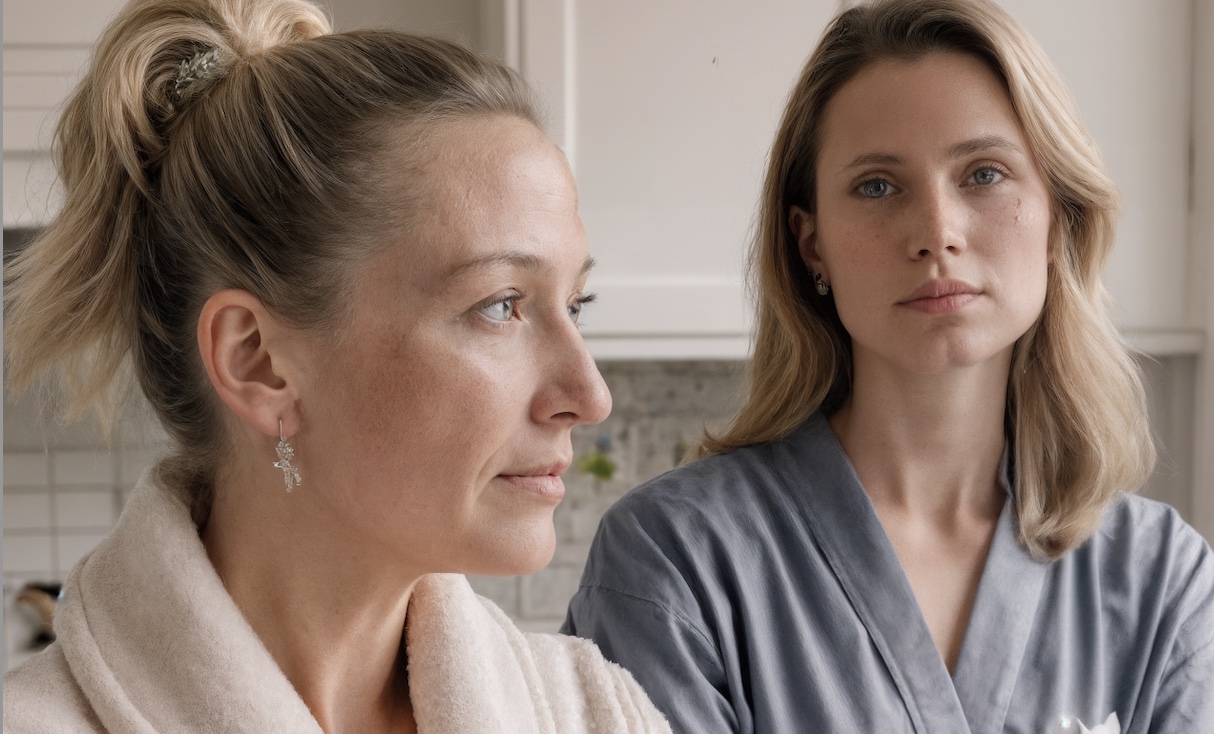
Natalia stood at the stove, slowly stirring oatmeal. The kitchen was eerily quiet, the silence broken only by the gentle hiss and crackle of the gas. Through the window, a cold dawn seeped in—blue-gray, like the misted eyes of someone worn down to the bone.
“Natalia, you didn’t forget Mom needs her blood pressure checked before breakfast, did you?” Viktor called from the bedroom.
“I didn’t,” she replied on autopilot—then froze, realizing she hadn’t been thinking about it at all.
She turned her head and caught her reflection in the glass. Dull eyes. Fine lines. Hair flattened at the roots. Once, she wouldn’t leave the house without lipstick. Now her only goal was to brew the herbs by eight.
Raisa Dmitrievna—her mother-in-law—appeared in the doorway, leaning on her cane. She moved with deliberate heaviness, a hint of performance in every step.
“We really should wash all the living room curtains today. And the hallway rugs too,” she announced without so much as hello. “You can feel the dust. My throat is scratchy.”
Natalia turned around.
“But it’s Wednesday—window day. I was planning—”
“Planning what?” Raisa Dmitrievna snapped. “You make plans, and I have asthma. Or does an old person’s health mean nothing to you now?”
Natalia knew: any pushback would become emotional blackmail. Illness, age, fatigue—Raisa Dmitrievna could turn all of it into a weapon.
Viktor shuffled into the kitchen, scratching his stomach under his T-shirt.
“Mom’s right. It does feel dusty. Maybe you toss the curtains in the washer, and I’ll do the windows this weekend… if I remember.”
“Sure,” Natalia whispered, that familiar heaviness rising in her chest. No one even asked whether she wanted to. She was simply expected to.
By nine, the kitchen had been scrubbed spotless. Raisa Dmitrievna sat in an armchair knitting, offering commentary on everything.
“Natalia, what are you wearing? That gray sweater—your face looks washed out. Lilac looks good on you, I told you.”
Natalia stared at her hands, red and raw from cleaning chemicals, and felt anger building slowly inside her. But she swallowed it. Like always.
Later she sat down at her laptop—she needed to go through reports. She still worked remotely as an accountant, but at home they treated it like a pastime, not an actual job.
“You’re at home anyway,” Viktor would say. “Why are you working yourself up over it?”
By evening, Raisa Dmitrievna reminded her again:
“Remember I told you we need to go to the market for potatoes? Mondays have discounts there. Go before they sell out. And don’t forget two sacks—one for winter storage, one for mashed potatoes.”
Natalia quietly closed the laptop.
“Tomorrow I’m working all day. A report in the morning, then a call with the tax office.”
“I’m not telling you to carry the sacks!” her mother-in-law shot back. “Order a taxi. These days it’s always ‘I’m tired’—an excuse for everything. In my day, women carried two buckets from the garden and didn’t complain.”
And again—silence. Natalia didn’t argue. Why bother? They’d make her the villain anyway.
Before bed she stood in the bathroom mirror. Her face looked slack, her hair as if the color had drained out of it. Who was this woman?
Beside the toothbrushes sat Raisa Dmitrievna’s drops, Viktor’s medication box, and somewhere behind them—Natalia’s face cream, expired three months ago.
She turned off the light.
The next morning she woke before dawn. Dressed quietly. Pulled on a jacket. No breakfast. No blood pressure check. No explanations.
She simply walked out and shut the door behind her.
The bus moved slowly, carrying Natalia away from high-rises, complaints, pills, and the constant, suffocating “you have to.” Outside the window, half-asleep villages slipped past, the occasional gas station, endless fields. With every mile, something inside her loosened. Not peace—not yet; anxiety still hovered close—but breathing became possible again.
She went to Tatyana—her friend, her former neighbor. Tatyana had moved into a tiny wooden house by the woods. No internet, but a stove, a samovar, and a porch where you could sit for hours and just look at the sky.
“You have no idea what you looked like that day at the pharmacy,” Tatyana said as she poured tea. “Like someone had squeezed you dry. I kept thinking—should I call you, or should I stay out of it… and then you showed up yourself.”
Natalia watched the steam curl from the mug. Then, suddenly, she said:
“I left. I just stood up and walked out.”
Tatyana didn’t look surprised. She only nodded.
“You know… you’re not the first. And unfortunately, you won’t be the last.”
The next day Natalia turned her phone off. The first time—out of fear. The second time—because she wanted to. For the first time in ten years there was no “Nat, where are the pills?” no “Did you salt the soup?” no “Where did you put my socks?”
She washed dishes, swept the floor, lit the stove. In the mornings she made herself coffee and sandwiches instead of oatmeal measured to a diabetic’s sugar limit. She pulled a dress from the closet—and no one said, “At your age…”
On the fourth day she turned the phone back on. Thirty-six missed calls from Viktor. Nine from his sister. Even two voice messages from Raisa Dmitrievna:
“Natalia… what are you doing? We’re worried…”
“You can’t do this. You’re an adult. Come home and stop with the hysterics.”
Natalia listened to everything, set the phone on the windowsill, and stepped outside. A fine rain drifted down. The air was damp, but it felt honest.
“If I go back now, it all starts again,” she thought. “And if I stay… what happens then?”
On the seventh day she texted Viktor: I’m okay. Resting. When I come back, we’ll talk.
His reply came instantly: This is too much, Natalia. Mom is worried. I don’t understand what’s happening.
A couple of hours later: At least tell me when you’re coming back. This isn’t human.
She didn’t respond.
On the ninth day she woke up at six out of habit, but for the first time in years… she stayed in bed. She stared at the ceiling, then at the window as the sky brightened. And suddenly, for no reason at all, she cried. Quietly. Without a sound. Simply because she could.
Two weeks later she returned. By taxi, with a bag, with a new steadiness in her voice. Raisa Dmitrievna opened the door without a word. Viktor stood behind her, frowning.
“So… you came back,” he muttered. “I thought you weren’t going to.”
Natalia set the bag down and said calmly:
“We need to talk. All of us.”
Raisa threw up her hands.
“Talk about what? You abandoned us, disappeared! I nearly called an ambulance! Do you have any idea what you put me through?!”
“And do you have any idea what you put me through—for ten years?” Natalia met her gaze for the first time. “No days off. No respect. No voice.”
Viktor turned away, grabbed the remote, and switched the TV on. Natalia walked over and pressed “off.”
“No, Viktor. Not this time. This time you don’t get to hide in silence.”
He exhaled. Raisa Dmitrievna sat rigid, lips pressed tight.
“I’m not living the way I was living anymore,” Natalia said. “If you want to know what happens next—listen to me.”
That evening Natalia insisted they all sit at the table. No TV. No phones. Just the three of them—her, Viktor, and Raisa Dmitrievna.
She served chicken casserole with broccoli for dinner. No broth. No bread. No “proper homemade borscht.” Raisa Dmitrievna took one look and grimaced.
“And you call this dinner?” she hissed. “Chicken without potatoes? Where’s the soup? Where’s the first course? This isn’t how Russians eat.”
“Tonight, dinner is what I decided to make,” Natalia said evenly, pouring herself tea. “Tomorrow you can choose the menu yourself.”
Raisa went silent, her mouth thinning into a line. Viktor kept eating slowly, as if waiting for everything to settle on its own.
“So,” Natalia began. “I left because I was at the edge. I could’ve collapsed—and you wouldn’t have noticed. All these years I’ve been here like background noise. Like a lamppost people lean on without ever saying thank you.”
Raisa snorted.
“Well, excuse us for not applauding your oatmeal.”
“Raisa Dmitrievna,” Natalia’s voice turned icy. “I’m not your nurse. I’m not your maid. I’m a person. With my own life. My own boundaries.”
“So that’s how you talk now,” her mother-in-law spat. “So now we’re a burden to you?”
“Yes,” Natalia said. “The way things were—yes. I can’t survive it anymore. So either we set new rules, or I leave. For good.”
Viktor lifted his head. His face had gone deathly pale.
“Natalia, are you serious? Where would you go? Back to Tatyana? To a cabin somewhere?”
“Anywhere,” she said. “As long as I don’t lose myself.”
Raisa straightened, her voice dripping with accusation and wounded pride.
“You’ve lost your mind. What nonsense have you filled your head with? We’re family!”
“Family isn’t one person doing the work for three while the others only criticize,” Natalia replied. “Family is support. Not constant drilling and control.”
“You lived like a queen!” Raisa shouted. “A roof over your head, food, a husband beside you!”
“A husband who stays quiet when I’m humiliated at the table,” Natalia said. “And a mother-in-law who thinks I exist to carry everything. No. Thank you.”
And then Raisa went all in.
A few days later she organized a “family dinner,” inviting a cousin, Viktor’s brother and his wife, even a distant niece. Natalia sensed the trap, but she came anyway. She stood in the doorway, took in the table packed with food, her mother-in-law’s prepared speech, and her husband’s indifferent face.
Raisa Dmitrievna rose, holding a salad bowl like a microphone.
“We’re all here to talk. Because something strange has started in our family. Our Natalia… suddenly decided she has some kind of ‘rights.’”
Someone giggled. Another voice chimed in:
“What is it, Nat—did you turn into a feminist?”
Natalia stood. Walked to the table. Calmly, without raising her voice.
“Are you all ready to answer for what you’re about to say? Because I’m done staying quiet.”
Silence.
“For ten years I’ve been convenient,” she said. “No one asked how I was. The only thing that mattered was borscht on time and clean curtains. But you know what’s truly terrifying? Living next to people who don’t notice you’re slowly dying inside.”
Viktor’s sister coughed.
“Don’t be dramatic…”
Natalia looked at her, cold and steady.
“If I died for real, the first thing you’d ask is who’s going to take over my duties. But the moment I chose to live—you call a meeting to put me on trial.”
Raisa Dmitrievna flushed, her lips trembling.
“You’re ungrateful. You’re… selfish!”
“If caring about myself is selfish,” Natalia said, “then I’m proudly selfish.”
And she walked out—of the room, of the conversation, of the role they’d written for her.
That night after the “family dinner” was oddly quiet. Neither Viktor nor Raisa spoke to Natalia. Behind the wall she could hear whispers, rustling, muffled remarks—yet no one dared come to her.
In the morning, as usual, Natalia got up at six. Made herself strong coffee. Not tea, not broth for her mother-in-law—coffee, for herself. She sat by the window, opened her laptop, and went to an online course website. Only two lessons remained in her art photography course. She’d already entered a contest at the city gallery.
An hour later Viktor walked into the kitchen.
“Hi,” he muttered, stealing a quick glance at her.
“Hi,” Natalia answered without looking away from the screen.
He hesitated, shifted on his feet, then finally forced the words out.
“Listen… I’ve been thinking. Maybe you’re right. I was… well, to put it mildly, I wasn’t very attentive.”
Natalia lifted her eyes.
“You weren’t inattentive, Viktor. You were comfortable. Because it was easier that way.”
He dropped his gaze.
“I don’t want you to leave.”
“Then learn to live differently,” she said. “Or I’ll leave anyway. No scandals, no tragedies. I’ll just go.”
The next day Raisa Dmitrievna asked a caregiver from the neighboring house to come help with her medication. Natalia, without saying a word, left her a list of phone numbers and visiting hours. No lectures. No triumph. Just a clear boundary.
Two weeks later Raisa Dmitrievna stepped into Natalia’s room. She stood there silently, then said:
“You’ve changed.”
“Yes,” Natalia nodded. “Because otherwise I wouldn’t have survived.”
Raisa sighed, looked out the window, and unexpectedly said:
“Aunt Vera has a spare room. I’ll move there. It’s quiet. And no one has to be anyone’s burden.”
Natalia didn’t answer. She only felt something inside her unclench—not out of spite, but relief.
A week later, Raisa Dmitrievna truly left. No tears. No loud scene. Just a brief “take care of yourself” in the hallway.
After that, the house began to breathe differently. The heavy pauses disappeared, along with the accusations and the constant tension in the shoulders. In their place came light breakfasts for two, Saturday drives out of town, tea on the veranda. Natalia framed her photographs and hung them on the walls. The old tapestries were replaced by living images: rain on glass, an apple tree in bloom, a woman in a coat walking into the dawn.
At first Viktor fumbled—forgot to take out the trash, mixed up the rags for floors and dusting. But he didn’t give up. He even suggested they clean out the storage room together, where no one had touched the dust in ten years.
“We did it,” he said one evening.
“So far, yes,” Natalia replied. “The main thing is not to forget how much it hurt when we weren’t.”
Lilacs bloomed in the garden. Natalia clicked the camera shutter. In the photo was her—not a shadow, not background, but a living woman with quiet strength in her eyes.