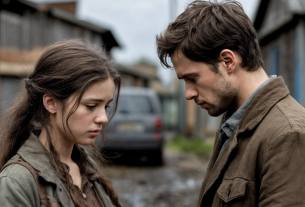
“Relaxing?”
Raissa Stepanovna’s voice, coming from right behind her, didn’t make Marina flinch. Marina had long since grown used to the sound of a key sliding into the lock—the soft metallic scrape that always signaled an invasion.
She finished the sentence she was reading, placed a silent period in her mind, and only then lifted her head from the book.
Her mother-in-law stood in the entryway without removing her coat. Solid, heavy, she blocked the corridor light completely. Her small, grasping eyes flicked over Marina, then the book in her hands, then the cup of tea gone lukewarm on the table. The look was obvious: disapproval, seasoned with superiority.
“Hello, Raissa Stepanovna.”
“I came to remind you that this Sunday—like always—everyone is at my place. In our family, that’s how it’s done: you respect your elders and you gather together. So we don’t have any ‘surprises’ later.”
She didn’t sound like someone giving a reminder. She sounded like someone issuing instructions. Every word dropped with weight, like a stone placed on a scale already tilting too far.
Marina calmly set her book on the sofa and carefully smoothed the bent page corner. Her calm was a shield—one she raised every time Raissa Stepanovna showed up like this.
“Raissa Stepanovna, Igor and I already agreed to go to our friends’ dacha. Didn’t he mention it?”
Her mother-in-law’s lips tightened into a thin, white line. Her face, stern to begin with, hardened further—as if it had been carved from rock. The air in the room instantly felt thicker.
“What friends could possibly matter more than your own mother?” she said, stepping forward into the living room. Her shadow fell across the sofa, covering Marina and the book like a curtain. “Right now it’s friends, country houses, fun. And later? Who’s going to bring you a glass of water when you’re old—those friends of yours? My own mother-in-law, may she rest in peace, kept me in an iron grip. On my feet from morning until night, not a minute to breathe. And I turned out fine. I became a real person. A real woman. And I’ll teach you how to be a proper wife too, since your mother clearly didn’t.”
That last line was delivered with a special pressure—cold, ringing contempt. It wasn’t aimed at Marina’s manners. It was aimed at her roots, her past, the person she treasured most.
And in that moment something inside Marina—some thin fuse she’d protected for years—burned out with a dry, final snap. Her shield of calm disappeared.
She stood up slowly. Not abruptly, not in a rush—just with a new, unsettling smoothness. Her eyes, once polite and tired, now looked straight ahead with no trace of deference. There was no room left in them for bargaining.
“I don’t care in the slightest, Raissa Stepanovna, what traditions your family had before me. I will never obey your rules. And if you keep trying to press me down and reshape me, I’ll simply move to another city with your son. The decision is yours.”
She didn’t shout. But every word drove into the silence like a nail.
Raissa Stepanovna went still. Her face showed raw, almost primitive disbelief. She sucked in air, outraged, her chest rising under the dark coat. In her world, this kind of open rebellion was unimaginable.
“I… I’ll open my son’s eyes to you! He’ll see what kind of viper he’s sheltered!”
Marina’s expression didn’t change. Her gaze stayed cold and level.
“Your choice,” she repeated, and made a small, unmistakable tilt of her head toward the door. “The door is there.”
Raissa Stepanovna stepped out onto the landing without even noticing the draft that lived in the stairwell. Her gloved hand crushed her phone so hard her knuckles paled.
She didn’t go downstairs. She just stood on the worn tile, inhaling the stale air that smelled of strangers’ dinners and old paint. The fury inside her wasn’t hot. It was cold and calculated—the fury of someone who believed she owned something, and had just watched it slip from her grip.
She wasn’t going to yell. She wasn’t going to complain. She was going to move.
She dialed her son and waited through the rings, staring at the cloudy stairwell window.
“Igor, sweetheart… are you alright?” Her voice was deliberately stripped of pressure. It held only tired, almost maternal worry.
“Yeah, Mom. I’m fine. Why?” Igor’s voice still carried workday focus, not yet muddied by family drama. “I was in a meeting.”
“Sorry to interrupt. I stopped by your place… Marina’s home.” Raissa Stepanovna paused—expertly, letting the next words gain weight. “She’s… acting oddly. She spoke very sharply. Said things… Maybe you should talk to her—maybe something happened? I got worried.”
She didn’t technically lie. She simply arranged the facts at the angle she preferred: she was the concerned mother; Marina was unstable, maybe even unwell; and Igor—as a man—was meant to step in and restore order. It was manipulation refined over years, neat as a surgeon’s stitch.
That evening Igor walked into the apartment. He didn’t toss his keys onto the stand like usual—he placed them down carefully.
Marina was in the same armchair. The book was gone. She was staring into the dark window where the room reflected back at her.
“Marin… what happened?” he asked cautiously, trying to keep his voice gentle. “Mom called. She’s shaken. Says you were rude.”
He didn’t sit. He stood in the middle of the room, in the very same position his mother had held earlier—like a figure dividing Marina from the rest of the world.
“I wasn’t rude,” Marina replied calmly, turning her head. Her gaze was direct and clear. “I answered her. Those are different things, Igor. Your mother came to remind me of my ‘duties’ and your family’s traditions. I told her I don’t have those duties, and that we will decide the traditions of our family—yours and mine—ourselves.”
His face showed the familiar fatigue. He’d been stuck between them hundreds of times, trying to put out sparks before they became a fire. He always chose the peacemaker’s role, never realizing that in a war like this, neutrality is just another form of betrayal.
“You know what she’s like,” he said. “She’s old-fashioned. Couldn’t you have been… softer? Just stay quiet, nod… Why go straight into a clash? She would’ve left in five minutes anyway.”
There it was—the sentence Marina had heard countless times. Endure it. Bend. Pretend.
She rose slowly, stepped close, and looked into his eyes. Not with accusation—with the calm curiosity of someone observing an experiment.
“And then what?” she asked. “What would happen after that, Igor? On Sunday we’d go there, and I’d spend the whole day washing dishes while she tells me what a terrible hostess I am. And a week later she’d come again with her key, to check whether I’d wiped the dust properly. This isn’t about this Sunday. And it’s not about her ‘character.’ It’s about whose family this is. Ours—or hers? Whose rules apply here?”
She never raised her voice. Her tone was even, almost colorless, which only made her words heavier.
She wasn’t demanding he choose “me or her.” She was stating a fact: their territory was being raided over and over, and he—supposedly the one responsible for protecting their small fortress—was proposing they not build walls, but politely ask the invaders to keep the noise down.
“She wants me to become what her mother-in-law was to her—a silent, obedient shadow. And I won’t. Never. The only question is whether you’re ready to accept that and defend the life we’re trying to build… or whether you believe ‘being softer’ is the answer.”
Igor went to his mother alone.
He did it the very next day—Saturday—under the excuse that he needed to pick up some old tools from his father’s garage. It was his plan, his “man’s decision,” as he framed it to himself.
He wasn’t going there to surrender. He was going to “smooth things over,” to play the wise diplomat who would explain to both sides that they needed to compromise. He parked, walked into the familiar building, and breathed in a smell that hadn’t changed in decades—a mix of borscht, old carpets, and his mother’s perfume.
Raissa Stepanovna met him as if nothing had happened. She wore a neat house robe; something sizzled in a pan in the kitchen. She poured tea into his favorite mug with the blue flowers, set a small dish of cookies on the table.
This was her territory—her fortress—where every object answered to her will.
“Mom, we need to talk,” Igor began, taking a sip of hot tea. “About Sunday. About Marina. All of this… it’s too much. Let’s make it simpler.”
She set her cup onto the saucer with a soft, crisp click. There was no wounded look on her face—only cool, steady confusion.
“Simpler?” she repeated. “How exactly, Igor? Let your wife dictate to the whole family how we live? Let her cancel the order we had before she was even born? I raised a son—a man. I thought you were the head of your household. And now you come to me asking me to be ‘simpler’ with your wife, like you need her permission. I don’t recognize you, son. Has she twisted you so tightly that you’re ready to go against your own mother?”
It hit him precisely where she meant it to: his pride, his sense of himself as a man.
He wasn’t henpecked. He just wanted peace. But in her mouth, his desire for peace sounded like weakness—like surrender. A dull irritation boiled up in him: at his mother for her rigidity, and at Marina for putting him in this position at all.
When he came home, he was different—wounded, but filled with a new, mistaken determination.
“Marina, listen,” he said, standing in front of her and trying to sound firm, convincing. “I’ve thought it through. We’re going to my mother’s tomorrow.”
She looked at him in silence. There was no surprise in her gaze—only a heavy kind of expectation.
“Not for long. Just an hour,” he rushed on. “We’ll come, drink tea, show respect. It matters. So she understands we’re not enemies. We’ll do it our way, controlling the situation. We’ll show we’re above these fights. And then we leave. It’ll be our move—not her victory.”
With a tight heart, Marina agreed.
She saw the trap. She saw how false this “man’s decision” was—how it was really Igor’s desperate attempt to prove to himself that he controlled something. But she agreed anyway. Maybe because she wanted him to finally see, with his own eyes, where compromise with tyranny always ends.
On Sunday they walked into Raissa Stepanovna’s apartment.
They were greeted with icy, performative politeness. Other relatives were already at the table—an aunt with her husband, a cousin. They hadn’t been invited by accident. They were meant to be witnesses. Marina understood immediately.
She sat down feeling like a defendant in a staged trial. The conversation stayed empty and strained. Igor tried to joke, but his jokes hung in the air and fell flat.
And then, when a cake was placed on the table, Raissa Stepanovna raised her glass of cherry compote.
“I want to raise a toast to family,” she began, sweeping the room with her commanding gaze. “To our roots, to our values. It’s a great blessing when the young remember and honor those who gave them life. Unfortunately, these days that doesn’t always happen. Some people read trendy books and start imagining they’re smarter than everyone else. They think they can build a life while forgetting their elders, forgetting duty. But true feminine wisdom isn’t in arguments or stubbornness. It’s in being a support for your husband, in respecting his family line. Only a woman like that can build a strong family—rather than a temporary arrangement, city-style. To real values!”
Her voice was calm, almost gentle—but every word was soaked in poison and aimed straight at Marina. A public whipping, performed brilliantly under the mask of a noble toast.
Everyone at the table fell silent, eyes dropping awkwardly to plates. Igor went pale and shrank into himself. He understood, too late, that he had personally delivered his wife to this execution.
Marina didn’t flinch.
She sat with a face like stone, slowly finishing her cooling tea. She didn’t even glance at her mother-in-law. She simply absorbed the humiliation, the concentrated cold venom—letting it do its work. Letting it burn away the last scraps of hope that peace was possible.
The drive home passed in complete silence. Not the awkward quiet you want to fill, but a thick, sticky emptiness that packed the whole car.
Igor gripped the steering wheel so hard his knuckles whitened. Several times he opened his mouth to speak—to apologize, to explain, to excuse himself—but the words jammed in his throat. He threw quick, guilty looks at Marina.
She sat upright in the passenger seat, straight as a wire, staring ahead at the gray ribbon of highway sliding under the tires. Her face was unreadable. Not hurt. Not angry. Unreadable—as if emotion had been switched off because it was no longer useful.
She hadn’t “endured” the humiliation. She’d survived it. And that was far more frightening.
When they entered their apartment, Igor felt as if he’d returned to someone else’s home.
He kicked off his shoes, walked into the living room, and dropped onto the sofa, hollow with exhaustion. He had lost. Not because his mother won, not because Marina won—because he had lost, trying to sit on two chairs at once and falling into the space between them.
He expected a storm now: yelling, accusations, blame. He was ready for it.
But Marina didn’t start a storm.
She calmly removed her shoes, hung her coat in the closet, and walked into the room. Her movements were measured and precise, like a surgeon preparing for an operation. She didn’t look at him.
She went to the dresser where the landline phone sat and picked up the receiver. Igor watched, bewildered. Who would she call on a Sunday evening?
She dialed a number she clearly had written on a slip of paper beside the phone.
“Hello. Yes, good evening. Is this the real estate agency? My name is Marina. I called you on Friday about a rental in Novosibirsk. Yes—we discussed two-bedroom apartments in the central area…” Her voice was steady and businesslike, as if she were planning next week’s groceries. “My plans have changed. I can do viewings by the end of next week. Yes—just for me. Please select a few options for me. The budget is the same. Thank you. I’ll wait for your call.”
She set the receiver back.
The small plastic click landed in the apartment’s silence like a gunshot.
Only then did she turn toward Igor.
He stared at her with wide eyes, confusion tipping into horror. He couldn’t make himself believe what he’d just heard.
“What… what does that mean?” His voice came out rough.
Marina stepped closer and stopped a few feet from him.
There was no love left in her eyes. No pain. No resentment. Only cold, absolute clarity.
“It means I’m leaving,” she said. Her voice didn’t shake or break. It simply stated a fact, like a weather report. “In two weeks I’m moving to another city. I’ve already found remote work, so there won’t be any problems. And as you heard, they’ll find me an apartment.”
She wasn’t asking. She wasn’t threatening. She was informing him.
“You… you can’t… just throw everything away,” he stammered, rising from the sofa. Inside him, everything flipped. The world he’d believed was solid crumbled in front of him.
“I’m not throwing anything away, Igor. I’m saving what’s left of me,” Marina replied. “Today at that table I understood something simple. I will never be able to build a family with you, because you will always try to reconcile me with someone who wants to destroy me. You will always choose a ‘compromise’ that is really just my surrender. You’re a good man, Igor. But you’re weak. And your weakness gives your mother permission to ruin everything you love.”
She said it without anger—detached, almost clinical. As if she were delivering a diagnosis: of their marriage, of their relationship, of him.
“You have two weeks,” she continued in the same icy, matter-of-fact tone. “Two weeks to decide. Either you come with me, and we start from zero—far from here, where her key can’t reach our door. Or you stay here. With your mother, her Sunday lunches, her rules, her ‘real values.’ This isn’t an ultimatum. It’s simply a choice you need to make. I’ve already made mine.”
She turned and walked into the bedroom.
The door didn’t slam. It simply closed, quietly.
And Igor remained standing alone in the living room, in the center of the ruins of his comfortable, familiar world—stunned not by shouting or a dramatic fight, but by the soft, final click of a telephone receiver and the realization that the last battle for his life had already happened… and he hadn’t even taken part.