— “Cream, maybe? White is too… hospital-y.” Igor lazily poked at his cheesecake with his fork, thoughtfully eyeing the invitation sample lying on the little table between their coffee cups.
Sunlight filtering through the café’s enormous window played over his hair, turning it into a golden halo. Inga watched him, and her heart filled with a quiet, warm happiness. Everything was perfect. Too perfect—so perfect it didn’t seem real. After two years of gray, hollow widowhood, when every day was only a copy of the one before, Igor’s appearance had felt like a miracle. He burst into her life—confident, attentive, with a contagious hunger for living. And most importantly—Tyomka, her two-year-old son, who was wary of all unfamiliar men, reached for Igor right away. He called him “Igo” and laughed when Igor tossed him up toward the ceiling. Their little “man friendship” became Inga’s final, decisive argument. She gave in. She allowed herself to believe in a family again.
“Let them be cream,” Inga agreed easily. “I like it. And we’ll get the champagne we drank on New Year’s, remember?”
“Of course I remember.” He winked at her, and smug little sparks flashed in his eyes. He was pleased with himself, pleased with her, pleased with the whole picture—a handsome man and his happy fiancée planning a perfect wedding in a trendy café. He’d been living with her for a month now, in her apartment, and had fully settled into the role of master of the house. He already felt like the head of their small, budding family. The one who made the decisions.
He took a sip of coffee, set the cup down with practiced precision, and looked at Inga with a serious, businesslike gaze. His tone changed too—no longer relaxed and romantic, but bluntly, man-to-man concrete.
“Inga, we need to discuss one more important thing. Organizational. We somehow haven’t talked about it.”
She nodded readily, expecting a question about the guest list or the honeymoon. She was ready to discuss anything with him, as long as he was near—feeling his confidence, which seemed to protect her from the whole world.
Igor paused for a moment, choosing his words—not because he doubted, but because he wanted to phrase his thought as clearly and as unequivocally as possible.
“Decide, my dear, where your son is going to live when we get married, because he definitely won’t be living with us. I’m not going to support someone else’s child!”
The sentence sounded casual. As if he were talking about taking an old sofa out to the country house before a move. A simple household decision.
For the first instant, Inga didn’t understand. Her brain refused to connect the man who’d been discussing napkin colors five minutes earlier with the monstrous meaning of his words. The fork clinked out of her fingers and struck the saucer. She stared at him—at his handsome, confident face—and saw only the movement of his lips.
“What… what did you say?” she whispered.
Igor frowned slightly, annoyed by her slowness. To him, the matter was closed. He’d already decided everything.
“I said Artem won’t be living with us,” he repeated more harshly, without a hint of a smile, deliberately using the full name as if drawing a line. “Listen, it’s logical. We’re starting a new life, our own family. A child will only get in the way. He can stay with your parents—they love him, don’t they? We’ll visit on weekends, take him places. I’m not rejecting him completely. But there’s no place for him in our home. I’m not ready to saddle myself with a yoke and raise someone else’s son. We’ll have our own children.”
He said it with the conviction of a man stating obvious truths. He sincerely didn’t understand what could be wrong with it. He was offering, in his mind, a reasonable compromise. He didn’t see the child waiting for him at home. He saw a problem to be removed for his own comfort.
Inga was silent. She no longer looked at him. Her gaze fixed on a point somewhere over his shoulder. The world—bright and sunny a second ago—collapsed into a ringing emptiness inside her head. She felt neither pain nor offense. Only a deafening, icy cold. She slowly picked up her purse from the chair beside her, stood up, and without saying a word, turned and walked toward the exit.
“Hey! Inga, where are you going?” he shouted after her, stunned by the reaction. “We’re not finished! Inga!”
She didn’t even turn around. She simply walked to the door, and each step was firm and irreversible, as if she were walking over shards of a life that had just been smashed to pieces.
“Hello, hi. I need an urgent lock replacement on my front door. Yes, both locks. The sooner, the better.” Inga’s voice on the phone was even and businesslike—like someone ordering office water delivery.
She sat in the back seat of a taxi, watching the evening city lights sweep past. No tears. Not even anger in the familiar, hot sense. Only the feeling of a perfectly smooth, cold surface inside, like a frozen lake in a dead season. Her thoughts moved slowly and frighteningly clearly. She didn’t replay his words or analyze them. She accepted them as a fact—as a diagnosis you don’t debate, only respond to. And her response was action.
The apartment greeted her with the smell of his cologne—a tart, expensive scent she herself had given him. Yesterday it had seemed like a symbol of comfort and masculine presence; now it smelled like smoke over ashes. She didn’t turn on the overhead light—only clicked the floor lamp in the corner, plunging the room into a soft dusk. It helped her not see the space as “theirs,” but as an operating room where quick, precise work was required.
First, she grabbed his gym bag, carelessly tossed in the hallway, opened it, and began a methodical sweep.
The bathroom. Two cups stood on the shelf by the mirror. In one, her toothbrush; in the other, his. She took his brush, his toothpaste, his razor, and tossed them into the bag. The cologne bottle went in too. She didn’t look at the things—she simply identified them as foreign objects and removed them.
Next—the bedroom. The hardest part. The sliding wardrobe where her dresses hung beside his shirts. She didn’t rip anything off hangers. She took each item down neatly, hangers and all, and placed it into a large cardboard box she found on the balcony. T-shirts, jeans folded on a shelf—into the box. A stack of his socks in a dresser drawer—she scooped them out in one motion, without a grimace, without disgust, the way you scoop trash out of a bin. This wasn’t cleaning. It was surgery. An amputation.
On the bedside table on his side stood a small framed photo of them together—the one taken the day they filed their application at the registry office. He had his arm around her, happy, sure of himself. She leaned into him, her eyes so full of hope that it was almost physically painful to look at now. Inga picked up the frame, looked at the glossy surface reflecting her current stone face, and, without hesitation, laid it in the box with his things. Face down.
She worked quickly, without fuss. From the kitchen, his favorite mug with the stupid slogan “The Boss Is Always Right” went into the box. His laptop from the table, the charger, a couple of books he’d been reading. Everything that carried the imprint of his presence was methodically moved into boxes and the bag.
Passing the nursery, she froze for a second. The door was ajar. In the crib, hugging a plush bear, Tyomka slept. He sniffled softly in his sleep, his chest rising and falling evenly. There he was. Her world. Her universe. Not an “obstacle,” not a “someone else’s child,” not a “yoke.” Her son. That brief pause didn’t stir self-pity or rage. On the contrary—it gave her strength. The cold emptiness inside filled with a hard, steel certainty.
The doorbell rang. The locksmith had arrived. A short, businesslike exchange. “These locks.” “All right—about forty minutes.”
While the man worked quietly at the door, Inga carried the bag and two boxes out onto the landing. She set them neatly by the wall, next to the door. Not thrown. Not dumped. Set. There was no anger in the gesture—only final, cold detachment. That man no longer had anything to do with her home. Neither did his things.
The locksmith finished, handed her a new set of keys, took payment, and left. Inga closed the door. She slid the new key—smelling of factory grease—into the lock and turned it twice. The dull, heavy clicks sounded like shots announcing the end of a war that never even began. She had won it ahead of schedule.
Igor drove up to the building in a great mood. His irritation over Inga’s little “scene” had mostly subsided, replaced by condescending confidence. A woman flared up—happens. Who hasn’t? He pictured himself opening the door with his key, finding her on the couch, tearful and already regretting her stupidity. He’d come over, hug her, say something like, “My silly girl,” and magnanimously forgive her. Maybe he’d even have to give her a little lecture about not running off like that without hearing a man out. He was ready for it. Ready to be wise, strong, and forgiving.
He was whistling a tune as he climbed the stairs to his floor. And then he stopped.
By the door to his apartment—no, her apartment, as he always emphasized to friends—were his things. His big black gym bag. Beside it, two cardboard boxes sealed with tape. The corner of his laptop stuck out of one. He recognized them instantly.
His first thought was absurd. Moving? Where? Why? He stepped closer, his mind scrambling for a logical explanation. Maybe she’d decided to rearrange things. Throw out junk. But these were his things. Every single one. Neatly packed and set outside the threshold like garbage someone forgot to take out.
The whistling died. His face hardened. He yanked the door handle. Locked. With a nasty chill in his stomach, he pulled out his key—the one she’d given him a month ago, saying, “Make yourself at home.” He slid it into the lock. It went in only halfway and hit something inside. He pushed harder. Nothing. He pulled it out and tried again. Same result.
And then it hit him—not as a thought, but like a punch to the gut. She’d changed the locks. That quiet, compliant Inga who adored him had pulled this off in the few hours he’d been gone.
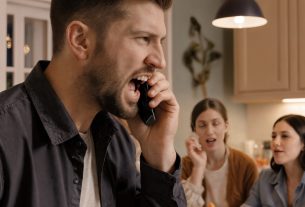
“Inga!” he didn’t yell—he barked, slamming his fist into the door. The door boomed. “Open up! What is this, a joke?”
Not a sound from inside.
“Inga, I said open the door! Are you out of your mind?”
He started pounding again, no longer holding back. The noise echoed through the stairwell. He could feel people freezing behind neighboring doors, listening. It was humiliating.
“Go away, Igor.”
Her voice. Calm, level, not the slightest tremor. It sounded so close, as if she were standing right behind the door with her shoulder against it. The contrast between his fury and her icy composure sent him over the edge.
“What do you mean ‘go away’? Are you insane? I live here! Come on, open up—let’s talk like adults!”
“We already talked. In the café. You said everything. I understood everything.”
“What did you understand?! What did you understand?!” His voice nearly broke into a shriek. “You’re destroying everything we built because of one phrase? Our family, our wedding! You’re crazy!”
“I’m not building a family that has no place for my son,” she said in the same flat, matter-of-fact tone. “And this is my apartment. You don’t live here anymore. Take your things and leave.”
He stepped back from the door as if facing an enemy. He couldn’t believe it was her speaking. The one who looked at him with adoring eyes, caught every word. He was her god, her savior. And suddenly, that god had been put out on the landing along with old jeans.
“Oh, so that’s how it is! It’s your apartment, is it?” Igor snapped, voice thick with spite. “You decided to remind me who’s in charge here? I was good enough for you for a month while I carried you and your… kid in my arms, and now I say one thing and you pull this? Fine! But you’ll regret it, Inga! Hear me? You’ll regret it badly when you’re alone in your precious apartment!”
He kicked one of the boxes with the toe of his boot. It shifted with a dry cardboard rasp.
Silence behind the door. That silence was worse than any scream. Absolute. Impenetrable. She wasn’t going to talk to him anymore. The door, upholstered in dark faux leather, had turned into a dead wall separating him from the comfortable, familiar life he’d had. And beside him stood his things—the evidence of his total and crushing defeat.
“All right, Inga, the circus is over,” his voice changed. The frothing rage vanished. Now it was different—soft, insinuating, with a poisonous, calculating note that was far worse. He switched tactics. Realizing brute force wouldn’t break this wall, he decided to poison it. “Let’s be honest. You’re playing the offended queen right now, but let’s think about what happens next. Do you really think you did the right thing?”
He paused, letting the words sink into the silence. Inga stood in the hallway with her shoulder against the wall. She didn’t go to the door, but she heard every word. She stared at the dark phone screen in her hands, her face completely unreadable.
“You’re alone now,” he went on, his voice like a tempter’s whisper. “Completely alone. No husband. And now no me. And who needs you? Look at yourself. A woman with a child. You think there’ll be a line of princes for you? I was your chance. Your only chance at a normal, complete family. I was ready to be a father to your son… well, almost a father. I would’ve taken care of him. But you ruined it yourself. Because of your little female pride.”
He fell silent again, waiting for a reaction—screaming, crying, pleading—anything that would prove he’d hit the mark. But behind the door there was still dead quiet.
“Did you even think about your son?” That blow was the most precisely aimed. The cruelest. “You’re taking a father away from him. Again. You’re condemning him to grow up in a broken home because your ambitions matter more than his happiness. He reached for me. He already thought I was his. And you just ripped me out of his life. You’re breaking his mind—not yours. That’s selfishness, Inga. Pure, distilled selfishness of a wounded woman. You’ll be alone in your precious apartment, looking at your son, and every day you’ll see what you deprived him of. For what? To prove you’re strong and independent? Who needs your strength if you’re howling into a pillow at night from loneliness?”
His words were no longer chaotic insults. It was a planned, methodical psychological attack aimed at her most vulnerable points. He painted her future—joyless, lonely, full of regret. He tried to make her feel guilty, insignificant, endlessly foolish.
“Open the door, Inga. Don’t be stupid. I’ll forgive you. We’ll just forget this idiotic evening. I’ll bring my things back in and we’ll discuss it calmly. I’m ready to make concessions,” he said, almost believing in his own magnanimity.
Silence. That silence drove him mad. It devalued all his effort. He realized he was losing. And in one last, desperate surge of spite, he decided to burn every bridge—to strike so hard it would leave a scar.
“You know what? To hell with you! You and your brood! You think I don’t get what kind of deal this is? I get a free apartment and in return I have to drag you and your ‘baggage’ along? I was doing you a favor! A favor!”
And in that moment, after the dirtiest, most humiliating phrase, he heard a sound. The click of a lock.
The door opened slowly.
Inga stood in the doorway. She wasn’t tearful or furious. There wasn’t a hint of suffering on her face. She looked at him calmly, almost with scientific interest. Her gaze slid over his face twisted with malice, over his clenched fists, over the boxes at his feet. She looked at him the way you look at something small and completely insignificant.
For a second Igor was thrown by that look. He expected anything but this cold, penetrating calm. He opened his mouth to continue, but didn’t have time.
Inga looked him straight in the eyes and said only one sentence. Her voice was quiet, but in Igor’s rage-deafened mind it sounded like thunder.
“You’re right, Igor. My son won’t live with a stranger.”
Then, without changing her expression, she smoothly closed the door. The second click of the lock sounded like a period at the end of a sentence. Final and irrevocable.
Igor remained standing alone on the landing. Inga’s words didn’t reach him at once. But when they did, he froze, as if struck. She hadn’t insulted him. She hadn’t humiliated him. She’d done something worse—she’d simply flipped his whole worldview, where he was the adult, the strong man, and everyone else were dependents and problems. In one sentence, she’d named him the child—immature, selfish, чужой. An outsider. And she put him on the same level as the “problem” he’d wanted to get rid of. He stood amid his boxes, disarmed, destroyed, understanding he hadn’t just lost this round by a landslide—he’d lost it before it even began…