Yulia stared out the bus window, watching the first snow lightly dust the sidewalks. December had only just begun, and with it came that agonizing feeling—the upcoming visit to her mother-in-law. The last three get-togethers had ended the same way: barbed remarks about her hairstyle, her dress, how Yulia cooked, how she spoke, how she held her fork. Each time she came home with a heaviness in her chest and a firm resolve never to go there again.
“Yul, please,” Maksim had started this conversation every morning for the past four days. “Mom called herself. She said she wants to fix things. I promise it’ll be fine.”
“Maksim, I don’t want to listen again to how my skirt is too short and my hair looks like a cleaner’s,” Yulia set her coffee mug down. “I don’t have the strength for her theatrics.”
“She’s really changed. I swear. All the relatives will be there—she won’t make a scene in front of everyone,” her husband took Yulia’s hand. “Just once. If anything goes wrong, I’ll never ask again.”
Yulia sighed. Maksim looked so hopeful that saying no felt impossible. Deep down, a thought flickered: what if something really had changed? Maybe her mother-in-law truly was tired of the cold war and wanted to act like a normal human being for once.
On Sunday morning Yulia got up early. She chose a simple gray knee-length dress—not too dressy, not too modest. She smoothed her hair, kept her makeup restrained. No bright lipstick, no large earrings—nothing that could be criticized. On the way they stopped at a shop: Yulia bought a bouquet of chrysanthemums in calm yellow tones and a small sponge cake topped with berries.
“See how hard you tried?” Maksim smiled, carrying the bag with the cake. “Mom will appreciate it.”
Yulia said nothing. Tension was building inside her, but on the outside she tried to look calm. They climbed to the fifth floor of an old nine-story concrete apartment block where her mother-in-law lived. Maksim rang the doorbell, and almost immediately the door flew open. Voices, laughter, and clinking dishes spilled out of the apartment.
“Come in already,” her mother-in-law tossed over her shoulder without even looking at Yulia, and turned right back toward the living room.
Yulia stepped over the threshold, took off her boots, and neatly placed them beside the other shoes. The entryway smelled of fried meat and onions. Maksim walked ahead; Yulia followed, bouquet in hand. In the living room, about ten people sat at a big table: Maksim’s sister with her husband, a cousin of his mother, some distant relatives Yulia had only seen once or twice. Everyone was talking, passing plates, pouring drinks.
No one turned their head when Yulia entered. As if a draft had blown in, not a person. Maksim nodded to his sister; she gave a weak smile and went back to her conversation with the woman beside her. Yulia glanced around, found an empty spot next to her husband, and quietly went to the window to set the bouquet on the sill. The flowers lay between a pot with a ficus and a stack of old magazines.
“Sit,” Maksim pointed to the chair beside him.
Yulia sat down and smoothed her dress over her knees. The table was crowded with salads, cold cuts, and hot dishes in big bowls. Yulia picked up a pitcher of fruit compote and poured herself a glass. Her hands trembled slightly, but she kept her face steady. Maksim was telling the cousin something about work, and her mother-in-law’s sister was discussing grocery prices with someone. A normal family lunch—nothing special.
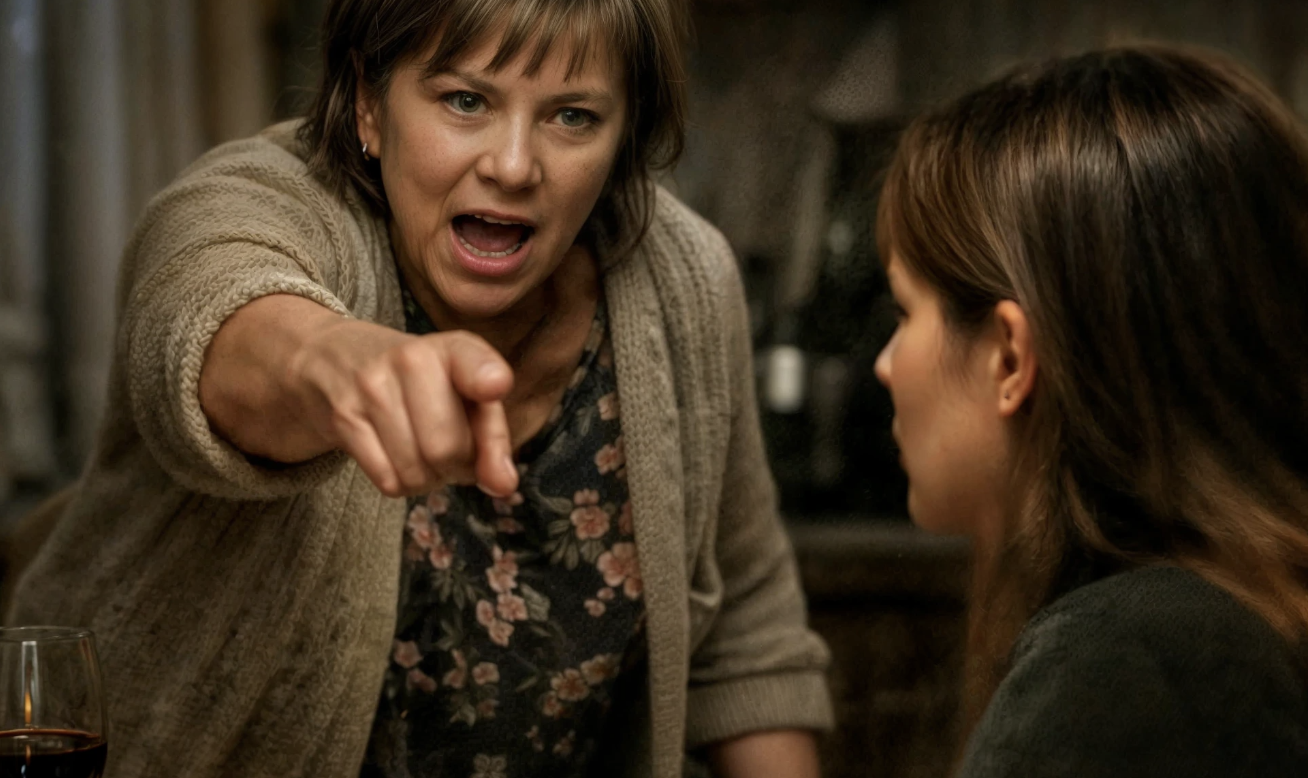
Yulia picked up her fork, about to serve herself salad, when she heard the sharp scrape of a chair. Her mother-in-law, seated at the opposite end of the table, turned her whole body toward her. The woman’s face twisted; her brows drew together, her lips pressed into a thin line.
“Get out!” her mother-in-law’s voice cracked like a whip. “I didn’t invite you—you ruin my appetite!”
Conversation stopped instantly. A thick, awkward silence fell. Someone froze with a fork halfway to their mouth; someone stared into their plate. Maksim went pale, dropped his gaze, clenched his fists on his knees. His mother’s sister looked away, pretending to examine the pattern on the tablecloth. The cousin coughed and reached for the pitcher even though his glass was full.
Yulia froze. Her fork hovered above the salad bowl. Heat rushed to her cheeks; her heart dropped. The words echoed in her head. She looked at the woman—open hostility in her eyes, almost triumph, as if she’d just won a long-awaited battle.
“Mom… what are you doing?” Maksim finally lifted his head, but his voice came out quiet, almost pleading.
“What do you mean, ‘what’?” his mother crossed her arms. “This is my home, my table, my guests. I didn’t call that woman here. You brought her—so take her wherever you like, just not here.”
Yulia slowly set the fork down. Her hands no longer shook—cold numbness spread inside her. Maksim twitched as if he might stand, but stayed seated, gripping the edge of the table.
“Mom, I told you I was coming with Yulia. You said yourself you wanted to mend things,” Maksim spoke so softly it was almost a whisper, as if he were afraid of making her angrier.
“I said I wanted to see you,” his mother emphasized the last word. “Not your wife. How much longer am I supposed to tolerate this upstart at my table? She’s always out of place, always with that dissatisfied face.”
“I think this is some kind of misunderstanding,” the cousin cut in, clearly trying to ease the tension. “Let’s just have lunch calmly.”
“There is no misunderstanding,” the mother-in-law snapped. “Everything is perfectly clear. I don’t want to see this woman in my house.”
Maksim’s sister sighed but said nothing. Her husband buried his face in his phone, pretending a message had come in. The other guests exchanged quick glances, but no one dared to intervene.
Yulia stood up. The movement was smooth, almost mechanical. She pushed her chair back and took her purse from the chair.
“Maksim, let’s go,” her voice was even—no hysteria, no tears.
Maksim sat with his head down. His fingers had gone white from how hard he was gripping the table edge.
“Max, I said—let’s go,” Yulia repeated a little louder.
Maksim lifted his eyes, looked at his mother, then at his wife. His face showed confusion and helplessness.
“Yul, let’s not make a scene. We’ll sit, we’ll talk it out calmly.”
“What scene?” Yulia frowned. “Your mother just threw me out from the table. In front of everyone. What is there to talk about?”
His mother smirked and leaned back in her chair.
“See? Showing her true colors. I always said that girl isn’t a match for my son.”
Yulia turned to her mother-in-law. Something boiled inside her, but she forced herself to speak slowly and clearly.
“I came here because Maksim begged me to. I bought flowers and a cake, dressed in a way that would please you. And what did I get in return? Another humiliation.”
“No one is humiliating you,” her mother-in-law waved a hand. “I’m just telling the truth. You don’t belong in this family.”
“Mom, enough,” Maksim finally stood up, but his voice was still uncertain. “Yulia is my wife. You can’t talk to her like that.”
“I can. And I will. As long as this is my home,” his mother rose to her full height. “If you don’t like it, you can leave with her. The door is over there.”
Yulia looked at her husband. Maksim stood with his lips pressed tight, staring somewhere at the floor—neither at his mother nor his wife, but into emptiness. Yulia waited for him to say something sharp, take her hand, and lead her out. But he stayed silent.
“Maksim,” Yulia said softly. “Let’s go.”
“Yul, wait. Maybe we really should sit down and talk normally?” Maksim finally looked at her, and something like pleading flashed in his eyes.
Yulia couldn’t believe what she was hearing. He was really suggesting she stay? After all that? After his mother had outright thrown her out?
“Are you serious?” Yulia slowly shook her head. “Your mother just called me an upstart and told me to get out. And you want me to sit back down and pretend nothing happened?”
“Well, Mom lost her temper… she didn’t mean it,” Maksim tried to take Yulia’s hand, but she pulled away.
“Didn’t mean it?” Yulia raised an eyebrow. “Maksim, open your eyes. Your mother has hated me since day one. And every time you find excuses for her.”
His mother snorted, arms crossed.
“Well then, great—she finally understood it herself. I hate you. I don’t hide it. My son deserves better than some gray little mouse with no manners and no upbringing.”
Yulia squeezed her purse handle so hard her fingers hurt. She wanted to answer, to say everything that had piled up over months of humiliation. But the words caught in her throat. She simply turned and walked to the door. Maksim called after her, but she didn’t look back. She quickly put on her boots, threw on her coat, and stepped onto the stairwell landing.
The door slammed behind her. Yulia leaned against the cold wall, closed her eyes. Her breathing went uneven; her hands shook. Inside, a storm raged—hurt, anger, bitterness. Maksim hadn’t defended her. Again. Like always. Every time he found an excuse, every time he asked her to endure it, to compromise. And in return—not a word of protection, not a single gesture that would show his mother there were lines she couldn’t cross.
Yulia pulled out her phone and called a taxi. Her hands still trembled as she typed in the address. She had to wait about ten minutes. All that time she stood by the window on the landing, staring at the gray sky and the rare snowflakes. Maksim never came out—neither after a minute, nor after five. He stayed there, at the table, with his mother and the relatives who acted as if nothing had happened.
When the car arrived, Yulia went downstairs and slid into the back seat. The driver asked something about the route, but Yulia answered in short phrases. The whole ride she stared out the window, noticing neither streets nor people. One thought kept spinning in her mind: how could she have agreed to this lunch? Why had she believed anything could change?
At home, Yulia tossed her coat aside, went to the kitchen, poured water, and drank it in one gulp. She set the glass in the sink, sat at the table, and rested her forehead in her hands. The tears finally broke through—quiet, bitter, unstoppable. She cried not from pain, but from helplessness. From being in yet another situation where she had to prove she deserved basic respect. From the fact that her husband hadn’t stood on her side.
Her phone vibrated. A message from Maksim: “Yul, I’m sorry. I didn’t want it to turn out like this. Mom just doesn’t understand. I’ll come over, we’ll talk.” Yulia stared at the screen, wiped her tears, and replied briefly: “Don’t.” Maksim started typing something else, but Yulia muted the phone and placed it face down.
Yulia sat in the kitchen, looking out the window. Snowflakes drifted slowly beyond the glass, settling on the window ledges of neighboring buildings. Inside, silence reigned—not soothing silence, but heavy, ringing silence. Yulia stood, went into the bedroom, and pulled a large travel bag from the closet. Her hands moved automatically: a few changes of clothes, her makeup bag, phone charger, documents from the desk drawer.
She didn’t rush around in a panic. She packed methodically, calmly, as if preparing for an ordinary trip. Only inside, everything burned. Every item she placed in the bag reminded her of how she had built this life, how she had believed it would get better. But it hadn’t. And today’s lunch had put everything in its place.
When the bag was packed, Yulia texted her friend Katya: “Can I stay with you for a couple of days?” The reply came almost instantly: “Of course—come. Did something happen?” Yulia didn’t go into details: “I’ll tell you later.” She called a taxi, put on her coat, took the bag, and left the apartment without looking back.
Katya met her at the door with a worried look but didn’t ask questions right away. She hugged her, took the bag, and led her into the living room.
“Tea? Coffee?” Katya asked, settling Yulia on the couch.
“Nothing, thanks,” Yulia kicked off her shoes and tucked her legs under herself. “I’ll just sit for a bit.”
Katya sat beside her and placed a hand on her shoulder.
“What happened?”
Yulia told her—without extra emotion, almost detached, as if retelling someone else’s story. How Maksim had begged her to go, how he’d promised it would be different. How his mother had thrown her out in front of everyone, and her husband hadn’t said a single word in her defense. How he’d suggested she simply sit back down and pretend nothing had happened.
Katya listened, her frown deepening. When Yulia finished, Katya shook her head.
“Yul, you did the right thing leaving. Seriously. That’s beyond the pale.”
“I’m tired, Katya,” Yulia rubbed her face with her palms. “Tired of proving I have a right to respect. Tired of him always making excuses for her.”
“So what now?” Katya asked carefully.
“I don’t know. I’ll probably get divorced,” Yulia said the word out loud for the first time, and it sounded strange—heavy, but at the same time freeing.
Katya nodded.
“If you need help—with anything—just say the word. Stay here as long as you need.”
Yulia thanked her, went into the guest room, and lay down on the bed without undressing. She closed her eyes, but sleep wouldn’t come. Fragments of the day kept looping in her head: her mother-in-law’s contemptuous face, Maksim’s lost expression, the silence of the relatives who preferred not to interfere. Each detail surfaced again and again, and with each one it became clearer: she couldn’t go back. Because nothing would change. Ever.
Yulia lay like that until morning. Her phone vibrated several times—Maksim calling, texting. Yulia didn’t open it, didn’t read it. She had no strength for conversations, for explanations, for yet another attempt by her husband to smooth everything over and pretend it could all simply be forgotten.
In the morning Yulia got up, washed, got dressed, and went to a legal consultation. She’d booked an appointment online the night before. The conversation was brief and to the point. The lawyer, a woman in her fifties with a tired but attentive gaze, listened to the story without unnecessary comments.
“No children together?” the lawyer уточнила.
“No.”
“Any jointly acquired property?”
“Only furniture in a rented apartment. Everything else was either before the marriage or bought separately.”
“Then it’s fairly simple. You file at the registry office if your husband agrees to the divorce. If not, then through the court—but in circumstances like these, it won’t take more than two months.”
Yulia nodded and signed the necessary papers. The lawyer explained the next steps and gave her a list of documents to gather. Yulia left the office with a folder in her hands and a strange feeling—like a huge weight had slid off her shoulders. There was still a lot ahead: conversations, paperwork, possibly conflicts. But the decision was made, and Yulia wasn’t going back.
The next day Maksim called again. This time Yulia answered.
“Yul, finally. Where are you? Why weren’t you answering?” his voice sounded anxious.
“Maksim, we need to talk. I’m filing for divorce.”
Silence. Long, heavy silence.
“What? Yul, are you serious? Over one incident?”
“One?” Yulia gave a humorless laugh. “Maksim, your mother humiliated me every time we met. And you stayed quiet. Always. And this time you stayed quiet too.”
“I didn’t know what to say! Mom was wrong, I get it, but she’s my mother!”
“And I’m your wife. Was,” Yulia corrected herself. “I’m not going to live in a family where I’m not respected. Where I have to beg for basic human decency.”
“Yul, let’s meet, talk calmly. I’ll talk to Mom, I’ll fix everything, I promise,” Maksim spoke quickly, almost pleading.
“No,” Yulia answered firmly. “The conversation happened there, at that table. I heard everything. And I heard your silence too.”
“Yulia, please…”
“Maksim, I’ll come pick up my things on Wednesday. I hope you’ll be at work so we don’t have to run into each other.”
Yulia hung up without waiting for an answer. Her hands didn’t shake; her breathing was even. Inside there was a strange emptiness—not painful, not heavy, just empty. As if a piece of her life had been cut out, and now there was nothing in its place. No resentment, no anger. Just emptiness, and the understanding that from now on everything would be different.
On Wednesday Yulia really did come for her things. Maksim wasn’t there—apparently he’d listened and gone to work. Yulia packed quickly: clothes, books, a few personal items. She left the keys on the entryway table, closed the door, and didn’t look back.
A week later Yulia filed at the registry office. Maksim signed his consent without protest. They met once on the appointed day, signed the documents. They spoke briefly, formally. Maksim looked tired, older. Yulia felt calm.
“Yul, I’m sorry,” Maksim said as they left the building.
“It doesn’t matter anymore,” Yulia replied without anger. “Let’s just forget it and move on.”
Maksim nodded, turned, and walked the other way. Yulia stood for a moment watching him, then pulled out her phone and texted Katya: “It’s done. It’s over.” Her friend replied almost immediately: “Proud of you. Tonight we celebrate.”
Yulia smiled—for the first time in a long while, a real smile. A new life lay ahead: without humiliation, without silent betrayal, without having to beg for respect. Yulia stepped forward, and with every step it felt lighter.
Her mother-in-law never called. Maksim tried a couple of times to text, but Yulia replied dryly and briefly. Gradually the messages stopped. Yulia rented a small apartment, found a new job, and started living again. Sometimes she remembered that December lunch—but without pain. Just as a lesson that had to be learned. A lesson that silence is also a choice. And sometimes the only right response to silence is to leave