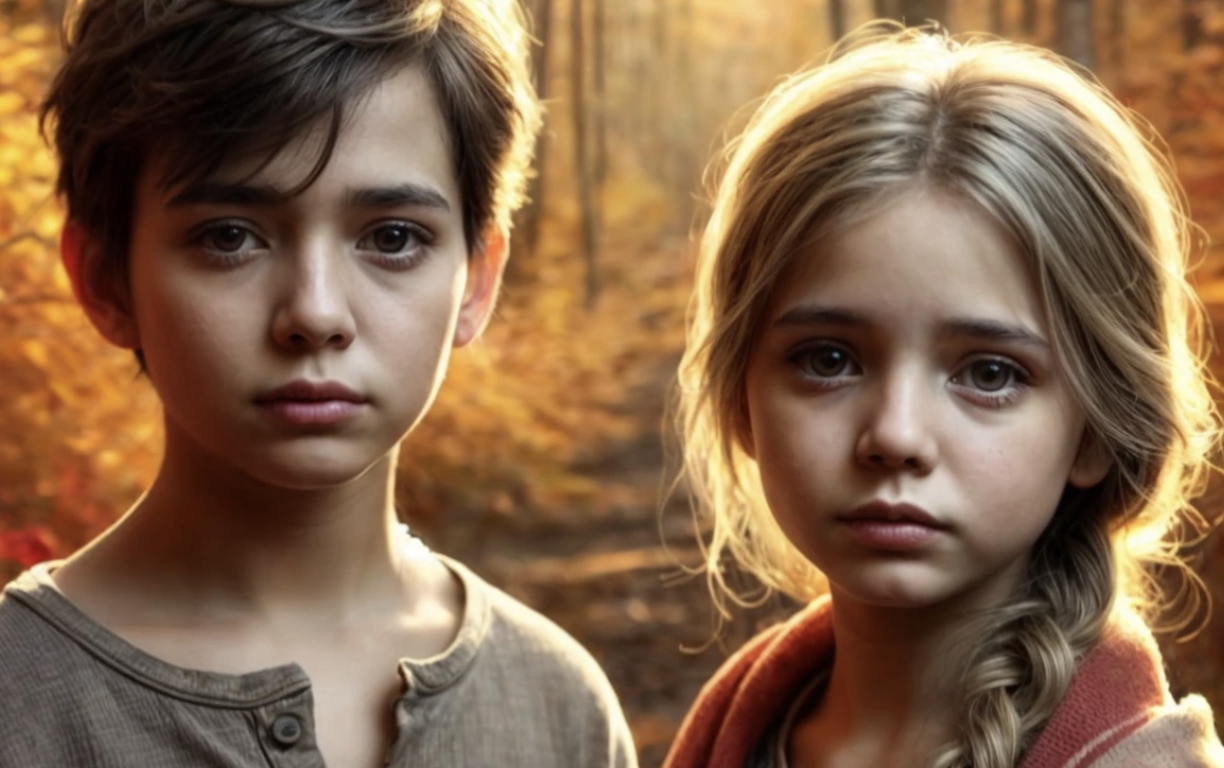
“Sir, please help us—we’re lost!” the children anxiously called out to Viktor Alexeyevich, having no idea how it might all end.
Viktor Alexeyevich had known this forest since childhood. His family used to come here to pick mushrooms and berries, and years later he still kept that tradition. The woods reminded him of happy times—when his parents were alive and they’d all go on picnics together.
Usually, a trip to the forest brought Viktor peace and calm. He was a withdrawn, solitary man, because long ago he had lost his fiancée—someone he’d never been able to forget. But on this autumn day, everything felt different.
He noticed the tracks of small boots, broken branches, and trampled bushes. Even the mushrooms had been crushed. It angered him—someone was ruining the forest. Following the trail, Viktor heard a child’s voice, which soon turned into sobbing.
“Someone, help!” came from deep in the woods.
Figuring out the direction, Viktor hurried toward the sound.
“Why are you yelling? Decided to stomp all over the mushrooms?” he demanded angrily as he stepped out to where the children were.
In front of him stood a boy and a girl, both in tears. Their clothes were dirty, and their faces showed exhaustion.
The boy rushed up to Viktor.
“Please help us, Grandpa—we’re lost!”
“Where do you live?” Viktor’s voice softened when he saw how frightened they were.
The boy glanced from his sister to the mushroom picker, unsure where to begin.
“We came to visit our grandma and went out for a walk. We saw lizards and ran after them, and then we got lost. We don’t know where to go,” he mumbled.
“And what’s the name of your grandma’s village? Do you at least remember the street?” Viktor tried to find out.
The children looked at each other but didn’t answer. They didn’t know the village name or the street—too little to remember things like that.
“Wait…” The boy took off a small medallion hanging from his neck alongside a cross. “Here—Grandma gave us this. The address is written on it.”
He handed the medallion to Viktor. Viktor could barely make out the tiny letters and pulled out his glasses.
“Where did you get this?” Viktor asked sternly, staring hard at the children.
“Grandma gave it to us,” they replied shyly.
“Grandma, huh? And where is she now?”
“In the village. She’s probably looking for us.”
Viktor felt his heart tighten. He looked at the medallion again.
“This medallion was mine… Before I went off to the фронm, I gave it to my fiancée.”
The children froze. The boy broke the long silence:
“Were you really at the maм?”
Viktor’s eyes filled with tears. He nodded and then began to speak:
“Yes. Like many others, I was drafted. Before we left, Galia—my fiancée—and I were standing on the station platform. She didn’t want to let me go. So I gave her this medallion, so it would protect her. When I came back, our village was gone—it had all been burned down. I tried to find her, but I couldn’t. And that’s how I ended up alone…”
The children said nothing. They were too young to grasp the full weight of his words.
The girl quietly interrupted the silence:
“If it’s so important to you, take it. We’ll tell Grandma we lost it. Just get us out of the forest.”
“My dear, you still don’t understand a lot,” Viktor said with a sad smile. “Maybe we’re related.”
He didn’t know the way to the village, but he remembered the route back to his car. After putting the children in the vehicle, they drove off to find their grandmother.
“Grandma, we’re back! And look who we brought!” the children shouted joyfully as they jumped out of the car.
“Excuse me—what’s your name?” Viktor asked the woman.
“Valentina. And yours?”
“Excuse me again… Is your mother’s name, by any chance, Galina? Do you have any photos of her?” he asked, feeling his heart pound faster.
“And how do you know all that?” Valentina said. “Come into the house—I’ll treat you to tea and show you an old album.”
As he flipped through the family album, Viktor noticed that all the photographs were of women and children. There wasn’t a single picture with a man.
“Galochka… my Galochka…” Viktor Alexeyevich whispered, stroking the photo of the woman placed at the center of the album. Tears rolled down his cheeks.
“And where is your father?” he asked Valentina carefully.
“I’ve never seen him—not even in photos,” she replied with quiet sadness. “They told me he went missing at the front. Mom was pregnant, and then she was very ill during the last year before she died. I don’t have any other family left—only neighbors. They were the ones who raised me.”
Viktor stepped up to Valentina, hugged her, and said, his voice trembling:
“I think I’m your father…”
“That’s not a funny joke,” Valentina said skeptically, frowning.
“Just a minute,” Viktor asked, heading to his car.
He came back with documents, among them an old photograph. In it, Viktor stood next to Galina.
“All my life, I’ve kept this photo,” he said, handing it to Valentina. “I never found happiness after I lost her…”
A few days later, the children’s parents arrived in the village. After hearing the whole story, they couldn’t believe what had happened for a long time. It turned out Viktor had found what he had waited for so long—a big family. Valentina’s husband turned out to be his grandson.
“Dad, if it’s lonely living by yourself, move in with me. I live alone too, and the grandkids visit rarely,” Valentina offered her “newly found” father.
Viktor agreed. And although his life was nearing its sunset, he finally learned what it meant to be part of a real family.