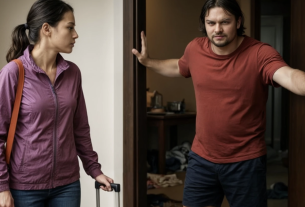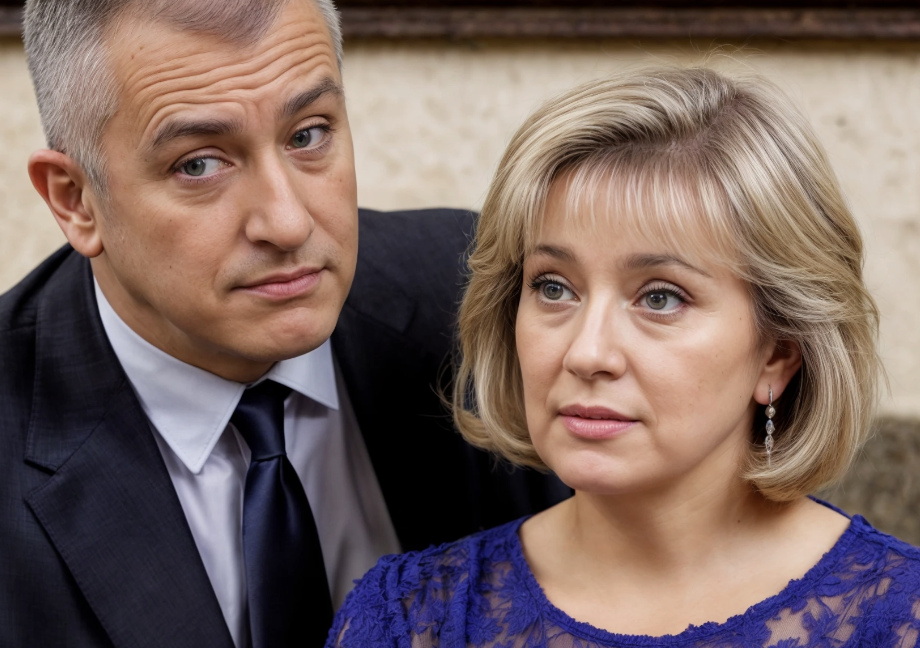
Okay then: the apartment is mine, the dacha outside Moscow is yours, the car is mine,” Andrey said, running his pen over the sheet without looking up. “You’ll get half of the bank deposit and my mother’s jewelry.”
I stared at the man I’d lived with for twenty-six years.
And I thought about how easily he was dividing up our life. Probably just as easily as, three months earlier, he’d told that girl from his department, “I love you.”
She was twenty-five. I remember being twenty-five—thinking I knew everything about life.
“It’s all fair under the law,” he added, finally lifting his eyes. “What we acquired during the marriage gets split fifty-fifty.”
Today Andrey was wearing a new shirt—white, with faint blue stripes.
We used to discuss purchases. Now he just showed up in new things. He’d even changed his cologne—from the one I’d given him for anniversaries to something sharp and youthful.
A folder of surprises
I nodded and pulled a folder of documents out of my handbag.
“You’re right, Andryusha. Let’s do it by the law, then.”
He frowned when he saw my folder.
He was probably expecting tears—or me begging him to come back. In twenty-six years he’d grown used to my predictability:
first I’d try to save the family,
then I’d accept his terms—
“for the children,” “to keep the relationship,” “for a sensible compromise.”
“What’s that?” he asked warily.
“Documents. You said: by the law. So let’s sort it out properly.”
Surprise number one
I opened the folder and took out the first page.
My mother’s will, notarized two years earlier, when she felt her strength fading.
A wise woman, my mother. She’d worked as a court secretary all her life. She knew paperwork settles more than emotions ever will.
“‘I bequeath to my only daughter, Lidiya Vadimovna Morozova, the apartment on…’” I read aloud slowly, savoring every word. “That’s the apartment, Andryusha. The very one you listed as ‘yours.’”
His face changed as the meaning reached him:
first confusion,
then bewilderment,
then something very close to panic.
“Lida, but we live there together…”
“Lived,” I corrected. “Legally, the apartment belonged to Mom. Now it belongs to me—by inheritance. It wasn’t acquired during the marriage.”
Surprise number two
“You kept quiet on purpose?”
“And why would I have said anything?” I shrugged. “We were a family. What difference did it make whose name it was in, if we were together? Now it turns out it does make a difference.”
Andrey reached for the will, but I slid it back into the folder.
“Show me again…”
“What for? It’s drafted properly. And the notary is reliable—Anna Vladimirovna Skvortsova on Krasnoselskaya. Remember? We went to her when we did the gift deed for the dacha.”
“What gift deed?” His voice went hoarse.
“Oh—you didn’t know?” I pulled out the second page. “The dacha is mine too. Mom gave it to me back in 1997, when we’d just gotten married. Looks like she sensed something.”
My mother’s wisdom
I remember that day.
She said, “Lidochka, a woman should always have a place she can go to.”
Back then it sounded strange—what young wife thinks about escape? Now I understand: Mom was smarter than I was.
“But we built the sauna together, added the veranda…”
“We did. And I’m grateful. We’ll have an expert assess the improvements—you’ll be compensated fairly.”
Andrey fell silent, scanning his notes.
His perfect division plan was crumbling. The apartment and the dacha were the main assets he’d counted on. That left the car, the deposits, and the furniture.
“Lida, this is… it’s somehow not right,” he said, and for the first time in months he wasn’t speaking in an ordering tone, but almost pleadingly. “I thought…”
“What did you think?”
“That everything we had was shared.”
“It was shared—until you decided to leave for Kristina.”
The name is spoken
He flinched at her name.
Yes, I knew what his new love was called. At the bank where I worked for twenty years, colleagues consider it their duty to warn you about things like that:
Lyudmila from the credit department saw them at a café.
Marina saw them at the mall.
For three months, city gossip tiptoed around me—until it finally reached my ears.
“How did you…?”
“Andryusha, I’m fifty-two. Do you really think that after all these years I wouldn’t learn how to tell when my husband…?”
He turned red.
It was strange seeing him embarrassed—Andrey usually kept his emotions on a tight leash. But now his plans were collapsing, and so was his control.
Surprise number three
“Lid, maybe we can talk sensibly? Not jump straight into paperwork…”
“We will talk,” I agreed. “But first we finish the property. I’ve got one more thing.”
A third page—an official bank statement for an account opened in my name.
The very deposit he’d so generously offered to split in half.
“You see, from the beginning I set some money aside in cash. Mom advised it—a woman needs a financial cushion. She was very wise, my mother.”
The number on the statement made Andrey whistle. It wasn’t as much as he’d imagined.
Twenty years of steady saving is serious money. But I didn’t put most of it into any joint account.
“You were saving… from me?”
“Not from you. For myself. And now I see—for this day.”
The moment of truth
He leaned back in his chair, staring at me as if I were a stranger.
“Lida, I don’t recognize you.”
“And I finally recognize myself,” I said. “For twenty-six years I was the convenient wife. I cooked, cleaned, raised the kids, didn’t ask unnecessary questions. And then I thought: what did I get in return?”
“You got a family. A home. Stability.”
“Stability?” I laughed. “Andryusha, you’ve been seeing a girl for three months who’s only a year older than our daughter. What stability are you talking about?”
After Mom died, I spent six months meeting with a lawyer, sorting out the inheritance.
That’s when I first learned:
what a will is,
what a gift deed is,
what ownership shares are.
Anna Vladimirovna explained patiently: “Lidiya Vadimovna, you’d be surprised how many women don’t know the basics of their rights.”
I didn’t know either. I thought my husband would arrange everything properly.
It turned out “properly” isn’t always “fair.”
Trying to regain control
He went quiet, absorbing this new reality.
I could see his mind at work—looking for loopholes, ways to challenge it, leverage he could use. But the paperwork was airtight, and he knew it.
“Do the kids know?”
“Know what exactly? That you’ve been lying to me? Or that I’m not as helpless as you thought?”
“Lida, why are you like this?” He rubbed his forehead. “We can settle this like human beings.”
“Like human beings—how? You leave for a younger woman, take the apartment and the dacha, and I nod gratefully?”
The worst part
“I didn’t want to upset you…”
“But you did. And you know what the worst part is? Not even your fling. It’s the way you spoke to me today—like I’m a stupid woman who doesn’t understand anything.”
Andrey stood and went to the window.
Outside, an October rain misted the glass. Yellow linden leaves stuck to the sill. In weather like this we used to drink tea together and talk about weekend plans.
A simple family life I valued more than he did.
One last attempt
“Lida… what if I stay?” he said without turning around. “We’ll forget it. Start over.”
“Start over?” I neatly stacked the documents back in the folder. “Andryusha—does Kristina know about your new plan?”
“What does that have to do with—”
“Everything. Last night she called you four times. You think I didn’t hear? I was in the kitchen, listening to your tender little voice in the hallway.”
He turned around. His face was lost—almost childlike.
It’s interesting, watching a strong man unravel when his plans fall apart.
“I can explain…”
“No need. Do you know what I learned these past months? Explanations are just a way to shift blame. A wise woman doesn’t demand explanations. She draws conclusions.”
My conclusions
“And what conclusions did you draw?”
I stood and walked to the dresser where we kept our family photos.
I picked up a picture from five years ago—New Year’s at the dacha, the whole family around the tree. Back then I still believed in our fortress.
“That twenty-six years ago, I married a good man. And twenty-six years later I understood: a good person and a good husband aren’t the same thing.”
“Lida…”
“You know, Andryusha, when did I start suspecting?”
Not when I saw an unfamiliar girl’s number on your phone.
Not when I smelled someone else’s perfume on your shirt.
But when you stopped caring what I thought.
Remember how in spring you asked where I wanted to go on vacation? And by summer you simply announced: we’re going to Sochi—I already booked it.
A small detail, but it said everything.
“I thought you didn’t care…”
“Exactly. You decided I didn’t care. That I’m like furniture—there, not in the way, no need for special attention.”
A different life
He sat back down, resting his head in his hands.
“So what happens now?”
“Now you move out. You take your things, the car. No alimony—our kids are grown. I won’t stand in the way of your happiness with Kristina.”
“And you? What will you do?”
Good question.
I’d been thinking about it for weeks, once it became clear the divorce was inevitable. At first it terrified me—how do you live alone at fifty-two?
Then fear turned into curiosity.
What happens if I stop adjusting myself to someone else’s plans?
“I’ll live for myself. I’ll try to figure out what I actually like. For twenty-six years I knew what you liked, what the kids liked, what your mother liked, what the neighbors approved of. And what I like—I somehow never asked.”
Remembering our first date
“Lid, maybe we shouldn’t rush. Let’s think—”
“Do you know what I remembered when Lyudka from the bank told me about your café?” I said. “Not that you were cheating. But that you chose the very place where we met the first time. Remember? On Tverskaya, by the metro.”
He lifted his head; something like guilt flickered in his eyes.
“I didn’t think…”
“That’s the point. You didn’t think about me. And it’s not malice, not even a desire to hurt me. I just became invisible to you. And an invisible person can’t feel, grieve, dream. They’re simply there—or they’re not.”
Goodbye
“Lida, I—”
“Andryusha, don’t apologize. Apologies now are just a way to make your guilt smaller. I don’t need your guilt. I need my freedom.”
He gathered his papers and slipped the pen into his pocket. His movements were slow, as if he still hoped for something.
“The kids… how do we tell them?”
“The truth. That their parents are divorcing, but that doesn’t mean they stop being parents.”
“And if they ask who’s to blame?”
“We’ll say both of us. You—for cheating. Me—for letting myself become invisible.”
At the door he turned back.
“Lid… I really didn’t want to upset you.”
“I know. But you did. And now I know what I’m capable of. I got through this—so I’ll get through everything else too.”
The first evening of freedom
After he left, I brewed myself tea and sat by the window.
The rain had stopped; the sun was peeking out. On the table lay his pen—he’d forgotten it. Expensive, a company gift for his anniversary.
In the past, I would’ve run after him. Now I simply put it in a desk drawer.
My daughter understood
On my phone was an unread message from my daughter:
“Mom, how are you? I won’t call—probably you and Dad are having an important talk.”
A smart girl, my Anya. At twenty-eight she already understands more than I did at forty.
I wrote back: “I’m good. Dad’s moving out. We’ll talk tomorrow.”
Her reply came quickly: “Finally. I didn’t want to push you because of appearances, but honestly I would’ve told you long ago—stop tolerating it.”
So that’s how it was. My daughter understood everything. She was waiting for me to ripen into the decision.
A friend approves
That evening Sveta, my college friend, called.
“Lid, I heard the news about Andrey and his secretary. How are you?”
“Good. I’m divorcing.”
“Finally! I’ve been looking at you two and thinking—when is Lidka going to wake up?”
“I woke up. Thanks to Mom’s paperwork.”
“What paperwork?”
I had to tell her about the documents, about today’s conversation. Sveta listened and laughed out loud.
“Lid, you’re incredible! So what now?”
“I don’t know yet. I’ll live alone for a while. Get used to the quiet. Maybe I’ll get a cat—I always wanted one, but Andrey didn’t like animals.”
“And men? Any plans?”
“You know, Svet, right now I’m more interested in figuring myself out. Half a century, and I don’t even really know what music I like, what movies, even what kind of tea I prefer. I was always adjusting to the family.”
“So what do you like?”
“That’s what I’m going to find out.”
A wish list
After the call, I sat down and wrote a list.
Not a list of chores—a list of wishes. The ones I kept postponing:
“later,”
“when there’s time,”
“when the kids grow up,”
“when Andrey retires.”
My new list:
Learn to drive.
Go to the sea—not on vacation, but just because I feel like it.
Read the books that have been sitting on the shelf for years.
Buy beautiful dishes—not practical ones, just beautiful.
And for the first time in many years, I didn’t feel exhausted by plans ahead of me—I felt curious about the future.
Outside, the streetlights came on.
For the first time in twenty-six years, the evening belonged only to me.
Sometimes the most important documents in a woman’s life aren’t a marriage certificate, but a wise mother’s will—and her own savings. And the most precious inheritance is the right to say “no” to anything that makes you invisible.
There are no victims here—only heroines with character