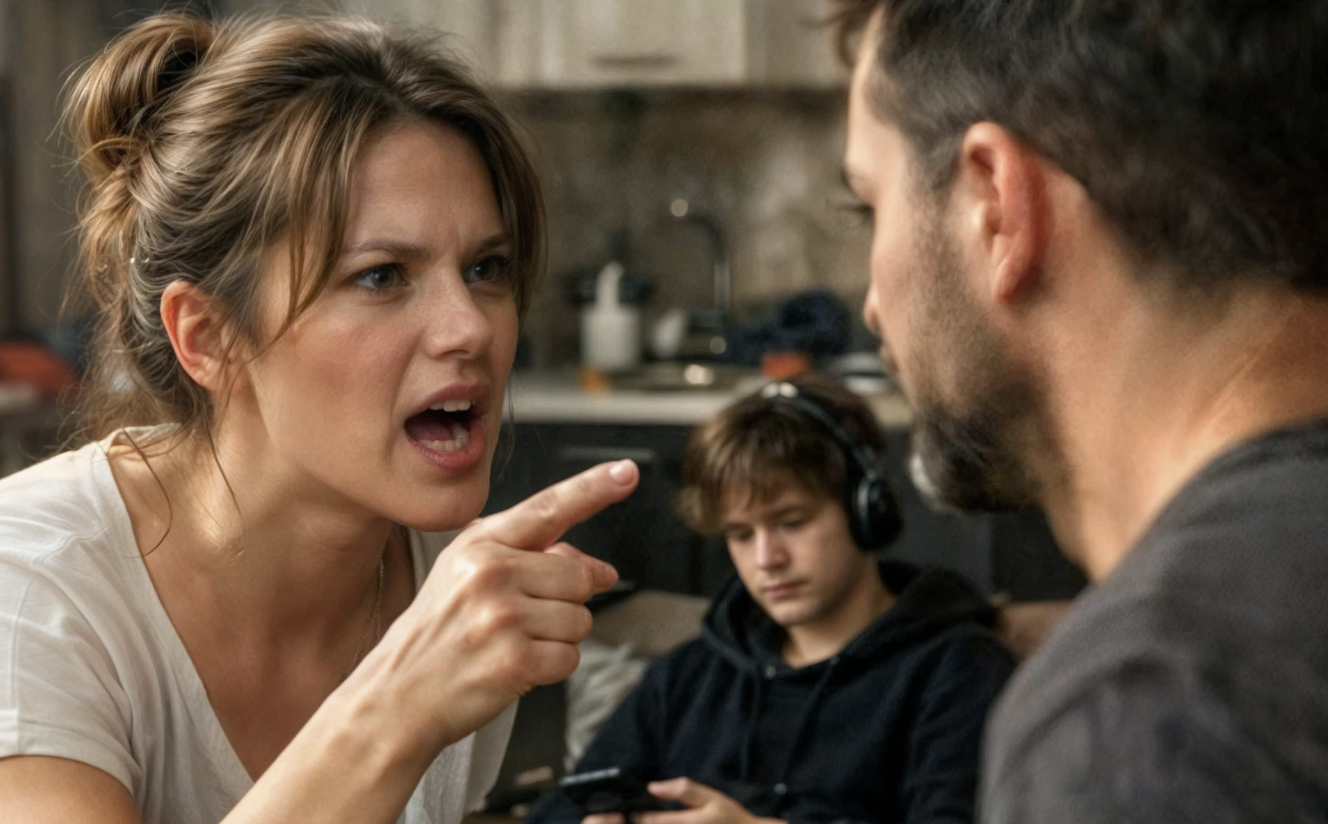
— I’m not your son’s servant, and I’m not a punching bag! If you can’t explain to that thick-headed sixteen-year-old that he’s not allowed to talk to me like that, then I’m not cooking for him anymore, and I’m not cleaning up after him either! Let him live in a pigsty and feed himself, since he’s such an adult!”
Her words fell into the living room’s silence like heavy stones. Svetlana stood there, her fingers digging into the back of an armchair, staring at her husband. Andrei sat calmly on the couch, his attention completely absorbed by the footballers flickering across the screen. He didn’t even turn around—just waved his free hand, as if brushing away an annoying insect.
“Sveta, come on, don’t start, okay? We’re counterattacking.”
The commentator on TV was choking with excitement, the stands were roaring. That roar—that artificial, чужой excitement—felt to Svetlana like the final insult. She crossed the room, her steps loud and decisive. She didn’t yell or yank the plug out of the socket. She simply took the remote from the table and pressed the red button.
The huge screen went dark. The stadium roar cut off mid-sentence, leaving behind only the thick, sticky hum of the refrigerator running in the kitchen.
Only then did Andrei slowly turn his head. There was no surprise on his face, no concern—only the dull, lazy irritation of a man being pulled away from something “important.”
“What are you doing? That was the best part.”
“The best part?” Svetlana placed the remote on his knee. “The best part is happening right now, Andrei. Here. Fifteen minutes ago your son, Konstantin, responded to my request to clear his dirty dishes off the table—where I was about to cook dinner for all of us—by calling me a ‘stupid sheep.’ And then he went to his room and blasted music at full volume. I want to know what your reaction is going to be.”
She stared straight at him, expecting anything—outrage, a promise to talk to his son, at least some formal sympathy. But Andrei only sighed heavily, rubbed the bridge of his nose, and leaned back against the couch.
“Oh God, Sveta, I asked you. The kid just blurted it out without thinking. That’s the age—teenage years. Hormones. Why are you even bothering him about dishes? You saw a plate—just take it to the sink. What, is your crown going to fall off?”
In that exact second, something inside Svetlana—something that had been tightening, yielding, bending for two years straight—finally hardened, turning into a cold, sharp shard. She understood it wasn’t about Kostya. It was about this calm, tired man on the couch who, time after time, chose his comfort over her dignity. To him, his son’s rudeness was a minor annoyance easier to ignore, and her reaction was an irritating interruption to his rest.
“No, Andrei. My crown won’t fall off. What fell off is my desire to be convenient for the two of you.” Her voice became level and metallic. “For two years I’ve lived in this house trying to become part of your family. I scrubbed your ‘child’s’ filth, I found his petrified socks under the couch, I kept quiet when he brought friends over and they left a pigsty behind. I put up with his sideways looks and snide comments. And all that time I waited for you—his father—to take my side at least once. But you always said the same thing: ‘He’s just a kid, put up with it.’”
She stepped away from the couch and stood in the middle of the room, as if drawing an invisible line.
“Well, my patience is over. I’m not putting up with anything anymore. Starting this minute, I’m declaring a total boycott of your son. I’m not cooking for him. I’m not washing his clothes. I’m not cleaning his room. If he leaves his plate on the table, it’ll sit there until it grows mold. From a household point of view, he no longer exists for me. He’s a grown guy who thinks he has the right to insult me? Fine. Let him act like an adult and take care of himself.”
Andrei sat up straight; his face began to flush. Shock gave way to anger. He finally understood this wasn’t just another “female hysteric.”
“Are you out of your mind? What is this, ultimatums now?”
“This isn’t an ultimatum. These are the new rules,” Svetlana replied calmly, looking him straight in the eyes. “You’re his father—you raise him. If you want, cook for him yourself. If you want, hire a housekeeper. But I’m not participating anymore. And yes—if you don’t like these rules, you can go take care of your son somewhere else. The door is open.”
The next morning didn’t begin with the smell of coffee, but with a deafening, tense silence. Svetlana got up to her alarm, as always. She walked silently to the bathroom, then to the kitchen. She didn’t look toward Kostya’s room, where the sounds of a computer shooter game were already coming from, and she didn’t wait for Andrei to wake up. She took two eggs, a piece of cheese, and a tomato from the refrigerator. Turned on the burner, set her own small personal frying pan on it, and made an omelet.
For herself.
She brewed one cup of coffee in a cezve.
For herself.
She sat at the table and ate calmly, looking out the window. She washed her plate, mug, and pan, dried them, and put them away.
At that moment Andrei shuffled into the kitchen, scratching the back of his head and yawning. He threw her a quick look, expecting to see signs of a sleepless night—maybe even remorse. But Svetlana’s face was completely calm, almost detached. He walked to the empty coffeemaker, clicked a button, and looked at his wife questioningly.
“No coffee?”
“I made mine in the cezve,” she replied evenly, folding a clean towel. “The coffeemaker is at your disposal.”
Andrei frowned. To him it felt like yesterday’s stupid argument, which, in his opinion, should have dissolved overnight. Silently he pulled out a jar of instant coffee, poured boiling water from the kettle over it, and sat at the table across from her.
“And how long is this concert going to last?”
“This isn’t a concert. This is my new life,” Svetlana answered without lifting her eyes from her hands. “You heard everything yesterday.”
The kitchen door flew open, and Kostya appeared in the doorway—headphones hanging around his neck, music blasting from them, wearing a wrinkled T-shirt and shorts. He went straight to the refrigerator, yanked it open, and stared blankly at the shelves for a few seconds.
“Dad, what the hell is there to eat?” he asked loudly, demonstratively ignoring Svetlana’s presence. “I’m gonna be late for school.”
Andrei looked helplessly at his wife. In response she only raised an eyebrow slightly and kept examining her manicure. The silence dragged on.
“Make yourself some sandwiches,” Andrei finally forced out. “Sausage, cheese. You’re not a little kid.”
Kostya slammed the refrigerator door.
“I don’t eat sandwiches. I need porridge or eggs. Like usual.”
He looked at Svetlana defiantly. It was a direct provocation—a test of her statement from the day before. She met his gaze without blinking, then slowly stood up from the table.
“I need to go to work,” she said, addressing only Andrei. “Have a good day.”
She left, leaving them alone in the kitchen, surrounded by unwashed dishes and an unsolved problem.
That evening, when she came home, Svetlana found the situation had only gotten worse. A mountain of dirty plates had piled up in the sink. Andrei’s morning mug, Kostya’s plate after the sandwiches—which he apparently did make after all, smearing butter across the countertop and scattering bread crumbs. Nearby lay an empty dumpling package—clearly their lunch or dinner.
Svetlana walked silently around that island of chaos. She made herself a light salad, ate, cleaned up after herself, and went to the bedroom with a book. She heard Kostya come back from training, heard him go rummaging in the fridge again, heard him ask his father what was for dinner. Heard Andrei answer irritably that he’d order pizza.
An hour later, the smell of pepperoni filled the apartment. They ate in the living room in front of the TV like two single roommates. The empty pizza boxes stayed on the coffee table. No one was going to clean them up.
The war shifted into a drawn-out trench phase. Svetlana created an enclave of cleanliness and order around herself, while the rest of the apartment slowly but surely turned into an extension of Kostya’s room. And with each passing hour it became clearer: Andrei wasn’t going to solve anything. He was simply waiting for her to break first.
Andrei’s patience lasted exactly three days. The turning point was Saturday. He woke up hungry, with a sharp craving for normal brewed coffee. The kitchen greeted him with yesterday’s pizza smell and a mountain of dishes in the sink that had already started to give off a sour odor. The last clean mug had been used by him the night before. Dried puddles of spilled cola clung to the countertop. In the trash can—no one had taken it out—there were cores and empty wrappers. It wasn’t just mess anymore. It was territory being slowly, inevitably seized by domestic chaos.
He checked the laundry hamper. A pile of stale clothes—mostly his and Kostya’s—came nearly to the top. His favorite gray T-shirt, the one he wore around the house, was somewhere at the bottom of that heap. Andrei slammed the bathroom door and headed for the bedroom.
Svetlana was sitting in an armchair by the window with a tablet in her hands, dressed in a neat loungewear set. Around her was an island of order. Her half of the bed was perfectly made, the nightstand spotless. The air here seemed cleaner. She didn’t raise her head when he entered, but he knew she felt him.
“Sveta, we need to talk,” he began in the tone of a man tired of childish games and ready to show magnanimity.
She slowly lowered the tablet and looked at him. There was no anger in her eyes, no hurt—only cold, calm expectation.
“I’m listening.”
“This can’t go on,” he gestured vaguely, meaning the whole apartment. “You turned our home into a pigsty. You declared a strike and everyone is suffering. First and foremost, me.”
He expected her to argue, to justify herself, but she was silent—and that irritated him far more than shouting.
“Do you understand? I come home from work to a filthy apartment with nothing to eat. My son’s eating garbage. And all of this because of your pride! Because of one word he threw out without thinking! You’re acting like a stubborn child.”
“I’m acting like a person who stopped being free service staff,” she answered just as evenly. “The house became a pigsty not because of me, but because two grown men aren’t capable of carrying their plates to the sink and pressing a button on the washing machine. This isn’t my strike, Andrei. This is your real life without my participation.”
His face twisted. He wasn’t ready for that pushback. He wanted her to repent, admit she was wrong, and then he—oh so graciously—would forgive her and tell her to go make breakfast.
“So you’re not going to stop? You’re going to keep testing my patience?”
“I’m not testing your patience. I’m living my life. I cook for myself, I clean up after myself. I suggest you do the same. Or you can finally do your duty as a father and explain to your son that there are rules of respect in this house.”
That was the last straw. Andrei exploded.
“Respect? You want respect from a sixteen-year-old kid, while you’re acting like an egoist! He’s my son! My blood! I’m not going to pressure him because of your whims! He lives in his own home! Maybe you should show some wisdom and flexibility instead of taking a stand? I thought you loved me, that we were a family! But you’re just dividing territory and picking fights with a teenager!”
He stood in the middle of the room, breathing hard. In that moment he wasn’t a loving husband or a fair father. He was his son’s ally against her. He made his choice—and said it out loud as clearly as possible.
“I see,” Svetlana said softly, and picked up her tablet again. “Conversation over.”
Her calmness was more frightening than any scene. He realized he’d lost this round. He didn’t get what he wanted—he only strengthened her certainty that she was right. Turning away, he left the room and slammed the bedroom door loudly—for the first time in days. The cold war had just turned hot.
After the morning blowup, the apartment sank into a dense, wavering silence—the kind a house has after someone dies. Andrei didn’t go apologize. He took Svetlana’s calm as a personal insult, as a display of superiority. All day he stayed in the living room, demonstratively turning the TV up loud and talking on the phone to friends, filling the air with fake cheer. Kostya, sensing his father was fully on his side, grew bolder. He stopped hiding in his room and started pacing between the kitchen and the living room, leaving a trail of crumbs, candy wrappers, and dirty cups, as if marking territory.
By Sunday evening Andrei understood he was losing this war of attrition. He had run out of clean shirts for the work week, and the very idea of dealing with the washing machine himself made him seethe. He decided to act. It wasn’t a plan for peace—it was an act of revenge. He wanted to show her who was in charge and force everything back into place.
He went into the bathroom, grabbed the laundry hamper, and demonstratively dumped its entire contents onto the floor. Dark, light, colors—everything mixed into one sloppy heap. Right on top, like a delicate white flag, lay Svetlana’s silk blouse—the one she’d set aside for an important meeting tomorrow. Andrei scooped up the whole pile—his jeans, Kostya’s socks, that blouse—and headed to the washing machine.
Svetlana came out of the bedroom just as he was stuffing the mismatched heap into the drum. She stopped in the doorway; her face became unreadable, like a mask.
“What are you doing?” Her voice was quiet, but there wasn’t a trace of weakness in it.
“Doing laundry. Imagine that,” he said without turning around, continuing his work. “Since the wife decided she’s a princess now and won’t touch dirty clothes, I have to do it myself.”
“Take my blouse out,” she said. It wasn’t a request. It was an order.
“I’m not taking anything out,” he snapped, slamming the door shut. “It’s all dirty, it all goes in. We have one hamper and one machine. Or have you split the washer too?”
He reached for the detergent drawer, but Svetlana stepped forward and placed her hand on the machine’s casing.
“You’re going to ruin it. On purpose.”
At that moment Kostya came out of his room. He saw the scene, and a pleased grin spread across his face. He leaned against the doorframe with his arms crossed, ready to enjoy the show.
“Dad, don’t bother with her rag,” he drawled lazily. “If it gets ruined, she’ll buy a new one. No big loss.”
And Andrei—rather than putting his son in his place—turned to him and nodded. That nod, that silent male agreement against her, became the final blow. Svetlana’s gaze flicked from Kostya’s smug face to her husband’s face twisted with spite. She understood everything. There was no family anymore. There was them—a united male clan—and there was her: an outsider, an unwanted element.
She removed her hand from the machine without a word. Without saying anything else, she turned and left the bathroom. Andrei smirked triumphantly after her, poured in the powder, and slammed the “Start” button. The machine rumbled loudly, beginning its destructive cycle.
He had won.
But a minute later, a strange grinding sound came from the living room. Andrei and Kostya exchanged looks and went to see.
What they saw made them freeze.
Svetlana, without any visible strain, with a cold, detached fury, was moving the heavy bookcase that had always stood against the wall. She dragged it to the middle of the room, perpendicular to the window and the door. The scrape of the legs against the parquet sliced at the ears.
“Are you completely out of your mind? You’re ruining the furniture!” Andrei shouted, not understanding what was happening.
She didn’t answer until she had set the bookcase squarely in the center, dividing the largest room in the apartment into two ugly, disproportionate halves. One side—with the couch, the TV, and the entrance to Kostya’s room. The other—with her armchair, her floor lamp, and access to the bedroom and hallway.
Then she silently went to the entryway and came back with a roll of painter’s tape. And in front of her stunned husband and stepson, she taped a straight, clean line along the floor from the bookcase all the way to the front door.
When she finished, she straightened up and looked at them. Her face was completely calm.
“You wanted to live together in your own world? Then live. That’s your half. And this is mine. Don’t cross the line…