“Speak.”
His voice in the phone receiver was even and a little tired, like someone who’d been pulled away from a complicated spreadsheet full of numbers. On the other end of the line, Olga stayed silent for a second, gathering her strength. When she finally spoke, her voice wasn’t trembling—it was completely empty, burnt out to ash.
“We were walking back from the park. Your mom was sitting by our building. With Tamara Petrovna and Valentina Grigoryevna.”
Yegor leaned back in his office chair. That was already bad. The combination of his mother and her “battle buddies” never meant anything good. It was her personal supervisory board—her supreme court—where every drama was staged.
“We didn’t notice them, Yegor. Honestly. Alyoshka and Masha ran ahead to the swings, I was watching them. We just walked past the bench. She caught up with us by the sandbox.”
He said nothing, letting her tell it all to the end. Nothing flared inside him—no anger, no outrage. Instead, a coldness began creeping through his veins, thick and heavy like mercury.
“She grabbed my arm,” her dead voice went on. “Right in front of the kids. And she started shouting. Loud. So everyone would hear. That I walked past on purpose. That I’m teaching the kids not to respect their elders. That I’m putting on airs because I think I’m better than everyone. That I’m deliberately humiliating her in front of people.”
Yegor closed his eyes. He saw the scene so clearly it was as if he were standing right there. His mother, Raisa Zakharovna—always perfectly straight-backed, her face set in cosmic grief, the wounded virtue of an offended saint. Her strong fingers clamped around Olga’s forearm. And her friends on the bench—not just watching, but soaking it up, enjoying it, taking their share of someone else’s humiliation.
“The kids?” His question was short, businesslike.
“They got scared. Masha started crying. Alyoshka hid behind me.”
“What exactly did she say about them?”
“That they’re growing up as ill-mannered egoists. That I don’t take care of them, only myself. And that she won’t let it go.”
He slowly opened his eyes and stared at his computer monitor. The numbers and graphs blurred, losing all meaning. The cold inside him condensed into a single heavy, solid ball somewhere around his solar plexus.
“Got it. Go home. Calm the kids down. I’ll be there soon.”
He ended the call without waiting for an answer. For a few seconds he sat motionless, looking at his hands resting on the desk. Calm, strong hands. He rose, walked to the coat rack, and took down his jacket. No rushing. Not a single unnecessary movement. He wasn’t pacing the office or clenching his fists. He was simply preparing for unpleasant but necessary work—like a surgeon getting ready for a difficult operation, knowing he’ll have to cut into living flesh.
The drive to the old neighborhood where his mother lived took twenty minutes. He drove with exaggerated care, stopping at every yellow light. He wasn’t thinking about what he would say. He already knew. He kept replaying not the words, but the mechanism of what had happened. It wasn’t about Olga or the kids. It was about the bench. The friends. The audience. His mother couldn’t bear that her status—the mother of a respected man, the status of a grandmother—hadn’t been confirmed at once by an obedient bow. What humiliated her wasn’t being overlooked, but the lack of a public display of reverence. So she staged another display: a public whipping.
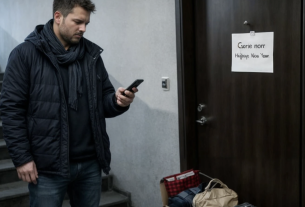
He parked at the end of her five-story building. The very same bench stood empty. Evening light turned the peeling green paint a sickly yellowish color. He walked past it and climbed to the third floor. The familiar childhood smell of the stairwell—bleach, old newspapers, and something sour. He stopped at her door, upholstered in dark brown leatherette with diamond patterns of shiny nailheads. He didn’t press the doorbell. He took out his key ring, separated one—the oldest—and silently slid it into the lock. The mechanism yielded smoothly with a dull, oily click.
He stepped inside, and the apartment’s smell hit him like an invisible wall. It was a complex aroma, calibrated over years. The sharp bitterness of Valocordin—always kept in plain sight on the dresser—mixed with the sterile, almost hospital scent of perfectly ironed linens. The smell of order and hidden anxiety. The smell of Raisa Zakharovna’s home.
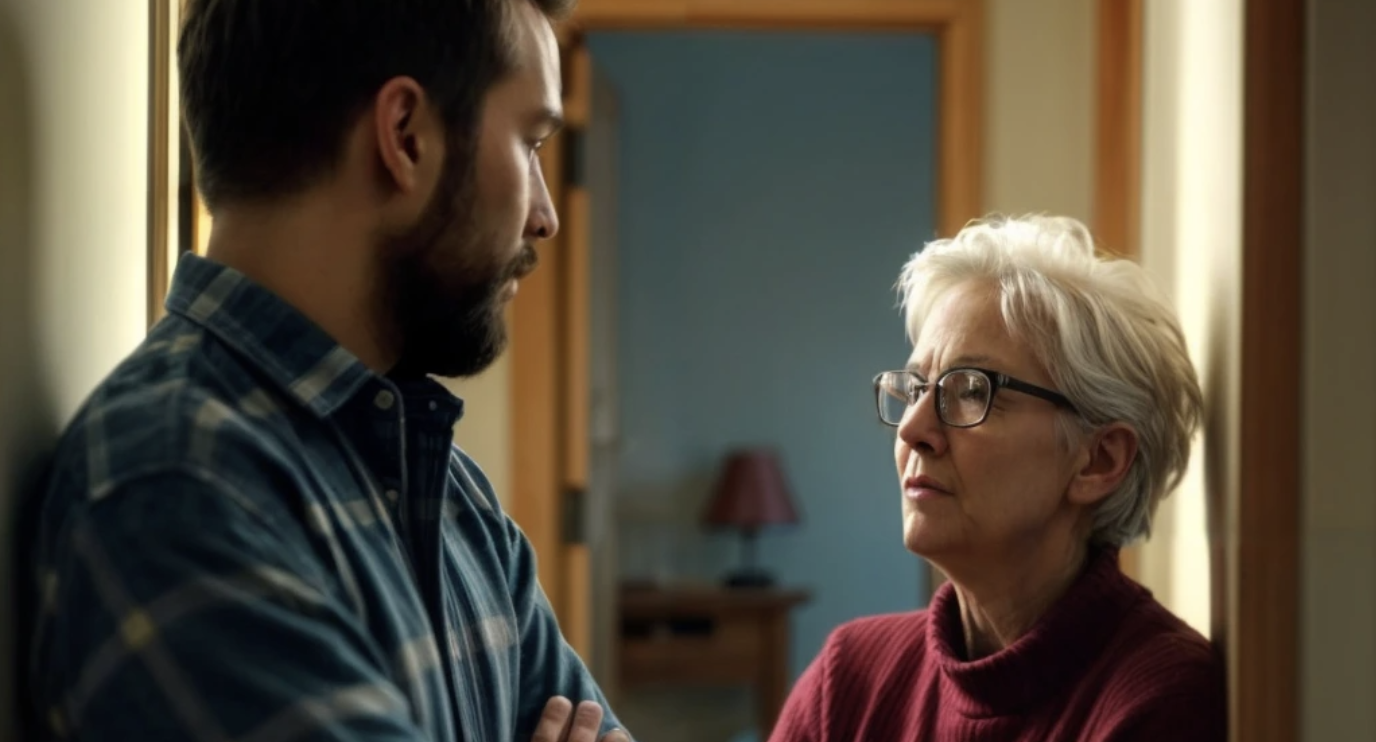
She stood in the hallway, as if deliberately blocking the way into the living room. Not sitting, not bustling at the stove. Just standing—straight as a string—in her best house robe with mother-of-pearl buttons. Her gray hair was neatly set, and her face wore the expression of deep, undeserved offense. She wasn’t simply upset. She was ready. This wasn’t a spontaneous quarrel but a carefully staged performance—and in it she was both the star and the director.
“I knew you’d come running,” she began first, her voice even and drenched in tragedy. She didn’t raise it; she didn’t need to. Her power was in making other people feel guilty. “To defend your queen. I’m nothing to you now. Just an annoying reminder from the past. Someone you can walk past and not even notice. Someone you can disgrace in front of the whole courtyard, in front of people I’ve lived alongside for forty years.”
Yegor stayed silent. He didn’t take off his jacket, didn’t step forward. He simply stood at the threshold, turning into a cold, attentive observer. His silence was denser and heavier than her words.
“They humiliated me, Yegor. They walked five meters away, they saw me—and that yours… she didn’t even turn her head. On purpose! To show Tamara and Valentina what a nobody I am. That my own son raised children who don’t even know who their grandmother is. She’s teaching them that. Turning them against me. And I only wanted to see my grandkids, to say hello! But she paraded past like a peahen, nose in the air. And I was supposed to swallow that? Sit there and wipe my face?”
She paused, letting her words settle, saturating the air with sticky resentment. She waited for his reaction—for excuses, persuasion, maybe even apologies on Olga’s behalf. She expected him to fuss, to smooth things over, to restore her shaken authority. But he kept silent, and his gaze grew darker and more unreadable. When he finally spoke, his voice held no emotion at all—only a statement of fact.
“You attacked my wife and my children, Mom, and now you’re saying it’s their fault? Why? Because they didn’t show you enough respect in front of your friends?”
The calmness of the sentence landed like a whip. Her martyr’s mask cracked. For a moment confusion flickered in her eyes, then was instantly replaced by anger. He hadn’t just refused to take her side—he had dared to judge her actions. He had dared to call things by their names.
“Attacked? Listen to yourself, Yegor! You’re speaking her words! That’s how she’s poisoned you! I made a remark! I, as a mother and grandmother, put her in her place! She lives in this family and she must follow its rules! The main one being respect for elders!”
Her voice rose at last, losing its tragic velvet and taking on sharp, metallic notes. The conflict shifted instantly from the bench and the rude daughter-in-law to him—to his betrayal.
“You didn’t come here to sort anything out—you came to accuse me. Your own mother. For her. Because she matters more to you now. More than the one who raised you. She erased me from your lives, and you’re helping her do it.”
“It’s not about her, Mom. And it’s not about me,” his voice cut through her tirade like a scalpel through inflamed tissue. He took a step forward, out of the shadow of the entryway into the dim hall light. “It’s about what you see—and what you refuse to see. You see one thing: the bench, your friends, your offended dignity. That’s it. Your picture of the world ends there.”
He stopped a couple of meters from her. Now they faced each other like two fighters in a ring—only one was dressed in armor made of righteous fury, and the other was protected by nothing but icy calm.
“And I see something else,” he continued, his voice still quiet but heavy now. “I see my wife’s arm, where red marks will be left by your fingers. I see my six-year-old son—who, until this moment, thought his grandmother was the kindest person in the world—looking up at you and not understanding why you’re hurting his mom. I see my little daughter, who is only learning to trust the world, hiding her tear-streaked face in Olya’s skirt because the person who should have protected her became a source of fear. You took away their respect for you. You took away their sense of safety around you.”
He wasn’t speaking to make her feel sorry. He was dissecting the situation, pulling out every excuse and leaving only the bare, ugly fact on the table—an adult attacking someone weaker. He stripped her of victimhood, mercilessly angling the mirror so she would see not a martyr, but an aggressor.
For Raisa Zakharovna, this was unbearable. His words weren’t just an accusation—they were sacrilege, an assault on the foundations of her existence. She stepped back as if he’d physically struck her. Her face twisted.
“How dare you! Those are my grandchildren! My blood! I’m raising them! I’m pointing out mistakes because no one else will! Because their mother is busy only with herself!”
“You weren’t raising them. You were humiliating them. Publicly. For an audience.”
“I’m your mother! I have the right!” she shouted. It was her main—her final—unshakable argument. She said it not as a justification, but as a proclamation of a universal law. In her world, the status of “mother” granted absolute, unquestionable power—the right to any word, any act, any cruelty, if done “for their own good.”
Yegor nodded slowly, as if he’d been waiting for that exact phrase—as if it were the key that triggered the next phase of their conversation. The cold ball of rage inside him hardened into a granite core of resolve.
“Fine. If you have the right, then you’ll have the obligation too. Here’s how it’s going to be. Tomorrow. At the same time Olya walks the kids home from the park. You will gather Tamara Petrovna and Valentina Grigoryevna on that same bench. And when my wife and my children walk past, you will stand up and apologize. Just as loudly as you screamed today. You will say you were wrong. That you shouldn’t have said those vile things. That she’s a good mother and they are wonderful children. Word for word. So the whole courtyard hears.”
A pause fell. The air in the hallway thickened. Raisa Zakharovna stared at him as if he’d offered her poison. Slowly her face filled with stunned disbelief that slid into contempt. She couldn’t believe what she was hearing. The very idea of humiliating herself like that—before her friends, before the whole courtyard—was monstrous, unthinkable. Worse than any shame.
“Are you out of your mind?” she hissed, her lips twisting into a spiteful smirk. “Me… because of that… Never in my life. You’ve completely lost it, Yegor. She’s twisting you around her finger, and you’re happy to do it.”
She was absolutely sure it was a bluff—a pathetic, clumsy attempt to scare her. She looked at him as if he weren’t an adult, independent son, but a sulky teenager threatening to run away from home and come back by dinner. She didn’t even suspect he had already left. For good.
Yegor looked at her face warped with contempt and felt nothing. No hurt, no anger, not even disappointment. He looked at her the way a doctor looks at an inoperable tumor. The point of no return had been crossed. She didn’t understand—and never would. He gave the faintest nod to his own thoughts. Her smirk was the last sound he wanted from her.
“Alright,” he said as evenly as before, but there was no agreement in the word—only the registering of a verdict. “Then there won’t be any apology.”
He paused for a moment, letting her enjoy her imagined victory. Her posture grew even more haughty. She was sure he would turn around and leave with his tail between his legs—and a week later he’d call as if nothing had happened.
“Or you can consider that you don’t have grandchildren anymore.”
The line she’d expected as part of his bluff landed nothing like she imagined. There was no threat in it. There was a cold, lifeless fact. And he didn’t stop. Slowly, like he was reading instructions, he began explaining what it would mean in practice.
“That doesn’t mean I’ll ‘forbid’ you to see them. That would be too simple. It means I will erase you. Do you understand? Tonight I’ll go home and take out every photo album. All of them. Starting from the day they came home from the hospital. And from every album I’ll carefully remove every photo where you appear. The ones where you’re holding Alyoshka. Where Masha is sitting on your lap at the dacha. Where we’re all together at a birthday. Those moments won’t exist anymore. There will be empty pockets in the plastic sleeves.”
The armor of her righteousness—so unbreakable a moment ago—splintered with its first crack. The smirk slid off her lips. She stared at him, and something new appeared in her eyes—not fury, but disbelief.
“And don’t think I’ll lie to them,” Yegor went on, his voice mercilessly calm. “I won’t say their grandmother died. I’ll tell the truth. When Masha asks where Grandma Raya went, I’ll answer: ‘Grandma Raya is very proud. One day she decided you didn’t respect her enough, and she chose her pride over you. She made her choice.’ And I’ll repeat it every time they ask. Calmly and honestly. Until they stop asking. Until your name becomes just a word to them—one that doesn’t stir any emotion.”
He took another step forward. Less than a meter separated them now. The Valocordin smell seemed thicker.
“Your New Year and birthday gifts won’t reach their addressee. I’ll throw them into the trash bin by the entrance without even opening them. If you try to come to their school or kindergarten, I’ll warn security and the teachers that the children don’t have a grandmother like that. That you’re a stranger to them. I’ll delete your number from their little phones. I will erase you from their present and their future as carefully as I will erase you from the photos of their past. Little by little they’ll forget your face, your voice. You’ll become a vague, unpleasant early-childhood memory. A blank spot.”
That was it. He’d said everything.
Raisa Zakharovna was silent. She looked at him, and her face—so arrogant and certain a minute ago—turned into a gray mask. She understood at last. This wasn’t blackmail. This wasn’t exaggeration. It was a detailed, thought-out plan. A plan to erase her completely and forever from their lives. Not because of a daughter-in-law’s whim, but because of her own “victory” there on the bench. Because of the right she was so proud of. The price of that right turned out to be absolute.
Yegor watched her for a few more seconds—watched her world collapse inside the walls of that apartment, amid the smells of order and righteousness. He didn’t see remorse in her eyes. Only terror at realizing the consequences.
He didn’t say another word. He turned and walked to the door. He wasn’t running. He walked slowly, with the firm, steady stride of someone who has made a final decision. He didn’t slam the door. He simply pulled it shut, and the heavy lock clicked dully, cutting him off from the past.
Raisa Zakharovna was left alone in the hallway—in a deafening, crushing loneliness—face to face with her pride, her Valocordin, and her small, petty victory that had just cost her everything.