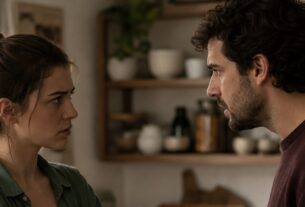
“I’m a man—I’m the boss in this house! Get out, both of you!” my husband screamed at me and my mother.
“Actually,” I replied, “this is my house. You have one hour to pack your things.”
It was four in the morning. Anya sat in an armchair with her legs tucked beneath her, the only light coming from the laptop screen balanced on her knees. What began as a simple sleepless night turned into something tense and frightening when Kirill stopped answering his phone.
Then came the click of the front door.
Kirill didn’t walk in—he drifted into the half-dark living room on a wave of euphoria. He hummed a tune under his breath and didn’t notice Anya right away. When he finally did, his face didn’t even flinch.
From the shadow of the kitchen doorway stepped her mother, Lyudmila Sergeyevna, in an old robe, arms folded across her chest.
“Oh, the muse has arrived,” her mother said, voice dry and cutting. “While we, the mere mortals, have been babysitting a thermometer all night. The child’s had a fever the entire time, and you…”
Kirill flashed her a quick, irritated glance—barely a second. His attention snapped back to Anya. He moved closer, carrying the smell of expensive whiskey and a sweet, unfamiliar trace of women’s perfume.
“Baby, it was a sensation,” he whispered, trying to wrap an arm around her shoulders. His eyes were blazing—but that fire wasn’t meant for her. “We got noticed. Real people from Moscow. I’m telling you—soon we’ll be out of here!”
Anya didn’t respond. She simply leaned away so she wouldn’t have to breathe that scent in. She looked at her husband and saw not someone dear, but an actor returning from a successful tour—now performing the part of a devoted spouse.
A scene from three years ago rose in her mind. She sat in that very chair, a buyout offer lying on the table—an offer for her share in the IT company she had built from nothing. A number with six zeros. Her business partner, Semyon—sharp and cynical—had smirked back then and said, “Anya, are you sure? Don’t confuse a startup with a family. Investing in human capital is the riskiest investment of all—especially when the ‘capital’ is a creative type.”
She had laughed in his face. She had been certain she was investing in their future.
She sold her stake so Kirill wouldn’t have to worry about money—so he could focus on creating. She became his manager, his PR person, his administrator, his shoulder to cry on, and his sponsor. She built this house and poured everything into his talent: money, time, belief.
And now that “investment” stood in front of her, soaked in someone else’s perfume, offering her a new life in Moscow. He didn’t ask about their son. He didn’t even notice her bloodshot, sleepless eyes. The world revolved around him—his music, his success—and she was just part of the support staff keeping the show alive.
“Kirill,” she said softly, and the calm in her voice finally made him tense. “Misha’s had a fever all night. Almost forty.”
He frowned. Their child being sick was an inconvenience—something that knocked him off his triumphant high.
“Well, your mother’s here,” he tossed out, nodding toward the kitchen. “You handled it. I’m going to lie down. Tomorrow’s a hard day. I need to think everything through.”
He turned and went to the bedroom, leaving a trail of чужой perfume behind him.
Morning was dull and gray. Kirill slept the sleep of someone with a clear conscience, arms sprawled wide as if he were embracing the whole world that had applauded him the night before.
Her mother didn’t pry. She simply set a mug of strong coffee in front of Anya and a plate of syrniki—cheese pancakes Anya hadn’t eaten since her student years. That silent gesture of support—her mother always knew how to treat wounds—worked more powerfully than any words.
Anya tried to arrange her thoughts: her husband came home late; he smelled like someone else; he didn’t care about their sick son… The conclusion was there, obvious and ugly, but she didn’t want to make it. She clung to the last scraps of faith, convincing herself it was just a stupid coincidence.
That was when a message pinged on the phone on the table.
Her friend Lena.
Anya opened the chat.
First came a photo—a screenshot from someone’s story. A blurred hotel-room background, dim light, and Kirill at the center, holding a thin girl with bright lipstick and a bold, provocative stare. His hand rested on her waist. At the bottom was a playful caption:
“After a concert you always need a good afterparty ;)”
Anya felt ice flood her chest. She zoomed in, scanning for details as if the pixels might offer an excuse: a treble-clef tattoo on the girl’s arm; a bottle of expensive whiskey on a side table. And in the background, leaning against the wall, stood Kirill’s guitar—the one Anya had hunted down across Europe and given him for their wedding anniversary.
Then came a short video—no sound. Same girl, same room. She laughed, said something, turned, and kissed Kirill.
And Kirill kissed her back.
The phone slipped from Anya’s hand and hit the table.
Her mother, who had watched in silence the entire time, picked it up, looked at the screen, and just as silently set it back down. Her face turned hard—like an investigator staring at a piece of undeniable evidence.
“I’ll go sit with Misha,” she said, and walked out of the kitchen, leaving Anya alone.
When Kirill finally appeared, sleepy, in nothing but a T-shirt, Anya felt nothing anymore. The pain had burned itself out, leaving only cold ash. He poured himself coffee, sat down, and smiled pleasantly.
“So,” he said, “how are my girls doing without me?”
Anya didn’t say a word. She picked up the phone and placed it on the table, screen up, right in front of his cup.
He looked.
His smile slowly slid off his face. Confusion turned to irritation—then to defensive hostility.
“And what is this?” he snapped, shoving the phone away. “Your little detective friends again? Aren’t you tired of spying on me?”
He didn’t apologize.
“I wasn’t spying, Kirill. People just love sharing their happiness.”
“She’s just a fan!” he barked. “Some crazy girl! Yeah, we had a few drinks after the concert, we relaxed! Don’t I have the right? I’m an artist! I need inspiration, emotion—do you understand? And you and your mother turned my home into an accounting office! Every step I take, under surveillance!”
At that moment Lyudmila Sergeyevna came back into the kitchen and heard him shouting.
“An accounting office?” she repeated with a small, amused snort. “Fine then. Let’s do some accounting, Artist, since you brought it up. The place you live in is two hundred square meters. Utility bills for last quarter were forty-two thousand rubles. Groceries for last month—about sixty thousand. Misha’s sports program, gas for the car you graciously use to get to rehearsals… Should I go on?”
She paused, staring him straight in the eyes.
“Your fees, Kirill—the ones you bring home whenever you feel like it—barely cover guitar strings and picks. Everything else is paid for with money Anya earned while you were strumming your little balalaika. She’s not just your wife—she’s your sponsor. And judging by that video, you’ve just declared bankruptcy.”
Her words—precise as scalpels—hit the raw nerve Kirill had been hiding behind his “creative genius” mask. This wasn’t only about cheating or coming home late anymore. It was about his ego—his sense of being the man.
He shot up so fast the heavy oak chair flew backward and slammed into the wall. The charming musician vanished; what replaced him was a primitive male whose dominance had been questioned.
“Money?!” his voice cracked into a sharp, ugly pitch. “You’re going to throw money in my face?! After everything I do for this family?! I’m the man in this house! I’m the one in charge! I decide who lives here!”
His eyes swept the kitchen, searching for a target, then landed on Anya—then on her mother.
“I’m sick of it! Both of you! Your constant control—and her poisonous jokes! You turned this home into a cage!”
He stepped forward and jabbed a finger toward the door, pouring all his rage into the gesture.
“Out! Get out of the house! Take your mother with you! Pack your things and get lost!”
Anya—who had been sitting there silently, tears slipping down her cheeks—lifted her head.
“You’re wrong, Kirill,” she said.
He froze for a second, thrown off by her calm.
“In the one way that matters most,” she continued, slowly standing up. She straightened her shoulders. “This is my house.”
Kirill blinked, not believing his ears.
“What?”
“You heard me. Everything was bought with the money from selling my share of that IT company. The deal closed on May tenth—one year and two months before our wedding. This house, and the land it sits on, is registered in my name as the sole owner.”
She looked him directly in the eyes.
“So legally, you’re just a guest here. And your stay is over. You have exactly one hour to pack your guitars, your laptop, and whatever is left of your ‘inspiration.’ If you’re still here in an hour, I’ll call the police. And unlike you, they won’t need a long explanation about property rights. They’ll simply remove you as a stranger trespassing on private property.”
Kirill stared at Anya and saw a judge delivering a final verdict.
He stood in the middle of the kitchen, scanning the walls, the tiles, the coffee machine Anya had given him for his birthday.
All the fight drained out of him. No more shouting. No more threats. He turned and went into the bedroom without a word. A few minutes later he came out with a backpack slung over one shoulder and a guitar case in his hand.
In the doorway of Misha’s room stood their son, woken by the shouting. The boy stared at his father with wide, frightened eyes. Kirill hesitated for a heartbeat. His gaze slid over the child’s face, but he didn’t step closer—what could he even say? He simply looked away and hurried to the exit.
The front door slammed.
Anya’s mother came up, wrapped an arm around her shoulders, and said softly, “That’s it. Go to your son. I’ll clean up here.”
A couple of weeks later he called. Anya answered automatically while sorting through work emails.
“It’s me,” a drunken voice slurred into the receiver.
She said nothing.
“Well—happy now?” he shouted. “You got what you wanted? You broke me! You destroyed my talent! You’re philistines! Greedy, small-minded women who don’t understand art! I would’ve been a star! But you… you buried me under your borscht and your utility bills! I’ll still get famous—just to spite you! You’ll hear about me!”
Anya listened to the flood of incoherent accusations. And for the first time, she didn’t feel even a drop of pain. He wasn’t yelling at her—he was yelling at reality, at the fact that it hadn’t turned out the way he’d imagined. She realized she hadn’t loved him so much as the version of him she had created herself: the “genius” who needed protecting. And the genius didn’t exist—only a talented but childish egoist did.
Without saying a word, she ended the call and blocked his number.
Six months passed. Anya returned to IT, found a remote job at a large company, and filed for divorce.
One warm autumn evening she sat on the terrace. Beside her, on a blanket, little Misha was building a tall tower out of blocks. The air was clean and cool.
From the small radio she kept on for background noise, music began to play. A familiar melody. A raspy, passionate voice. It was a new song from Kirill’s band, and it had become fairly popular—several stations were playing it.
Misha’s tower collapsed with a loud crash. He looked at the ruins, puffed his lips for a second… then, without crying, started building again, picking up the blocks one by one.
Anya smiled.