The numbers on Olga’s phone screen stayed there for exactly two minutes. That was precisely how long she was allowed to enjoy them.
The rent payment had arrived from her tenants, right on schedule, as always—on the fifth of the month, almost to the minute. Sergey and his wife were responsible people who never missed a payment. Olga looked at the increased balance in her account and felt that quiet sense of satisfaction familiar to anyone who had built their own financial security with their own hands.
This money was honestly earned. Not today, perhaps, but through years of saving, discipline, careful planning, and denying herself things she wanted.
Then her phone chimed.
Once.
Twice.
Three times.
Messages from Margarita Viktorovna, her mother-in-law, began pouring in one after another, almost as though the woman had been waiting for the rent payment to arrive. As if some invisible alarm had gone off telling her that her daughter-in-law had money again.
“Hello, Olya dear. Petya needs twenty thousand by the end of the week. There’s some delay with his suppliers. Please transfer it to my card and I’ll give it to him.”
“And Artyom could use another five thousand toward a new phone. His is terribly old now. It’s embarrassing for him to carry something like that.”
“You got the rent money today, didn’t you? Perfect timing.”
 
Olga slowly lowered herself onto the stool beside the kitchen table.
“Perfect timing.”
Her mother-in-law had not even asked whether Olga could help. She had already decided everything for her. The money had been mentally divided and distributed. All that remained was for Olga to open her banking app and press the correct buttons.
And this was far from the first time.
Not even the tenth.
It had been going on for three years, steadily and relentlessly, like drops of water wearing away stone.
Olga owned two apartments.
One had belonged to her grandmother, an old two-bedroom apartment on a quiet street that the elderly woman had left to her only granddaughter.
Olga had bought the second apartment herself before getting married.
She had fought for every square meter of it. At twenty-six, she had taken out a mortgage and spent six years paying it off while working as a logistics specialist for a transport company and taking additional weekend jobs whenever she could.
When she finally made the last payment, she experienced true financial independence for the first time in her life.
Now she and her husband Denis lived in her grandmother’s apartment, while Olga officially rented out the other property—the one she had purchased herself. She had proper contracts with her tenants, paid taxes on the income, and handled everything legally.
Yet at some point Denis’s relatives had decided that the rental income from Olga’s personal apartment belonged to everyone.
It had somehow become “family money.”
A shared emergency fund from which every relative could take whatever they needed.
Margarita Viktorovna liked to say with a slightly dismissive smile:
“What does it matter to you, Olya? That money practically falls out of the sky. You rent out an apartment and do nothing while the cash keeps coming in. Some of us actually have to work for a living.”
The fact that Olga had spent six years paying for that “little apartment” while denying herself almost everything never seemed to enter the discussion.
Nor did anyone remember that apartments required repairs, maintenance, taxes, and other expenses.
To Denis’s relatives, rental income simply appeared out of nowhere.
Easy money.
Money that belonged to no one in particular.
And if it belonged to no one, then surely it belonged to the family.
At first, the requests had been polite.
Loans.
Denis’s older brother, Pyotr, once asked for money “just for a month.”
“I’ll repay you as soon as I make my first profit,” he had promised.
Olga gave him the money.
A month passed.
There was no profit.
Somehow everyone forgot about the debt.
Then another urgent situation appeared.
Then another.
Gradually, the word “loan” disappeared entirely.
Requests became expectations.
 
Expectations became demands.
Nobody talked about repayment anymore.
And Olga kept giving in.
Twenty thousand.
Thirty thousand.
Fifteen thousand.
Anything to avoid arguments.
Anything to keep peace in the house.
Anything to prevent Denis from looking at her with that wounded expression, as though refusing his relatives made her a bad person.
Meanwhile, the number of people expecting help kept growing.
Pyotr was a permanently unsuccessful entrepreneur.
Every few months he launched a new business idea. First he tried reselling car parts. Then he opened some kind of shawarma stand. After that came another mysterious supply business involving goods from somewhere nobody quite understood.
Once Olga had given him a substantial amount to “develop the business.”
Three months later, Pyotr went bankrupt.
The money disappeared.
Naturally, Pyotr himself was not responsible.
It was the economy.
The competition.
The crisis.
Bad luck.
Anyone and anything except him.
Then there was Artyom, the twenty-year-old nephew.
He had practically become a permanent dependent.
Olga helped pay for his driving lessons.
She contributed toward his phones.
There was supposedly a savings fund being built for his first car.
And somehow all of it came from Aunt Olga’s pocket.
 
The young man had grown used to the idea that Aunt Olya always had money available.
So whenever he wanted something, he asked without embarrassment.
Margarita Viktorovna also regularly needed financial assistance.
Sometimes it was supposedly for medical treatment, although suspiciously often the “treatment” was followed by a new fur coat.
Other times she needed “expensive medication.”
Then there were personal expenses, household expenses, unexpected expenses.
She accepted Olga’s money with the confidence of someone collecting something that was rightfully hers.
Every member of that family seemed genuinely convinced that Olga had no moral right to refuse them.
Because she owned two apartments and earned rental income, they treated her financial stability almost like a debt she owed the family.
But the most painful part was Denis.
He always sided with them.
“Olya, they’re my family,” he would say whenever she tried to protest. “They’re struggling. Helping them isn’t difficult for us. It’s not like we’re going to become poor. You can’t refuse your own relatives.”
“It isn’t difficult for us.”
“We’ll help.”
Except the money was always Olga’s.
Olga was always the one actually helping.
Denis earned an average salary and had very little savings of his own. Yet he loved generously distributing his wife’s income, playing the role of the kind son, caring brother, and generous uncle.
Olga increasingly felt that everyone around her was dismissing everything she had worked for.
The sleepless evenings spent calculating mortgage payments.
The holidays she had skipped.
The clothes she had not bought.
The restaurants she had avoided.
The years of discipline.
None of it meant anything to Denis’s relatives.
In their eyes, she had simply gotten lucky.
The final straw came during an ordinary Saturday evening.
 
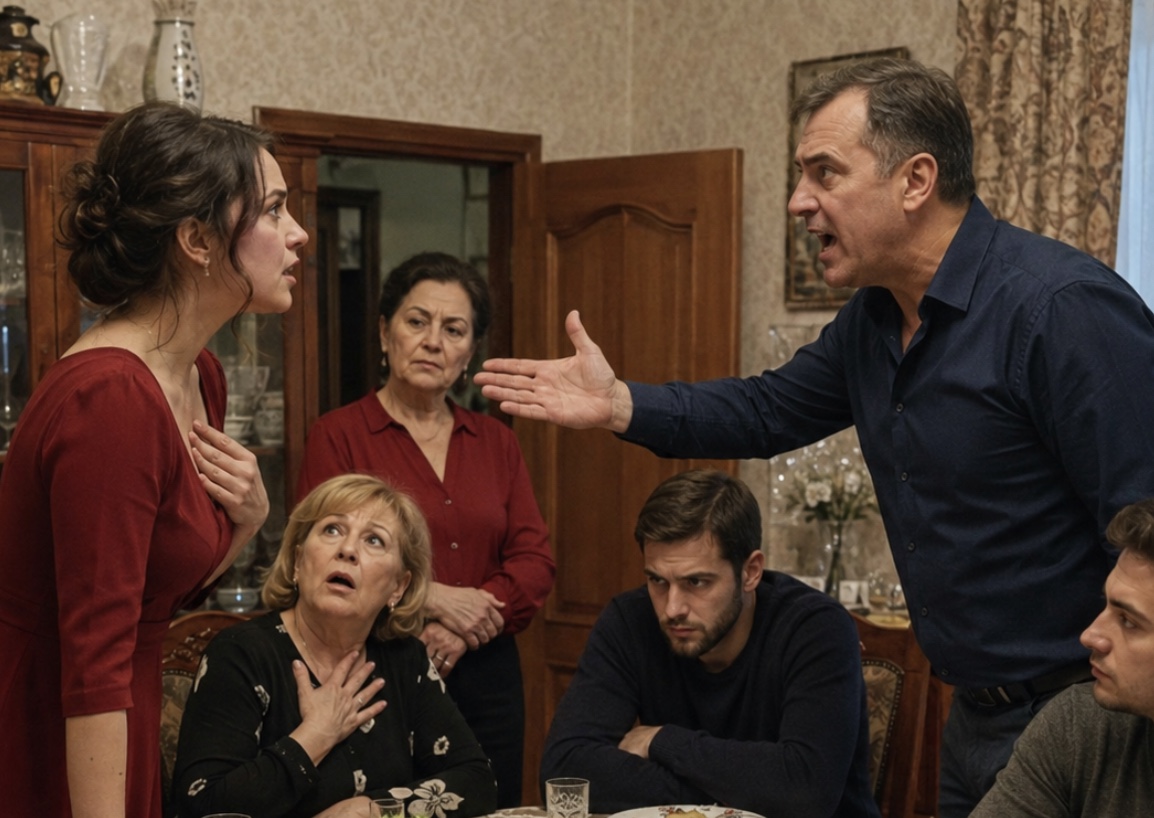
The whole family had gathered for dinner at the apartment Olga had inherited from her grandmother—the home where she and Denis lived.
Everyone was there.
Margarita Viktorovna.
Pyotr.
Artyom.
Even Margarita’s younger sister, Tamara Viktorovna, had stopped by. She was just as loud and just as convinced of her right to interfere in everyone else’s affairs.
Dinner continued normally at first.
But as Olga moved around the table serving food, she sensed something unusual.
The guests kept exchanging meaningful looks.
Then, somewhere between the salad and tea, Margarita Viktorovna carefully placed her fork down, dabbed her lips with a napkin, and spoke in the casual tone of someone announcing something that had already been decided.
“Olya dear, I found a wonderful health resort in Kislovodsk. I really need to take care of my heart and my nerves. It costs one hundred and ten thousand for twenty-one days. Please pay for it. The next session begins next week. I already wrote down the payment details.”
She handed Olga a folded piece of paper.
The room fell silent.
Everyone looked at Olga expectantly.
Calmly.
Confidently.
They already knew what her answer would be.
One hundred and ten thousand.
For a health resort.
And the payment information was already prepared.
Not one person had asked, “Can you afford it?”
Nobody had said, “Would you mind helping?”
Nobody cared what Olga thought.
They had simply presented her with a bill.
Something inside Olga, something that had been tightening for three years, finally snapped.
“No,” she said.
The single word dropped into the silence.
For a moment, Margarita Viktorovna looked as though she had not understood.
“What do you mean, no?” she asked, still holding the folded paper in midair.
“No, Margarita Viktorovna. I’m not paying for your trip.”
 
Her mother-in-law slowly lowered her hand.
Confusion quickly turned into outrage.
“What do you mean you’re not paying? What are you saying? I need to improve my health and you tell me no? Have you no conscience?”
Olga looked directly at her.
“Why exactly am I supposed to pay for it?”
Everyone stared.
“Explain it to me. Why am I responsible for spending one hundred and ten thousand on your vacation?”
“Because you have the money!” Pyotr immediately interrupted, pushing his cup aside. “What else are you going to do with it? Money keeps coming from that apartment every month. Mother is sick. Are you seriously going to be stingy with your own mother-in-law?”
“Money keeps coming from the apartment,” Olga repeated slowly.
Then she looked at him.
“Pyotr, I spent six years paying the mortgage on that apartment. Alone. Without anyone’s help. And since we’re discussing money, you still haven’t returned the hundred thousand I gave you for your business. Remember?”
Pyotr exploded.
“You’re still talking about that?”
His face flushed.
“How petty can you be? It wasn’t my fault the business failed! You act like some merchant counting every kopeck. You’ve always been an outsider in this family. Always!”
Olga looked around the table.
Margarita Viktorovna sat with one hand pressed dramatically against her chest, wearing the expression of someone who had been mortally insulted.
Pyotr was red-faced with righteous anger.
Tamara Viktorovna nodded in support of her sister.
And Artyom lounged in his chair scrolling through the very phone Olga had helped buy him.
Then he finally spoke without even looking up from the screen.
“Well, Aunt Olya, he’s kind of right. That money comes easily to you. Why are you acting like we’re strangers?”
Something about hearing those words from a young man she had financially supported for years became the final breaking point.
Olga turned toward her husband.
Denis sat beside her, staring down at his plate.
It was already obvious.
He was not going to defend her.
Again.
“Denis.”
Olga looked directly at him.
“Are you going to say anything at all? Your family is demanding one hundred and ten thousand from me for a health resort. My money. Income from my apartment. Do you think this is normal?”
Denis shifted uncomfortably.
“Olya, Mom isn’t well,” he finally muttered, still avoiding her eyes. “Just give in this once, okay? For me. What does it really cost you? You’ll make peace afterward.”
That was the moment Olga stood up.
 
She straightened her shoulders and looked at every person sitting around the table.
The relatives who had spent three years living partially at her expense while acting as though she owed them.
And the husband who had not stood beside her even once.
“I am not obligated to support your entire family just because I own an apartment!” she said loudly and clearly.
Artyom finally looked up from his phone.
For a second the words hung over the table.
Then everyone erupted at once.
Margarita Viktorovna immediately grabbed her chest and leaned dramatically against the back of her chair.
“Oh… oh, I feel terrible…”
She began breathing heavily.
“She’s made me ill… she’s driving her husband’s own mother into an attack… Tamara, get me some valerian drops. Look what she’s doing to me. And after everything I’ve done for her…”
Tamara Viktorovna rushed around her sister, glaring at Olga while muttering that some people had no shame at all.
Apparently Olga had become the kind of monster who gave her mother-in-law a heart attack over money.
Pyotr pushed himself halfway out of his chair and leaned across the table.
“You are a stranger!” he shouted. “You always have been! Denis, who did you even marry? She’s not a woman, she’s a calculator! Family means nothing to her as long as she can protect every last coin!”
Olga stood in the middle of the shouting and suddenly felt strangely calm.
Almost detached.
As though a curtain that had covered her eyes for three years had finally been pulled aside.
She saw these people clearly for the first time.
Not as family.
But as a group of people who had grown accustomed to feeding from her hand and were furious because that hand had suddenly closed.
Then Denis said the words that finally made everything clear.
“You know what, Olya,” he said, standing as well, a hardness appearing in his voice that she had rarely heard before. “If you can’t accept my family, if you don’t care about the people closest to me, then maybe you and I really shouldn’t be together. I can’t live like this—with my wife constantly fighting against my mother.”
Olga stared at him for a long moment.
Eight years together.
And this was where they had ended up.
“So maybe we shouldn’t be together,” she said quietly. “I understand now.”
She paused.
“I thought you loved me, Denis. But apparently you loved my apartments. And the rental income. I’m only realizing that now.”
“Stop twisting everything!” Denis snapped.
“I’m not twisting anything. I’m just finally seeing it clearly.”
Olga did not continue the argument that evening.
She quietly cleared the table and saw the guests out.
Margarita Viktorovna left holding her chest, groaning dramatically and promising that Olga would regret what she had done.
Olga never paid for the health resort.
Not that evening.
Not later.
Two days afterward, Denis packed a suitcase.
“I’ll stay with Mom for a while,” he muttered without looking at his wife. “When you’ve had time to think about your behavior, call me.”
“I won’t,” Olga replied calmly.
Then she added:
“And Denis, take your winter clothes too. That way you won’t need to come back twice.”
Denis moved into his mother’s apartment, sincerely convinced that he was the victim.
A suffering husband whose cruel wife had rejected his family.
The next day, Olga filed for divorce.
And that was when Denis’s relatives discovered something they had never expected.
For three years they had been so focused on Olga’s money that they had overlooked one very important detail.
Both apartments belonged exclusively to Olga.
Her grandmother’s apartment had been inherited.
The second apartment had been purchased before marriage with Olga’s own money, and the mortgage had been fully repaid before she married Denis.
 
Neither property was marital property.
There was nothing to divide.
Absolutely nothing.
When Margarita Viktorovna and Pyotr finally understood this, their disappointment was almost comical.
Privately, they had apparently expected that after the divorce Denis would receive at least one apartment.
Then, somehow, that property would naturally return to “the family.”
But Denis’s lawyer gave him a very simple answer.
There was no chance.
Inherited property and assets purchased before marriage were Olga’s.
The family could expect nothing from either apartment.
Once Margarita Viktorovna realized there would be no more money—no health resort, no apartment, no financial support—she launched an aggressive campaign against Olga.
She called relatives, friends, acquaintances, and anyone willing to listen.
In her version of events, Olga had heartlessly thrown her poor husband out of his own home.
She had tormented her sick mother-in-law.
She cared only about money.
She refused to help family.
With every retelling, the story gained new dramatic details.
In the past, Olga would have rushed to defend herself.
She would have explained everything.
She would have tried to prove what had really happened.
Now she simply stopped answering those calls.
Let people say whatever they wanted.
The people who truly cared about her already knew the truth.
Everyone else was no longer worth her nerves or her explanations.
The divorce was completed quickly.
One of the first things Olga did afterward was change the locks in her grandmother’s apartment—the home where she had lived with Denis.
His relatives had, naturally, possessed a spare key.
Not anymore.
New locks.
New keys.
No outside copies.
Olga also called Sergey and his wife, the tenants in her other apartment, and reassured them that nothing would change for them.
They could continue living there peacefully.
Everything remained exactly as before.
 
And then, for the first time in three years, the rent payment that arrived on the fifth stayed entirely in Olga’s account.
No messages came from Margarita Viktorovna containing bank details.
No one wrote, “Petya needs money.”
No one said, “Artyom could use a new phone.”
Nothing.
There was only Olga’s income.
Her money.
Money she was finally free to use however she wished.
It took her surprisingly long to get used to the silence.
At first, when her phone remained quiet and nobody demanded anything, she experienced a strange phantom anxiety.
It felt as though something were missing.
Eventually she understood what it was.
Guilt.
The guilt that had been carefully cultivated inside her for years was gone.
And its absence brought her more relief than anything else.
A couple of weeks later, Olga did something she had not allowed herself to do for years.
She visited the website of the very same health resort in Kislovodsk that Margarita Viktorovna had so confidently chosen for herself.
Olga browsed through the rooms and treatment programs.
Then she booked a twenty-one-day stay.
For herself.
A private room.
Paid entirely with her honest rental income.
“To take care of my heart and nerves,” she thought with a smile, repeating her mother-in-law’s words.
Then she clicked “Pay.”
Olga went alone.
Those three weeks became some of the best she had experienced in years.
Mountain air.
Silence.
Slow walks along the health trails.
Mineral baths.
A book read on a bench beneath tall pine trees.
Nobody called with demands.
Nobody counted her money.
Nobody reminded her how “easy” her life supposedly was.
Olga walked through the quiet paths, breathed deeply, and for the first time in a very long while felt truly free.
Not simply free from Denis’s relatives.
 
Free from the endless obligation to remain convenient for everyone.
Free from the expectation that she should always give, always surrender, always apologize, and always feel guilty.
Denis contacted her after she returned home, rested and slightly tanned.
He sent a long message.
He admitted that he had lost his temper.
He said he had been wrong.
His mother had gone too far, of course, but he had also made mistakes.
He missed Olga.
He suggested that they meet, talk everything through, and try again.
Olga read the message while sitting at the kitchen table in her grandmother’s apartment, a cup of tea in her hands.
She read it a second time.
And then she noticed something surprising.
She felt no anger.
No resentment.
Not even the painful little “what if?” that might have appeared only a month earlier.
There was nothing.
Only a calm emptiness where her marriage had once been.
Olga did not send an angry reply.
She did not remind Denis of everything he had done.
She simply typed a few lines.
“Denis, thank you for writing. But I don’t want to come back. Not because I’m angry. I’ve simply realized how much I like the life I have now. Take care of yourself.”
She sent the message.
And, strangely enough, there was no heaviness afterward.
Only relief.
 
Olga put the phone aside and walked over to the window.
Outside, it was a beautiful autumn day.
Yellow leaves spun slowly above the pavement, and somewhere below, children were laughing.
She took another sip of tea and thought that her grandmother would probably have been pleased.
After all, her grandmother had not merely left her an apartment.
She had left her granddaughter a fortress.
Perhaps, having lived a life in which she herself had known how to stand up for what was hers, the older woman had somehow understood that one day Olga might need a safe place of her own.
What Olga had been forced to learn by herself was that a fortress sometimes needed protecting not only from strangers, but from the people closest to you.
Perhaps she had learned that lesson later than she should have.
But she had learned it.
And that knowledge was now hers forever.
More valuable, in the end, than any apartment.