Zhanna set her travel bag down on the hallway floor and took off her coat with the same calmness she might have shown after coming home from an ordinary day at work.
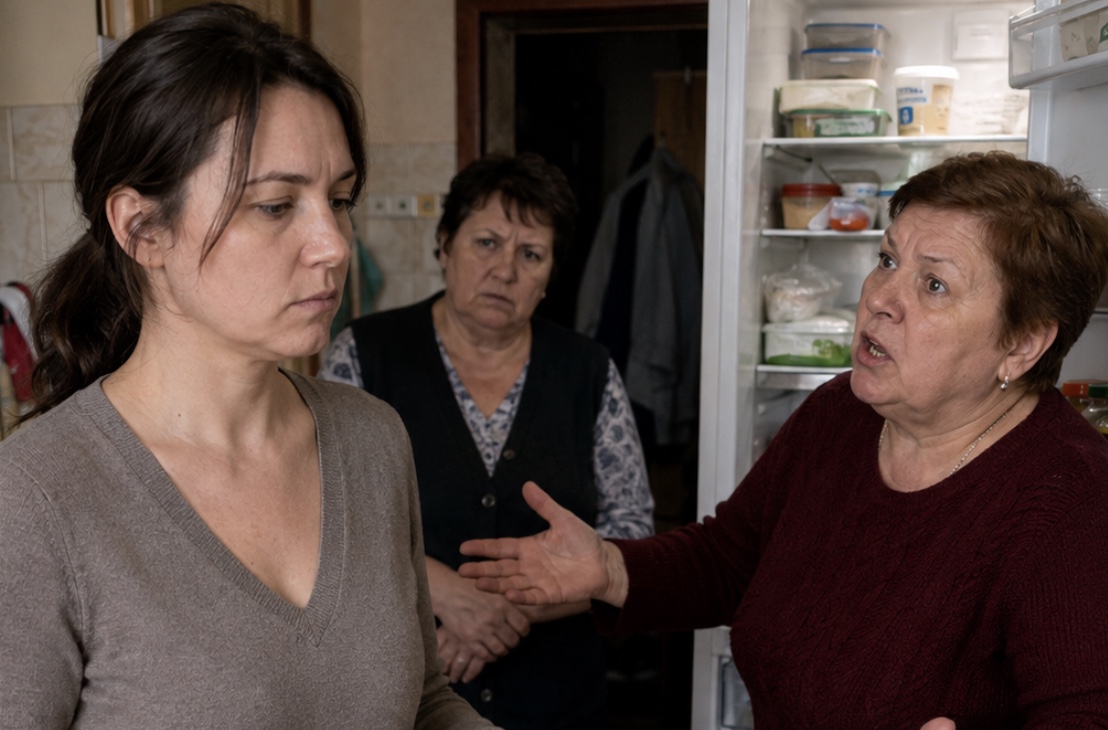
“Are you making fun of me?” Tanya asked. Her voice trembled, and red blotches spread across her face.
“No. I’m showing you that I’m serious.”
“You can’t just… move in with us!”
“Why not? I never signed a rental agreement with you. But you didn’t sign any agreement with me either when you spent six months eating in our kitchen. So I suppose we can say I’m following the same rules you did.”
Tanya backed toward the window as though putting a few extra steps between them might somehow help. Her husband, Grisha, briefly appeared in the doorway. He saw the bag, took one look at his wife’s face, and immediately decided there was apparently something extremely important he had forgotten in the bedroom.
“I’m not leaving until I’ve eaten enough food to equal the amount you owe us,” Zhanna repeated slowly, making sure every word sank in. “So get the plates out. We’ll start with lunch.”
 
But the story had not begun with that sentence, or even in this apartment.
It had started several months earlier, when Grisha, the brother of Zhanna’s husband Sergey, announced that he was moving to the city with his wife Tanya and their two children.
“Only temporarily,” they said. “Just until we get back on our feet.”
Until then, they had lived in a small provincial town where Grisha had neither a decent job nor much hope of finding one. Moving to the city seemed sensible enough.
The problem began when everyday life entered the picture.
Sergey was pleased that his brother would be nearby. Zhanna was more cautious, but she kept her concerns to herself. After all, her husband’s relatives were not people she wanted to start dictating terms to before anything had even happened.
At first, Grisha’s family rented a tiny apartment not far away. It was nearly empty—hardly any furniture, almost no kitchenware, and very little money left after the move.
Grisha began calling Sergey almost every day.
Sometimes their refrigerator was empty. Sometimes there was nothing for the children to eat for breakfast. Sometimes the invitation sounded harmless enough.
“Maybe we could come over for a little while? We’ll sit together, talk… maybe have something to eat.”
Sergey had never been good at refusing his brother.
Zhanna could see the tension in her husband whenever Grisha called. His entire manner changed. His voice became apologetic, as though Sergey somehow needed to feel guilty for having a stable job and a regular salary.
“They’re just getting settled,” he kept telling her while avoiding her eyes. “Once Grisha starts earning properly, things will get better.”
At first, Zhanna tried to believe him.
Eventually, the sentence became less of an explanation and more of something Sergey repeated because admitting the truth was uncomfortable.
And the truth was simple.
Tanya, Grisha, and the children started coming over almost every day.
Not exactly to visit.
To eat.
It began innocently enough with tea and a few sandwiches. Before long, those visits turned into full dinners for several extra people. Zhanna bought groceries expecting them to feed her own household, only to watch them disappear during yet another family gathering.
The refrigerator emptied faster than she could restock it.
Meat that should have lasted several days vanished in one evening. Fruit, vegetables, cheese, and snacks disappeared at an alarming rate. Even the sweets Zhanna bought specifically for her son rarely survived long enough for him to enjoy them.
“Mom, where are the cookies?” her son asked one afternoon, looking through the cupboard.
“Uncle Grisha took them for the children,” Zhanna answered, doing her best not to sound irritated.
She began keeping track of the expenses.
Not because she was stingy. She simply needed to understand what was happening to their household budget.
When she finally added up one month’s grocery spending, the total made her feel almost sick. The amount being spent on Sergey’s relatives was close to twice what Zhanna’s own family normally spent on food.
At first, she jokingly told herself they had accidentally opened a free cafeteria.
Soon, the joke stopped being funny.
 
Every time she carried grocery bags in from the car, a silent calculation started in her head.
This chicken is meant for our family.
These vegetables are meant to last until Friday.
This cheese is for our son’s school lunches.
And how much of it will still be here tomorrow?
Zhanna first tried to discuss the problem gently with Sergey.
“Sergey, I think we need to set some boundaries. This isn’t occasional help anymore. It’s become a routine.”
“They’ve only just moved,” he replied. “What am I supposed to do? Tell my brother I won’t give him a piece of bread?”
“I’m not counting pieces of bread. I’m counting meat, fish, fruit, vegetables, and meals for four additional people almost every day.”
“So you want my brother and his children to go hungry?”
The question was phrased in a way that made any answer sound cruel.
Zhanna stopped arguing.
She knew when a conversation had stopped being a conversation and turned into emotional manipulation.
But remaining silent did not solve anything.
It only allowed the problem to continue.
 
The turning point came on an ordinary Tuesday.
Tanya called and said she wanted to “drop by for a few minutes to talk about kindergarten.”
By then, Zhanna had learned what phrases like that usually meant.
Another meal.
Sergey was at work, and Zhanna was home alone with her son. For the first time in a while, she had enough peace and quiet to think.
She pulled out the notebook where she recorded household expenses and recalculated everything.
This time she did it coldly, almost like an accountant.
When she saw the final number, she closed the notebook and sat by the window for several minutes.
Enough.
The thought came without anger.
Without tears.
Without drama.
Just certainty.
That evening, when Sergey returned from work, Zhanna did not start a fight.
She simply said, “Tomorrow I’m going to Tanya’s place.”
“What for?”
“To talk about the money they owe us.”
Sergey frowned, preparing to object, but Zhanna had already walked into the kitchen.
The conversation was over.
The following day, she went to Tanya and Grisha’s apartment without warning.
Tanya opened the door wearing a house robe. She looked exhausted, and unpacked boxes were still scattered around the apartment.
“Zhanna! What a surprise. Come in.”
“I’m here for a reason,” Zhanna said as she stepped inside. “We need to talk about money.”
 
Tanya’s smile vanished instantly.
“What money?”
“The money you’ve effectively eaten at our house over the past few months. I calculated the expenses. It’s a significant amount.”
Tanya stared at her.
“Zhanna, you can’t be serious. We’re family.”
“Being family doesn’t mean you get unlimited free meals,” Zhanna replied evenly. “I’m not asking you to repay everything. I’m asking you to cover at least part of what we’ve spent. That seems fair.”
Tanya immediately burst into tears.
The reaction came so quickly that Zhanna suspected tears had solved difficult conversations for her more than once before.
“We don’t have any money, Zhanna! None! We can barely afford this apartment. Grisha has only just found a job, and my salary is tiny. You have no idea how hard things are for us!”
Zhanna listened without interrupting.
She waited until Tanya had exhausted her explanations.
“Fine,” she said at last. “If you don’t have money, I have another solution.”
“What solution?”
Zhanna went downstairs.
She walked to her car and took a travel bag out of the trunk.
She had packed it beforehand, just in case the conversation went exactly the way she expected.
As she carried the bag back upstairs, she had plenty of time to change her mind.
She could have decided the whole thing was too absurd.
She could have gone home and pretended she had only meant to frighten Tanya.
Instead, with every step, Zhanna became more certain.
She had spent too long quietly tolerating the situation to settle for another half-measure.
Back inside the apartment, she placed the bag on the floor.
 
“I’m not leaving until I’ve eaten enough of your groceries to cover what you owe us,” she said. “I’ll stay here, eat what you eat, and live the way you’ve been living off us. If it takes several days, I’ll stay several days. If it takes longer, then I’ll stay longer.”
Tanya stared at her as though Zhanna had suddenly started speaking another language.
“You’re joking.”
“No.”
“You can’t just move in here!”
“Why not? You practically moved into our kitchen every day without asking. I’m simply following your example.”
At that moment, Grisha entered the room. He had heard the raised voices and finally decided to see what was happening.
Then he noticed the bag.
He stopped in the doorway.
“What is going on?”
“Your wife can explain,” Zhanna replied, lowering herself onto the only free chair like someone planning to stay for quite a while.
Grisha looked at Tanya.
Tanya looked at the travel bag.
Then both of them looked at Zhanna.
“You seriously intend to live here?” Grisha asked.
“Absolutely. Now get the plates. We’ll begin with lunch.”
For several seconds, no one spoke.
The only sound came from a dripping kitchen faucet.
 
Tanya and Grisha exchanged uncertain glances, each waiting for the other to decide whether Zhanna was bluffing.
“Zhanna, this is too much,” Grisha finally said, trying to sound stern, though there was obvious panic beneath his voice.
“Too much is eating at someone else’s expense every day for months and pretending that’s normal,” she replied. “I’m only trying to restore the balance. Either you repay some of what you consumed, or I eat here until the amount evens out. There is no third option.”
Tanya tried crying again.
This time the tears looked far less convincing.
She had already understood that they were no longer going to work.
“Well,” Zhanna said, standing. “Since neither of you has anything to say, I’ll look in the kitchen and see what you have.”
She walked past Grisha, opened the refrigerator, and inspected its contents with the concentration of someone studying products in a supermarket.
“Not much,” she observed. “Never mind. We’ll work with what you have. Consider my lunch today the first payment toward the debt.”
Grisha reached for her arm, apparently hoping to physically stop her.
Zhanna calmly pulled away.
“Don’t touch me,” she said quietly. “I’m not causing a scene. I’m simply taking what I’m owed in exactly the same way you took from us without asking.”
Tanya suddenly ran from the room.
 
Zhanna heard her footsteps disappearing and assumed her sister-in-law had either gone to seek help or simply could not handle the humiliation.
Grisha remained where he was, completely unsure what to do next.
“Sit down,” Zhanna told him. “Since Tanya has gone off to think, you and I can talk calmly.”
Grisha sat on the edge of the sofa and rubbed his hands nervously.
“Zhanna, surely you understand how strange this is.”
“What was strange was having your family eat at our table every single day while my husband was too afraid to say anything because you’re his brother. I’m tired of being the person who quietly pays for four extra mouths.”
“We didn’t mean for it to happen. It just sort of… happened.”
“‘It just happened’ works for one evening, Grisha. Maybe two. Not for months. Once something keeps happening over and over again, it becomes a system. And since talking hasn’t changed the system, I’m changing it with action.”
Grisha lowered his eyes.
When he spoke again, the authority had disappeared from his voice.
“You could have just asked us.”
“I did. More than once. I spoke to Sergey, and he spoke to you. But he softened everything I said. I’m sure what reached you sounded like ‘we’ll sort it out somehow,’ instead of ‘this is becoming too expensive for us.’ Today you’re hearing it directly.”
“So what now? Are we supposed to pay you for every dinner?”
“No. What you need to decide is whether you want to be relatives who visit occasionally or people who expect to be fed every day. Those are two very different things. Somewhere along the way, you stopped understanding the difference.”
About twenty minutes later, Tanya returned.
Her eyes were red from crying, but she was carrying an envelope.
“Here,” she said, handing it to Zhanna. “Ten thousand. That’s all the spare money we have. Take it and… can we just end this?”
 
Zhanna opened the envelope, checked the contents, and nodded.
“All right. We’ll consider that enough to cover most of it. I’m taking my bag and going home.”
“So you’re not staying here?” Grisha asked, visibly relieved.
“No. If you’re willing to repay at least part of what you owe, there’s no reason for me to stay. I don’t want to humiliate you. I wanted fairness.”
Tanya nodded without meeting Zhanna’s eyes. She looked embarrassed and relieved at the same time.
“Are we even now?” she asked quietly.
“We’re even.”
Zhanna picked up her bag and left.
For the first time in months, she felt genuinely satisfied.
That evening, Sergey came home already knowing what had happened.
Grisha had called him almost immediately, stumbling over his words and trying to describe the whole incident as some sort of misunderstanding.
A major argument erupted.
“Have you lost your mind?” Sergey shouted. “You threatened to move in with my relatives? You humiliated me in front of my brother!”
“I didn’t threaten anyone,” Zhanna replied calmly, continuing to chop vegetables for dinner. “I gave them a choice. They selected the option that suited them better.”
“You made us look ridiculous!”
“No, Sergey. What looked ridiculous was your brother’s family eating food we paid for month after month while you were too afraid to say anything. I simply stopped pretending it was acceptable.”
“You could have talked to me properly!”
“I did. Several times. Every time, you told me you couldn’t deny your brother a piece of bread. Somehow that ‘piece of bread’ turned into daily meals for an entire family.”
 
Sergey fell silent.
There was very little he could say.
His anger was not really about Zhanna’s reasoning.
Deep down, he knew she had done what he himself had been too uncomfortable to do.
“You humiliated Tanya,” he finally said.
“Tanya humiliated herself every time she came to our house for food and pretended it had happened by accident. I simply made it clear that the pretending was over.”
“And what if they stop talking to us?”
Zhanna put the knife down and looked directly at her husband.
“Sergey, if your relationship with your relatives survives only because we feed them for free, then it isn’t much of a relationship. If they stop coming because the meals stopped, then the meals were apparently the main reason they came.”
Sergey said nothing.
He sat at the table, put his head in his hands, and remained there while Zhanna finished making dinner.
“You could at least have warned me,” he said eventually. His voice was quieter now.
“I did warn you. You just didn’t listen because you didn’t want to.”
He looked up at her.
His expression contained resentment, confusion, and somewhere beneath both of those things, reluctant acceptance.
“So what happens now?”
“Now we eat dinner that was paid for entirely with our own money,” Zhanna answered as she set a plate in front of him. “You might be surprised how much better food tastes when you aren’t wondering whether there will be anything left tomorrow.”
Several weeks passed.
Grisha and Tanya began visiting far less frequently.
 
At first, they always had excuses. They were busy. The children had plans. Grisha had work.
Eventually, they stopped inventing reasons altogether.
They still called occasionally and asked how everyone was doing, but the old invitations to “drop by for tea” disappeared.
Those cups of tea had always somehow turned into full dinners.
At first, Sergey remained uneasy about the entire confrontation. Sometimes he became tense whenever the subject came up.
Gradually, however, his irritation gave way to relief.
The house was quieter.
Family life felt calmer.
And most noticeably, the refrigerator no longer mysteriously emptied overnight.
One evening, while Zhanna was clearing the table, Sergey watched her for a moment before speaking.
“You know, I’m still not sure what you did was right.”
“But?” she asked without turning around.
“But I can’t say I’m unhappy with the result.”
Zhanna smiled to herself.
She did not let Sergey see it. Let him continue believing she was still perfectly serious about the whole matter.
Inside, however, she felt something she had not felt in a long time: calm confidence.
It was the kind of confidence that appears when a person finally stops tolerating a situation that has been making them miserable and decides to act.
Zhanna knew that from now on, Sergey’s relatives would think twice before showing up at their apartment empty-handed and hungry.
That knowledge was enough for her.
 
There had been an argument.
Sergey had been hurt.
Tanya and Grisha had been embarrassed.
And somewhere inside, Zhanna understood that family problems rarely had simple or painless solutions.
Sometimes there were only choices that required enough courage to finally make them.
Every so often, while putting her son to bed, she remembered Tanya’s expression when she had realized that the travel bag in the hallway was not an empty threat.
Zhanna did not feel pleasure at the memory.
What she felt was relief.
The relief of someone who had spent far too long pretending that everything was fine and had finally given herself permission to say the truth aloud.
Zhanna did not consider herself cruel.
She considered herself fair.
And to her, that mattered far more.