The key turned heavily in the lock, as it always did in the evenings when Valeria’s hands were tired and grocery bags pulled painfully at her fingers. She pushed the door open with her shoulder, carried the shopping inside—and froze in the hallway.
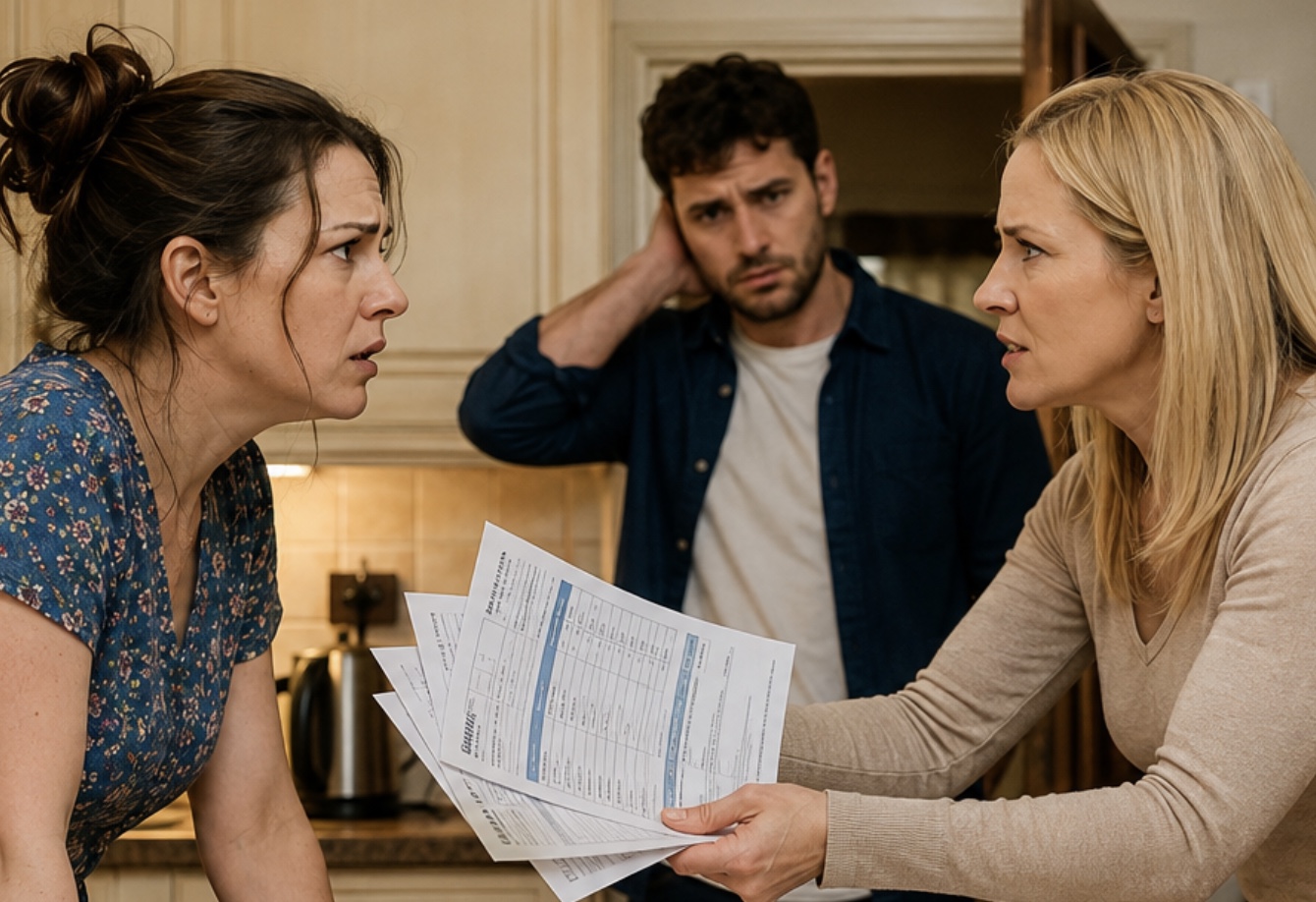
Something unfamiliar was coming from the kitchen. Not a smell exactly, but a presence. The light was on. The kettle had clearly boiled not long ago. And at the table sat Larisa, her sister-in-law, with papers spread out in front of her like cards before a winning hand.
“Finally,” Larisa said, moving her mug aside to make room. “We’ve been waiting for you. I thought you’d be home earlier.”
Valeria remained standing with the bags in her hands. The carton of milk felt cold through the plastic.
“Larisa. How did you get in?”
“Maxim let me in. He’s in the other room talking to someone on the phone.” Larisa swept her palm over the papers as if inviting Valeria to admire a beautifully laid table. “Come in. We need to have a serious conversation. It’s long overdue.”
 
There was something in her tone that stopped Valeria from going to the refrigerator, even though the ice cream in one of the bags was already beginning to soften. She set the groceries down right there by the entrance.
Larisa never came over without a reason. In the seven years Valeria had been married to Maxim, his sister had crossed their threshold only a handful of times. And every time, she had worn the expression of someone visiting a museum and feeling offended that the exhibits were nicer than anything she owned.
“What conversation?” Valeria asked.
She walked into the kitchen but did not sit down. Instead, she stood by the window with her arms folded.
Printed documents covered the table. On top of the pile lay a long chart divided into columns: dates, payments, remaining balance. A blue bank logo appeared at the bottom of every page.
Valeria’s eyes moved over the numbers, but she could not understand what any of it had to do with her.
Then she saw the total at the top.
Suddenly, the melting ice cream in the hallway stopped mattering altogether.
“What is this?”
“This, Lera, is what Kostya and I will be living with for the next twenty years,” Larisa replied in a tone suggesting Valeria should already know everything and was merely pretending otherwise. “It’s our mortgage payment schedule.”
“Congratulations,” Valeria said carefully. “You wanted an apartment. So you finally bought one?”
Larisa gave a crooked little smile and tapped the document with her fingernail.
“We did. But sit down first. This isn’t going to be a two-minute conversation.”
And that was the moment Valeria understood.
Not through logic yet, but instinctively.
A decision had already been made without her.
They had not waited for her because they wanted to ask permission. They had waited because they intended to present her with a fact.
Larisa sat in Valeria’s kitchen as though she were the owner of the apartment and Valeria were merely a guest who was about to be informed of the new rules.
 
That calm certainty frightened Valeria more than shouting would have.
To understand why Larisa felt entitled to behave that way, one had to go back about eight years.
Valeria had owned the apartment before she ever met Maxim.
The two-bedroom flat in a quiet residential district had come from her aunt on her mother’s side—a childless woman who had lived alone, worked at a factory all her life, and in old age had left the apartment to the only niece who regularly visited her.
When the aunt moved out to the countryside to live with Valeria’s mother and spend her remaining years in fresh air, she transferred the apartment to Valeria.
“You’ll always have a roof over your head,” she had told her. “A home of your own is a home of your own.”
Valeria registered everything legally in her name while she was still unmarried.
Two years later, Maxim appeared in her life. He was calm, domestic by nature, and worked as a mechanic at an auto repair shop.
By then, the apartment already belonged exclusively to Valeria.
It had been hers before the marriage.
Hers alone.
For years, that fact had felt like a warm stone she carried close to her heart.
She and Maxim could argue, make up, survive difficult months when money was tight—but underneath everything was the certainty that this was her home.
Not rented.
Not jointly owned.
Not “Mother’s apartment.”
Hers.
And when it came to Maxim’s relatives, that knowledge had comforted her more than once, because his family was complicated.
Larisa, Maxim’s older sister by three years, had been unable to forgive Valeria for owning property almost from the moment they met.
Larisa and her husband Konstantin had rented apartments for years: first a one-bedroom near the subway, then a cheaper room, then another one-bedroom. Every year or two they moved again whenever landlords raised the rent.
Konstantin drifted between jobs. He worked in sales, then at a warehouse, then somewhere else in sales again.
Money never stayed in their hands for long.
Whenever Larisa visited Valeria, she wandered slowly through the rooms, touched the curtains, looked out onto the balcony, and always said some version of the same thing.
“You’re lucky. It’s yours. And we’re moving again, can you imagine? Our landlord has completely lost her mind. She raised the rent by another five thousand.”
Their mother, Alina Viktorovna, always supported her daughter.
She was an authoritarian woman who was accustomed to Maxim obeying her without argument. She had never truly accepted Valeria as family. She treated her more like an inconvenient circumstance she had no choice but to tolerate.
Sometimes Valeria accidentally overheard conversations between Alina Viktorovna and Larisa.
Their message was always the same.
 
Valeria had it easy.
Valeria already had everything.
Valeria could afford to help the family.
She would hardly become poor from sharing.
Those hints had floated around for years like spiderwebs: too thin to grab hold of, yet always sticking unpleasantly to her face.
Valeria tried to ignore them.
She told herself that people sometimes became jealous when their own lives were difficult.
She tried not to be angry.
Occasionally she even lent Larisa small amounts of money when the couple was especially desperate.
And every single time, Larisa accepted the money as though Valeria were simply returning something that had belonged to her all along.
About a year and a half earlier, Larisa and Konstantin had announced that they were finally taking out a mortgage.
Not for a tiny apartment either.
They were buying a spacious three-bedroom place in a new building, with a balcony and a large open-plan kitchen and living room.
Everyone was amazed.
Valeria had wondered where the money would come from. Their income was unstable, and they had practically no savings.
But Larisa had glowed with confidence.
They had calculated everything, she said.
Kostya was starting a new job with a much better salary.
They would manage.
What Valeria did not know—and what no outsider knew—was that from the very beginning, Larisa and her husband had never intended to rely solely on themselves.
Larisa had built a very simple equation in her head.
Valeria owned her apartment outright.
Therefore, Valeria had no mortgage hanging around her neck.
Therefore, Valeria must have extra money.
And if she had extra money, then surely family members had a moral right to some of it.
Larisa never said this openly, but she had built her financial plans on that assumption as though it were solid concrete.
They had taken the mortgage with more confidence than their circumstances justified.
If anything went wrong, there would always be someone in the family to offer a shoulder.
Or more accurately—a wallet.
For the first eight months, everything did work.
Konstantin started the new job and made the payments on time. Larisa posted photographs of their empty rooms on social media, talking proudly about their “dream renovation.”
Then the whole thing began to collapse.
Konstantin had a serious argument with his manager, largely because of his own temper, and was told to leave.
At home, of course, he told the story differently.
The company was downsizing.
 
Times were difficult.
He was not the only one who had been let go.
Larisa accepted his version without question.
But the next mortgage payment was due in two weeks.
And that was when the backup plan they had quietly prepared long ago was finally taken off the shelf.
“Lera, you have to understand,” Larisa said more gently, pushing the payment schedule closer until the edge of the page almost touched Valeria’s hands. “We’re not strangers. We’re family. And when we bought the apartment, that’s exactly what we thought—if something went wrong, family wouldn’t abandon us. That’s what family is for.”
Valeria slowly looked down at the figures.
Now she was beginning to understand.
“Wait. When you took out the mortgage… you were already counting on me?”
“Well, who else?” Larisa replied lightly, almost cheerfully, as though the answer were obvious. “You own your apartment. You don’t have to pay for housing. You must have money left over. We calculated…”
“You calculated,” Valeria repeated.
Heat rushed into her face, then down her neck.
She pressed one palm against the tabletop so no one would notice that her fingers were trembling.
They had calculated.
They had sat somewhere—probably in their rented kitchen—and calculated Valeria’s money.
They had divided up what did not belong to them.
They had included her in their financial plan like a line in a spreadsheet without ever thinking to ask her permission.
“Larisa, did you ever once ask whether I actually have this ‘extra money’?” Valeria asked.
Her voice remained even, and somehow that calmness frightened even her.
“Maybe Maxim and I have plans of our own. Maybe I’m saving. Maybe I help my own relatives.”
“Oh, come on. Who are you trying to fool?” Larisa waved dismissively. “You have a good salary. You sit in a warm office working as an accountant. And you own your apartment. Just think about it—you already have everything, and we’re about to end up on the street. From a human point of view, how can that be right?”
There it was.
The appeal to pity.
Soft, slippery, practiced.
And right behind it came the accusation, carefully wrapped in moral concern: surely Valeria was not heartless enough to refuse.
Valeria looked at her sister-in-law and suddenly understood how thoroughly this conversation had been prepared.
Larisa had planned which emotional buttons to press, which words to use, exactly when to push the papers across the table.
No one had come here to persuade Valeria.
They had come to work on her until she gave in.
“How much do you want?” Valeria asked quietly.
Larisa immediately brightened and began shuffling the documents.
“Look, this is the monthly payment. If you could cover at least half of it until Kostya finds another job… it would only be temporary. Or even better, you could become a guarantor. Then the bank might agree to restructure the loan, and everything would be fine.”
“A guarantor,” Valeria repeated. “Meaning I would put my own apartment at risk because of your debt.”
“Oh, why do you have to put it like that? It’s just a signature.”
At that moment Maxim entered the kitchen.
 
Valeria turned toward her husband with one last flicker of hope.
Seven years together.
Surely he would stand beside her now.
Surely he would tell his sister that this was too much.
That this was their home, their money, and that Larisa needed to find another solution.
Instead, Maxim leaned against the doorframe and rubbed the back of his neck, the way he always did when he felt uncomfortable.
“Lera, just hear Larisa out. They really are in a desperate situation. Kostya lost his job, and they’re planning to have a baby soon. What are they supposed to do? We’re family, after all. Family should help, even when it’s difficult.”
“We,” Valeria said.
“We should help.”
She looked directly at him.
“And who exactly is ‘we,’ Maxim? Who are you talking about?”
He did not answer.
He looked away in exactly the same way he always did when he did not want to disagree with his mother.
And his mother did not keep them waiting.
Alina Viktorovna appeared in the kitchen doorway at such a perfectly timed moment that she might have been standing behind the wall listening.
Most likely, she had been.
She pressed a hand to her chest and breathed more heavily than usual.
Valeria knew the performance by heart.
“Why are you all shouting?” Alina Viktorovna said weakly as she lowered herself onto a stool. “My heart has been acting up since this morning. Lerochka, are you really going to be stingy with your own family? The children are suffering. Poor Kostya has no job…”
Three of them.
They surrounded her from every side.
Larisa with the documents.
Maxim by the doorway.
Alina Viktorovna on the stool, clutching her chest.
Each had a role.
Each had rehearsed a different emotional note.
And suddenly Valeria saw the entire scene as if she were looking at it from outside.
Her kitchen.
Her table.
Her chipped mug, pushed aside by someone else’s hand.
Yet somehow she herself no longer existed as a person in the room.
To them she had become a resource.
Something that only required the right key to unlock.
“We took out this loan expecting you to help us!” Larisa suddenly blurted out.
With a sharp movement, she thrust the payment schedule toward Valeria, holding the page so close that it nearly touched her chest.
For several seconds, Valeria simply stared at it.
At the columns of numbers.
At someone else’s debt that they were trying to place in her hands, right there in her own kitchen, as though it were her responsibility.
They had not asked.
They had not sought her permission when they took the mortgage, and they were not truly asking now.
They had simply decided for her and come to collect.
“Take it away,” Valeria said.
The sheet trembled slightly in Larisa’s hand.
 
“Get that paper away from me.”
“Lera!” the others cried almost together.
“No.”
Valeria placed both palms on the table and straightened.
“Now you’re all going to listen to me. All three of you. You’re sitting here dividing up my money. My apartment. When you were making your calculations, you were calculating my life behind my back before you even took out the mortgage. Am I understanding this correctly?”
“Nobody divided anything,” Larisa began, but red patches were already appearing on her cheeks.
“Yes, you did,” Valeria replied.
She turned toward her sister-in-law.
“Eight years, Larisa. For eight years you’ve walked into this apartment and touched my curtains. For eight years I’ve heard the same things: ‘You’re lucky, it’s yours,’ ‘We’re moving again,’ ‘Everything is so easy for you.’ Do you think I never heard you complaining to your mother that I have it easy? In your head, you claimed this apartment years ago. And now you’ve decided to make it real.”
Larisa jumped to her feet.
The stool rocked and scraped unpleasantly across the floor.
“You greedy woman! That’s what you are! Sitting on your property like a dog guarding hay! Your aunt took pity on you, and now you begrudge your husband’s own sister a piece of bread!”
“Larisa,” Maxim muttered weakly.
“What? Larisa what?” his sister snapped.
She was no longer holding herself back.
“They don’t even have children! What are they saving for? Who are they keeping everything for? So they can enjoy it themselves? They could at least give something to the family and make it useful!”
Those words hung in the kitchen separately from everything else.
Larisa knew exactly where she was striking.
She knew about the years Valeria and Maxim had spent visiting doctors.
She knew about the hopes that had failed.
She knew how Valeria had learned not to cry at other people’s christenings.
And she said it anyway.
Deliberately.
She aimed for the most painful place, hoping Valeria would break.
Valeria did not break.
Only the knuckles of her hands, pressed against the table, turned white.
Alina Viktorovna let out an exaggerated gasp and leaned sideways on the stool.
“My heart… someone bring me water… look what you’ve done to an old woman…”
No one moved to get water.
The performance continued without an audience.
“You see what you’re doing?” Maxim finally stepped away from the doorway—but he did not move toward Valeria.
He went to his mother.
He placed a hand on Alina Viktorovna’s shoulder.
“Mom feels sick because you’re being so stubborn. How long are you going to keep this up? You’ve become cruel, Lera. You weren’t like this before.”
“Cruel,” Valeria breathed.
The sound was almost a laugh, except there was no amusement in it.
 
“I’m cruel. I see.”
Konstantin, who until then had remained silent in the hallway, squeezed into the kitchen.
He already had another document and a pen ready in his hands.
“Lera, enough drama. Just sign here agreeing to become our guarantor. It’s only a formality. Once the bank sees that you own an apartment, they’ll approve the restructuring. You’re not risking anything, I swear. One signature, that’s all.”
“Not risking anything,” Valeria repeated as she looked at the pen.
“Kostya, I’m an accountant. I know exactly what a guarantor risks. If you stop paying—and you’re already unable to pay—the bank comes after me. And after my assets. Including the very apartment this entire evening is really about.”
“You really are a stranger!” Larisa exploded. “I knew it! You’re not one of us! Maxim, I told you she doesn’t consider us human!”
“A stranger,” Valeria nodded.
“Now we’ve finally found the right word. Half an hour ago I was family. I was one of you. Family must help. But the moment I refused to hand over money, I became a stranger. That was fast.”
She looked around at them.
Larisa, her face blotched red.
Maxim, his hand still on his mother’s shoulder.
Alina Viktorovna, who had somehow forgotten to clutch her heart and was now staring at Valeria sharply and angrily.
And something inside Valeria finally settled into place.
Quietly.
Without drama.
As though for years she had been holding a heavy door shut with her shoulder, only to step away and discover that the door stood perfectly well on its own.
The wall was solid.
Valeria picked up the mortgage schedule—the very document Larisa had been waving at her—folded it neatly in half and handed it back.
“Take it. I am not paying your mortgage. I will not become your guarantor. And I will not risk my apartment because of your mistakes—not with a single ruble, not with a signature, not with one comma on a piece of paper.”
“You’ll regret this,” Larisa hissed as she snatched the document away.
“Maybe.”
Valeria turned toward her husband.
Her voice was completely calm now, almost tired.
“Maxim. I want you to choose. Right now, in front of them. Who is your family? The wife you live with in this home—or all of this? Because the two cannot continue together. Choose.”
The kitchen became completely silent.
Maxim removed his hand from his mother’s shoulder.
He rubbed the back of his neck.
He looked at his sister, then at his mother, and finally gave Valeria a brief glance.
“Lera, they’re my blood. My mother. Larisa. I can’t turn my back on them. You have to understand.”
“I understand,” Valeria said.
“Then I guess… I’ll stay with Mom for a while,” Maxim continued, slowly gaining confidence as though persuading himself. “You’ll cool down. You’ll think about it. You’ll get lonely here by yourself and come running. Then we can talk like normal people.”
He clearly expected her to become frightened.
He expected her face to change.
Expected her to grab his sleeve and beg him not to leave.
That was the calculation.
A lonely woman in an empty apartment would change her mind quickly.
Valeria did not touch his sleeve.
She walked over to the window and said calmly,
“Pack your things. You know where the bag is.”
They left that evening.
Maxim carried a hastily packed sports bag.
Larisa walked out with her lips pressed tightly together.
Alina Viktorovna, miraculously, stopped clutching her heart the moment she reached the hallway.
The door closed behind them.
Valeria stood there for a moment.
Then she returned to the kitchen, took the half-melted ice cream from the grocery bag by the entrance, sat down at the table, and ate it directly from the carton with a spoon.
She barely tasted it.
She simply needed something to do with her hands.
 
Maxim called several times afterward.
During the first few days, his tone was condescending.
“So, are you ready to talk yet?”
When he realized she had no intention of running after him, he became irritated.
Later, when the first warning letters from the bank arrived regarding Larisa’s mortgage and it became clear there was nowhere else to get money, his voice became pleading, almost pitiful.
He asked to come back.
He said he had overreacted.
He insisted his relatives had misunderstood everything.
He suggested they start over.
Valeria listened.
And somewhere around the third such call, she realized something unexpected.
It did not hurt anymore.
Not at all.
It was as though a string inside her that had been stretched painfully tight for years had finally snapped loose.
All that remained was silence.
A month later, she filed for divorce.
And that was when Maxim’s family encountered something they had never included in their calculations.
For years, Larisa had treated Valeria’s apartment as though it were some sort of shared family asset—something they might eventually reach through pressure on Maxim.
But the apartment had come to Valeria before the marriage.
It had been inherited.
It was registered solely in her name.
Legally, it was her personal property and was not subject to division in a divorce.
Not half.
Not a quarter.
Not even one ruble’s worth.
Maxim had no claim whatsoever to those walls—not when he lived there and certainly not after he left.
Larisa kept insisting that Maxim should “sue for his share.”
Eventually she even spoke to a lawyer.
The lawyer could do nothing but shrug.
Inherited before marriage.
Registered solely to Valeria.
Legally clear.
There was nothing to challenge.
The plan they had been building for eight years collapsed against a single line in the ownership documents.
Larisa and Konstantin could not keep up with their mortgage either.
Without Valeria’s money, without her signature, and with Kostya unemployed and unable to find another stable job, every month became a race they kept losing.
First came one missed payment.
Then another.
Then calls from the bank.
Restructuring attempts.
 
Penalties.
Eventually, they lost the apartment—the same three-bedroom home with the balcony and dream kitchen.
Everything they had poured into it disappeared: the down payment, the renovation Larisa had so proudly posted online, and a year and a half of mortgage payments.
They found themselves exactly where they had started.
Back in a rented one-bedroom apartment near the subway, surrounded by the same boxes they had barely had time to unpack.
Alina Viktorovna got her son back.
But he did not return as a victorious man.
He returned as a man approaching forty, without a home of his own, carrying a bag of clothes and still accustomed to obeying his mother in everything.
He now lived in her small apartment and slept on a fold-out sofa in the living room.
Every morning, as Alina Viktorovna poured him tea, she spoke less and less often about the heartless daughter-in-law who had destroyed the family.
Because the “heartless” daughter-in-law was still living peacefully in her own two-bedroom apartment.
Meanwhile, her beloved son—the one she had insisted must always choose his blood relatives—was now living at her expense.
And with every passing month, that burden became heavier.
Valeria stayed exactly where she had always been.
In her apartment.
The home they had failed to beg from her, pressure out of her, or take through the courts.
The first few weeks felt strange.
The apartment was too quiet.
There seemed to be too much space.
Sometimes in the evenings she caught herself listening for the sound of a key turning in the lock.
Eventually, that stopped.
She rearranged the furniture the way she had wanted to for years.
She developed a Saturday tradition of baking something for tea and inviting the neighbor from across the landing.
She continued sending money to her aunt, just as she had before.
There were no payment schedules.
No calculations.
No obligations.
She did it simply because she wanted to.
Then, one spring morning, the cactus on her windowsill unexpectedly produced a bud.
It was orange, firm, stubbornly alive.
Valeria noticed it while morning sunlight fell across the glass at a warm angle.
She stood there looking at it for a while.
There was nothing extraordinary about it.
Just a flower.
 
And yet, for some reason, it was on that particular morning that Valeria finally understood that she had survived the betrayal.
She had not forgotten it.
Things like that were not forgotten.
She had simply grown beyond it.
She had left it behind like an old coat that no longer fit.
The apartment was empty and filled with light.
But the emptiness no longer pressed down on her.
It breathed.
“A roof of your own is always a roof of your own,” her aunt had once said.
Only now did Valeria finally understand that she had never really been talking about walls.