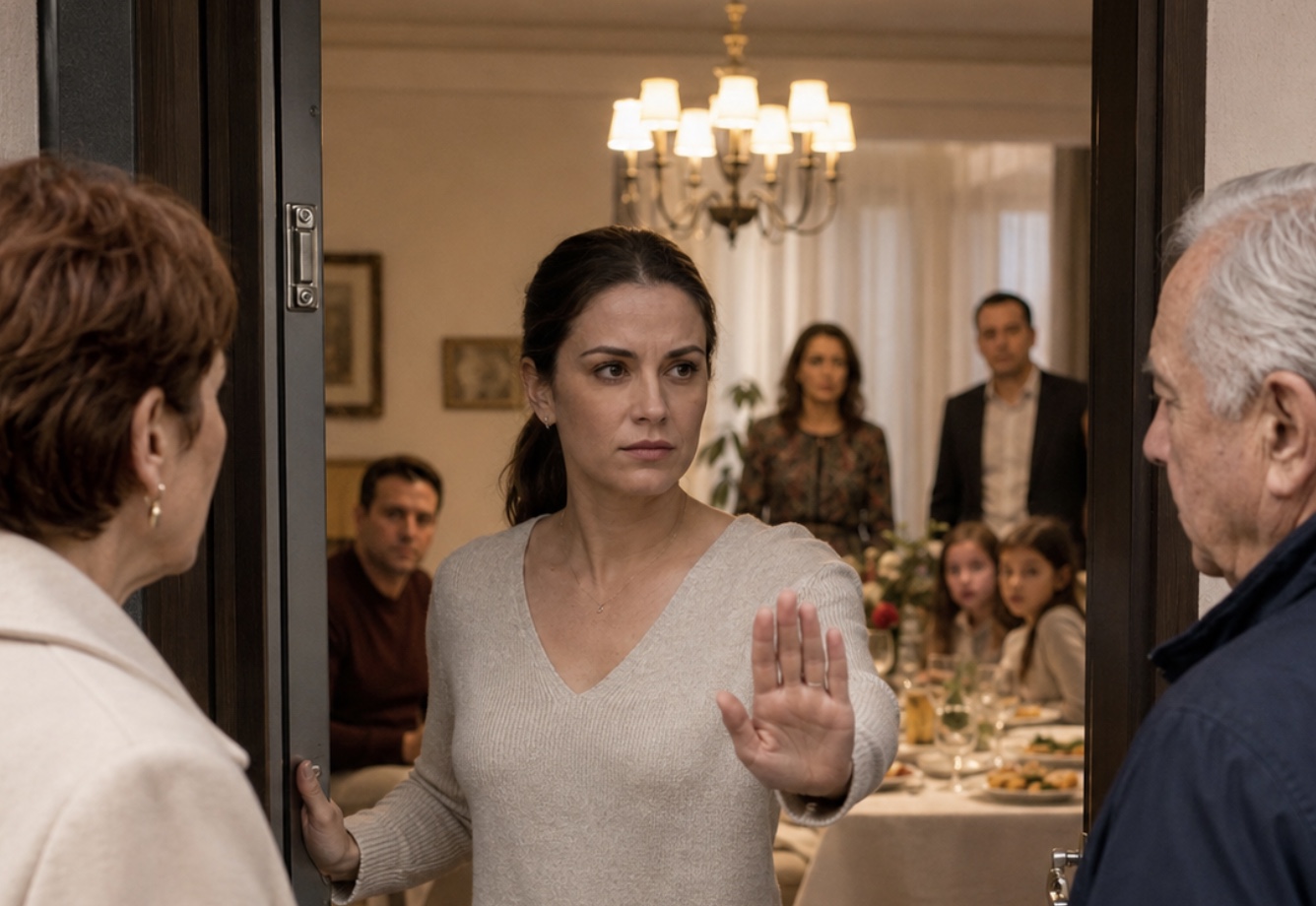
The envelope lay on the kitchen table in front of her. Thick cream-colored paper, the restaurant’s gold seal, and a neatly folded estimate tucked inside. Her husband, Artyom, sat nearby with his mother, Nina Pavlovna, his sister Lida, and three other relatives who had supposedly come over “just to discuss the details,” although their expressions made it obvious that they had no intention of discussing anything.
Outside the open window, the July courtyard buzzed with noise. Someone was rolling a scooter across the paving stones near the playground, and the smell of hot asphalt and sweet linden blossoms drifted up from below. A fan turned back and forth in the kitchen, pushing warm air around the room.
Oksana sat upright. She did not raise her voice, and she was in no hurry.
That irritated Nina Pavlovna more than anything else.
Her mother-in-law had expected outrage, hurt feelings, perhaps even confusion. In their family, people were used to winning arguments by making the most noise. Whoever spoke the loudest was considered right.
But Oksana had never played by that rule.
“Oksanochka,” Nina Pavlovna said, leaning forward and tapping the envelope with one fingernail. “At least take a proper look at it. This is Artyom’s father’s anniversary. The man is turning sixty-five. You can’t celebrate an occasion like that any old way.”
“You can celebrate it however you like,” Oksana replied. “With your own money.”
Lida snorted and turned toward the window. She was Artyom’s younger sister—bright, quick with words, and astonishingly helpless whenever the time came to pay for her own wishes.
“Oh, here we go,” she drawled. “It’s not as though we’re buying fur coats for ourselves. This is Dad’s celebration.”
Oksana looked at her.
“Then why was the bill brought to me?”
Artyom, sitting beside her, frowned slightly. He had clearly expected his wife not to make the conversation uncomfortable in front of his relatives.
He had miscalculated.
Oksana had worked for years as an administrator at a private dental clinic. She knew perfectly well that when someone arrived with a decision already made but called it a request, the best response was to bring the discussion back to the facts.
“No one is saying you have to pay for everything,” Artyom intervened. “It’s just that money is a little tight for us right now. You’re good at planning. You always have everything organized.”
“Being good at planning does not make me responsible for financing other people’s plans.”
Nina Pavlovna tightened her grip on the handle of her handbag. Irritation flickered across her face, but she quickly restored her soft, almost maternal tone.
“Oksana, you understand that Artyom’s father spent his entire life doing everything he could for his children. We can’t embarrass ourselves in front of people. The hall has already been reserved, the host has been hired, and the musicians promised us a discount. Relatives are coming from out of town. It would be terribly awkward to cancel.”
“What was awkward was booking a restaurant without consulting the person you expected to provide most of the money.”
The kitchen became quieter.
Even Lida stopped playing with the bracelet around her wrist.
Oksana picked up the estimate, unfolded it, and scanned the entries. A riverside restaurant. A banquet hall for forty-eight guests. Hot dishes, appetizers, fruit, a corkage fee, a host, musicians, balloon decorations, and a photo backdrop.
There was also a separate charge for a cake, although Oksana remembered perfectly well that her father-in-law did not eat sweets and always asked people to move desserts away from him at family gatherings.
She looked up.
“Who made the guest list?”
“We all did,” Lida answered quickly.
“Who exactly is ‘we’?”
“Mom, me, and Artyom. Then Aunt Tamara added her people because they would be offended otherwise. Then Dad’s cousin and his wife. And the children, of course.”
“The children are staying at the restaurant until midnight too?”
Lida grimaced.
“Don’t nitpick.”
“I’m not nitpicking. I’m calculating. This celebration is not for my father-in-law. It is for relatives who want pretty photographs by the river.”
Nina Pavlovna straightened sharply.
“Don’t you dare speak about our family that way.”
“I’m speaking about the estimate.”
Artyom rubbed the bridge of his nose and then said quietly:
“Oksana, let’s not turn this into a war. We just need to cover the remaining amount. We’ll sort everything out later.”
“The remaining amount?” Oksana looked at him more closely. “So the deposit has already been paid?”
He hesitated for a fraction of a second.
That was enough.
“Yes,” Nina Pavlovna answered for him. “We paid it. Otherwise, someone else would have taken the hall. It’s summer—weddings, anniversaries, everything is booked.”
“Who paid it?”
Lida adjusted her hair and glanced quickly at her brother.
“Artyom helped. Everyone will contribute later.”
Oksana turned to her husband.
“Which account did you use?”
Artyom inhaled sharply through his nose.
“Don’t start interrogating me.”
“Which account?”
“Our joint card,” he forced out. “But it’s only temporary.”
Without saying a word, Oksana opened the banking app on her phone. A few taps later, she found the transaction from three days earlier. A substantial deposit to the restaurant, labeled as banquet services.
She turned the screen toward her husband.
“You used the card where we keep money for utilities, groceries, and the car repair?”
“I was going to put it back.”
“With what money?”
“I’ll figure something out.”
“No. We are figuring it out now.”
The relatives exchanged looks.
Nina Pavlovna placed one hand on the edge of the table as though she were about to rise, but she remained seated. She did not like the fact that the conversation had moved away from the familiar territory of “be a good daughter-in-law” and into the territory of specific transactions.
Oksana opened the notes on her phone. She kept a record of every monthly expense there: housing costs, groceries, insurance, Artyom’s dental treatment, which he had postponed until the last possible moment, the car payment, medicine for her mother, groceries for her grandmother, and savings for a vacation they had already delayed for three years.
No amounts were spoken aloud.
Only the categories.
She placed the phone on the table with the screen facing upward.
“These are our essential expenses. This is the amount you took for the deposit. It was supposed to cover the car repair and part of our housing payments this month. That means someone decided the banquet was more important than our obligations.”
Artyom flushed. Not dramatically, but noticeably. His ears turned dark pink, and his fingers locked together.
“I didn’t take it. I used it temporarily.”
“When you do it without permission, it is called something else.”
Nina Pavlovna cut in sharply.
“Oksana, are you calling my son a thief?”
“No. I am calling this situation what it is instead of turning it into a family legend about noble generosity.”
Lida leaned toward her mother.
“Mom, I told you we should have spoken to her first.”
“You said that?” Oksana turned toward her sister-in-law. “Interesting. So someone understood that this was not normal.”
Lida fell silent. Anger flashed across her face, but it was not directed at Oksana. She was more annoyed with herself for saying too much.
Oksana’s father-in-law, Boris Ivanovich, was not present at the meeting. Officially, they were arranging a surprise for him. Unofficially, it was easier to plan everything without him. He would have been the first to ask why he needed a hall for fifty people when all he wanted was to go fishing and spend the evening in the yard with two old friends.
Oksana knew him well enough. He was direct, somewhat reserved, disliked showing off, and had never asked her for money.
That made the whole situation even more shameless.
“Fine,” Oksana said. “Let’s go through this point by point. Who signed the agreement with the restaurant?”
Nina Pavlovna became guarded.
“I did.”
“In whose name?”
“Mine.”
“Then the financial obligations to the restaurant are yours.”
“But it is a family celebration!”
“The contract is yours.”
Lida leaned back in her chair with irritation.
“Are you really going to argue over paperwork now?”
“Yes. Paperwork begins to matter the moment someone plans a celebration using somebody else’s money.”
Artyom looked at his wife as if he were seeing her for the first time. Not the calm Oksana who bought groceries from a list and scheduled their medical appointments in advance, but a woman with a cold, practical business instinct.
“Can the deposit be refunded?” she asked.
Nina Pavlovna narrowed her eyes.
“They keep part of it if we cancel.”
“What if you reschedule?”
Her mother-in-law did not answer.
Oksana picked up the estimate, found the small print at the bottom, and quickly read the terms. The restaurant kept the full deposit only if the booking was canceled less than seven days before the event. The anniversary was still two weeks away. If they moved the date, the money would remain as credit.
She placed the paper in front of Nina Pavlovna.
“You won’t lose the money if you postpone the banquet and reduce the scale. So there is no disaster.”
“You want me to humiliate myself?” Her mother-in-law’s voice hardened. “I have already told people.”
“Then you will have to tell them something different.”
“And what am I supposed to say? That my daughter-in-law refused to help?”
Oksana smiled faintly.
“Tell them the truth. You ordered a celebration you could not afford.”
Galina, Nina Pavlovna’s cousin, who had been silent until then, leaned forward cautiously.
“Nina, perhaps we really should make it smaller. Boris doesn’t even like noisy banquets. We’ll attend and then go home, but you’ll be the ones dealing with the consequences afterward.”
Nina Pavlovna shot her such a look that Galina immediately picked up her glass of water and began studying it with exaggerated interest.
Meanwhile, Oksana took a notebook from her folder. It was not the one she used for household purchases, but a separate work notebook with a thin black cover.
Artyom knew that notebook.
His wife brought it out when she intended to have a serious conversation.
“I have a proposal,” she said.
Lida brightened.
“Finally.”
“My proposal is not designed to please you. It is designed to solve the problem. First, Artyom will return the entire deposit he took from our joint funds without discussing it with me. He will return it today. Not in installments, not someday, and not after the anniversary. Today.”
“From where?” her husband demanded.
“Sell the fishing rods you bought in the spring and have never used. Or ask your brother, since you opened our budget so generously for his benefit. I don’t care.”
Lida gasped.
“What does Vitya have to do with this?”
“Guests who are the loudest about wanting a celebration can contribute more than opinions.”
Nina Pavlovna went pale with anger, but Oksana continued.
“Second, you either reschedule the restaurant or reduce the guest list to a number you can afford yourselves. Third, if anyone tries to control our money without my consent again, the joint spending card will be closed. I will pay all essential bills directly, and Artyom will receive a list of his share and will transfer the money in advance.”
“You’re going to put your husband on an allowance?” Lida hissed.
“No. I’m going to return responsibility for his decisions to an adult man.”
Artyom stood up abruptly.
“That’s enough. You’re talking as though I’m a child.”
Oksana stood as well, but not suddenly. She simply rose and looked directly into his eyes.
“An adult discusses an expense with his wife before transferring the money. A child takes the shared card, pays for his mother’s banquet, and then waits for everyone to pretend that nothing unusual happened.”
He opened his mouth but could not find an answer.
The clicking sound of the rotating fan became clearly audible in the kitchen.
Nina Pavlovna put the estimate back inside the envelope.
“I understand now. Money matters more to you than family.”
“No. My money will simply no longer be used to prove your importance in front of your guests.”
Her mother-in-law rose.
“Come on, Lida. There is no point talking to her today.”
“Today?” Oksana looked at her without smiling. “Nina Pavlovna, there will be no point talking to me about this tomorrow either. Or next week. My answer does not depend on the temperature outside or on how many relatives you bring with you.”
Lida grabbed her handbag, but stopped at the doorway and turned around.
“Dad will find out that you ruined his anniversary.”
“Let him find out. Preferably from me, with the estimate in front of him.”
That sentence made everyone stop.
Artyom took a step toward her.
“Don’t drag Dad into this.”
“It is his celebration. His name is on the invitations. It is his sixty-fifth birthday. Why is he the only person who does not know what is happening?”
“Because it’s a surprise!”
“A surprise is something that makes a person happy. It is not a banquet he never asked for, followed by a bill delivered to his daughter-in-law.”
Nina Pavlovna fastened her handbag with a sharp snap.
“You will regret being so cold.”
Oksana opened the front door.
“The only thing I would regret is staying silent today.”
The relatives disappeared into the heavy summer evening, leaving behind the scent of perfume, the heat from the stairwell, and an unpleasant silence.
Artyom returned to the kitchen, poured himself a glass of water, took several swallows, and looked at his wife.
“Are you satisfied?”
Oksana gathered the papers and placed them in a folder.
“No. I’m paying attention.”
“You humiliated my mother.”
“I refused to finance her decision.”
“She meant well.”
“For whom?”
Artyom did not answer.
Oksana put the folder in a cabinet, took out her phone, and opened the banking app.
“You have until nine tonight to return the money to the card.”
He gave a short, bitter laugh.
“And what if I don’t?”
“Then I will pay the essential bills from my personal account and record your share as a debt. Starting tomorrow, the joint card will be blocked. Not by the bank, Artyom. By me. I will remove the automatic payments and stop transferring my money into it.”
“You’ve already decided everything.”
“Yes. After you decided on my behalf.”
He stood across from her, and for the first time his expression showed calculation rather than irritation.
Artyom was not stupid.
He quickly understood that his wife was not making an empty threat. She would do exactly what she had said. That was the main difference between Oksana and his relatives. They liked dramatic statements.
She preferred action.
He returned the money that evening.
Not all of it came directly from his own account. His brother Vitya transferred part of the sum, Lida contributed another portion, and Artyom covered the rest by selling an expensive fish finder he had bought “for the future.”
Oksana did not ask for details.
The result was what mattered to her.
But the story did not end there.
The following day, Boris Ivanovich called Oksana himself. His voice was low and slightly hoarse, without its usual hint of humor.
“Oksana, may I come over this evening?”
“Of course.”
“Alone.”
“All right.”
He arrived after seven, when the heat had eased a little. He brought a watermelon and a bag of tomatoes from his garden. He entered the kitchen, greeted Artyom, and then looked at Oksana.
“Will you show me the estimate?”
Artyom lowered his eyes.
That meant they had already spoken.
And the conversation had not been pleasant.
Oksana silently handed over the envelope. Boris Ivanovich read everything from beginning to end. He paused at the line mentioning the photo backdrop and then grunted.
“A photo backdrop. For me. With balloons.”
“There is also a host,” Oksana remarked dryly.
“I see that. And musicians. At least they didn’t order a trained bear.”
Artyom tried to smile, but his father turned toward him.
“Why did you dip into the household budget without discussing it with your wife?”
“Dad, I wanted to help.”
“You help your own household first. You took money from your family and carried it to the people who demanded it the loudest.”
Artyom tensed.
“I paid it back.”
“You paid it back because Oksana cornered you. Those are two different things.”
Oksana did not interfere. She had no need to humiliate her husband further in front of his father.
Boris Ivanovich was managing perfectly well on his own.
“Mom wanted it to look nice,” Artyom said more quietly.
“Nina always wants things to look nice when someone else is paying,” his father snapped. “I don’t need a hall full of people. I wanted to go to the country house on Saturday. Barbecue, my old friends, you and Oksana, Lida and her daughter. That’s all.”
“Mom has already invited people.”
“Then your mother can call them and explain.”
At that moment, the front door opened.
Artyom had his own key, and Nina Pavlovna had been using her spare set to enter their apartment far too freely. She walked in without ringing, carrying a shopping bag, and froze when she saw her husband.
Oksana slowly turned her head toward Artyom.
“The keys.”
“What?” he asked, confused.
“Your mother has keys to our apartment. You are taking them back now.”
Nina Pavlovna straightened immediately.
“And what is this supposed to mean?”
“It means we are establishing personal boundaries,” Oksana replied. “No one will enter this apartment without ringing the bell again.”
“I am his mother!”
“You are a guest.”
Boris Ivanovich put the estimate down on the table.
“Nina, give them the keys.”
“Boris, stay out of this.”
“It is too late for that. You have already involved everyone.”
Her mother-in-law looked at her son. He turned his eyes away and then extended his hand.
“Mom, she’s right. Give me the keys.”
Nina Pavlovna’s features sharpened. She took out her key ring, removed the key to Artyom and Oksana’s apartment, and placed it on the table.
She did not throw it.
She laid it down carefully, but with the expression of a woman ending a relationship with a single gesture.
Oksana picked up the key and put it in a drawer.
“Thank you.”
“You’re welcome,” her mother-in-law said coldly. “You can live behind your fence now.”
“Sometimes a fence protects you from people who refuse to see doors,” Oksana answered calmly.
Boris Ivanovich covered his face with one hand to hide a smile.
Nina Pavlovna noticed and flushed.
“So everyone is against me now?”
“No,” her husband said. “It was my birthday, but you gave the orders. The money was not yours, but you spent it. The keys were not yours, but you walked in whenever you pleased. Perhaps it is time to stop.”
Those words struck harder than any shouting could have.
Nina Pavlovna sat down and placed the shopping bag beside her. For the first time, she did not look like the commanding mistress of every family decision. She looked like a woman who had suddenly discovered that her familiar power no longer worked.
“I only wanted it to be no worse than what other people have,” she said dully.
“And instead it became worse than a simple celebration at home,” Boris Ivanovich replied. “At least things are honest at home.”
The anniversary still took place.
But not at the restaurant.
Two weeks later, on a hot Saturday, the family gathered at Boris Ivanovich’s country house. There was no host, no photo backdrop, and no crowd of forty-eight guests.
Only the people Boris Ivanovich actually wanted to see were invited.
The men grilled meat in the yard, the women sliced vegetables, the children ran between the apple trees, and quiet music played from an old radio.
At first, Nina Pavlovna walked around with a stern, offended expression. Then she saw Boris Ivanovich laughing with his friends near the grill, his grandchildren hugging him around the shoulders, and Lida helping set the outdoor table without demanding anything from anyone for once.
By evening, her mother-in-law had softened a little, although she still spoke to Oksana cautiously.
Oksana did not behave like a winner.
She did not enjoy displaying strength.
In her opinion, real strength did not mean loudly declaring that you were right. It meant calculating the consequences in advance and refusing to retreat when people began pressuring you with guilt.
Artyom stayed close to her throughout the day. Not clingy or visibly ashamed, but attentive.
After their argument, he had tried several times to explain himself, and each time Oksana brought him back to the same question: why had he believed he could take their shared money without asking her?
The third time, he finally stopped talking about his mother, his father, and the urgency of the situation.
“Because I thought you would agree anyway,” he admitted one night in the kitchen.
“Now that is honest,” Oksana replied.
“I’m used to you finding a solution.”
“And I found one.”
“Not the one I wanted.”
“But the one we needed.”
After the anniversary, Boris Ivanovich approached Oksana while she was packing a bag beside the car.
“Thank you,” he said.
“For what?”
“For ruining the restaurant banquet.”
She narrowed her eyes slightly.
“That is an unusual thing to be thanked for.”
“I would have sat there like a monument to myself. This was normal. Human.”
He paused and added:
“And thank you for what you did with Artyom. It was useful for him to get a blow to the head before it was too late.”
Oksana glanced toward the country house. Artyom was helping Lida pack the leftover food. Nina Pavlovna was arguing with a neighbor over the fence about varieties of cucumbers, and the children were laughing near a barrel of water.
It was an ordinary summer scene.
Almost peaceful.
“I have no intention of raising a grown man, Boris Ivanovich.”
“And you shouldn’t. Let him grow up by himself.”
Artyom was quiet for most of the drive home. The car moved along the evening highway as the sun sank behind the line of trees. Air carrying the scent of dry grass and dust entered through the half-open window.
Oksana looked straight ahead without turning on the radio.
“I told Mom she can’t come over without warning anymore,” he finally said.
“Good.”
“And I told Lida that next time she wants to organize something, she should calculate her own contribution first.”
“Even better.”
“Do you trust me now?”
Oksana turned her head.
The confidence he had once worn so easily was gone from his face.
And that was appropriate.
Trust should not be treated like a piece of furniture that remains in place regardless of how carelessly people handle it. Trust was more like glass. If it cracked, it might still be kept, but the fracture could never be ignored.
“I’m still watching,” she said.
Artyom nodded.
He did not take offense. He did not try to pressure her.
He simply accepted it.
That was the first moment in several weeks when Oksana thought their marriage might not have to be written off completely.
Not because she had softened, but because Artyom had finally heard more than her refusal.
He had also understood the reason behind it.
A month later, they still had a joint card, but the rules had changed.
Any expense larger than usual had to be discussed in advance. No money was transferred to relatives without a direct conversation between husband and wife. Only the two of them had keys to the apartment.
At first, Nina Pavlovna remained offended. Eventually, she became accustomed to calling before visiting.
Lida once tried asking to “borrow a little money for Dad’s present,” but Artyom answered her himself. He told her that a gift should match the giver’s financial means.
Oksana overheard the conversation from the other room and said nothing. She simply closed the notebook where she had been reviewing their household expenses and put down her pen.
Sometimes victory does not look like a dramatic confrontation.
Sometimes it looks like a peaceful evening in which no one reaches into your wallet without permission.
Oksana did not throw away the cream-colored envelope.
She kept it in a folder with the important documents. Not out of spite, but as a reminder: the most expensive celebrations do not begin in restaurants.
They begin the moment someone decides that your money already almost belongs to them.
And if you do not say no in time, you will eventually have to pay for more than the banquet.
You will also have to finance someone else’s certainty that your consent is nothing more than an empty formality.