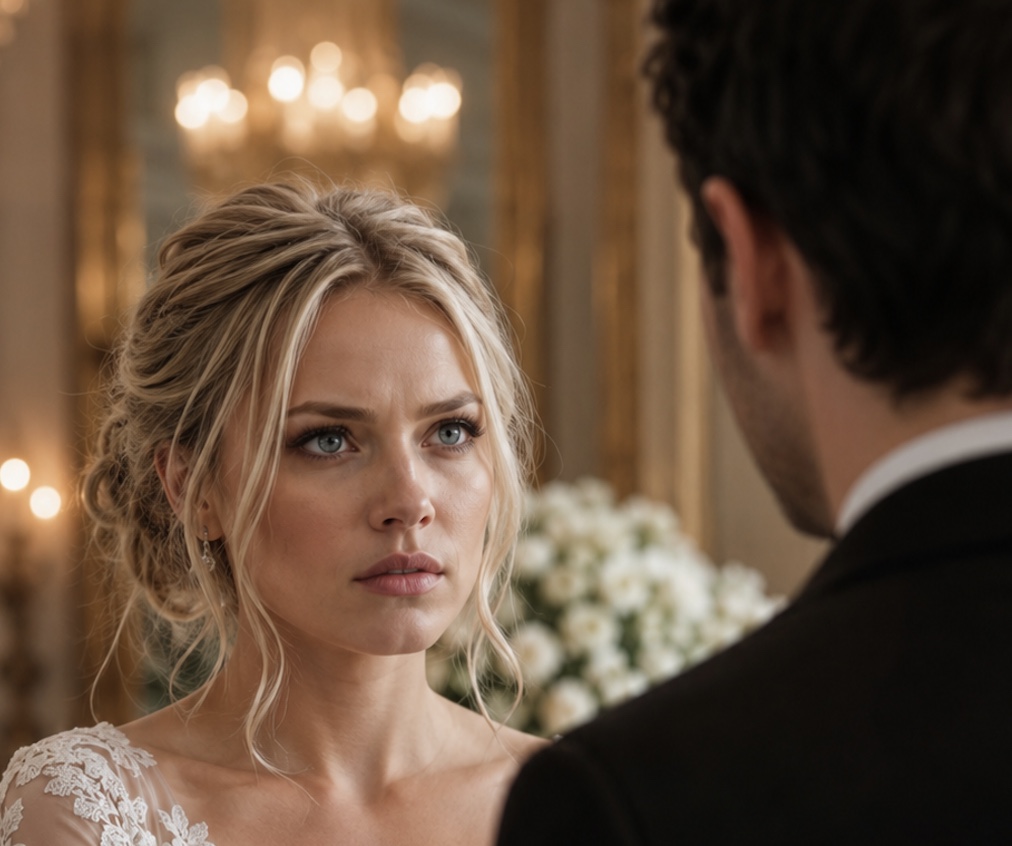
The pine trees stood motionless, as if painted against the evening sky. The smell of charcoal and grilled meat drifted from the gazebos toward the lake, where the water had grown thick and golden under the sinking sun. Alina sat on the veranda railing, swinging her legs and smiling the way people smile when, in just one week, their whole life is supposed to become different.
“Why are you sitting here all alone?” Sveta asked, walking up with a glass of lemonade. “Kostya nearly dropped the shashlik into the grill. Historic entertainment.”
“I’m not sulking,” Alina laughed. “I’m just sitting here thinking that in seven days I’ll be wearing a white dress. Strange, isn’t it?”
“Strange is when someone sits alone on a veranda a week before her wedding instead of dancing with her fiancé,” Sveta said, sitting beside her and nudging her shoulder. “Where is Dmitry anyway?”
“He went off somewhere toward the far cabins with Roma and Artyom,” Alina shrugged. “Men’s business, I suppose. He’ll come back.”
“Men’s business,” Sveta snorted. “That’s what they always call it. Kostya had ‘men’s business’ too, and then it turned out he spent half an hour trying to open a jar of pickles.”
Alina finished her lemonade and set the glass on the railing. The evening was warm and heavy, soaked with the scent of pine needles and burning coals. She felt almost happy — that soft, cautious kind of happiness that is afraid of being spoken aloud.
“Sveta, tell me honestly,” Alina lowered her voice. “Do you think Dima and I are… right together?”
“What do you mean, right?” Sveta turned to her. “Are you having doubts?”
“No, I’m not doubting him,” Alina shook her head. “It’s just that sometimes I feel like… his friends’ opinions matter more to him than mine. We arrived today, and he immediately went off with them. I’ve been alone for an hour and a half.”
“Listen,” Sveta took her hand. “Men get nervous before weddings. Let him be one of the boys for one more week. Then he’ll become a husband, and everything will change.”
“You say that as if people get replaced after the wedding,” Alina smiled.
“They do,” Sveta winked. “Kostya got replaced three months after we moved in together. He used to be a cheerful idiot. Now he’s a responsible idiot.”
They both laughed. Along the path from the distant cabins, Artyom was walking alone, without Dmitry or Roman. Tall, wearing a dark shirt with rolled-up sleeves, he moved slowly, as if the evening belonged to him.
“Oh, here comes Artyom,” Sveta said, following Alina’s gaze. “He is handsome, you have to admit.”
“Sveta,” Alina frowned.
“What? I’m not suggesting you throw yourself at him. I’m just stating a fact. Objectively handsome man.”
Artyom came up onto the veranda, nodded to them both, and stopped by the railing, looking out at the lake. For a while he said nothing. Then he turned around.
“Alina, can I borrow you for a couple of minutes?” he asked quietly, without pressure. “I wanted to ask you something. About the wedding gift. Dima said you’d know better what the two of you need.”
“Of course,” Alina jumped down from the railing. “Sveta, I’ll be right back.”
“Go ahead,” Sveta waved, but there was a look on her face that Alina did not notice.
They walked down the path toward the lake. The pine trees closed above them, forming a dim corridor at the end of which the water shimmered. Artyom stayed silent until they were far enough from the gazebos.
“So what about the gift?” Alina stopped first.
Artyom turned to her. In the half-darkness, his face looked different — more serious, older, sharper.
“There is no gift,” he said. “I lied. I needed to speak to you alone.”
Alina took a step back. Not out of fear, but out of surprise, because of how his voice had changed. He was no longer the polite acquaintance from their circle of friends.
“Artyom, what is going on?”
“What’s going on is that I’ve been silent for a year and a half,” he said. He did not come closer, but his words shortened the distance better than any step could. “Since the very day Dima brought me to your birthday at Kostya’s. Do you remember?”
“I remember,” Alina answered automatically. “You were two hours late and came with a guitar.”
“And you were wearing a green dress,” Artyom said it as if that green dress had been the most important event in his life. “You were sitting on the windowsill and laughing, and your eyes looked as if someone had given you the whole world.”
“Artyom, stop.”
“I’m not asking you to leave Dima,” he raised his hands, palms open, as if surrendering. “I’m asking for one thing. One kiss. Just so I know. So I can let go.”
Alina remembered that evening. She remembered how Artyom had sat across from her and quietly touched the guitar strings, and how their eyes had met. Back then she had crushed that spark — quickly, firmly — because Dmitry was beside her, and only a week earlier he had confessed his love.
“Do you understand that I’m getting married in seven days?” Alina asked evenly, though keeping her voice steady cost her effort. “To your best friend?”
“That’s exactly why,” Artyom nodded. “In seven days it will be too late. In seven days I’ll forever become ‘a family friend.’ And I’ll accept that. But right now, I’m just a man who has carried something inside him for a year and a half that he had no right to carry.”
“No,” Alina said. “No, Artyom. I’m sorry if this is hard for you, but no. I love Dima.”
She turned and walked back along the path, feeling her cheeks burn, her heart pound, her legs carrying her faster than necessary. At the bend in the path, she almost ran into Galina Petrovna.
Her future mother-in-law stood there in a summer jacket, her back straight, her face wearing the expression that promised nothing warm. Behind Alina, Artyom emerged from the path.
“Good evening,” Galina Petrovna said, and the word “good” sounded almost like an accusation. “Out for a walk?”
“We were just talking,” Alina tried to smile.
“A week before the wedding,” Galina Petrovna did not even look at Artyom, who silently passed by and disappeared among the trees, “the bride goes walking in the dark with another man. If I didn’t know you, Alina, I might think something unpleasant.”
“Nothing happened. He asked about the wedding gift.”
“The gift,” Galina Petrovna repeated, as if the word tasted sour. “Gifts are discussed in daylight and in front of witnesses. Not in the woods. I’m telling you this not as a stranger. I’m telling you this as the mother of your future husband.”
“I understand,” Alina lowered her eyes. “I’m sorry. It won’t happen again.”
“I hope not,” Galina Petrovna turned and walked toward the main building, her heels striking the wooden walkway.
Alina leaned against a pine tree and closed her eyes. Shame burned inside her, even though she had done nothing wrong. The sense of injustice mixed with irritation toward Artyom, who had put her in such a position.
Meanwhile, in the gazebo by the far cabin, Dmitry sat at the table, turning a bottle of beer in his hands and calmly watching Roman and Kostya.
“Well?” Roman raised an eyebrow. “You seriously went through with it?”
“Completely seriously,” Dmitry took a sip from the bottle. “Artyom is a good-looking guy. If Alina falls for him, then I don’t need a wife like that.”
“Dima,” Kostya twirled a finger near his temple. “Do you understand what you’re doing? This isn’t a movie. She’s your fiancée.”
“Exactly because she’s my fiancée,” Dmitry said calmly, with the kind of calm that frightened more than shouting, “I want to know who I’m marrying. My father didn’t test my mother, and they divorced five years later. I’m not repeating his mistake.”
“This is nonsense,” Roman leaned back against the bench. “Shakespeare would drink himself into grief if he knew his Othello had been turned into some cheap show at a tourist camp.”
“Not Shakespeare. Me,” Dmitry smirked. “And the show isn’t cheap. Artyom agreed for free. Out of friendship.”
Sveta approached the gazebo, having heard the end of the conversation, and stopped at the entrance with an expression as if she had stepped on glass.
“Dmitry,” she said his name slowly. “Did I understand correctly? You asked Artyom to seduce Alina?”
“To test her,” Dmitry corrected. “Not seduce. Test.”
“What’s the difference?” Sveta crossed her arms. “You sent another man after your fiancée to see whether she would weaken. That is disgusting.”
“Sveta, stay out of it,” Kostya tried to take her by the arm.
“Don’t touch me,” she pulled her hand away. “Dmitry, do you even realize that if she finds out, there won’t be a wedding? Not because she is guilty, but because you are a traitor.”
“She won’t find out,” Dmitry finished his beer and set the bottle on the table. “Artyom won’t tell her. You won’t tell her. And I’ll know the result.”
An hour later, Dmitry found Alina sitting on the steps of their cabin, hugging her knees. He sat down beside her, put an arm around her shoulders, and kissed her cheek.
“Why so sad?” he asked in a voice that had warmed her heart only that morning.
“Just a little tired,” Alina leaned into him. “Dima, can we spend the evening together? Just you and me. We could go to the lake or sit here.”
“Oh,” Dmitry grimaced. “I promised Roma and Kostya a poker game. They’re already setting up the table. Tomorrow?”
“Tomorrow,” Alina repeated, and the word sounded dull, like a coin falling onto carpet.
“Don’t be upset,” he stood and ruffled her hair the way one pats a dog that keeps getting underfoot. “We’re going to be together our whole lives. And I won’t see the guys for a while after the wedding — everyone will scatter afterward. Don’t be jealous of my friends. Okay?”
“Okay,” Alina said, and Dmitry left, whistling.
She remained on the steps for another ten minutes, listening as male voices and the clinking of poker chips rose from the nearby gazebo. Her hurt was quiet, not sharp — like a blunt needle that did not pierce, but pressed.
Footsteps crunched on the gravel. She lifted her head. Artyom. He stood on the path three meters away, hands in his pockets, looking at her as though she were the only source of light in all that pine-darkness.
“Go away,” Alina said.
“I just wanted to apologize,” he did not move. “For what happened there. I had no right.”
“No, you didn’t,” she confirmed. “And you did it anyway.”
“Yes. Because a coward is someone who stays silent all his life and then regrets it. I don’t want to regret it.”
“Artyom, I told you no. What else is there?”
“Nothing,” he shrugged. “I respect your decision. Completely. But since Dmitry is busy with poker and you have nothing to do — maybe we could just take a walk? No hidden meaning. As friends. To the lake and back.”
“Are you joking?”
“No. I want to make amends. I’m ashamed of that confession. Let me at least remain a normal acquaintance in your life, not the lunatic who tried to kiss you in the woods.”
Alina looked at him and thought about Dmitry laying out poker chips right now. About how he had patted her head and walked away. About how tomorrow he would also say “tomorrow.” And the day after that too.
“Ten minutes,” she said. “To the lake and back. And if you say one word out of line, I turn around.”
“Agreed,” Artyom nodded.
Alina went inside the cabin to change. She pulled on a warm sweater — the same burgundy one that Artyom had once casually praised a month earlier at Kostya’s birthday. She caught herself doing it and froze in front of the mirror. Then she shook her head. Nonsense. It was simply a warm sweater, and it was chilly by the lake. There was nothing improper about a walk.
She went outside, and they walked toward the lake. For the first two minutes, they were silent. Then Artyom began to speak easily, about nothing dangerous: the pine trees, how water looks black as oil at night, the old boat near the pier.
“You know, I lived near a lake like this when I was a child,” he said. “Every summer my grandmother took me out of the city. Back then I thought happiness was a boat and a fishing rod.”
“And now?” Alina asked despite herself.
“Now I think happiness is when someone sees you,” Artyom said, looking at the water. “Doesn’t judge you, doesn’t test you, doesn’t weigh you. Just sees you.”
Alina said nothing. They reached the pier, stood there for a minute, and turned back.
“Thank you,” she said by the cabin. “And no more, Artyom. Don’t do this again.”
“No more,” he repeated, nodded, and left.
Alina closed the door behind her, leaned back against it, and stood there for several seconds, listening to his footsteps fade. Then she took off the burgundy sweater, threw it onto the bed, and lay down without undressing.
She did not sleep. She tossed and turned, angry at herself, at Artyom, at Dmitry, who was still playing poker — bursts of laughter drifted from the gazebo. At half past midnight, Alina got up, put on her sneakers, and went outside. She needed to walk, to clear the evening from her head.
She headed along the path toward the service building where the water machines stood. Halfway there, the path curved past the far gazebo, the one hidden behind bushes. Voices came from inside.
Alina wanted to pass by, but then she heard her name. She stopped. She parted a branch.
Dmitry, Roman, and Kostya were sitting in the gazebo. The poker game was over — empty bottles and cards lay on the table. Dmitry was speaking, and his voice was nothing like the one he used with her.
“Artyom texted,” Dmitry was looking at his phone. “Says she agreed to a walk. They went to the lake. She wore his favorite sweater.”
“So what?” Roman asked. “A walk isn’t cheating.”
“A walk with a man who confessed his love to her an hour earlier,” Dmitry lifted his head, “is not just a walk. It’s a beginning. Today it’s a walk, tomorrow it’s ‘oh, we’re just friends,’ the day after tomorrow it’s ‘he understands me better than you do.’”
“Dima, you’re paranoid,” Kostya rubbed his hands together. “She rejected Artyom. He wrote it himself — she said no clearly and immediately.”
“And then she went to the lake with him,” Dmitry put away his phone. “A woman who has firmly decided would not go. She went. That means the worm is there.”
“What worm?” Roman grimaced. “You left her alone the whole evening. She was bored, Artyom suggested a walk. Normal situation.”
“Normal?” Dmitry smiled in that special way Alina had seen only once before — when he spoke about his parents’ divorce. “Roma, I didn’t set all this up for you to tell me everything is normal. I set it up to see the truth.”
“The truth,” Roman repeated. “You know what truth I see? That you’re manipulative. That you set up your own fiancée because you don’t have the courage to trust her.”
“Don’t start,” Dmitry raised a finger. “Trust has to be earned.”
“She’s been with you for a year and a half. She said yes to your proposal. She’s preparing for the wedding. What else do you need for trust?”
“Proof,” Dmitry said, as if driving in a nail.
“You know, Dima,” Kostya got up from the table. “Sveta is right. If Alina finds out, you’re finished. And honestly? You’ll deserve it.”
Alina stood behind the bushes and felt nothing. Nothing at all. As if someone had flipped the switch that controlled her emotions. She stood there for thirty seconds, then turned and walked back along the path.
She did not cry. She did not tremble. She walked evenly and counted: one, two, three, four. Twenty steps to the turn. Another thirty to the cabin. She went inside. Turned on the light. Pulled her bag from under the bed. Began packing.
Twelve minutes later, she came out onto the porch with her bag. Artyom was standing by the neighboring cabin, smoking. When he saw her with the bag, he straightened.
“Alina? Where are you going?”
“Tell me one thing,” Alina walked right up to him. Her voice was as straight as a ruler. “This whole ‘I have feelings for you’ story — was it Dmitry’s idea? Yes or no.”
Artyom was silent for three seconds. Then he lowered his eyes.
“Yes.”
“He asked you to test me?”
“Yes.”
“And you agreed.”
“Alina, listen…”
“You. Agreed,” she did not raise her voice. “You acted out a confession. You stood in front of me and talked about the green dress and my eyes — and all of that was scripted. Scripted by my future husband.”
“Not all of it,” Artyom lifted his head. “The green dress was real. I really remembered it.”
“I don’t care,” Alina adjusted the bag on her shoulder. “Where is the parking lot?”
“Alina, wait. Don’t do this. Talk to him. Sort it out.”
“No,” she shook her head. “I won’t. Sorting it out means giving him a chance to explain. And there is nothing to explain. He tested me. Like an item in a warehouse. Like a thing that can be returned if it doesn’t meet expectations. I don’t need his explanations.”
She took out her phone and called a taxi. It would take forty minutes to reach the tourist camp. She was ready to wait.
Dmitry appeared five minutes later — apparently Artyom had called him. He walked quickly, wearing the expression of a man who had been woken by a fire alarm.
“Alina, what are you doing? What’s with the bag? What’s going on?”
“You don’t know?” she stood under the lamp, bag on her shoulder, looking straight at him without a trace of the gentle patience she’d still had three hours ago.
“Artyom said you’re leaving. That’s ridiculous. In the middle of the night. Where?”
“Home,” Alina said sharply, as if cutting with scissors. “Home, Dmitry. Away from you. For good.”
“What?” he stopped. “Wait. What did Artyom tell you?”
“Artyom confirmed what I heard with my own ears,” Alina looked him in the eyes, and he seemed to understand something because his face changed. “I was standing behind the bushes, Dmitry. I heard every word. About ‘proof.’ About the ‘worm.’ About how you asked your friend to pretend to be in love with me so you could see whether I’d run after him like a little dog.”
“Alina, that’s not how it was,” he stepped toward her.
“Don’t come closer,” she raised her hand. “Don’t you dare come near me.”
“Listen, I just wanted to be sure. For myself. For both of us. It’s normal to want to know whether a person is faithful to you!”
“Normal?” Alina repeated the word until it turned poisonous. “Normal is trusting someone. Normal is not sending your friends after your bride. Normal is being with her on the evening before the wedding, not playing cards while pulling strings like a puppeteer.”
“You’re exaggerating,” Dmitry tried to smirk. “So I tested you. So what? You passed. You rejected him. Be happy.”
Alina froze. Then she slowly lowered her bag to the ground. She walked up to him and slapped him — quick and sharp, so loud his head jerked to the side.
“Be happy,” she repeated.
Dmitry stood there with his hand pressed to his cheek, silent. Roman, Kostya, and Sveta emerged from behind the trees, drawn by the raised voices. Artyom stood a little farther away. Everyone was silent.
“I did not ‘pass a test,’” Alina picked up her bag. “You failed one. You failed the test of decency, respect, and basic human honesty. You turned our relationship into a circus. You humiliated me, humiliated Artyom, dragged your friends into this shameful performance. And now you stand there and tell me to be happy?”
“Alina,” Dmitry finally lowered his hand. “Don’t do something stupid. Our wedding is in a week. Guests, hall, dress — everything is paid for. You want to destroy all of that over nonsense?”
“Over nonsense,” Alina repeated with such coldness that Sveta shivered. “So that’s what it is now. A minute ago it was ‘the worm’ and ‘proof,’ and now it’s nonsense.”
“All right, fine, I was wrong,” Dmitry raised his hands, but the gesture was not apologetic — it was bargaining, like at a market stall. “I admit it. I was wrong. I was an idiot. Whatever you want. Let’s forget this, go to bed, and talk normally in the morning.”
“In the morning I’ll be in the city,” Alina heard the approaching taxi horn. “I left the ring on the table in the cabin. Cancel the hall yourself — the reservation is in your name.”
“You won’t do this,” Dmitry stepped toward her, and something new slipped into his voice. Not pain. Not remorse. Fear. The naked, ugly fear of a man used to controlling everything, suddenly realizing the remote had slipped out of his hands.
“I already have,” Alina turned her back on him and walked toward the car.
“Stop!” he lunged after her, but Roman caught him by the elbow.
“Let her go,” Roman said quietly. “You deserve this.”
“Roma, are you serious? You’re my friend!”
“Exactly because I’m your friend, I’m telling you: you deserve this. I warned you.”
Alina opened the taxi door. She threw her bag onto the back seat. Then she turned around one last time.
“Dmitry,” she said, and there was no anger in her voice, no hysteria, no melodrama. “You wanted to know whether I could be trusted. Here is my answer: I can. You cannot.”
The door slammed shut. The taxi drove away.
Dmitry stood under the lamp, watching the red taillights dissolve into the darkness. There were five people around him, and no one said a word.
Then Galina Petrovna spoke. She stepped out of the shadow of the main building — it turned out she had been there the whole time.
“Mom?” Dmitry turned. “You’re here?”
“I’m here,” Galina Petrovna approached him, her heels striking the walkway like a metronome. “I heard everything, Dmitry. Every word.”
“Mom, she left. Can you call her? She listens to you. Tell her I lost my head, that…”
“No,” Galina Petrovna stopped in front of him. “I will not call her. And you will not call her either.”
“What?”
“An hour ago, I scolded that girl for walking with another man,” Galina Petrovna said quietly, and that quiet was more frightening than shouting. “I shamed her. Told her a bride should not behave that way. And now it turns out my son staged the whole spectacle. That you sent your friend after her and calmly waited to see whether she would crack. I am ashamed, Dmitry. Ashamed of you. I have never been this ashamed in my life.”
“Mom…”
“Be quiet,” she raised her hand. “You lost a decent girl. The only one who looked at you like a human being, not like a convenient option. And you lost her not because she was bad, but because you decided you had the right to experiment on her.”
Dmitry said nothing. Roman said nothing. Kostya put an arm around Sveta’s shoulders and led her away. Artyom stood aside, looking at the ground.
“Artyom,” Galina Petrovna turned to him. “You are no better. You agreed to take part in this circus.”
“I know,” Artyom did not lift his head. “There is no excuse for me.”
“No,” Galina Petrovna confirmed. “There is not.”
She turned and left. Dmitry remained beneath the lamp. His phone rang — he looked at the screen. Alina. He grabbed the call.
“Alina!”
“I forgot to say something,” her voice was calm, almost businesslike. “I didn’t leave the ring in the cabin. I took it with me. Tomorrow I’m returning it to the jeweler — it was bought with my money, in case you forgot. From the same money I saved for three years. So your ‘paid wedding’ is mostly my paid wedding. The hall, flowers, photographer — that’s all on you. Cancel them if you can. If not, carry the cost. I imagine it will be substantial. Consider it your own little test of character.”
“Alina, wait, we can…”
“No,” she said. “We can’t. Good night, Dmitry.”
The line went dead.
He lowered the phone and looked at Roman. Roman shook his head.
“Don’t look at me like that,” Roman said. “I warned you. Kostya warned you. Sveta warned you. You didn’t listen.”
“She’ll come back,” Dmitry said uncertainly, testing the phrase, and even he felt how empty it sounded.
“She won’t,” Roman took out his car keys. “I saw her eyes. Those were the eyes of someone who had decided. Not thought about it, not weighed it, not hesitated — decided. Finally. You lost, Dima. You outplayed yourself.”
Roman walked toward the parking lot. Dmitry stayed alone. The lamp hummed above his head, and moths beat themselves against the glass — foolishly, stubbornly, uselessly.
In the morning, Dmitry found a note on the table inside the cabin. The handwriting was neat, without a single crossed-out word:
“You were looking for proof of my loyalty. Here it is: I was loyal to you for a year and a half. Every day. Without tests, without experiments, without traps. I was loyal because I loved you. And you didn’t notice. Because the one who tests does not trust. And the one who does not trust does not love. You never loved me, Dmitry. You loved control. Goodbye.”
Beside the note lay a ring — a thin silver one, the first thing he had given her on their third date.
The engagement ring, she had truly taken with her.