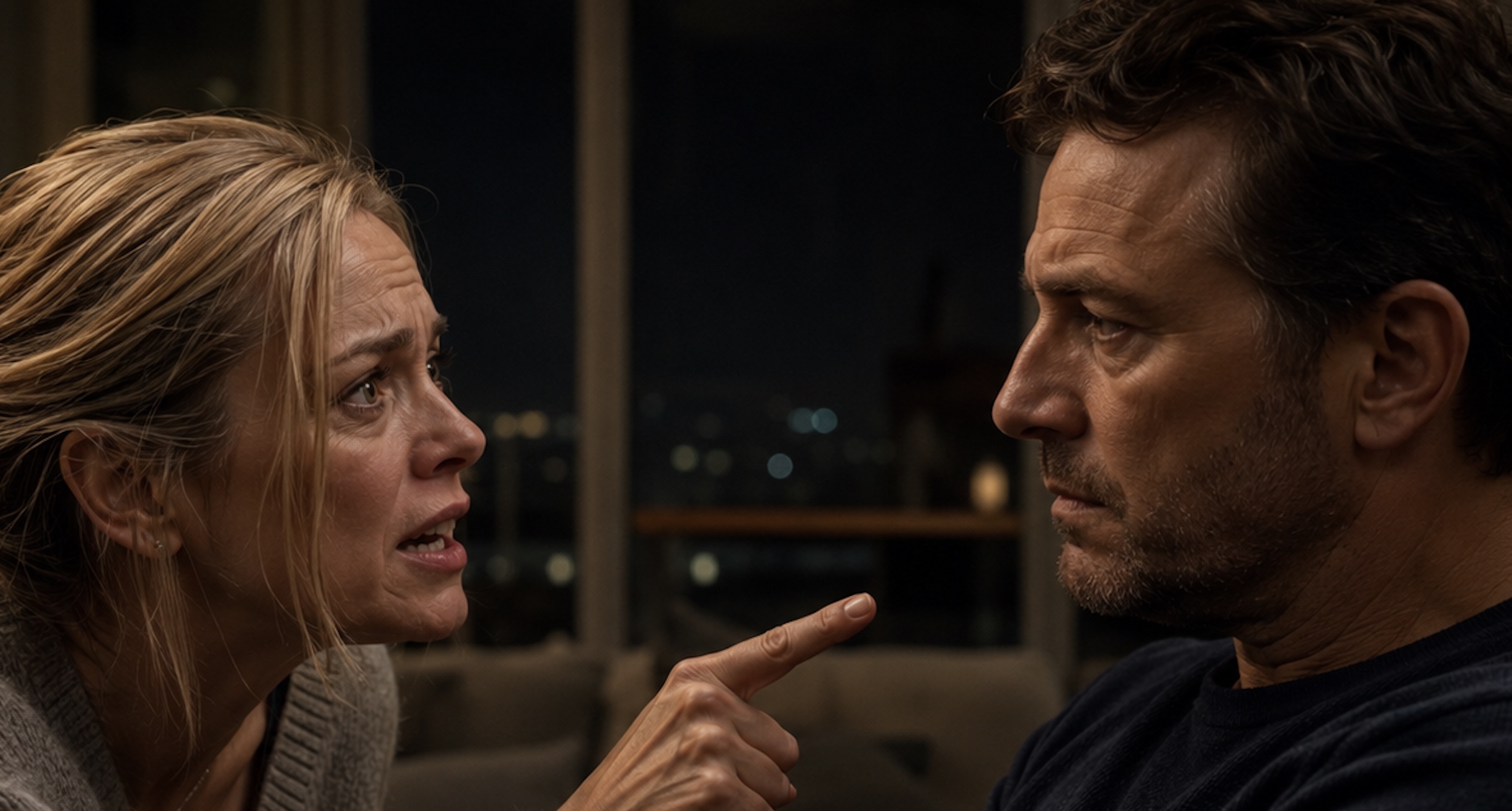
Marina stood in Yegor’s study with a leather folder in her hands. She had only wanted to tidy up — dust the shelves, sort the papers, go through the pile of old receipts. It was Saturday, a quiet morning. Yegor had gone to visit his mother, and for a few hours the house belonged only to her.
The folder was lying in the bottom drawer of his desk, hidden beneath a stack of old magazines. Marina pulled the zipper open and saw a thick sheet of paper with an official seal. She read the words “last will and testament” and “notarized” twice, unable to believe her eyes.
The apartment in the city center — to Danila.
The workshops — to Danila.
His share in the business — to Danila.
To Marina and Pavel — a fixed cash payment, the amount squeezed into a single line.
She carefully put the folder back. Closed the drawer. Sat down in her husband’s chair and stared at the wall, where their wedding photo hung — taken twenty-two years earlier. Young Yegor was holding three-year-old Pasha in his arms, while she stood beside them in a simple white dress, laughing.
Twenty-two years. She had come to this man with one suitcase and a child whose own father had abandoned him. Yegor had not asked a single question. He had simply taken Pasha by the hand and led him to choose a room.
“Do you want the one with the balcony? You can launch paper airplanes from there.”
Pavel had been three then, and he had clung to Yegor’s hand as if he were holding on to the only safe thing in the world.
And now — “a fixed payment.”
A line on a piece of paper.
The price of twenty-two years.
Marina did not cry. She had never known how to cry from pain — only from joy sometimes, when her sons called and said silly, tender things. There was no pain now. There was something else — heavy and icy, like a stone at the bottom of a river.
When Yegor came home that evening, she served dinner, poured tea, and asked how his mother was. He said she was fine, her blood pressure was acting up again. Marina nodded. He noticed nothing.
For three days she said nothing, and that silence was not empty. It filled slowly, like water behind a dam, and Marina felt the dam was about to crack.
On the fourth day, after dinner, when Danila had gone out with friends and Pavel was in his room, Marina placed a mug in front of Yegor and sat across from him.
“Yegor, I need to talk to you.”
“Of course,” he smiled. “What happened?”
“I found the will.”
The smile slid from his face slowly, like paint peeling from a wall.
“What will?” His voice became quiet.
“Don’t, Yegor. The leather folder. Bottom drawer. Under the magazines. Notarized. Do you want me to quote it?”
He said nothing.
She went on, evenly, almost gently, the way she had spoken to him all these years while patiently waiting for him to understand something important.
“The apartment goes to Danila. The workshops go to Danila. The business goes to Danila. I get a payout. Pavel gets a payout. We’re on the same line, Yegor. Me and my son — the one you called your own for twenty-two years.”
“Marina, wait…”
“I am waiting. I’ve been waiting for four days.”
Yegor stood up from the table and walked to the window. He stood with his back to her, and Marina could see how tense his shoulders had become.
“Sit down, please,” she said. “I want to see your face while you explain this.”
He turned around. And only then did she notice what she had failed to see for three days: he had lost weight. There were shadows beneath his eyes, his cheeks had sunk in, and his skin had taken on a grayish tone.
Yegor sat back down and placed his hands on the table.
“I need to tell you two things. Both of them are difficult.”
“Say them.”
“First: I’m sick. Cancer of the spine. I was diagnosed four months ago. The doctors give me a year, maybe a year and a half.”
Marina did not move. Only her pupils widened, and she drew in a slow breath through her nose.
“Four months,” she repeated. “You knew for four months and said nothing.”
“I didn’t want to…”
“For four months I washed your shirts, made your breakfasts, planned a vacation for August. And you had already signed a paper where I was nobody.”
“Marina, let me finish. The second thing: the will wasn’t my idea. It was my mother. Galina Fyodorovna came to me after I found out about the diagnosis. She said…”
He faltered.
Marina waited.
“She said you would leave as soon as you found out. That you would take the property and leave Danila with nothing. That Pavel wasn’t my biological son and had no right… She said it every day, every evening. She called, she came over. I was in such a state after the diagnosis that I just… gave in. I signed it. I thought it was only a formality, an empty piece of paper, just in case.”
“Just in case,” Marina said so quietly that Yegor flinched.
“I didn’t believe it. I know you’re not like that.”
“But you signed it.”
“Yes.”
“You signed a document where my son is a stranger. Where I am temporary. Twenty-two years — and ‘just in case.’ Do you understand what you did?”
“I do.”
“No,” she shook her head. “You don’t. When Pasha fell from the playground slide at five and needed stitches above his eyebrow — who held him? You did. When he got into a fight at school and they wanted to expel him — who went there to deal with it? You did. He calls you father, Yegor. Not stepfather. Father. And on paper, you erased him.”
“Marina…”
“Wait. I’m not finished. You knew for four months that you were dying and hid it from me. From your wife. From the person who has been beside you for twenty-two years. You trusted your secret to your mother, but not to me. You allowed her to decide who I was. And you agreed with her.”
Yegor lowered his head.
“I was scared,” he said. “The diagnosis, the pain, everything fell apart. Mother said, ‘Sign it, protect Danila.’ I signed it and forgot about it. I thought there would still be time to change everything.”
“According to you, you have a year, maybe a year and a half. And you ‘forgot’?”
“I’m a coward, Marina. I know.”
She stood up. Her hands were perfectly calm — no trembling, no fuss. She removed her apron, hung it neatly on the hook by the door, and said:
“I’m leaving for a few days. I need to think. If I stay now, I’ll say things I won’t be able to take back.”
“Don’t go.” He rose too, and she saw him sway, grabbing the edge of the table. “Please.”
“Yegor, I didn’t leave for twenty-two years. Not once. Even when it was unbearable — after my second birth, when you disappeared at construction sites for weeks, when your mother told me to my face that I had ‘found myself a comfortable arrangement.’ I endured. But not now. Now I need to leave so that I can come back. If I can come back after this betrayal.”
She took her bag, her keys, and left. The door closed quietly behind her, without a slam.
Marina rented a tiny studio through acquaintances. Twenty square meters, a folding bed, a table, a chair. She switched off her phone and lay down. For three days she barely ate — drank water, chewed dry crackers, and thought. She did not cry, did not scream. She thought.
On the second day, Katya called — her friend, the only person Marina trusted completely. The phone was off, but Katya sent a message:
“I know that if you’re silent, something serious has happened. I’m here. Turn on your phone when you’re ready.”
On the third day, Marina turned the phone back on.
Seventeen missed calls from Yegor.
Eight from Danila.
Twelve from Pavel.
One voice message from Galina Fyodorovna.
Marina pressed play.
Her mother-in-law’s voice sounded dry and instructive.
“Marina, stop making a circus out of this. Yegor is unwell. He was taken to the hospital this morning. He lost consciousness. If you still care about this family, come. If not, we’ll manage without you. As, frankly, we would have managed anyway.”
Marina listened to it twice.
“As, frankly, we would have managed anyway.”
There it was. That same tone Galina Fyodorovna had used for twenty-two years — looking down at her like a stray cat her son had foolishly let into the house.
The phone rang. It was Pavel.
“Mom, where are you?”
“I’m all right, Pasha.”
“Dad is in the hospital. He got worse last night. An ambulance took him. Danilka is with him. I got here an hour ago.”
“I know. Galina Fyodorovna sent a message.”
“Mom, come. Please. I don’t care about the will. I don’t care about the money, the apartment, any of it. He’s my father. The only one I ever had. He taught me to read, he built my first bicycle, he sat with me in the emergency room when I had my appendix removed. And now he’s lying unconscious, and he needs you.”
Marina’s throat tightened.
“Pasha, he wrote a paper where you are a stranger.”
“I know. Danilka told me. Dad admitted it to him yesterday before he lost consciousness. Danilka is in shock. He cried for an hour. He said he would refuse everything if Pavel doesn’t get an equal share. Mom, Danilka said, ‘Pashka is my brother. That’s it.’”
Marina closed her eyes.
“All right. I’ll come. Tell me which hospital.”
Pavel gave her the address.
Marina got ready in ten minutes — washed her face, pulled on jeans and a jacket, and left. In the taxi, she called Katya.
“Katya, I need help. A lot of help.”
“Tell me.”
“Yegor is sick. Spinal cancer. I found a professor who operates on cases like this. The consultation is paid, the surgery is expensive. I don’t have that kind of money. The account I can access has almost nothing.”
“How much?”
Marina named the amount.
Katya was silent for three seconds.
“I’ll transfer it today. No interest, no deadline. You’ll return it when you can.”
“Katya…”
“Stop talking and go to your husband. The money will be there within an hour.”
Marina ended the call and stared at the lights flickering beyond the window. She did not know whether she could forgive. But she knew what had to be done — and that was what mattered.
The hospital corridor smelled of chlorine. Danila sat on a plastic chair outside the ward, pale, with red eyes. When he saw his mother, he jumped up.
“You came.”
“Of course I came. How is he?”
“Serious but stable. The doctor said one of the vertebrae shifted and pinched a nerve. He lost consciousness from the pain shock. They’re keeping him on IVs for now.”
“Where’s Pasha?”
“He went to get water.”
Galina Fyodorovna appeared from around the corner. She walked straight-backed, like a ruler, in a dark coat, clutching her handbag to her chest. Seeing Marina, she slowed down but did not stop.
“So you came,” she said. “I thought you’d already be in another city.”
“Galina Fyodorovna,” Marina turned fully toward her. “Let’s step aside. Danila, stay here.”
They moved to the end of the corridor, near the fire exit. Marina spoke first — quietly, clearly, without a single unnecessary word.
“I know about the will. I know it was your idea. I know you spent four months convincing Yegor that I would abandon him and take everything. I know you called my son — the one your son raised — a stranger. Now it’s your turn to speak.”
Galina Fyodorovna straightened even more, though it seemed impossible.
“I was protecting my son and my grandson. That is my right.”
“Your right? You stripped Pavel and me of everything — and you call that your right?”
“Marina, don’t be naive. You came to Yegor with empty hands and another man’s child. He gave you everything — a home, status, a family. What did you give him?”
“Twenty-two years of my life. Danila. Care. Loyalty. Or does that mean nothing to you?”
“Pretty words. But paper is more reliable. I’ve seen women like you. While the husband is healthy, you stay. As soon as he weakens, you’re at the door with suitcases.”
Marina took a step forward. Galina Fyodorovna instinctively stepped back.
“Twenty-two years,” Marina repeated. “For twenty-two years you looked at me as if I had stolen something. For twenty-two years you hissed into Yegor’s ear. And when he was in the most terrifying situation of his life, you didn’t support him. You used his fear. You played on your own son’s illness to push me out.”
“I was protecting Danila!”
“Danila is my son too. And by the way, he was the first to say he would refuse everything if Pavel didn’t receive an equal share. Your grandson turned out to be more decent than you.”
Her mother-in-law’s face twitched. It was the first crack in her armor Marina had ever seen.
“You don’t understand,” Galina Fyodorovna began. “When Yegor learned the diagnosis, he called me. Not you — me. What does that tell you?”
Marina froze. The blow hit its mark. Galina Fyodorovna sensed it and continued.
“He didn’t believe you would endure it. He himself doubted you, Marina. I only helped him make a decision.”
“You helped?” Marina came closer. “You destroyed his trust in me. You broke what we had built for more than twenty years. And you stand here saying you ‘helped’?”
“I am standing here because my son is dying!”
“Your son is not going to die,” Marina said with such force that Galina Fyodorovna flinched. “Because I’ve already found a surgeon. I’ve already borrowed money for the operation. I — the woman with empty hands and another man’s child — did in three days what you didn’t even try to do in four months. You knew about the diagnosis for four months. And instead of looking for doctors, you looked for a notary.”
Galina Fyodorovna opened her mouth and closed it. Then opened it again.
“You… that’s not true. I looked for doctors, I called…”
“Who? Who did you call? Name one.”
Silence.
“That’s what I thought,” Marina stepped back. “You didn’t call anyone. You were busy with papers.”
At that moment, Pavel appeared at the end of the corridor with bottles of water. He stopped when he saw the two women near the fire exit and slowly approached.
“What’s going on here?”
“Nothing, Pasha. Galina Fyodorovna and I are finished.”
But her mother-in-law suddenly turned to Pavel and said the one thing she should never have said.
“And you, Pavel, should know this: you are not Yegor’s son. You never were. And you have no right to claim what doesn’t belong to you.”
Pavel went white. The bottles slipped from his hands and hit the floor with a dull thud. He stood motionless, and Marina saw the muscles tighten in his jaw.
And then Marina turned and slapped Galina Fyodorovna across the face.
Not dramatically. Not wildly. Just a short, precise slap with an open palm. The sound was dry, like a snap.
Galina Fyodorovna stumbled back and pressed her hand to her cheek. Her eyes widened.
“You… you…”
“Yes,” Marina stood firm. “And if you ever tell my son again that he is a stranger, I will do it again. Right here, in front of the whole hospital. For twenty-two years I stayed silent, endured, smiled at your family dinners while you discussed me behind my back. Enough. It’s over.”
Her mother-in-law stood with one hand pressed to her burning cheek and said nothing. For the first time in her life, she had no answer. For twenty-two years she had built a wall of superiority and coldness, and one slap had brought it down like a house of cards.
“Now listen to me,” Marina continued. “I’m going in to see Yegor. Tomorrow morning I’m bringing the professor for a consultation. The operation will happen in a week if the doctor confirms it. The money is covered. And here is what you are going to do: you will go to the notary and give a statement that the will was written under your pressure. Not for the money — I don’t need your apartments. For the truth. For Pavel, whom you just called a stranger. Is that clear?”
“I… need to think.”
“No. You can think at home. Right now, you say yes or no. And what I do with you depends on your answer.”
Galina Fyodorovna looked at Pavel. He was still standing motionless, but there was something in his eyes she had not expected — not anger, not hurt, but pity.
He pitied her.
And that hurt more than the slap.
“Yes,” Galina Fyodorovna said quietly. “I’ll do it.”
“Good,” Marina turned to Pavel. “Let’s go to your father.”
Pavel picked up the bottles from the floor and walked beside her. Galina Fyodorovna remained standing alone by the fire exit.
Yegor regained consciousness closer to evening. The first thing he saw was Marina sitting on a chair beside his bed.
“You’re here,” he whispered.
“I’m here. And I’m not going anywhere. But first — listen to me.”
“I’m listening.”
“I found a surgeon. A professor. He operates on exactly these kinds of cases. He’ll come tomorrow for a consultation. The money is there — Katya gave it.”
“Katya?” Yegor frowned. “I don’t want you borrowing…”
“And I don’t want you dying. End of discussion. Next: your mother agreed to confirm that the will was written under pressure. She’ll do it this week.”
“She… agreed? How did you manage that?”
“You don’t want to know.”
Yegor gave a weak smile.
“Marina… I’m guilty. I know.”
“You are. And I’m not going to pretend nothing happened. You betrayed me, Yegor. Not with a knife, not with words — with paper. You signed a document where my son, the one you raised, was nobody. And you hid it for four months. It hurts. Very much.”
“I understand.”
“No, wait. I want you to hear everything. I don’t forgive you. Not yet. Maybe in a month. Maybe in six months, when you’re back on your feet after surgery. Maybe when you look Pavel in the eyes and tell him what you should have told him long ago. But right now — no.”
“Then why did you stay?”
“Because I am not the woman your mother described. I don’t run. I stay. Even when it hurts. Even when I’m offended. Even when I want to slam the door and forget your name. I stay because twenty-two years is not a line in a will. It is a life.”
Yegor closed his eyes. One tear rolled down his cheek — slow, heavy, solitary.
“Thank you,” he said.
“Don’t thank me. Get well. You still have a lot to fix.”
The door to the room opened quietly. Danila came in with a food container.
“Dad, I made broth. Chicken, with noodles, the way you like it. Pavel helped — he cut the carrots, and I almost burned the onions.”
Pavel walked in behind him.
“I did not cut the carrots. I butchered them. Danilka is lying.”
“I am not lying! You really dropped half a carrot into the sink.”
Yegor opened his eyes and looked at both of them — at Danila, his biological son, and at Pavel, the son he had chosen himself twenty-two years ago.
“Pashka,” he said hoarsely. “Come here.”
Pavel came closer. Yegor took his hand.
“You are my son. You always have been my son. And that document… it was my cowardice and my mistake. I’ll fix it. Do you hear me? As soon as I get back on my feet, I’ll fix it first thing.”
“I know, Dad,” Pavel squeezed his hand. “I know.”
Danila placed the container on the bedside table and sat on the edge of the bed.
“Dad, I want to say something too. I spoke with Grandma on the phone an hour ago. She was crying. First time in my life I’ve ever heard her cry. She said she’s going to the notary tomorrow.”
“Did she say anything else?” Marina asked.
“Yes,” Danila hesitated. “She said, ‘Tell Marina she turned out stronger than I thought. And that I’m ashamed.’”
Marina said nothing. She simply moved her chair closer to the bed and opened the container of broth.
“Yegor, eat. Your sons cooked it.”
Three days later, the professor examined Yegor and scheduled the operation. The prognosis was cautious, but not hopeless: if the surgery went well — remission; if it went very well — a full life.
Katya transferred the money that same evening, just as she had promised. Marina signed all the papers.
The surgery lasted seven hours. Pavel and Danila sat shoulder to shoulder in the hallway — one working on his laptop, the other scrolling through his phone, but every five minutes both of them looked up at the doors of the operating unit. Marina stood against the wall, fingers crossed inside the pocket of her jacket — an old habit left over from childhood.
When the surgeon came out and said, “The operation was successful, the tumor has been removed, the patient is in intensive care,” Danila shouted so loudly that every nurse on the floor hissed at him to be quiet.
Pavel simply closed his laptop, pressed it to his chest, and exhaled softly.
Marina called Katya.
“Everything is fine. They removed the tumor. He’s going to live.”
“There you go,” Katya said. “And you were afraid.”
“I wasn’t afraid. I was angry.”
“Sometimes that’s the same thing.”
Two weeks later, Yegor began walking. A month later, he was discharged. Galina Fyodorovna, as promised, went to the notary. The will was canceled. Yegor wrote the new one himself, without anyone’s advice: all property was to be divided equally between Marina, Pavel, and Danila.
But something else happened — something no one knew until the very end.
A month and a half after the surgery, when Yegor was already walking on his own and even beginning to return to business, Danila called his mother.
“Mom, can you come over? I need to show you something. It’s important.”
Marina came.
Danila sat at the table with his laptop and a stack of printouts.
“I was checking Dad’s accounts — he asked me to help sort out the bookkeeping while he was sick. And I found this.”
He turned the screen toward her.
Marina read slowly, line by line.
“These are… transfers?”
“Yes. Over the last year and a half, Grandma transferred more than two million from Dad’s business account to her personal account. Small amounts — one hundred, two hundred thousand at a time. She had power of attorney. Dad gave it to her after the diagnosis.”
“Two million,” Marina repeated.
“And there’s more. She transferred one of Dad’s warehouse properties into her own name. Quietly, while he was in the hospital. The documents are here.”
Marina stared at the screen and felt anger rise inside her — cold, sober, without a trace of hysteria.
Everything fell into place.
The will Galina Fyodorovna had convinced Yegor to sign left everything to Danila — a twenty-one-year-old boy whom his grandmother could easily control. Marina and Pavel were pushed aside. And she, Galina Fyodorovna, would have the money and the obedient, grateful grandson.
“Mom,” Danila said, “this isn’t protecting the family. This is theft.”
“I know,” Marina replied. “Call your father.”
Yegor came in, sat down, and read the documents. He was silent for a long time. Then he dialed his mother’s number.
“Mother, come over. Now.”
“What happened?” Galina Fyodorovna’s voice was wary.
“Come over. This is not a conversation for the phone.”
She arrived forty minutes later. She entered and saw all four of them — Yegor, Marina, Danila, and Pavel — sitting at the table with the documents spread out before them.
“What is this?” she asked, stopping at the doorway.
“Sit down, Mother,” Yegor said. “I want you to explain these transfers.”
He turned the papers toward her.
Galina Fyodorovna looked at them — and went pale.
“These… these were necessary expenses. I was paying for…”
“What were you paying for? Two million? Where did it go?”
“Yegor, you were ill. Someone had to manage things…”
“Managing does not mean stealing. And this,” he tapped another document with his finger, “is the transfer of a warehouse property into your name. While I was unconscious. This is a criminal case.”
Galina Fyodorovna was silent. Her hands were shaking.
“Mother,” Yegor spoke quietly, but there was something unyielding in that quietness. “You came to me when I learned the diagnosis. You said, ‘Sign the will. Protect Danila.’ I signed. And at the same time, you were transferring my money to yourself. You were putting my property in your own name. And you were convincing me that Marina was the enemy. Because if Marina had stayed close, she would have noticed. Just as she has noticed now.”
“That’s not true!” Galina Fyodorovna jumped up. “I did it for the family! For Danila!”
“For Danila?” Danila rose from the table. “Grandma, that money is in your personal account. Not mine. The warehouse is in your name. Not mine. Who were you protecting? You’re lying.”
Silence.
“I want you to return everything,” Yegor said. “Every ruble. And the warehouse. By the end of the month. I am revoking your power of attorney today.”
“Yegor… son…”
“And one more thing. You attacked my family — my wife, my sons. Both of my sons. You called Pavel a stranger. You pushed Marina out of the house. You used my illness. I don’t want to see you until you return the money and apologize to every person sitting at this table. Not to me — you will apologize to me last.”
Galina Fyodorovna stood there, and her face changed — from arrogant to confused, then frightened, then empty.
She understood that she had lost. Not to Marina — to her own greed.
She left without saying a word. The door closed behind her.
Pavel looked at Yegor.
“Dad, how are you?”
“Awful,” Yegor answered honestly. “But right.”
Marina stood, walked over to her husband, and placed a hand on his shoulder. She did not hug him. She did not kiss him. She simply placed her hand there.
It was enough.
“Are you going to eat?” she asked. “Danila promised to make borscht.”
“Danila is making borscht?” Yegor raised an eyebrow.
“Hey, I learned!” Danila protested. “Pavel showed me.”
“Pavel showed Danila how to make borscht,” Yegor shook his head. “So while I was sick, a miracle happened.”
“More than one,” Marina said. “Far more than one.”
A month later, Galina Fyodorovna returned all the money and transferred the warehouse back. She came to apologize on a weekday, when only Marina and Yegor were home. She stood on the threshold, small and quiet, and said only three words:
“Forgive me. Please.”
Marina let her in, poured tea, and they sat at the table for two hours, barely saying anything. But this silence was different — not icy, only tired. The silence of two women who had finally stopped fighting.
That evening, Yegor took the old photograph from the drawer — the wedding photo where he was holding three-year-old Pashka in his arms. He hung it back on the wall.
And for the first time in many months, he felt solid ground beneath his feet.