The boots stood in the middle of the hallway — dark brown, with a neat heel, still carrying the scent of new leather.
Anton stood in the kitchen doorway with his phone in his hand, staring at them as if they were not shoes, but a grenade with the pin pulled out.
“Do you still have the receipts? Return everything you bought! I promised your bonus to my mother!” he demanded, his voice carrying that special tone of a person who had spoken faster than he had thought.
Ira looked up.
She could have stayed silent. She knew how to stay silent — three years of marriage had taught her that. She knew how to smooth things over, turn tension into a joke, walk into another room, and quietly rage into a pillow. But today, she was not going to endure it.
Maybe it was because of the boots. Maybe because the old pair — the ones she had been unsuccessfully patching at the repair shop for the second year in a row — had finally soaked through on her way home from the bus stop that day. Maybe because she had been setting money aside for this purchase for three months, telling herself to wait, to be patient, that now was not the right time.
And now it turned out that even now was not allowed.
“Say that again,” she said quietly.
Anton did not notice the change in her voice. Or perhaps he did, but decided pressure was more important than caution.
“I said my mother is sick. She needs medicine, a massage appointment next week, and she has to redo some tests. I already told her the money would be there. You could have at least asked me first!”
“Asked you?”
“Yes! It’s our family budget. We’re supposed to discuss things like this!”
“Our family budget,” she repeated with a small nod.
And there was something in that nod that finally made Anton fall silent.
“Anton, when was the last time you discussed with me how much money you send your mother every month?”
“That’s different.”
“Why is it different?”
“Because she’s sick!”
“She has been sick for three years.” Ira’s voice was almost calm. “For three years, she has been sick. For three years, you have been giving her money every month. How much — you don’t tell me. What she spends it on — you don’t know. Whenever I ask, you say I’m heartless. And now you’re standing here demanding that I return boots I bought with my own money, because you promised something to another woman.”
“She is not another woman. She is my mother!”
“I remember who she is,” Ira said, sitting down on the small bench by the mirror and beginning to take off her old boots. “I remember very well who she is.”
Silence settled over the hallway.
Anton watched as his wife carefully placed the old boots in the corner and picked up the new ones — the very purchase he had demanded she return.
“Are you serious?” he asked.
“Completely.”
She put on the left boot. Then the right. She stood up and walked down the hallway. The heel struck the floor confidently, firmly, like it belonged there.
“We’re going to your mother’s,” Ira said.
They drove in silence the entire way.
Anton opened his mouth several times, as if he wanted to say something, but each time he closed it again. Ira looked out the window. The lights of the November city drifted past the glass, wet asphalt reflecting the streetlamps, pedestrians disappearing beneath umbrellas.
She was thinking about what he would say to his mother.
More precisely, she was thinking about what she would make sure he said.
Because Ira had a plan.
It had not appeared today. It had been forming for a long time, little by little, from small observations, from conversations she had overheard by accident, from numbers that never added up, from complaints that repeated with suspicious regularity — and always exactly when extra money appeared in their home.
Valentina Sergeevna lived in a two-room apartment on the fifth floor. The elevator worked. Ira knew that for certain because once, she had helped her mother-in-law carry heavy bags while Valentina Sergeevna complained that the elevator was broken. It had not been broken. Valentina Sergeevna simply preferred when other people carried things for her.
The door opened quickly.
Her mother-in-law was wearing a robe, but her hair was styled and her makeup was done. Ira had long ago noticed that Valentina Sergeevna was always ready for visitors, even when she claimed she could barely move.
“Antosha!” Valentina Sergeevna beamed.
Then she noticed Ira and dimmed slightly.
“And you came too.”
“Good evening, Valentina Sergeevna,” Ira said quietly.
The apartment smelled of good coffee and fresh pastry. An open magazine lay on the coffee table. Some television series was paused on the screen. Ira looked over everything very carefully and said nothing.
They sat down.
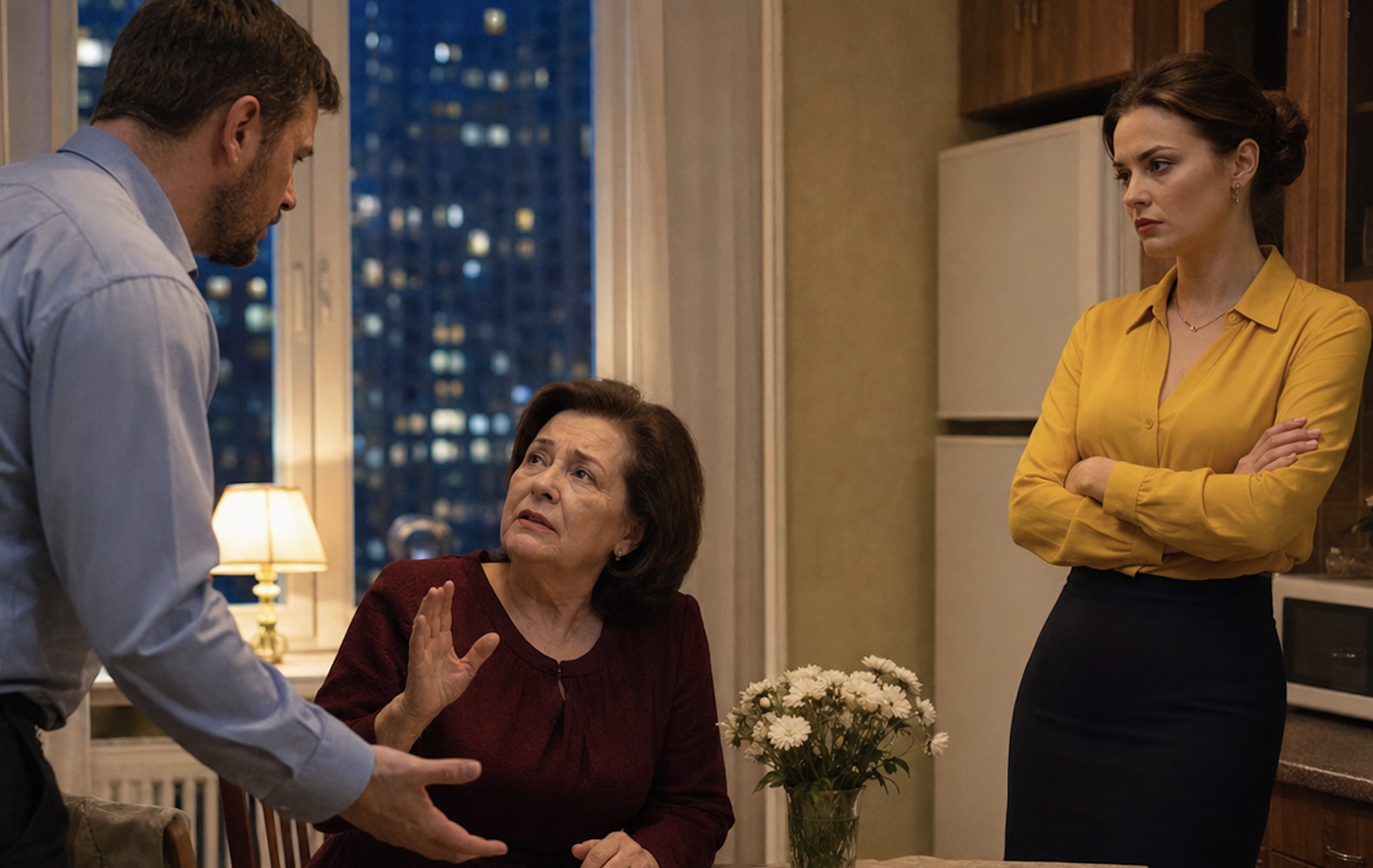
Anton was nervous. His mother had already sensed that something was wrong and kept glancing from her son to her daughter-in-law with the expression of someone preparing to defend herself, though she did not yet know where the attack would come from.
“Mom,” Anton began.
Ira heard the effort in his voice as he tried to speak exactly the way they had agreed in the car.
“I wanted to tell you something important. I’ve thought about it, and I’ve decided I’ll go to the pharmacy myself, buy the groceries myself, and bring everything to you. That way it’ll be better. You won’t have to worry about anything or go anywhere. I’ll take care of it.”
Valentina Sergeevna listened.
Her face changed several times during his little speech. First, there was surprise. Then something like confusion. Then — and at that moment Ira almost nodded to herself — anger.
“What do you mean, you’ll go yourself?” her mother-in-law asked quietly, very clearly.
“Well, Mom, it’s more convenient. You won’t have to go anywhere. I’ll buy whatever you need…”
“You don’t trust me?”
Her voice suddenly grew louder. Sharper.
Valentina Sergeevna straightened in her chair so quickly that not a trace of weakness or illness remained.
“What am I, a little girl who can’t be trusted with money? Who put this idea in your head?”
She turned toward Ira, and her look was so sharp that on another day Ira might have lowered her eyes.
“She did, didn’t she? She came up with this. She turned you against me so you’d stop giving your mother money. So I have to live according to some list, like I’m in an orphanage?”
“Mom…” Anton said, confused.
“I am a sick woman! I need to choose for myself what I need! And you want to control me! This is humiliating! She taught you this. I know it. I know her!”
That was when Ira spoke.
She did not raise her voice. She spoke calmly, without hurry, and perhaps that was exactly what affected Valentina Sergeevna the most.
“Valentina Sergeevna, I listened to you for three years. For three years, I heard how sick you were — while you still managed to look perfectly well and keep up with every television series. For three years, I heard how you needed money for medicine — but nobody knew exactly what medicine. For three years, every time money appeared in our home, you suddenly had another crisis. Today, Anton wants to help you differently: with groceries, medication, and real care. If you are an honest person who truly needs help, you should be relieved. Because that is help. But you are angry. Why?”
Silence.
Valentina Sergeevna opened her mouth. Then stopped.
“You… you have no right to speak to me like that…”
“I’m speaking to you the way people speak to someone they respect enough to tell the truth,” Ira replied. “That is better than what you have been doing to us for three years.”
Valentina Sergeevna had no convincing words left after that. So she moved on to tears, but they no longer had the effect they once had.
Anton sat very straight and looked at his mother with the expression of a man who was slowly, painfully beginning to understand something.
They left twenty minutes later.
The car was silent again. But this silence no longer pressed on them. It was necessary, so everything they had heard could settle into place.
“You saw it?” Ira asked when they turned onto the highway.
“I saw it,” Anton said.
“She wasn’t angry because I insulted her. She was angry because I guessed correctly.”
“I saw it,” he repeated.
Then, after a pause, he added:
“I’m an idiot.”
“You’re a loving son,” Ira said. “That isn’t the same thing. Though sometimes one doesn’t prevent the other.”
He glanced at her sideways. Then at the boots.
“They’re nice,” he said.
“I know,” she answered.
He told his mother himself that he would no longer give her money. He did it over the phone, briefly and firmly.
Valentina Sergeevna hung up. Then she called back and said everything she had not managed to say in front of Ira.
Anton listened without interrupting, then said:
“Mom, I love you. But I’m not going to do what you want just because you want it.”
Ira heard the conversation from the kitchen. She was washing dishes and thinking that some things a person has to understand on his own. You cannot rush it. You can only wait. And stay nearby.
They stopped communicating with Valentina Sergeevna for a while. She stopped calling.
It was hard for Anton. Ira could see it in the way he sometimes looked at his phone. In the way he grew quiet whenever the conversation touched on mothers in general. She did not push that subject. She simply stayed close.
About a month later, the phone rang.
Anton answered. Ira stood in the doorway and watched his face change. First came tension. Then something like exhaustion.
“Mom, wait. Wait. I hear you.” A pause. “No, I’m not offended. I just told you the truth, and you didn’t accept it.” Another pause, longer this time. “Mom. I said no. We already discussed this.”
He put the phone down and looked at Ira.
“She started with accusations again,” he said.
“I know,” Ira replied.
“You said it would be like this.”
“I know.”
He exhaled, sat down at the table, and rubbed his face with both hands.
“Will this ever end?”
Ira came over, sat beside him, and took his hand.
“I don’t know. But you’re handling it.”
Another month passed before Valentina Sergeevna called again.
This time her voice was different. Not as forceful. More tired.
“Antosha. I… well, maybe I was wrong. A little. You understand, it’s difficult for me…”
“I understand, Mom.”
“Well then. Since you understand… maybe after all…”
“I’ll buy you groceries and medicine. Tell me what you need.”
A short pause.
“Well, money would be more convenient…”
“Groceries and medicine, Mom. Nothing else.”
She agreed. Not with gratitude, of course. With grumbling. With comments that he had bought the wrong kind of butter and should not have forgotten this or that.
Anton listened calmly, nodded, and wrote everything down.
Ira watched him and stayed silent. Because some victories look ugly from the outside, but something very important is happening inside.
At the end of November, Anton came home with a box of pastries. For no special reason.
“What’s this?” Ira asked.
“I wanted to say that you were right,” he said. “I just couldn’t accept it for a long time.”
Ira opened the box.
Inside were éclairs — her favorite.
“A long time,” she agreed.
“But I did accept it.”
She looked up at him. He was serious, looking at her the way a person looks when he wants to say something important but has not yet found the exact words.
“You’re not still hurt, are you?” he finally asked. “Because of everything that happened?”
Ira thought about it. Truly thought before answering.
“I was angry,” she said. “Very angry. Especially that day in the hallway, when you demanded I return the boots.”
“I’m sorry.”
“I’ve already forgiven you. But you need to understand something, Anton.”
She placed the éclair back in the box and looked straight at her husband.
“I’m not going to explain what is happening to you every single time. I explained it once, and once is enough. You have to learn to see things yourself. Not because I want you to, but because this is your life.”
“I understand,” he said.
“Good.”
She picked up the éclair again.
“Are they good?”
“I bought them from the place you always go to.”
That was the right answer.
Ira appreciated it.
Outside the window, snow was falling. The first real snow of the year — thick and steady. It gathered on the windowsill in soft white caps and made everything around them a little quieter, a little gentler.
Ira looked outside and thought that winter was a good time for something to end and something new to begin.
The boots stood in the hallway.
Dark brown, no longer brand-new, but still very good.