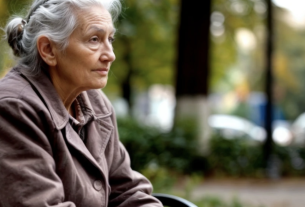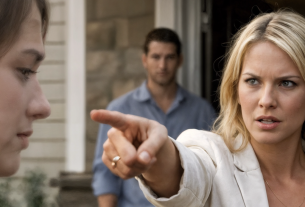
Olga Smirnova was a manicurist. No, wait — a former manicurist. Eighteen years ago, she shut down her little nail studio in a shopping center because Igor had said, “Why do you need to work? I make enough for both of us.” And she agreed.
Igor Smirnov was a sales director. A man who knew how to persuade everyone — clients, coworkers, his wife. Especially his wife. In that, he was a true professional of the highest order.
He left her on a Thursday. Set his bag down in the hallway, cleared his throat, and said all the usual things: that he was tired, that life was short and there would be no second one, that he had met someone who truly interested him. Twenty-seven years old. Her name was Vika. She worked in his department. Olga just stood there and looked at him.
“You’ve changed,” Igor said. “You’ve become boring. You stopped taking care of yourself.”
Olga lowered her eyes. Her robe — yes, old and faded. Her hair — pulled back in a ponytail. Her nails — undone. Funny, really. A nail technician with no manicure.
“I’m tired of all this,” he added, for emphasis.
She did not scream. She did not throw plates. She simply said, calmly and very quietly, “All right.”
He left, a little surprised that everything had gone so quietly. He had probably expected tears. A scene. Something dramatic.
The door closed.
And that was it.
For the first week, Olga barely seemed alive.
Not in the sense that she lay in bed staring at the ceiling — though she did that too. She got up, moved around the apartment, made coffee, stood by the window. But all of it felt as though it were happening to someone else. As if she were watching herself from a distance, thinking: there is a woman standing by the window, looking out at the courtyard, and not a single person in the world truly cares.
Her phone hardly rang. Friends texted, and she answered briefly: “I’m fine, don’t worry.” Her mother called once, said, “I knew it, he was always unreliable,” and offered to come over. Olga said, “Don’t, Mom.” Her mother took offense.
On the third day, Igor texted her about the utility bills. Businesslike, nothing extra. Olga replied the same way.
On the seventh day, she opened the wardrobe.
She had only meant to find a warm sweater. Instead, she came across an old cardboard box labeled “miscellaneous” in her own handwriting. She could no longer remember when she had shoved it in there.
Inside were old photographs.
Not family pictures — her pictures. Olga at twenty-five, laughing in a red dress. Olga at the seaside, tanned, wearing a straw hat and holding some cocktail. Olga at her desk in her old studio — the lamp, the tools, a client sitting in front of her — and Olga herself wearing the expression of someone doing something important.
Because back then, she was.
She stared at that last photo for a long time.
Then she closed the box and put it back.
The next day, she booked an appointment with a hairdresser.
Not because she wanted to impress anyone or prove something to Igor. She just had not had a haircut in eight months, and honestly, it had become indecent. The hairdresser, a young woman named Sonya with lilac-colored nails, asked what they were doing today. Olga looked at herself in the mirror. At the ponytail. At the tired face.
“Cut it,” Olga said. “And I mean really cut it.”
Sonya worked for forty minutes. Olga sat in silence, watching the hair fall. It felt strange — almost like shedding something unnecessary. Something that had long outlived its purpose, but somehow had never been thrown away.
By the time she stepped outside, it was already dark. She paused by a shop window and looked at her reflection.
“Hello,” Olga said out loud.
A few passersby turned around. Olga kept walking.
Three days later, she found massage therapy courses.
She had been thinking about them for five years. Thinking, postponing, always finding reasons: too expensive, too time-consuming, no time, Igor probably would not approve. He had never liked it when she “invented hobbies for herself,” as he used to say with that faint, mocking smile.
She called. Asked about the schedule. Signed up for the next group. Hung up the phone and thought: well then.
The classes started two weeks later. There were eight people in the group, mostly women of different ages. The instructor, Sergei Nikolaevich, was a man in his fifties with a surgeon’s hands and a way of explaining everything from the beginning — without condescension and without unnecessary harshness. At the first lesson, Olga listened so intently that she later realized she had filled three pages of notes in tiny handwriting, with little diagrams.
She had not done that since college.
At the end of the second week, Natasha — a friend she had not seen since February — called.
“So, how are you?”
“I’m taking massage classes,” Olga said.
A pause.
“What?”
“Massage. Therapeutic massage. Mondays and Wednesdays.”
“Wait,” Natasha said. “Are you serious right now?”
“Completely.”
Natasha went silent for a second, then laughed in surprise.
“Well, look at you.”
“Yeah,” Olga agreed.
By the end of the month, the apartment had been rearranged. Nothing dramatic. One Sunday, Olga decided to move the sofa to another wall, then stood back, looked at it, and moved the armchair too. The place felt brighter. More open. As if the apartment had exhaled along with its owner.
She packed up the rest of Igor’s things. Shirts neatly folded. Books boxed up. Tools from the storage closet in a separate bag. She placed the boxes by the front door.
Let them wait. He had said he would come for them.
Olga put a potted flower on the windowsill — something she had wanted for a long time, but Igor could not stand houseplants — and went to prepare for her next lesson.
A month later, Sergei Nikolaevich told her she had good hands.
“You can feel the tissue,” he explained. “You either have that, or you don’t.”
Olga nodded.
A week later, she made arrangements with a small salon across the street: a few clients a week. The owner, a woman named Alla, looked at her carefully and said, “Come on Wednesday, we’ll see.” Olga came. She worked. Alla said, “Good,” and immediately offered her a permanent position.
Olga accepted without hesitation.
Igor called on a Friday morning.
“Olga, I need to pick up some of my things. When is a good time?”
“Sunday,” she said. “After two.”
“All right.”
She hung up and looked at the calendar. On Sunday at three, she had a client — Marina Sergeyevna, cervical osteochondrosis, second session. Good. That gave her fifteen minutes for Igor, no more.
On Saturday, she did her own nails at home, sitting at the table with good lighting and proper tools. Dark burgundy. Neat. Then she took out a light-colored dress she had not worn in ages. It fit well. Better than she expected.
Igor rang the intercom at exactly 2:15.
Olga opened the door.
He was standing there in the same jacket she had given him three years earlier for his birthday. He held a shopping bag in one hand. He looked at her — first in the usual way, then differently. His gaze moved over the dress, the haircut, the face. Then lingered.
“Hi,” he said.
“Hi. Come in.”
He stepped inside. Looked around the entryway. Saw the four boxes lined up neatly against the wall, labeled.
“You already packed…”
“Yes. Everything of yours is there.”
He said nothing. Then walked into the room.
“You moved everything around,” he said.
He sat down on the sofa, automatically, out of habit. Olga remained standing.
“You look good,” he said. Cautiously. As if testing the ground beneath his feet.
“Thank you.”
“No, I mean it. You’ve changed somehow.”
“It’s been two months.”
“I know. It’s just…”
He fell silent, searching for words.
“How are you, really?”
“Fine.”
“Are you working?”
“Yes.”
“Where?”
“At a salon. Massage.”
A pause. Igor looked at her with an expression Olga did not immediately recognize. Then she understood: confusion. He had expected a different Olga. The one he had left two months before. This was not her.
“You learned massage in two months?”
“I finished the course. I got lucky with a good teacher.”
He looked around the apartment again, slowly, as if taking inventory of the place and failing to find what he had expected. No tear-stained face. No wrecked apartment. None of that thick atmosphere of abandonment he must have imagined he would walk into.
“Listen,” he said. “I wanted to talk.”
“About what?”
“Well… about what happens next. About us, I mean.”
“About us?” Olga repeated the words without even the tone of a question.
“Olga, come on…” He rubbed the back of his neck.
“Igor,” she said, “if this is about paperwork, write to the lawyer. I already sent you the contact details. Did you see them?”
“I did. But I don’t only mean the paperwork. I mean us. In general.”
“Us?” she repeated again.
“Olga…”
“I have a client at three,” she said. “If you have something specific to say about the apartment, say it now. Otherwise, take the boxes. I’ll help you carry them to the elevator.”
He stood up, went into the hallway, and lingered over the boxes. Picked one up, set it down, then picked up another.
“Olga,” he said without turning around, “would you want to meet sometime? Dinner, maybe. Talk properly.”
“No,” she said.
“Why not?”
“Because there’s no reason to. Igor, you have fifteen minutes. Take the boxes. I’ll help you get them to the elevator.”
They stepped out into the hallway.
The elevator doors opened. Igor pushed the boxes inside. Then he turned back to her. He looked at her with that belated expression of understanding that only arrives when nothing can be undone, nothing fixed.
“Olga…”
“Goodbye, Igor,” she said.
The elevator doors closed.
Olga went back into the apartment.
After that, there was silence. Long, steady silence. No calls. No messages. The documents went through the lawyer, calmly, without scandal. Olga signed what needed to be signed and returned to her life.
In October, Natasha texted her that she had seen Igor at the mall. With the girl. She wrote it carefully, with three dots and a question mark at the end, clearly bracing for a difficult conversation. Olga replied: “I saw a photo of that new nail gel — show me when we meet.”
Now Olga worked at the salon on Tuesdays, Thursdays, and Saturdays from morning until lunch, sometimes a little longer. Clients booked in advance. Marina Sergeyevna referred a friend. That friend brought another. Word of mouth spreads quickly when someone has gifted hands.
One evening, Olga took that same box of photographs out of the wardrobe again. She looked once more at the picture of herself in the salon studio. The girl at the desk. The lamp. The tools. That serious expression.
Then she placed the photo on the shelf.
Right beside the one where she was wearing the red dress.