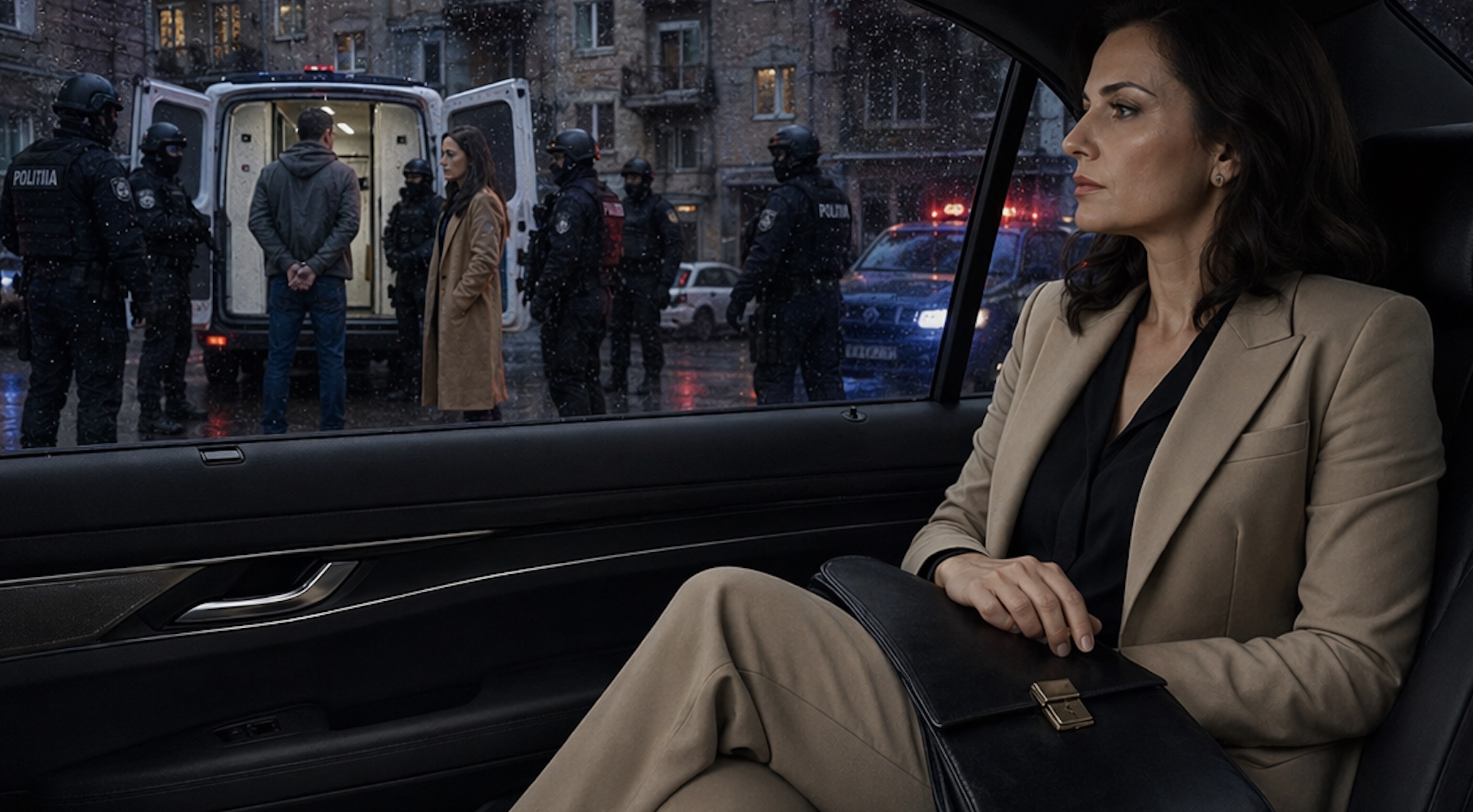
The snap of the lock sounded drier and louder than usual. In those old Stalin-era doors, the mechanisms always clanked with a kind of theatrical drama, but this time the sound felt final. Like a blade dropping. I yanked the handle — useless. On the other side, in the corridor, someone was breathing heavily. I knew that rhythm. Denis. My husband, the same man who had promised that morning we’d go pick out bathroom tile together.
“Open the door,” I said, trying to keep my voice from shaking. “Denis, this isn’t funny. I have to submit a report to the department in an hour.”
The answer did not come from him.
Instead, I heard Tamara Arkadyevna’s dry, rasping laugh. My mother-in-law was clearly standing right outside, practically pressing her ear to the paneled wood.
“A report, she says,” she croaked. “You can sit there, Innochka. Since you don’t understand your place the easy way, we’ll do this the hard way. You’ll transfer the apartment to Denis, or you’ll rot in there, got it? Right in that room. We won’t even bring you food until we see your signature.”
I stepped away from the door and sat on the edge of the bed. My hands were ice-cold. Slowly, I rubbed my palms together, counting the rough fibers of the bedspread. One, two, three, five… strange that I had never noticed before how scratchy it was. Only one thought kept pounding in my head: they really did it. My husband, his mother, and his sister Oksana — who, judging by the rustle of her dress, was standing out there too, serving as backup.
“Inna,” Denis said at last. His voice sounded cracked, guilty, but underneath that guilt was stubborn greed. “Mom’s right. You inherited this apartment from your grandmother, and we have debts. My debts are our debts — we’re family. Oksana’s out of work, collectors smashed the windows in my car. Is it really so hard for you? Just transfer the deed to me and this all ends. We’ll let you out right away. We’ll even order dinner from a restaurant.”
My eyes shifted to the leather case sitting on the chair by the window. Heavy, fitted with thick metal locks and an almost invisible emblem on the flap. Denis always called it “your stupid bag full of hardware.” He had no idea that inside that “bag” was a secure communications terminal with an active location beacon.
“Denis, listen to me very carefully,” I said, walking back to the door and lowering my voice until it was almost gentle. “You have exactly five minutes to turn that key. You have no idea what kind of mess you’ve just stepped into. This is not a family spat. This is a state-level crime.”
“Oh please, spare us,” Oksana sneered. She was the younger sister, the proud owner of three unpaid loans for iPhones and a completely empty head. “A crime, really? You’re just a wife, Inka. An ordinary woman. Sit in the dark long enough and all that pride will disappear. We left your phone in the hallway, by the way, so there’s nobody for you to call.”
They thought I was cut off. They thought I was just sitting there crying.
I looked at the clock again. 5:12 p.m. At 5:15 I was due for a mandatory check-in through the terminal. If someone in my department — someone with top-level clearance — failed to check in within three minutes of the scheduled time, and if the GPS sensor showed the device inside a red-zone property — and my apartment had been placed on a restricted protocol list because of the nature of my work from home — then the automatic code “Alert-1” would trigger.
I opened the case. My fingers tapped in the code on the terminal’s digital panel from pure habit. The screen flickered to life with a cold blue glow.
SYSTEM: STATUS CONFIRMATION PENDING.
TIMER: 02:14… 02:13…
I did not enter the confirmation code.
Instead, I pressed the sequence that meant forcible detention. The system asked for biometric confirmation. I pressed my finger to the scanner. The protocol was now irreversible. In three minutes, the duty officer at headquarters would see on his monitor that Engineer Sedova was under threat and that secure communications might be compromised.
“Mom, she went quiet in there!” Oksana called out. “She’s probably signing already. I told you, she’s weak. She’ll cry and do what she’s told.”
“Let her sit,” my mother-in-law snapped. “I’m going to put the kettle on. Denis, don’t leave the door. If she starts banging, scare her.”
I heard them walk off down the corridor toward the kitchen. Denis stayed. There was the scrape of furniture — he had apparently dragged over a chair and sat down by the door. He always did that when we argued. He would simply outwait me until I gave in first. He was used to me being convenient. Used to my quiet departures for work, to my business trips I never explained. To him, I was just Inna — the woman who cooked fish beautifully and brought home a good salary that he had somehow learned to siphon into his “business ideas.”
Denis, you have no clue that right now the Orenburg regional office has already activated a response team.
I sat down on the floor by the window, leaning against the radiator. The metal was warm. I closed my eyes and began counting my heartbeat. At work, they taught us one thing above all else: in any uncertain situation, keep your rhythm.
From behind the door, Denis started humming some idiotic tune. He was sure he had won. In his mind, everything was simple: a locked door, no phone, and three people against one woman meant guaranteed victory. He had no idea my case was now transmitting encrypted data packets across a protected channel, recording the sound levels in the room, the temperature, even the number of people outside the door through floor-vibration sensors.
“Inn, what’s going on in there?” he shouted maybe ten minutes later. “Mom took the pies out of the oven. Sign the paper and we’ll let you out, we’ll eat like normal people. Why are you being so stubborn? The apartment will still be ours together. I’ll transfer it back to you later, when things start going well.”
He was lying. And he wasn’t even good at it.
I said nothing. Inside me, a strange cold calm was beginning to boil. It wasn’t rage. It was disappointment. The kind that comes when you’ve stared too long at a beautiful painting and suddenly realize it was done in cheap poster paint on a piece of old cardboard. Denis had been my husband for four years. Four years, and I hadn’t seen that beneath all his “self-discovery” was nothing more than a parasite.
“Fine, don’t talk,” he muttered with childish resentment. “Tamara Arkadyevna says you’ll be begging soon enough.”
I remembered the first time my mother-in-law stepped into this apartment. She had wandered through the rooms, touching the curtains, peeking into the wardrobes. “Nice ceilings,” she had said then, without looking at me. “Real plaster molding. Shame the current owner is only temporary.” I had laughed it off. Thought she was just an older woman jealous of her son’s wife.
Turned out she wasn’t jealous.
She was planning.
Oksana needed housing. Denis needed money. And I needed to “learn my place.”
I walked over to the mirrored wardrobe door. A pale woman stared back at me, hair pulled into a severe ponytail. Her eyes were calm, though her fingers had a life of their own, working the edge of her cardigan. I unbuttoned the top button. Then buttoned it again. That helped me focus.
The clock read 5:24 p.m. Twelve minutes had passed since the lock clicked shut. According to protocol, the rapid-response unit should arrive within fifteen to twenty minutes if the target was within city limits. My building stood on the Ural embankment. With sirens on, headquarters was only three minutes away.
I wondered what they were doing in the kitchen now. Probably Tamara Arkadyevna was pouring tea into my favorite cups with the gold rim — the ones my colleagues had given me for my thirtieth birthday. She always used them without asking, insisting that “everything in a family belongs to everyone.”
“Oksana,” I heard her call loudly from the kitchen, obviously so I could hear. “Look at these curtains. I’ll take them down tomorrow and wash them. And this rug has to go, it’s a dust trap. We’ll redo everything in here. Denis, make sure she doesn’t go near the window! What if she starts screaming?”
“Who’s she gonna scream to, Mom?” Denis answered lazily. “Third floor, empty courtyard. Everyone’s still at work.”
I listened.
Down below, outside, came the distant, barely audible wail of a siren. It grew louder fast, slicing through the evening quiet.
“Hey,” Denis shifted in his chair. “What’s that? An ambulance?”
“What ambulance?” Oksana said. “Probably firefighters headed somewhere. Mom, do you really think she’ll sign?”
“Where’s she gonna go?” my mother-in-law replied sharply. “She’s got spirit, sure, but no strength. A woman without support is nothing. And she has no one except us. Parents out in the village, friends all driven off. She’ll cry, then she’ll sign. I know women like her inside out.”
The siren stopped abruptly, right beneath our windows. Then came the screech of brakes. One vehicle, then another, then a third. Car doors slammed. Short, clipped commands.
“Denis, go look out the window! What’s happening?” my mother-in-law shouted.
I heard him jump up. His steps moved away from my door toward the hallway window.
“Mom…” His voice changed. It took on that whiny edge he always got whenever the police came after him over unpaid fines. “Mom, there are black vehicles out there. And men… in helmets. With rifles. They’re running into our building.”
“Oh God,” Oksana gasped. “Who are they here for? Maybe the guy upstairs? People said he dealt in foreign currency.”
“Everyone stay quiet!” Tamara Arkadyevna hissed. “It has nothing to do with us. Let them kill each other if they want. The main thing is — do not open the door.”
I smiled.
For the first time that evening.
I knew exactly what was happening. My terminal had transmitted not only the alert, but also the audio from the last ten minutes. Headquarters already knew about the locked room, the blackmail, the threat that I’d “rot in there.” For a special response unit, that was classified as the detention of an officer with the intent to gain access to protected state equipment.
The building thundered with heavy footsteps. Someone barked from the stairwell: “Everyone stay where you are! Hands visible!”
“They’re coming here,” Denis whispered. I heard him sprint past my door toward the kitchen. “Mom, they’re knocking on our door!”
The first blow hit the apartment’s front door — the heavy reinforced one Denis had insisted on, thinking it would protect him from debt collectors. Now it had become a trap for him.
“Open up! Police!” a powerful voice boomed. “Is Sedova, Inna Vladimirovna, inside?”
“She’s not here!” Tamara Arkadyevna screamed. “She left! You have no right! We’ll file complaints! Denis, don’t open it, they don’t have a warrant!”
“Break it,” someone ordered curtly from outside.
The crash that followed was so violent it seemed the whole building shook. The special unit didn’t hesitate. They were operating under a top-priority protection protocol. The front door, the one Denis had spent three months’ salary on, flew inward on the second strike from a hydraulic ram.
I heard Oksana screaming, boots pounding across the floor, the dry crackle of a taser.
“Down! Hands behind your head!” voices thundered in the corridor. “Where is the target? Where is Sedova?”
“In there… locked in…” That was Denis. He was practically crying. “We were just joking… we didn’t… she…”
I stood up and walked toward my door.
“I’m here!” I shouted. “The room is locked from the outside with a key!”
“Inna Vladimirovna, step away from the door!” someone commanded.
I took three steps back toward the window.
Exactly twenty minutes had passed since the lock had clicked shut.
Then came a sharp, dry blast.
My bedroom door — my good old oak door — exploded into splinters. Figures in black camouflage filled the doorway, faces hidden behind masks, compact assault weapons in their hands. One of them, built like a wardrobe, assessed the room in a second and lowered his weapon.
“You alive?” he asked through the mask.
“Yes,” I said, nodding at the shards of wood by my feet.
“Get your things. Take the case. We’ll evacuate you.”
I picked up my leather case. My fingers were no longer shaking.
The corridor was packed with men in black. Denis and Oksana lay face down on the floor. Tamara Arkadyevna was pinned against the wall. Her face — usually so smug, so full of self-importance — now looked like a deflated gray balloon. Her eyes darted wildly. Her mouth worked uselessly for air.
“Innochka,” she groaned when she saw me. “Tell them… tell them it’s a misunderstanding. We’re family. We just had an argument. Denis, tell them!”
Denis said nothing. His forehead was pressed into the parquet, his shoulders trembling in small jerks.
I walked past them without stopping, heading for the exit. The case weighed heavily in my hand. At the apartment door stood a man in plain clothes — Lieutenant Colonel Konev, head of our internal security service. He looked at me, then at my relatives, and there was not a trace of sympathy in his eyes.
“Protocol completed, Inna Vladimirovna?” he asked.
“Yes, sir. Forcible detention, attempted coercion to obtain property, threats to the life and health of a government employee on duty.”
Konev nodded.
“Take them,” he told the officers. “To the station. Full charges. Article 127 of the Criminal Code — unlawful deprivation of liberty, committed by a group in prior conspiracy. Add attempted pressure on a state employee.”
“What pressure?” Oksana shrieked, trying to lift her head. “We just wanted the apartment! She’s rich, look at her salary! And we…”
Her head was pushed gently but firmly back to the floor.
I stepped onto the landing. My neighbor from across the hall, Aunt Valya, was standing in her doorway with a hand clapped over her mouth.
“Innochka…” she whispered. “I had no idea you were… like this.”
I said nothing.
As I walked down the stairs, each step felt lighter than the one before.
Outside, by the entrance, stood my “service car” — an unremarkable gray Lada with a red communications light flashing inside.
I slid into the back seat. The case rested beside me.
Ten minutes later, they started bringing out the family.
Denis came first, wrists cuffed behind his back. He looked pathetic: shirt torn, hair disheveled, eyes full of helpless disbelief. He still could not comprehend that his quiet, accommodating wife could bring the full weight of the state crashing down on him with a single decision.
Oksana came next, sobbing loudly, mascara smeared all over her face.
Tamara Arkadyevna was last. She walked in silence, staring straight ahead. When they led her past my car, she paused for a second and looked at the tinted window. She couldn’t see me, but she knew I was there.
“We’ll be back!” she shouted into the empty dark. “Do you hear me, Inka? That’s my apartment! My son! You’re nothing without us!”
The vehicle shook as officers slammed the transport van doors shut.
Lieutenant Colonel Konev came to my window and tapped on the glass. I lowered it.
“Inna,” he said more quietly, “we’ll seal the apartment as a crime scene. You’ll stay at the department guest facility for now. We’ll move your belongings later. File the statement tomorrow morning. Tonight, just rest. You did well. You didn’t panic.”
“Thank you, Viktor Sergeyevich.”
I raised the window again.
The driver pulled away. We rolled slowly out of the courtyard, weaving between the dark emergency vehicles. I looked up at my windows on the third floor. The lights were still on. Probably those gold-rimmed cups were still sitting in the kitchen, and the pies Tamara Arkadyevna had prepared so lovingly for my “surrender” were already going cold.
“You’ll rot in there,” I remembered her saying.
I opened the case and shut down the terminal. The blue glow vanished. The screen went black and reflective. My eyes stared back at me — dry, calm, and utterly alien to the woman who, barely an hour earlier, had still been trying to persuade her husband to open the door.
One of the officers had returned my phone after picking it up from the hallway. A notification lit the screen. I opened it.
It was a message from Oksana, sent before the raid, when they still thought I was trapped inside without any way to communicate:
Think very carefully. The apartment or prison. Mom isn’t joking.
I deleted the message.
Then I dialed the lawyer who handled our department’s cases.
“Hello, Grigory Markovich? Yes, this is Inna Sedova. I need to file for divorce. Urgently. And I want to submit a claim confirming sole ownership of the apartment due to an attempt on the owner’s life. Yes. The documents are ready.”
I laid the phone face down on the seat.