— “By the way, I never told you. My folks are coming next week. For about a week.”
The words dropped into the kitchen like heavy, dirty stones into a clear stream. Irina froze, her hand holding the carton of milk suspended halfway to the refrigerator. The crinkle of the paper carton against the countertop, the sound of her steady breathing—everything cut off. A tense, thick emptiness settled over the kitchen, one that even the hum of the fridge couldn’t break. Slowly, as if afraid to make a sudden move, she set the carton down on the cool glossy surface and straightened.
“Sorry, what?” Her voice was quiet, almost colorless. It wasn’t a question so much as a demand to repeat it—give her a chance to make sure she’d misheard.
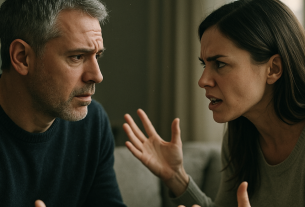
Igor was standing in the doorway, leaning against the jamb with his arms crossed. On his face played a lazy, slightly condescending smirk—the look of someone announcing something already decided and not up for discussion. He didn’t move, only tipped his head slightly, as if surprised by her slow comprehension.
“My parents,” he said. “They’re coming. Monday. What’s so hard to understand? They called half an hour ago—already bought the tickets.”
He said it as if he were talking about the weather forecast, not something that six months earlier had nearly destroyed their marriage. Irina turned to him slowly. She looked at him straight on, her gaze heavy and appraising, as if she were seeing him for the first time. She wasn’t looking at her husband now, but at some smug stranger who had invaded her home and her life.
“Igor. We agreed,” she said, enunciating every word. No begging, no hysteria—only a cold, leaden statement of fact. “You promised me. You gave your word that after last time… they wouldn’t set foot in this house again.”
He shrugged, and the smirk widened—bolder, more insolent. That gesture—dismissive, devaluing—hit harder than if he’d shouted.
“Yeah, I promised. So what? Things changed. They’re my parents. What am I supposed to say—don’t come, my wife’s against it? Think about how that’ll look.”
“I don’t care how it’ll look,” she said, still even, but now there was steel in her voice. “I care that you broke your word. You lied to me. After what your mother pulled last time… After she went through my things while I wasn’t home, then announced I was a terrible housewife and didn’t look after your health… You forgot how we didn’t speak for a week afterward? You forgot how you yourself said it was too much?”
He peeled off the doorframe and stepped into the kitchen, pushing into her space. The easy humor vanished; irritation took its place. He didn’t like being reminded of his weaknesses.
“Here we go again. Ira, stop it. Mom got carried away—who hasn’t? She apologized.”
“She didn’t apologize,” Irina snapped. “She said, ‘If I offended you somehow, then forgive me.’ That’s not an apology, Igor. That’s a way to make me guilty for daring to be offended. And you stood there nodding like one of those little bobblehead dolls.”
“Enough!” he barked, his voice slamming into the walls. “I’m not discussing this. It’s decided. They’re coming. Period. I’ve made my choice.”
His words—“I’ve made my choice”—didn’t sound like a threat. They sounded like a diagnosis. Final. Not subject to appeal. Irina looked at him, and something inside her—something warm and alive that had still been trying to justify, to compromise—suddenly went cold and hardened. She felt it almost physically, as if liquid nitrogen had been poured into her chest. All emotion—hurt, anger, disappointment—evaporated, leaving only a ringing, absolute clarity. She no longer saw a loved one who’d made a mistake. She saw an outsider who had just calmly declared that her feelings, her peace, and her home were worth nothing at all.
Igor, mistaking her silence for submission, decided to cement his victory. He walked to the table, took an apple from the bowl, and bit into it with a loud crunch. The juicy, defiant sound was an act of self-assertion. He chewed slowly, looking down at her, and open triumph glimmered in his eyes.
“Well, good,” he said through a mouthful. “Glad we understand each other. And if you don’t like it—if you’re not ready to show respect to my family… then you can move out for a week to a friend’s place. Sit it out until they leave. That way everyone will be calmer.”
He said it. He actually said those words out loud, standing in the middle of her kitchen—in the apartment bought with her money long before she ever met him. He suggested she, the owner, get out of her own home to make room for people who had already once turned her life into hell. And in that moment, everything ended for Irina. Not the marriage. Not love. The person she’d known as Igor ended. He ceased to exist, crumbled into dust, leaving behind only a brazen, self-satisfied shell.
Without a word, she turned away. No extra gestures. She didn’t keep putting groceries away—those symbols of ruined coziness. She simply left the kitchen and, without looking at him, walked down the hallway to the front door. Her steps were steady and firm—no rush, no fuss. Igor, surprised by the move, followed her, still chewing the apple.
“Where are you off to? Decided to pack your stuff after all? Good. No need to put on a drama here.”
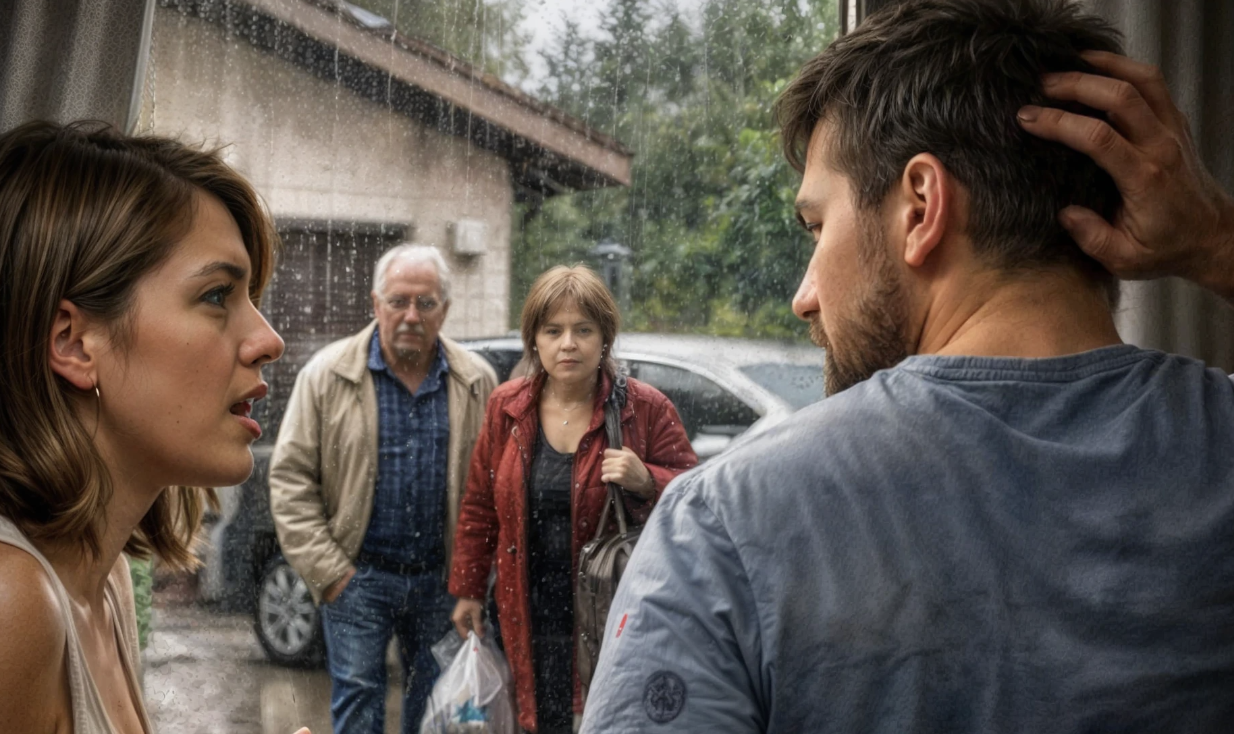
Irina reached the door, took the lock handle, and turned it. A loud, distinct click sounded. Then she pulled the door toward her, and it swung open silently, letting in the cool air and dim light of the landing. She turned to him. There was no anger or hurt on her face—only the cold, detached calm of a surgeon preparing for an amputation.
“Igor, you promised me your parents wouldn’t come to our home again after the last scandal! Why are they coming here again?!”
Her voice was level, not trembling in the slightest. It wasn’t a question; it was the reading of an indictment before the sentence. She looked him straight in the eyes, and for the first time he saw something there that made him uneasy.
“What are you doing, putting on a show?” he tried to smirk, but it came out strained. “Close the door—there’s a draft.”
“You’re right,” she nodded with that same icy composure. “Someone really should move out. Right now. You. Go. Go to your parents. And you can stay with them not for a week, but forever. Get out of my home.”
For a moment Igor froze. His brain, used to a certain script—her offended silence, then tears, then his condescending reconciliation—refused to process this new reality. The words “Get out of my home” sounded so clear and matter-of-fact they seemed like an absurd system error. He blinked, and genuine, almost childlike confusion flickered across his face. Then it twisted into a crooked, angry grin.
“You’re serious?” he gave a nervous laugh, stepping forward, intending to close this damned door and stop the draft and the theatrics. “Ira, are you out of your mind? You’re kicking me out? Over something this stupid? You’re ready to destroy our family just so you don’t have to let my old folks into our home for a couple of days?”
He deliberately used “our family” and “our home,” trying to drag her back into the familiar coordinates where everything was shared—and therefore his. But Irina didn’t budge, blocking his path to the door.
“No, Igor. Not ‘our home.’ Mine,” she corrected him, and that calm clarification was like a scalpel cut. “My apartment. You forgot? This is my apartment. And you live here. You’re a guest who stayed too long and somehow decided he was the owner.”
His face turned crimson. Being accused of freeloading was the most humiliating thing he could hear. All his performed confidence—his role as head of the family—cracked and crumbled.
“I live here?!” he roared, raising his voice to a shout. “I work, I bring money into this house! Or did you forget I don’t just lie on the couch? I support you and your apartment!”
Irina tilted her head slightly, and something like a researcher’s curiosity appeared in her eyes, as if she were studying a primitive organism.
“Support me? Interesting. Let’s do the math, Igor. My salary goes to the mortgage on this apartment, which I took out before you. To utilities. To the groceries in that fridge. To the cleaning supplies you’re too precious to use for уборка. And where does your salary go, Igor—remind me. Oh right. Gas for your car. The new rims you bought last month. Your Friday bar trips with your friends. And that ridiculously expensive drone that’s been collecting dust on top of the wardrobe for half a year. You don’t bring money into this home. You spend it on yourself—while letting me pay for your comfortable existence here.”
Every word was a dry fact, stripped of emotion. Not a reproach—an accounting report. And that bloodless precision drove him mad far more than screaming and broken dishes would have.
“You… you kept track?” he choked. “You sat there counting who spent what? What a petty, calculating—” He couldn’t find the words, breathless with rage.
“I didn’t keep track. I just stopped lying to myself,” she said, even quieter, and therefore heavier. “For a long time I pretended we were partners. That we were a family. I closed my eyes to the fact that you don’t act like a grown man—you act like a spoiled teenager who thinks everyone owes him. A wife should provide the household, and he’ll ‘bless’ her with his presence. But today you crossed the line. You didn’t just break your promise. You thought you could point me to the door in my own home. You decided you had that right.”
He stared at her, hatred and bewilderment mixed in his eyes. He didn’t recognize this woman. Where was the Ira who always smoothed things over, who forgave, who was afraid to upset him? In front of him stood a stranger—cold, impenetrable, and absolute.
“You just hate my parents! You always hated them!” he shouted—the last thing that came to mind, the most worn-out and pathetic accusation of all.
For the first time in the whole conversation, Irina allowed herself a smile. But there wasn’t a drop of amusement in it.
“Your parents have nothing to do with this, Igor. They’re just litmus paper. They simply showed who you really are. A man whose word means nothing. A man who’s willing to humiliate his wife just to not look like a bad son in Mommy’s eyes. So go. Go be a good son. Your role as a good husband ends here. Get lost. ”
The word “Get lost” hung in the hallway air. It wasn’t an emotional outburst—it was a dry, lifeless fact. Igor looked at her, and one thought thrashed in his mind: this isn’t real. This is some sick, drawn-out prank. Any second now she’ll blink, her face will twist with held-back tears, and everything will go back to normal. He’ll pretend he magnanimously forgives her; she’ll pretend she’s grateful. But nothing happened. Her face stayed a blank mask. She didn’t cry. She didn’t rage. She waited.
And then it hit him—not anger, but something much worse: panicked terror at losing control. He was losing everything—this convenient apartment, this predictable woman, this well-oiled everyday life he’d taken for granted. And in that animal fear he grabbed for his last weapon. The dirtiest, most poisonous one—used when you don’t just want to win, but to destroy.
Slowly, deliberately, he looked her up and down. His gaze was sticky and appraising, like a merchant inspecting damaged goods. Then he smirked—quietly, nastily.
“Got it,” he drawled, venom winding through his voice. “Now it all makes sense. You’re just jealous. I have a family. A mother, a father. Normal, living people who love me. And who do you have? Nobody. Just these walls. That’s why you go crazy when they come. They remind you how… empty you are.”
He paused to let the poison sink in. Irina didn’t move. Her face was carved from stone. Her silence spurred him on, gave him confidence. He took another step in his verbal attack, aiming for the softest spot.
“I always wondered why you don’t want kids. All those excuses—career, not the time… But that’s not it. You’re just not capable of loving anyone but yourself. You’re infertile, Ira. Not medically—no. In your soul. There’s no warmth in you, no life. Just calculation and cold. That’s why you’ll never be a mother, and that’s why my family line is like a bone in your throat. It’s real. And you’re a fake.”
He finished, breathing hard, laying his last card on the table. He expected anything: screaming, a slap, a stream of insults. He was ready for it—hungry for it—because any reaction would mean he’d hit the mark, that she was still alive inside, that he could hook her.
But nothing changed on her face. Nothing at all. No pain. No hurt. No anger. Her eyes looked as if they were focused straight through him, as if he were speaking some foreign language about someone else entirely. The person he’d thought she was finally died in her gaze. In that place there was only emptiness. She was silent for several seconds that felt like an eternity.
Then she spoke. Her voice was terrifyingly calm, like an operator reading evacuation instructions.
“Take your jacket from the hook. Your phone and wallet are on the console. The keys to your car are in the blue little vase there.”
She spoke slowly, giving him time to grasp every word. It wasn’t a suggestion. It was an order.
Igor went rigid. He hadn’t expected this reaction. The complete, total disregard for his monstrous words disarmed him. He was crushed not by her rage, but by her indifference.
“The keys to this apartment,” she added in that same flat tone, “leave on the console. You won’t need them anymore.”
Silently, like a sleepwalker, he turned around. His hands automatically found the leather jacket, pulled it off the hook. He took his phone. He scooped his keys from the little vase, and his fingers touched the cold metal of the apartment keyring. He froze for a moment, then pulled them out and set them down on the lacquered surface of the console. The sound was quiet, but in the deafening atmosphere it rang out like a gunshot.
He put on the jacket and stepped over the threshold without looking back. Irina didn’t watch his back. She turned away and looked down the hallway, into the depths of her apartment. He stood on the landing for a second, waiting for something—a slammed door, a final curse. But nothing followed. He had simply been erased.
She took the handle and slowly pulled the door toward herself. The heavy door panel slid into place without a sound. She turned the key in the lock. One turn. A second. The clicks were dry and final.
She stood in the hallway of her apartment. Alone. And the silence no longer felt oppressive.
It was clean…