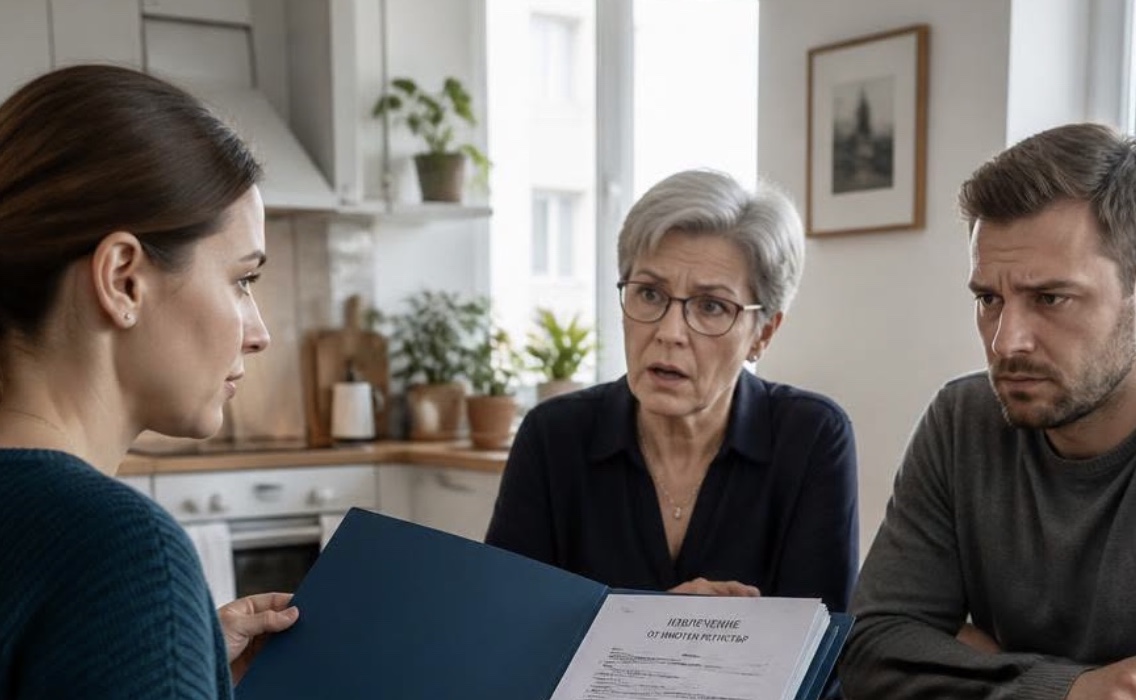
“Sign the prenuptial agreement. We already have an appointment with the notary tomorrow morning,” Galina Viktorovna said. “Vadim will receive half of the apartment and then transfer his share to Oksana. We’ve already discussed everything.”
A blue folder brought by my sister-in-law lay in front of me. The first page contained my passport details, home address, and the apartment’s cadastral number. On the final page, there was an empty line waiting for my signature.
During what was supposed to be an ordinary family dinner, they were asking me to give away half of a home I had purchased four years before getting married.
“Who gave you my personal information?” I asked.
Vadim pushed his plate aside and replied that he had taken the details from documents kept at home. His voice was calm, as if he were talking about filling out a warranty form for a new appliance.
Oksana sat beside her mother, slowly turning the pages of the agreement. At the bottom of one page, someone had written in pencil:
“After registration, transfer the share to Oksana as a gift.”
The dinner took place on July 2, 2026, in my two-bedroom apartment. I had purchased it on October 18, 2016. Vadim and I had registered our marriage on June 20, 2020.
Galina Viktorovna considered those dates an insignificant technicality standing in the way of solving her daughter’s housing problem.
“Oksana’s rent has gone up again,” my mother-in-law continued. “Every month she gives money to a stranger, while you have an entire room sitting here unused. Vadim has lived here for six years. He helped renovate the place. He is entitled to half.”
“Who exactly says he is entitled to it?” I asked.
“The law and basic human decency,” she replied confidently.
Galina Viktorovna could not name the specific law she was referring to.
Instead, Oksana opened a furniture catalogue to a page displaying a narrow sofa and announced that the smaller room had enough space for a wardrobe, a chest of drawers, and a bed.
“It will be a little cramped, but it’s enough for me,” she said. “I’ve already ordered the chest of drawers. The delivery address is this apartment.”
That explained why a furniture store had called me two days earlier to confirm which floor I lived on.
At the time, Vadim had claimed that his sister had accidentally given them our address. The measuring tape on the windowsill had supposedly been another coincidence. The catalogue of narrow wardrobes left near my desk had been dismissed as meaningless too.
Now all those coincidences were sitting together inside one blue folder.
“You were planning to bring her furniture here before I even signed anything?” I asked.
“Don’t exaggerate,” Vadim interrupted. “We were only looking for a practical solution. You work in the kitchen more often than you use that room anyway.”
He knew perfectly well that I worked at the desk by the window almost every evening.
Oksana knew it too.
Yet on the room plan, my desk had already disappeared, as though the decision had been made long ago.
I opened my own gray folder and placed three documents on the table: a current extract from the Unified State Register of Real Estate, the apartment purchase agreement, and our marriage certificate.
The original documents were being held by Vera Leonidovna, the lawyer I had consulted the previous day. I had kept copies at home.
“The property extract lists only one owner: me,” I said. “The purchase agreement confirms that I bought the apartment in October 2016. The marriage certificate confirms that Vadim and I married in June 2020. Ordinary renovations do not create ownership rights to half an apartment. Changing the legal ownership arrangement requires my voluntary consent and a notarized agreement. I do not consent.”
Vadim picked up the property extract, glanced over the first page, and tossed it back onto the table.
“That’s why the agreement was prepared,” he said. “You sign it, the notary verifies it, and the matter is settled.”
“I have already said no.”
“You’re angry right now. We’ll discuss it calmly in the morning.”
His confidence disturbed me more than the agreement itself.
Vadim treated my refusal as a temporary obstacle that his mother and sister would help him overcome. He had already given them my personal information, scheduled an appointment with a notary, and allowed Oksana to order furniture.
My participation in their plan began and ended with the signature line.
Galina Viktorovna pulled the property extract toward herself.
“You’re only the owner on paper,” she said. “This family has invested in the apartment for six years.”
“Then list those investments,” I replied.
Vadim named the wallpaper in the hallway, the kitchen cabinet fronts, the dishwasher, the coffee machine, and the kitchen faucet.
I reminded him that the wallpaper had been paid for from our joint account, the cabinet fronts had been purchased with my annual bonus, and the appliances were a separate matter.
He was welcome to take the coffee machine and his personal belongings.
Half of my apartment was not included in that list.
“After everything Vadim has done for you, you’re counting every cabinet door,” my mother-in-law said bitterly.
“I am counting the things you have already divided among yourselves without consulting me.”
Oksana snapped the folder shut and remarked that I did not need two rooms if I was going to live alone.
Then she looked at her brother.
That brief exchange revealed another part of the conversation that had taken place without me.
“Why would I be living alone?” I asked.
“Because there can’t be a normal family after this,” Oksana replied. “Vadim shouldn’t have to live with someone who values square meters more than people.”
My husband sharply told her to be quiet, but it was too late.
They had already discussed not only my apartment but also Vadim’s life after receiving his share.
The prenuptial agreement was only the first step. Divorce would change nothing in their plan. Half the apartment would remain with him and would later be transferred to his sister.
I photographed every page of the proposed agreement, including the handwritten note about gifting the share to Oksana.
Then I pushed the folder back toward Vadim.
“There will be no signature. I am not going to the appointment. Oksana will not move in here, and no furniture ordered in her name will be accepted at this address.”
“But we’re family!” Vadim exclaimed.
“A family discussion takes place before an appointment with a notary is scheduled.”
He stood up and accused me of creating a scandal over a draft agreement that had not changed anything yet.
Galina Viktorovna immediately defended him. According to her, a loving wife helped her husband’s relatives first and asked questions afterward.
I did not continue arguing.
Vadim lived in the apartment as my husband. I could not legally force him out immediately with a single command, and I had no intention of turning the situation into an unlawful eviction.
Instead, I offered him two calm options.
He could remain temporarily in the smaller room while we separated, but Oksana and her belongings would not be allowed inside.
The second option was for him to move voluntarily to his mother’s home, collect his personal property according to an inventory, and return the keys.
“I’ll stay with Mom,” Vadim said. “I’ll come for my things in the morning.”
“Come at ten. Oksana stays outside.”
My sister-in-law grabbed the blue folder and the measuring tape. Before leaving, she complained that the chest of drawers had already been paid for and that my refusal was causing her serious problems.
“You chose the delivery address without asking me,” I replied. “You can deal with the consequences yourself.”
After they left, I photographed the furniture store label attached to the catalogue and sent Vadim a message confirming the time when he could collect his belongings.
He replied that he would not consent to a divorce and would not go to the civil registry office.
We had no minor children together, so his refusal simply meant that the divorce would have to go through the courts.
Vadim arrived alone the next morning, July 3.
Empty cardboard boxes were waiting on the landing. Oksana had brought them but remained downstairs in the car.
I handed my husband two copies of an inventory list. It included his clothes, laptop, books, tools, sports bag, coffee machine, and personal documents.
“You’re treating me like a tenant,” he said.
“The inventory protects both of us. You collect your belongings, sign the document, and keep one copy.”
Vadim spent more time reading the inventory than he had spent examining the property extract.
Then he began packing.
I worked in the kitchen and only came into the room when he asked about a specific item. Within an hour, three boxes and two bags were standing near the front door.
During that time, the furniture delivery driver called.
I explained that I would not accept Oksana’s order at my address and had never authorized anyone to bring furniture into the apartment.
A few minutes later, Oksana called her brother.
Over the speakerphone, she demanded that he accept the chest of drawers and keep it in the apartment until evening.
Vadim muted the call and continued packing his books.
“Mom says you’re afraid of going to court,” he said later. “That’s why you’re photographing everything.”
“If you believe the apartment is jointly owned, file a lawsuit and prove that you made substantial investments in it,” I replied. “I will provide the purchase agreement, the property extract, and the financial records.”
He gave a mocking smile and asked when I had started speaking like a lawyer.
I reminded him that he was the one who had brought me a ready-made prenuptial agreement and expected me to sign it without discussion.
After that, he stopped talking about my supposed greed.
In the smaller room, Vadim noticed Oksana’s furniture plan still hanging beside my desk.
He studied the drawing for several seconds, focusing on the place where my desk had been crossed out.
“Did she really order the furniture in advance?” he asked.
“You were sitting beside her when she said so.”
“I thought the chest of drawers was going to stay at Mom’s house for now.”
“My address is written on the delivery invoice.”
Vadim took the room plan down from the wall and placed it on the desk.
For the first time, he made no attempt to defend his sister.
Once all the boxes had been carried outside, we checked the inventory together.
Vadim added a handwritten note confirming that he had received the listed belongings, moved voluntarily to his mother’s home, and returned his set of keys.
After checking the boxes, I signed beneath his statement acknowledging the handover.
“So this is all ending because of that folder?” he asked as he stood in the hallway.
“The folder revealed a decision you had already made without me.”
He picked up his final bag and left.
Oksana was waiting near the boxes on the landing.
She never entered the apartment.
That afternoon, I filed a petition for divorce with the court. I made no property claims. My copy was stamped to confirm that the documents had been accepted.
On Saturday, Vadim returned for the rest of his clothes and two boxes of tools.
We updated the inventory, and he signed another statement confirming that he had received the remainder of his belongings.
Galina Viktorovna came with him but stayed in the car.
Oksana was busy dealing with her furniture delivery and never called me again.
I moved my desk back to its place by the window and removed the room plan from the wall.
The property extract, purchase agreement, and marriage certificate went back into the gray folder. I saved the photographs of the proposed prenuptial agreement in a separate location.
The envelope containing the returned key and the signed inventory was placed in a drawer.
Only two things remained on the desk: my own set of keys and a copy of the divorce petition bearing the court’s official stamp.