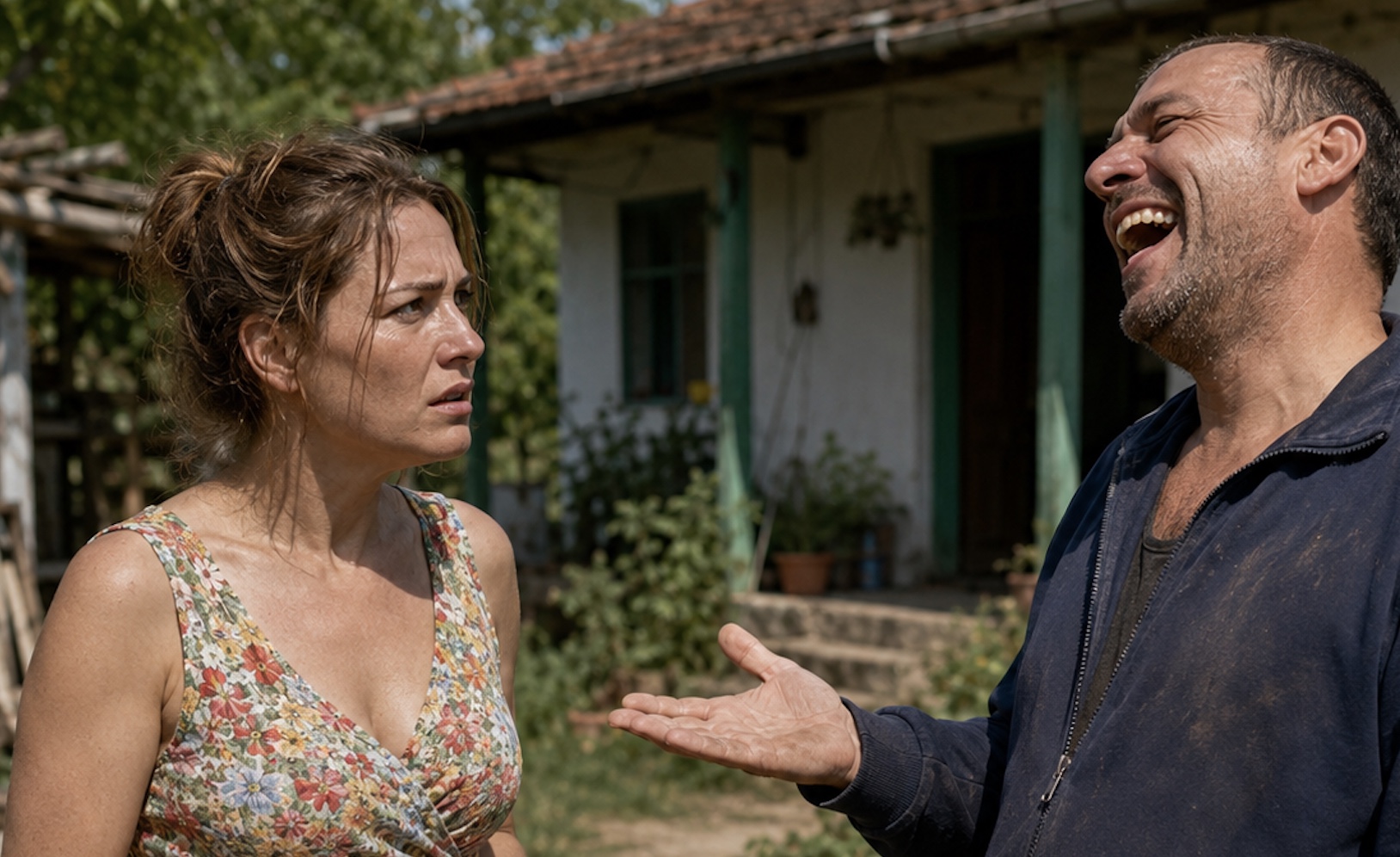
The barbecue smelled of smoke and betrayal.
Galina stood holding a skewer, watching the juices drip onto the glowing coals. The smell of meat roasting outdoors had always reminded her of celebration. Of childhood. Of something simple and good.
But now, as she looked at her husband through the wavering heat above the grill, that familiar aroma seemed permanently entwined with something else—with a feeling she had spent years struggling to name.
“Give me that.”
Boris stepped toward her quickly, almost casually, and snatched the skewer from her fingers.
He did not ask for it. He pulled it away.
Then he gave a short laugh, as though he had just performed a clever trick.
“You haven’t earned it!”
He burst out laughing.
Natasha and Oleg laughed too, a second later—the way people laugh when they want to show that they understand a joke, even though they are really just afraid of the awkward silence that would follow if they did not.
Galina stood there with empty hands.
The sun was sinking toward the water. The river shimmered beyond the reeds, and somewhere in the distance a cuckoo was calling.
It was a beautiful place—genuinely beautiful, filled with that special freshness the countryside has in May, when everything is already green but not yet covered in summer dust.
Boris had chosen a good spot.
Boris always chose good spots.
Galina lowered her eyes to her hands. Then she looked back at her husband.
And at that moment, something clicked inside her.
Quietly, almost soundlessly, like a lock finally opening when the key turns the right way.
They had met six years earlier at a mutual friend’s birthday party.
At the time, Boris had seemed dependable. Confident, but not in an arrogant way. His confidence had appeared reassuring, as though he simply knew what he wanted and that certainty brought him peace.
Galina, already in her early thirties, valued peace.
She had grown up in a family where her father could explode without warning and her mother often cried alone in the kitchen. Boris had seemed different.
He brought her flowers. Took her to restaurants.
Once, while they were driving along the coast late in the evening, he had suddenly pulled over so she could get out and watch the sunset.
Galina had thought, This is him. This is the man I have been waiting for.
They married a year later.
The first few months were ordinary, like the beginning of most marriages: adjustments, small disagreements, minor joys.
Galina cooked. Boris ate in silence.
Galina cleaned. Boris noticed whatever she had missed.
Galina bought something for the apartment. Boris told her she had chosen the wrong thing or paid too much.
“My mother never did it like that,” became his favorite phrase.
At first, Galina treated it as information. Something useful she could remember.
Then she began to hear it as criticism.
Eventually, it became a weapon he always kept within reach.
Boris’s mother was apparently a remarkable woman. Galina believed that.
But this remarkable woman lived somewhere inside Galina’s imagination, where she did everything perfectly, never grew tired, never forgot to salt the soup, and always greeted her husband with a hot meal waiting on the table.
It was impossible to compete with such a woman.
Not that Galina wanted to compete. She worked hard, and by evening she often had no strength left for elaborate meals or domestic perfection.
“How much do you earn?” Boris asked her one day during the third year of their marriage.
He spoke as if he were asking for the first time, though he knew the answer perfectly well.
“Exactly. So which one of us should be thinking about the family?”
He earned more than she did.
That was true.
He knew how to use that fact against her.
That was true as well.
Gradually, year after year, Galina began to feel like a dependent in her own home—someone who was merely being tolerated.
She tried explaining it to her friends, but they only shrugged.
“All men are like that,” one of them said.
“At least he doesn’t hit you,” said another, as though that proved everything was fine.
Galina would fall silent and wonder whether they were right.
Perhaps all men really were like this.
Perhaps she was the one doing something wrong.
The thought that the problem might not be her came rarely and never stayed for long.
Until that May afternoon by the river.
Boris had been gloomy from the moment they began preparing for the trip.
Galina did not know why. Maybe something had happened at work. Maybe he had simply woken up in a bad mood.
She tried to stay out of his way.
She packed the bag, checked that they had brought the dishes, and covered the basket of food with a blanket.
During all that time, Boris did not say a word to her.
When she tried to help him load the grill into the car, he pushed her aside with his shoulder.
“Don’t touch it. You’ll drop it.”
The car belonged to Galina.
She had bought it on credit and made every payment herself.
Boris’s Toyota had been sitting in a repair shop for three weeks because of some problem with the transmission. The details were complicated and unimportant.
They were traveling in Galina’s silver Škoda, but Boris sat behind the wheel with the expression of a man doing her a favor.
Natasha and Oleg were waiting outside their apartment building.
They were acquaintances Galina had never learned to think of as close friends, even after five years.
Technically, they were relatives. Natasha was Boris’s cousin, and Oleg was her husband.
In practice, they were people who looked at Galina with the same faint condescension Boris did, as though she were a guest at someone else’s family celebration.
“Oh, look—the newlyweds have arrived!” Oleg shouted when he saw their car, laughing at his own joke.
Galina smiled.
She had learned to smile at jokes like that.
The drive took more than an hour.
Boris and Oleg talked about work, fishing, and mutual acquaintances. Natasha scrolled through her phone.
Galina looked out the window at fields, patches of woodland, and distant blue squares of water.
May really was the best month of the year, she thought.
It was only a shame that good weather and a beautiful place could not guarantee a good day.
The spot Boris had chosen was indeed lovely.
There was a clearing beside the river, tall pine trees, and soft grass broken here and there by cool patches of shade.
They spread out the tablecloth and unpacked the food. Boris began working on the grill.
That was when something inside him seemed to release.
It was as though he had been carrying a heavy burden all day and had finally found somewhere to unload it.
It began with something trivial.
Galina poured herself some juice and placed the glass somewhere Boris believed it should not be.
“Galya, where are you putting that? The tablecloth is already wet.”
“Sorry,” she said.
She picked up the glass and moved it farther away.
But Boris was only getting started.
Galina had learned to sense it without even looking at him—that peculiar pressure in the air before a storm, when he had found a subject and intended to keep pulling at it until he had said everything he wanted.
“No, seriously,” he said as he adjusted the coals. “You can’t even do the simplest thing properly. I don’t understand it. You’re a grown woman.”
Natasha nodded sympathetically.
Oleg gave a quiet snort.
“Are you talking about the glass?” Galina asked evenly.
“I’m talking about everything.”
Boris straightened up and wiped his hands.
“The glass. The fact that you brought a white tablecloth into the countryside. White! And you forgot the salt…”
“I didn’t forget it. It’s in the bag.”
“In the bag. Wonderful. So taking it out isn’t your responsibility either?”
Galina stood up without a word, opened the bag, removed the salt, and placed it on the tablecloth.
Boris looked at her as though she had just confirmed some long-held belief of his.
“You know, Galya,” he said, sitting down in a folding chair and reaching for a beer, “sometimes I think about it. You earn next to nothing. Our home looks like… well, like the home of people who simply don’t care.”
He paused.
“And I honestly don’t understand what you contribute to this family. I really don’t.”
Natasha lowered her phone.
Oleg turned toward the river with the expression of a man pretending not to hear while listening to every word.
“Boris,” Galina said.
“What do you mean, ‘Boris’? I’m telling the truth. Are you offended by the truth?”
“I just wanted us to have a nice day.”
“And I wanted a wife who knew how to cook.”
He laughed, and his laughter was not even angry.
That was the worst part.
He laughed lightly, as though he had said something genuinely amusing.
“My wife is certainly talented with her hands. No doubt about that.”
Natasha smiled too.
It was a small, restrained smile, one Galina might have chosen not to notice.
But she noticed.
By then, the meat was ready.
Boris removed it from the grill himself. He had chosen the meat, marinated it the night before, and cooked it, so Galina had willingly let him handle it.
The barbecue smelled of onions, and the crust was a deep golden brown.
He knew how to grill meat.
That was another truth.
Galina reached for a skewer.
“You haven’t earned it!” Boris said with a laugh, pulling it away.
That was when it began.
She looked at him.
At his pleased expression.
At Natasha, who was now laughing openly.
At Oleg, smiling toward the river.
And Galina thought, So this is what it is.
This is what it is called.
Not “a difficult personality.”
Not “a man with strong principles.”
Not “he’s simply tired after work.”
This was what it really was.
It mattered to him that she remain smaller than he was.
That she depend on his approval.
That even a piece of meat at a picnic should not simply be food but a reward he could grant or withhold as he pleased.
Five years.
For five years, she had explained everything away.
She had searched for reasons.
He was tired.
His blood pressure was high.
He was simply in a bad mood.
She invented excuses for him faster than he could invent them himself.
Galina inhaled slowly.
Then she exhaled.
She looked at her husband calmly—so calmly that he seemed to become slightly uneasy.
“You’re right,” she said.
Boris lowered the skewer a little.
“What do you mean?”
“You bought the meat. You marinated it. You cooked it. My contribution to this barbecue was minimal. You’re absolutely right.”
There was a pause.
Natasha stopped smiling.
“Well…” Boris began.
“No, I’m serious,” Galina continued in the same level voice.
She was already standing up and brushing the grass from her jeans.
“I don’t want to interfere with your day. Honestly. Eat, relax. It’s a lovely place.”
“Galya, where are you going?”
She was already walking toward the car.
Her car.
The silver Škoda she had bought herself, paid for herself, and used to drive her husband around for three weeks while his Toyota sat in the repair shop.
“Galina!”
Boris shouted louder now, and something unfamiliar entered his voice.
Something close to confusion.
She opened the door, got in, and started the engine.
In the rearview mirror, she saw the three of them standing in the clearing.
Boris still held the skewer.
Natasha’s mouth was hanging open.
Oleg looked like a man who had only just realized something was happening that required his attention.
Behind them, the river sparkled.
The cuckoo continued calling.
Galina turned the car around and drove away.
The journey home took more than an hour.
She turned on the radio. Something light and cheerful was playing, a song that sounded like spring.
Galina sang along softly, almost without making a sound, simply because her mouth seemed to open on its own.
She did not cry.
She had expected to cry. Tears seemed like an obligatory part of a moment like this.
But there were no tears.
There was something else.
A lightness that made her almost dizzy, like the first drink of water after a long, unbearable thirst.
She called her mother from the highway using the car’s speakerphone.
“Mom, I’m coming over. Can I stay with you for a while?”
Her mother was silent for a second.
Then she said, “Of course, Galochka. Your father is making barbecue right now.”
Galina laughed.
A real laugh, deep and warm, rising from her stomach.
When she reached the apartment, she packed quickly.
Not because she was in a hurry, but because she suddenly realized how few truly important things she had there.
Documents. Clothes. A few books. Photographs—but only the ones where she was alone, with her parents, or with friends.
She left the photographs with Boris on the shelf.
Let them stay there.
Her phone began ringing as she placed the last bag near the door.
Boris.
She answered.
“Galya,” he said.
His voice sounded different—quiet, almost pleading. She had not heard him speak like that in years.
“Galya, what are you doing? It was only a joke. Don’t you understand humor?”
Galina sat on the edge of the sofa and closed her eyes.
“Boris,” she said, “if you want to become a clown, enroll in circus school. They’ll teach you what a joke actually is.”
“Wait. Listen to me…”
“I’m listening. Just tell me something new, all right? Something I haven’t heard before.”
He was silent.
Then he began talking about how tired he was. About work. About stress. About how she should understand him.
Galina listened for a minute.
Maybe a minute and a half.
Then she said, “Send me a message when you get back. It’s a remote place, after all.”
And she ended the call.
Her parents’ home smelled of grass and old wood.
It was the scent Galina remembered from childhood, and it had always meant one thing to her.
Safe.
Her father came out to meet her. He looked at her, then at the bags, and asked no questions.
He simply picked them up and carried them into her old bedroom.
Her mother hugged her in the doorway—tightly, the way only mothers can hug when they understand that their daughter has come home.
“The barbecue is ready,” her mother said. “Go wash your hands.”
The three of them sat together at the table on the veranda, eating meat and drinking fruit compote.
Her father told them a story about a neighbor’s cat that had started sneaking into their garden.
Galina listened and thought, This is what a normal family looks like.
She filed for divorce two weeks later.
Boris tried calling several more times.
Sometimes he sounded pitiful. Sometimes accusatory. Then pitiful again.
Once, he told her she had destroyed their family.
Galina considered his words before replying.
“A family that can be destroyed because someone drove away from a picnic was already broken long before that.”
The court proceedings were peaceful.
Galina took what she was legally entitled to—half of their jointly acquired property, without bargaining and without drama.
Her lawyer told her she was one of the calmest clients he had ever represented.
She did not explain that calmness comes when the decision has already been made and you are finally at peace with it.
On the first weekend after everything became official, Galina drove out of the city alone.
She found a pleasant spot beside a river and parked her car in the shade.
She cooked the barbecue herself, without rushing, turning the skewers at regular intervals.
The air smelled of smoke and onions.
The sunlight lay across the water in golden patches, and some small bird rustled among the reeds.
When the meat was ready, Galina lifted a skewer from the grill and settled onto the blanket.
She picked up her phone and took several photographs—the river, the sky, the plate of steaming meat, her feet resting in the grass.
She paused a little longer before taking the final picture.
It was simply her face in profile, outlined by the sunlight.
She was smiling.
The caption she wrote was brief:
“Earned it.”
Then she put the phone aside and picked up the skewer.
The meat was delicious.
She had done everything right.