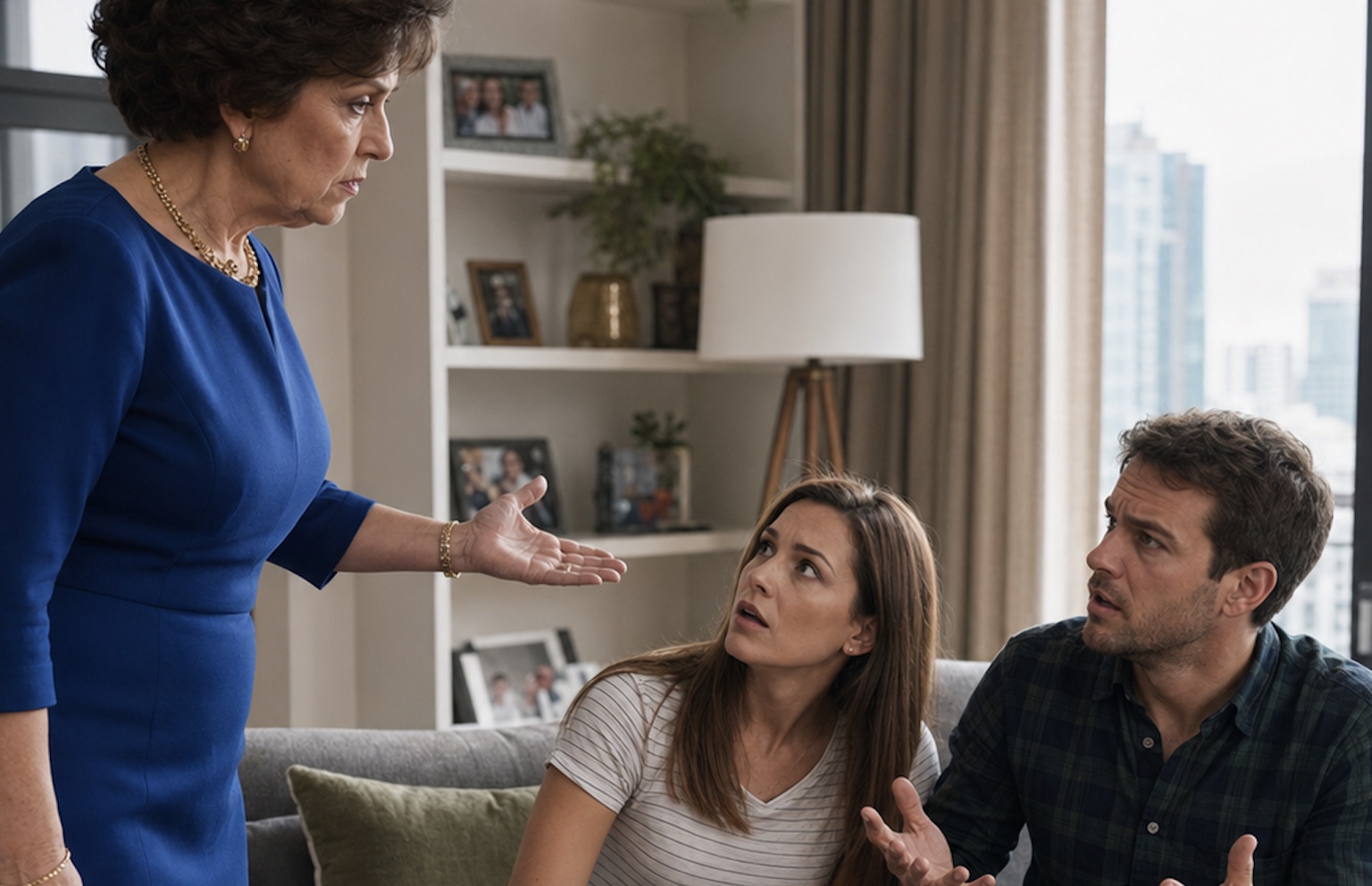
Daria froze with a cup of coffee in her hand. The hot drink nearly spilled over her fingers. She had barely gotten used to her new car, which she had bought only a month earlier after saving for eight long years.
“Excuse me, what do you mean by leaving the keys?” Daria asked, struggling to keep her voice steady.
“I mean exactly what I said. I’m an elderly woman, and taking buses is difficult for me. You’re young. You can manage.”
Galina Ivanovna spoke as though she were asking to borrow a little salt or an umbrella. There was no hesitation in her voice and certainly no request. It was a firm declaration, as if the matter had already been settled.
Daria slowly placed her cup on the table. At that moment, she realized this conversation had gone far beyond an ordinary family favor.
Daria had never been someone to whom money came easily. She worked as a project manager for a large real estate development company. Her salary allowed her to live comfortably, but she was far from wealthy.
The idea of buying her own car had come to her during the first year of her marriage. She opened a separate savings account and deposited her first five thousand rubles.
“Why do you need a car?” Alexei asked when she told him about her plan. “The metro works, and there are minibuses everywhere. We can live without one for now.”
“You can,” Daria replied quietly. “But I want one of my own.”
Alexei shrugged and never brought up the subject again. He was the kind of person who could support someone else’s initiative, but rarely started anything himself.
Daria, however, moved toward her goal with determination. She refused to buy a new fur coat while the women around her updated their wardrobes. She skipped foreign holidays for three years in a row. During tax season, she took on extra work in the evenings, checking financial reports for small companies while her husband watched television.
Eight years later, she walked out of a dealership holding the keys to a silver crossover.
There was no loan and no debt.
The car belonged entirely to her.
Galina Ivanovna called that same evening.
“Well done, Dasha,” she said warmly. “I’ve already told all my friends. I said, ‘My daughter-in-law is so clever. She earned the money herself!’”
Daria smiled then, never suspecting that something unpleasant was already beginning to grow behind that praise.
A week later, her mother-in-law asked for a ride to the clinic. Daria took her. A few days later, she needed to go to the market. Then somewhere else. The requests were polite and accompanied by smiles, so Daria saw nothing alarming in them.
Not yet.
During the first few months, Daria convinced herself that everything was merely a coincidence.
What was wrong with driving an elderly woman to a medical appointment? Why not take her to the market on a Saturday? It seemed natural, almost like a family obligation. After all, Daria had a car, and her mother-in-law was no longer young.
But gradually, the trips became more frequent.
Galina Ivanovna began calling every Friday with a complete schedule for the weekend.
“Dasha, tomorrow morning we need to go to the pharmacy. After that, I promised Nina Sergeyevna we would collect her from her country house. Then we’ll need to bring her back in the evening,” she would say, without the slightest hint that Daria had a choice.
“Galina Ivanovna, I already have plans tomorrow,” Daria would answer carefully.
“What plans could you possibly have? It’s Sunday.”
Daria noticed something else as well. She always paid for the fuel. Her mother-in-law never once offered to contribute, as though even discussing it would be inappropriate.
Gratitude was rare. More often, Galina Ivanovna found something to criticize. Daria had taken the wrong route. She had kept her waiting too long outside the building. The car was too cold.
One evening, during dinner, her mother-in-law said something that stayed with Daria.
“A family car should serve the entire family,” she declared while helping herself to salad. “Otherwise, what is the point of having one?”
Alexei nodded without looking up from his plate.
“Alexei, do you agree with that?” Daria asked quietly.
“Well, Mom is right in a way. You don’t live alone.”
Daria said nothing, but something shifted inside her.
It was no longer the fact that they used the car that bothered her. She was not a selfish person. What hurt was their complete certainty that her opinion did not matter.
Eight years of effort had become nothing more than background noise, something that apparently did not require respect, gratitude, or even permission.
They celebrated Alexei’s sister Svetlana’s birthday with a large gathering. About fifteen people crowded around the table. There were loud toasts, roasted chicken, and children running through the hallway.
Daria sat beside her husband and was in a good mood.
Then, without warning, the conversation turned to the car.
Galina Ivanovna, flushed from the wine, addressed the entire table.
“It’s strange, isn’t it? There’s a car in the family, but every time you ask to use it, they behave as though they’re doing you some enormous favor.”
The table fell silent.
Daria felt heat rise into her cheeks.
“Mom, why are you saying this now?” Alexei muttered, but there was no real objection in his voice.
“Why shouldn’t I say it? It’s the truth. I’ve already suggested that they arrange a power of attorney and leave the car outside my building. I need it more. I go somewhere every day.”
Uncle Valera gave an approving cough. A distant aunt sitting nearby nodded enthusiastically.
“She’s right. Public transport is difficult for pensioners these days. The buses hardly run properly.”
Then Alexei added something Daria had not expected.
“Dasha, you could try to understand her position. Mom isn’t getting any younger.”
Daria looked at her husband and barely recognized him.
She smiled mechanically, only because she did not want to cry in front of everyone at someone else’s birthday table.
Later, when the guests moved into the kitchen for tea, Daria went into the hallway to collect her handbag.
Through the half-open living room door, she heard her mother-in-law’s voice. Galina Ivanovna sounded confident, almost pleased with herself.
“I already told Svetochka that the matter is settled. The car will be parked outside my place soon. Dasha won’t have a choice.”
Daria stood in the hallway, clutching her bag.
At that moment, something inside her finally became clear and unshakable.
Galina Ivanovna arrived on Wednesday without warning.
She rang the doorbell with the expression of someone who had already made the decision and had come merely to collect what belonged to her.
“Dasha, let’s not waste time arguing. Where are the keys?”
“Come in, Galina Ivanovna,” Daria replied evenly, stepping aside.
Her mother-in-law entered, sat on the sofa, and folded her hands in her lap.
“At my age, comfort matters more. You’re young and healthy. You can take the bus. It won’t hurt you.”
Alexei stood near the wall and said nothing.
“Wait a moment,” Daria said. “You went to Turkey last year, didn’t you?”
“What does that have to do with anything?”
“You also renovated your apartment. And you bought this new sofa. I remember you telling us about it. You have enough money for comfort. Your own comfort.”
Galina Ivanovna’s face turned red.
“It’s my money! I can spend it however I like!”
“Exactly,” Daria said with a nod.
She brought over a folder filled with documents.
“These are my eight years. Extra jobs, missed holidays, and monthly savings. Everything is recorded here. None of you contributed a single ruble toward this car.”
She opened the folder and placed it on the table.
“You do have a driver’s license, but you haven’t driven in almost ten years. I checked.”
The room fell silent.
“The car belongs to me,” Daria said calmly and firmly. “This discussion is over.”
The scandal still happened, only a little later.
Galina Ivanovna left without saying another word, but the next morning she began calling relatives.
She described Daria as cold, selfish, and ungrateful. She complained that her daughter-in-law refused to share a simple car with the family.
Alexei walked around in a dark mood for several days.
“You could have handled it more gently,” he said one evening.
“I was calm,” Daria replied. “That is not the same thing as being soft.”
He had no answer.
The turning point came unexpectedly.
Galina Ivanovna called her son and demanded that he pay for insurance on the car.
“Mom, you don’t even use it,” Alexei said in confusion.
“Not yet. But I will.”
After that conversation, Alexei remained silent for a long time.
Then he entered the kitchen, where Daria was reviewing work documents.
“You were right,” he said quietly. “It’s your car. I should never have stayed silent.”
Daria looked up at him.
“Thank you for saying that.”
Once Alexei openly refused his mother, the calls from relatives stopped.
The issue disappeared as suddenly as it had begun, almost as though it had never existed.
In May, Daria and Alexei set off on a five-day trip toward Karelia.
Daria drove along the morning highway while Alexei dozed in the passenger seat, his head tilted back.
“Are you tired?” he asked after about three hours.
“No,” she replied. “I enjoy driving.”
A pine forest stretched beyond the windows, and the pale blue sky reflected in puddles along the roadside.
Daria held the steering wheel and thought about how strangely time worked. Those eight years had once seemed endless. Now, looking back, they almost felt easy.
In the end, Galina Ivanovna applied for a discounted public transport pass and returned to her usual routine.
Sometimes, during family dinners, she cast brief glances in Daria’s direction. Perhaps they still held resentment, or perhaps the habit had simply remained.
But she never mentioned the car again.
Daria did not hold a grudge.
She did, however, remember the lesson.
She finally understood something she had previously known only in theory: the value of hard work is not measured only in money.
It is measured in years, sacrifices, and evenings spent working through exhaustion.
Protecting the result of that effort is not greed.
It is self-respect.