For two weeks after moving in, Inna carried the keys to the new apartment in her coat pocket for no real reason. She rarely took them out. Every now and then, she would simply run her fingers over the jagged metal edge.
It was a silly habit, perhaps, but she loved the feeling it gave her.
Mine.
At last, something that was truly mine.
For eight years, she and Stepan had drifted from one rented place to another. First there had been the studio near the railway station, where frost formed on the inside of the windowsill every winter. Then came a one-bedroom apartment in a residential district, whose landlady visited once a month to inspect the property. After that, there was another apartment, and then another.
Everywhere they went, there were someone else’s wallpaper, someone else’s furniture, someone else’s smell.
And at the end of every month, Inna transferred more than thirty thousand rubles to a person she barely knew.
Then Aunt Galya died.
She had been Inna’s mother’s older sister, a childless woman who had lived alone. She left behind a will.
In it, she gave Inna a spacious four-room apartment in an old but solid brick building in the city center. It had high ceilings and windows overlooking a small park lined with linden trees.
Inna could still remember the first time she entered the apartment as its legal owner.
The rooms were empty. The parquet flooring had dried out and cracked in places. The walls were covered in faded floral wallpaper from the 1970s.
And yet her heart had nearly stopped with happiness.
She could do anything here.
There could be a nursery.
A study.
A large kitchen, the kind she had dreamed about for years.
The renovation consumed almost all the money Aunt Galya had kept in her savings account. Inna invested every last ruble.
She chose the tiles herself. She drove to the warehouse to collect the laminate flooring. She argued with the foreman when the wallpaper seams were crooked.
During that time, Stepan was busy working. He sold auto parts and spent most of his days driving between suppliers. On weekends, he helped with physical tasks when he could.
But the mind and soul behind the renovation belonged to Inna.
Every socket was exactly where she had decided it should be.
“Look at this,” Stepan said when everything was finally finished.
They stood in the middle of the living room, breathing in the smell of fresh paint.
“It’s beautiful. Just imagine—this is all ours now. We don’t owe anyone another kopeck.”
“Ours,” Inna repeated with a smile.
At the time, she did not pay much attention to that word.
They moved in at the beginning of spring.
For the first few months, life was exactly as Inna had imagined during all those years of renting.
In the mornings, sunlight flooded the kitchen. She made coffee in her new copper pot while Stepan read something on his phone. Outside the window, leaves rustled in the park.
They settled in slowly, hanging a painting one week, installing a shelf the next.
Stepan earned close to one hundred thousand rubles a month. Inna worked as a manager for a medical-equipment company and made around sixty thousand.
They had little money left after the renovation and had only just started rebuilding their savings. But for the first time in their lives, they were not paying rent.
That alone made it easier to breathe.
Nearly six months passed without a single serious argument.
Inna had begun to think that perhaps this was it—the stability she had spent so many years begging life to give her.
Then, one Saturday in July, someone rang the doorbell.
Inna was dusting the shelves in the living room. Stepan was home, fixing a leaking tap in the bathroom.
She went to open the door, wiping her hands on her apron, completely unaware of what was waiting on the other side.
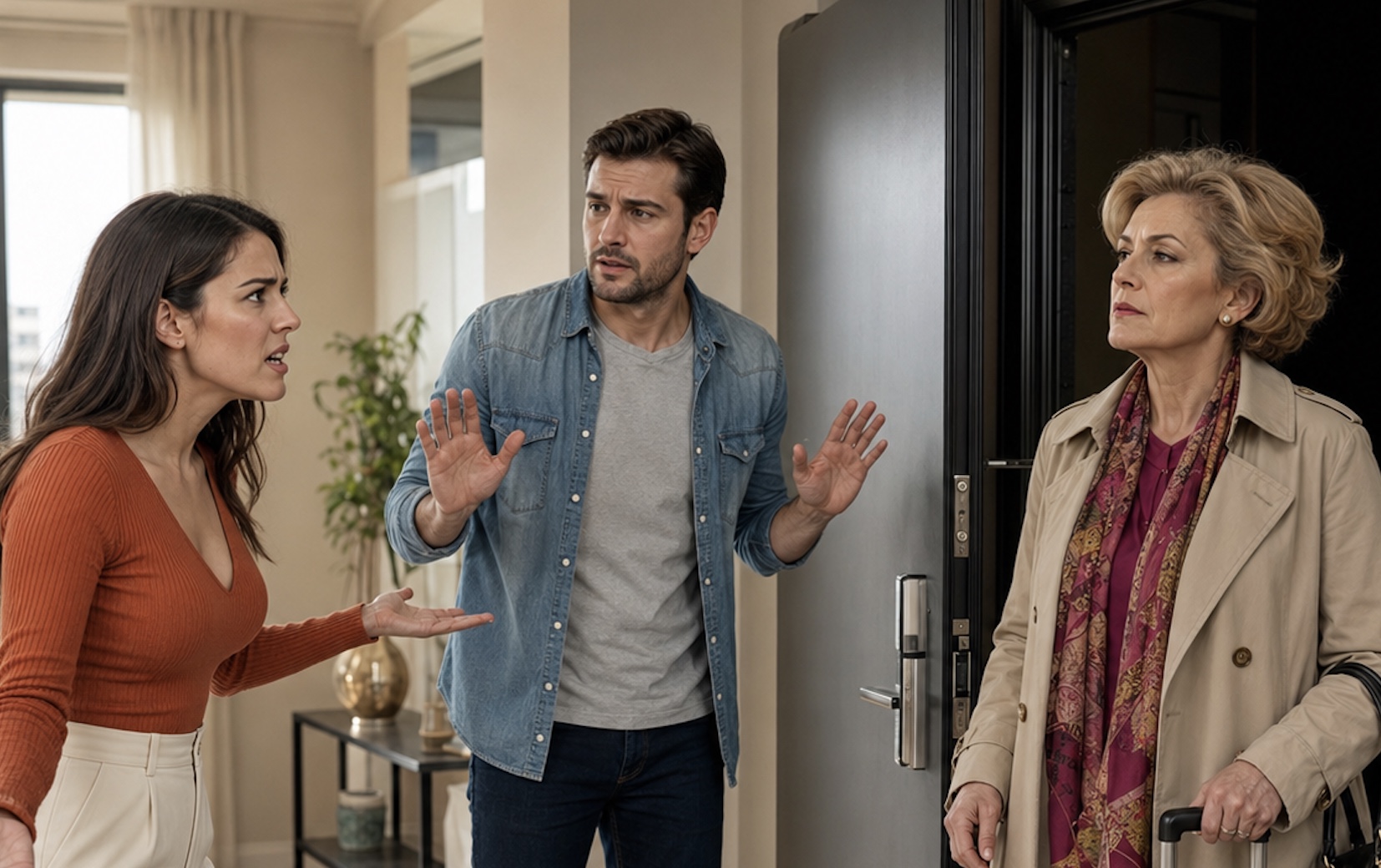
Vera Petrovna, Stepan’s mother, stood in the doorway.
Her large figure filled almost the entire entrance. Beside her was an enormous plaid suitcase on wheels and two bulging travel bags.
“Finally,” her mother-in-law said instead of greeting her.
Without waiting to be invited inside, she stepped across the threshold.
“I thought no one was going to answer. Stepan! Son, come help your mother with the suitcase!”
“Hello, Vera Petrovna,” Inna said, moving aside in confusion. “Are you visiting us? How long are you planning to stay?”
“You mean you don’t know?”
Vera Petrovna looked around the hallway with a sharp, appraising gaze, as though already deciding what belonged where.
“I’ve come to live with you. Permanently.”
She rolled the suitcase inside herself, leaving two dark streaks across the newly installed laminate floor.
Inna stared at the marks and, for several seconds, could not find the words to respond.
“What do you mean, permanently?”
Stepan emerged from the bathroom, drying his hands on a towel.
The moment he saw his mother, Inna noticed something important.
He was not surprised.
Not even slightly.
Only his eyes shifted nervously.
“Oh, Mom. You’re here. Come in. Why are you standing in the doorway?”
“Stepan,” Inna said, turning to him. “What does she mean, she’s here permanently? Did you know about this?”
“Inna, can we talk about it later?” he said. “At least let her take off her coat first.”
He grabbed the suitcase and carried it toward the living room.
“Mom, how was the journey? Did you get here all right?”
“What journey? That miserable minibus shook me around for two hours.”
Vera Petrovna had already taken off her coat. She hung it on the hook where Inna usually kept her jacket, pushing Inna’s things aside without hesitation.
“What an apartment you have. So much space. I told you, there’s room here for everyone.”
Inna stood frozen, looking from her husband to her mother-in-law and back again.
Something was happening.
Something had been discussed and decided without her.
Behind her back.
Inside her own home.
“Room for everyone?” she repeated quietly.
“Of course.”
Vera Petrovna walked into the living room and settled comfortably into an armchair, looking around as if she owned the place.
“You have four rooms. More than enough for two people. I’ll take the smallest bedroom. I don’t need much. Then I can rent out my apartment and make a little extra money. My pension is barely enough to live on.”
She spoke so calmly, so casually, as though everything had already been settled and there was nothing left to discuss.
As though she were the owner of the apartment and Inna were merely some young girl expected to bring tea and stay out of adult conversations.
Heat rushed into Inna’s face.
She opened her mouth, then closed it again.
Stepan fussed around his mother, asking about her health and some neighbor of hers. He was deliberately avoiding his wife’s eyes.
And that nervous performance told Inna more than any confession could have.
He had known.
He had known in advance.
He and his mother had planned everything together, while Inna—the legal owner of the apartment—had been treated like a piece of furniture that could be moved without permission.
“Stepan,” she said in a quiet, controlled voice. “Can I speak to you for a minute? In the bedroom.”
“Inna, come on…”
“One minute.”
Something in her tone made him stand up.
Vera Petrovna watched them leave. For a moment, something appeared on her lips—not quite a smile, but the shadow of one.
Satisfied.
Confident.
Inna closed the bedroom door behind her husband and leaned back against it.
For several seconds, she said nothing. She simply breathed, trying to steady herself.
Everything inside her was trembling with tension, and she was afraid her voice would break.
“Inna, don’t get worked up,” Stepan began immediately, already defending himself. “I know this is unexpected…”
“Unexpected.”
Inna gave a short, bitter laugh.
“Yes, I suppose that’s one way to describe it. Explain something to me. Why did your mother suddenly decide she was going to live here? This is not a boarding house. It is my apartment.”
She forced the words through clenched teeth.
“Oh, here we go.”
Stepan turned toward the window.
“My apartment, my apartment. What am I to you, then? A roommate?”
“You’re my husband. And you know perfectly well how I got this place.”
“You inherited it. It practically fell out of the sky.”
“Fell out of the sky?”
Inna stepped toward him.
“I spent six months living in dust and paint fumes. I put every ruble of Aunt Galya’s savings into this renovation. Where were you when I was fighting with the contractor over the floor screed? And the money was inherited too, by the way. It wasn’t yours.”
“Keep your voice down. Mom will hear you.”
“Let her hear!”
Even so, Inna lowered her voice.
“Stepan, do you understand that the two of you decided what would happen to my apartment without even asking me? Am I nothing to you?”
At last, Stepan turned around.
His expression was stubborn and defensive—the look he always wore when he knew he was wrong but had no intention of admitting it.
“Mom and I discussed everything. She’s alone in that old apartment of hers, all the way across town. Her health isn’t what it used to be. Here, we’ll be nearby, and she can rent her place out for extra income. It makes perfect sense.”
“You discussed it.”
Inna nodded slowly.
“You. And your mother. And I find out when she appears at the door with a suitcase.”
“How else was I supposed to do it? You would have started shouting immediately, just like you are now.”
“Perhaps because I have every reason to!”
“There, you see?”
Stepan spread his arms, as though she had just proven his point.
“You’re selfish, Inna. Honestly. The apartment is huge. Four rooms, and you can’t spare one corner for my own mother. She’s my mother. What am I supposed to do, abandon her?”
“Selfish,” Inna repeated. “I understand.”
She turned around and left the bedroom.
Stepan said something behind her, but she no longer listened.
Vera Petrovna was still sitting comfortably in the armchair. Judging by the way she looked around the room, she was already deciding where her own furniture would go.
On the coffee table stood Inna’s favorite cup.
Her mother-in-law had already helped herself to tea.
“Well?” Vera Petrovna asked pleasantly. “Did you have your little talk? Stepa is a sensible boy. He’ll explain everything to you.”
“Vera Petrovna.”
Inna stopped in the middle of the room.
“I’m going to be direct so there are no misunderstandings. You will not be living here.”
The room fell silent.
Vera Petrovna slowly lowered the cup.
“I beg your pardon?”
“Please take your suitcase and your bags. This apartment belongs to me. I inherited it from my aunt. It was renovated with my money and through my effort. I did not invite anyone to move in. That includes you.”
Vera Petrovna sat up straight.
Her pleasant expression disappeared instantly. Her face stiffened, then became blotchy with anger.
“What is this supposed to mean?” she demanded, turning toward her son as he came out of the bedroom. “Stepa! Do you hear the way your wife is speaking to me? She is throwing your own mother out onto the street!”
“Inna, have you lost your mind?” Stepan shouted, his face turning red. “That’s my mother! How dare you speak to her like that?”
“I am speaking calmly,” Inna replied.
She was surprised by how steady her voice remained, even though everything inside her was shaking.
“I am not insulting Vera Petrovna. I am simply asking her to leave. Those are two different things.”
“I’m not going anywhere!”
Vera Petrovna struck the armrest with her palm.
“I’ve already told my neighbor to start looking for tenants. I’m preparing my apartment to be rented out. Do you think I dragged myself across the whole city for nothing?”
And at that moment, everything became completely clear to Inna.
This was not about a lonely aging mother.
It was not about poor health or a desire to be closer to her son.
It was about money.
Vera Petrovna had calculated everything in advance.
She would move into someone else’s fully renovated apartment without paying a thing. Then she would rent out her own apartment and keep the income.
And her son had helped her arrange it.
All at Inna’s expense.
“So that’s what this is about,” Inna said quietly. “You’ve already started searching for tenants. You move quickly.”
“What’s wrong with that?”
Vera Petrovna lifted her chin.
“I have every right. I’m a mother moving in with her son. It’s perfectly normal.”
“With your son. But into my apartment.”
“Enough about your apartment!” Stepan exploded. “You keep repeating the same thing. Are we a family or not? Everything belongs to the family!”
“Everything?”
Inna turned toward him.
“Fine. Then let’s do this properly. Your auto-parts business, your car, everything you own—is that shared too? Shall we give those things to your mother? Or does ‘shared’ only apply to what belongs to me?”
Stepan hesitated.
His mouth opened, then closed.
“That’s different.”
“Of course it is.”
Inna shook her head wearily.
“It’s always different.”
Vera Petrovna stood up from the armchair and moved beside her son, folding her arms across her chest.
Now there were two of them facing Inna.
Her mother-in-law narrowed her eyes, her expression filled with cold confidence.
“Don’t get too bold, young lady,” she said quietly. “Stepan is your husband. If he wants his mother to stay, soon enough you’ll be the one begging him not to leave. A son won’t abandon his mother. But wives like you? Do you know how many others he could have?”
“Mom, there was no need to say that,” Stepan muttered.
But his protest was weak and empty.
Inna looked at both of them.
At her mother-in-law, who had already begun treating Inna’s home as her own.
At her husband, who stood beside his mother and did not even have the courage to properly defend his wife.
And Inna understood one simple, final truth.
If she gave in now—even one step, even for one day—she would lose everything.
Not only the apartment.
Herself.
“Fine,” she said. “If that’s how it is, Stepan, pack your things. You too.”
Her husband blinked.
“What?”
“Leave. Both of you. This apartment belongs to me, and I don’t want either of you living here. Not you, and not your mother.”
“You’re throwing me out?”
Stepan stared at her as if she had suddenly begun speaking a foreign language.
“Me? Because of my mother?”
“Not because of your mother. Because of you. Because you decided you had the right to control my home without asking me. And then you called me selfish for objecting.”
“You’ll regret this!” Vera Petrovna shouted. “What are you going to do without a husband? Sit alone in four empty rooms?”
“I would rather be alone inside my own four walls than live with two people who treat me as though I don’t exist.”
Stepan continued trying to change her mind.
At first, he shouted. When he realized shouting would not work, he switched to persuasion.
Everyone had lost their temper, he said. They should sleep on it and discuss everything calmly tomorrow.
Inna said nothing.
She simply took his sports bag from the wardrobe and placed it on the bed.
That quiet gesture told him more than any words could have.
Packing took a long time.
Vera Petrovna dragged her suitcase around noisily, complaining loudly that an elderly woman was being thrown into the street.
Stepan tossed his belongings into the bag in angry jerks, muttering about ingratitude.
Inna stood near the window and looked at the linden trees in the park.
She folded her arms across her chest so that neither of them would see her fingers trembling.
When the door finally closed behind them, the apartment became deafeningly quiet.
Inna remained in the hallway for a while, listening to the silence.
The divorce was not as simple as their departure.
Once Stepan had calmed down—and, apparently, listened to enough of his mother’s advice—he filed a claim for division of property.
More specifically, he demanded a share of the apartment.
Inna learned about it when the court summons arrived.
At first, she could hardly believe what she was reading.
“Is he serious?” she asked the lawyer she had arranged to consult. “The apartment was inherited. It belongs to me.”
The lawyer was a middle-aged woman in a strict gray suit. Her tired eyes had clearly seen every imaginable kind of family dispute.
She sorted carefully through Inna’s documents.
“Let’s look at the facts. You received the apartment through inheritance?”
“Yes.”
“You have the will?”
“Yes. My aunt left it to me. I also have the certificate of inheritance.”
“Excellent. Under the law, inherited property belongs solely to the person who receives it. It is not considered marital property, even if the inheritance was received during the marriage. That is the key issue.”
The lawyer set the papers down and looked at Inna over the top of her glasses.
“Do you know what his argument is likely to be? In cases like this, the spouse usually tries to rely on the renovation. He may claim that joint marital funds were invested, that the apartment increased significantly in value, and therefore it should be recognized as shared property.”
Inna felt a chill run through her.
“Could he succeed?”
“That depends on how the renovation was paid for. If you used joint funds, there may be questions. But if…”
“It was paid with my aunt’s money,” Inna said quickly, leaning forward. “The money I inherited. I have bank statements. My aunt kept her savings in an account, and I withdrew the money and used it for the renovation. Everything went through the bank. I paid the construction crew by transfer. I also kept nearly all the receipts for materials. I put them in a folder out of habit.”
For the first time during the meeting, the lawyer smiled slightly.
“You have no idea how wise it was to keep all of that. It changes the situation completely. Bring me everything: bank statements, the contract with the construction crew, receipts, photographs from before and after the renovation. We will prove that the work was paid for exclusively with inherited funds. If there was no joint financial contribution, then he has no basis for claiming a share.”
The following weeks passed in a feverish haze.
Inna searched through old folders, requested archived bank statements, and went through thousands of photographs on her phone.
Fortunately, she had photographed every stage of the renovation—partly for herself and partly to send updates to her mother.
There were pictures of bare walls after the faded floral wallpaper had been stripped away.
Pictures of the floor screed.
The newly installed wallpaper.
The completed kitchen.
Every photograph was dated.
Everything matched.
Stepan called several times.
Once, he called in a voice that sounded less angry than confused.
“Inna, can’t we settle this like civilized people? Maybe you could give me some kind of compensation. I didn’t spend eight years with you for nothing.”
“Stepan, did you put any of your own money into this apartment?” she asked. “Even one ruble?”
There was silence on the other end.
“I helped, didn’t I? I worked with my hands.”
“You came by a few weekends and helped hold some furniture. Thank you. I’ll gladly thank you for that verbally. But you didn’t invest a single ruble, and you know it.”
“It’s Mom who keeps insisting,” he suddenly admitted in a quiet voice. “She says I should demand a share. She says you shouldn’t be allowed to keep everything.”
“So once again, you’re doing what your mother tells you.”
He did not answer.
Inna ended the call.
The court proceedings dragged on.
There were hearings, postponements, and an appraisal.
But with every stage, it became clearer which side the truth was on.
Stepan’s lawyer argued that the apartment had increased in value during the marriage and that the renovation had significantly improved the property.
But Inna’s lawyer calmly presented the evidence, one document after another.
The will.
The inheritance certificate.
The statements from Aunt Galya’s account.
The payments to the renovation crew.
Every expense had been covered by inherited money.
There had been no joint funds.
No shared investment.
At one hearing, Stepan arrived with his mother.
Vera Petrovna sat in the courthouse corridor with her lips pressed tightly together, glaring at Inna as if she were the one who had been robbed.
Inna walked past without meeting her eyes.
She had stopped being afraid of that woman on the day she closed the apartment door behind her.
The ruling was announced at the end of autumn.
The court recognized the apartment as Inna’s sole personal property.
Stepan’s claim for a share was denied in full.
Inna stepped out of the courthouse.
The first snow of the season was falling—large, wet flakes that melted the moment they touched the pavement.
She tilted her face toward the gray sky and stood like that for several seconds, feeling the snow dissolve against her cheeks.
There was no triumph inside her.
No satisfaction.
Only a vast, peaceful silence.
The same silence that had filled the apartment after the door closed.
Stepan and his mother came outside behind her.
Vera Petrovna was scolding her son in a sharp, furious voice.
Inna caught only a fragment.
“…I told you, you fool, not to get involved with that woman…”
Stepan walked with his shoulders hunched, staring at the ground.
When he reached Inna, he looked up for a moment.
It seemed as though he wanted to say something.
“Don’t, Stepa,” Inna said gently. “Honestly. Don’t.”
And he said nothing.
Inna walked all the way home through the city center, even though the distance was long and the air was cold.
She simply wanted to walk.
Past shop windows already decorated for winter.
Past people hurrying home from work.
Past the same linden-tree park, now bare and empty without its leaves.
She turned into the courtyard, climbed to her floor, and opened the door with her own key.
In the hallway, she switched on the light.
She had scrubbed the suitcase marks from the laminate floor back in the summer. It had taken time, but eventually she had removed every trace.
The apartment welcomed her with warmth, silence, and the familiar scent of home.
Her home.
Inna made coffee in her favorite pot and sat at the kitchen table beside the large window.
Tomorrow was Saturday.
A whole free day lay ahead, and it belonged entirely to her.
She could sleep late.
She could finally buy the shelving unit for the study that she had noticed in the summer but kept postponing.
She could invite her mother to stay for a few days—a real guest, someone loved and wanted, not a person who forced her way inside with a suitcase.
Inna warmed her hands around the hot cup and looked out the window.
Somewhere on the other side of the city, Vera Petrovna was returning to the small apartment she had never managed to rent out.
Somewhere, Stepan was living with the consequences of choosing his mother and losing both his wife and the property he had tried to claim.
Inna thought of them without anger.
They were simply people who had once been part of her life and now were not.
That happened sometimes.
People left.
Walls remained.
The coffee had a pleasant bitterness.
Inna took a slow sip and realized that, for the first time in many months, she no longer needed to feel for the keys in her pocket to believe that all of this truly belonged to her.