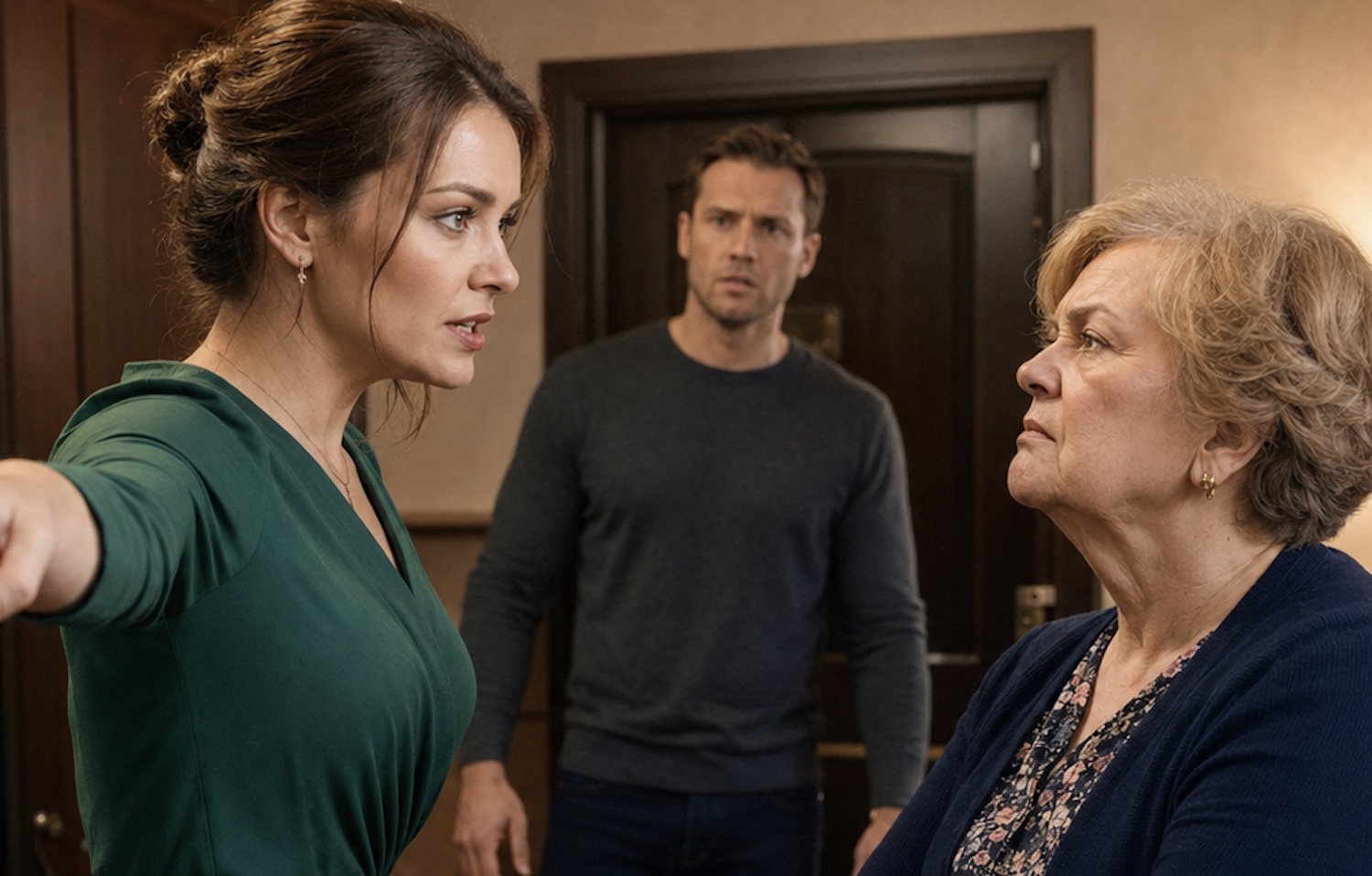
“Anna, we’ve already made the decision. A two-bedroom apartment is far too much for just you and Oleg. Marina can barely move around in her tiny one-bedroom place with a newborn. So, in the next few days, you’ll go to a notary and transfer the apartment into her name.”
Tamara Pavlovna stood in the middle of the living room with her hands planted firmly on her hips. She stared at Anna as though the verdict had already been delivered and there was nothing left to discuss.
Beside her, Marina shifted awkwardly from foot to foot, holding her baby and sniffling quietly while glancing at her mother for support.
Oleg stood a little farther away, helplessly looking from his mother to his wife, as though he hoped the storm might somehow pass without forcing him to take a side.
Anna slowly took in the entire scene.
The ice that had settled around her heart several days earlier now entered her voice.
“No, dear mother-in-law,” she said softly. “I bought this apartment before I married your son, using my own money. So now you can leave. Immediately.”
To understand the weight behind those words, one had to know what the apartment had cost Anna.
She still remembered arriving in the city after graduating from university with one suitcase and an enormous dream.
At the time, she rented a tiny room in a shared apartment. The only furniture was a narrow bed and a chair. During the day, she worked as an administrator at a fitness club. At night, she took shifts at a call center.
She slept four hours a night.
She denied herself new clothes, dinners with friends, holidays and weekend trips. She saved with discipline, almost with fury.
Owning a home became her obsession, the fixed point on the horizon that kept her moving forward.
“Anna, when are you finally going to let yourself rest?” her best friend Katya sometimes asked. “You live like a nun.”
“I’ll rest when I have a place of my own,” Anna would answer with a smile. “Then I’ll allow myself to breathe.”
Six years later, she received the keys to a two-bedroom apartment on the fourth floor of a newly built residential block.
She stood alone in the empty rooms, surrounded by the smell of fresh plaster, and cried quietly with happiness.
It belonged to her.
Every square meter had been paid for with her time, exhaustion, sacrifices and sleepless nights.
She met Oleg afterward.
He was charming and attentive, and he seemed genuinely impressed by her strength and determination.
When their relationship became serious, Anna made her position clear from the beginning.
“I bought the apartment before there was an ‘us,’” she told him. “It is legally and personally mine, and I need us both to understand that.”
“Anna, come on,” Oleg replied, sounding almost offended by the suggestion. “I would never dream of making a claim to it. This apartment is your achievement. I’m proud of you.”
She believed him.
And perhaps she was right to do so. Oleg himself had never planned to take anything from her.
The trouble came from somewhere else.
Tamara Pavlovna entered their married life immediately after the wedding—loudly, confidently and armed with an opinion about everything.
At first, her remarks seemed merely irritating rather than dangerous.
“What a spacious balcony you have,” she would sigh during visits. “Marina could really use one like this for the baby carriage.”
“The renovation is lovely, of course,” she commented another time. “But it isn’t very practical for children. Too many sharp corners. When Marina has a baby, she’ll need something safer.”
Anna dismissed the comments as part of her mother-in-law’s personality and tried not to take them seriously.
But after Marina gave birth, those harmless observations turned into constant pressure.
The cramped conditions in Marina and her husband’s one-bedroom apartment became the central topic at every family gathering.
Tamara Pavlovna began using the newborn child like a battering ram against the walls of Anna’s independence.
The pressure increased gradually.
At first, Tamara Pavlovna tried to sound sweet and reasonable.
“Anna, darling, Marina has no space at all,” she said in a honeyed voice during one of her visits. “The poor baby cries all the time, and the apartment is so stuffy. Perhaps you and Oleg could live with us for a while and let them stay here. Just for a couple of years, until they get back on their feet. What do two people need a two-bedroom apartment for anyway?”
Anna refused politely but firmly.
“No, Tamara Pavlovna. This is my home.”
“Oh, don’t start with that ‘my home’ nonsense!” her mother-in-law exclaimed, throwing up her hands. “We are family!”
Oleg tried not to get involved.
“Mom, stop,” he would mutter, avoiding the eyes of both women. “The apartment belongs to Anna. We can’t do that.”
Anna could see how uncomfortable he was.
He did try to defend her, but his defense was so weak and hesitant that it often made the situation worse.
When they were alone, he asked Anna not to become angry.
“You know what my mother is like,” he said. “She’s only worried about Marina.”
“Oleg, she is asking us to move out of my apartment.”
“I understand. But there’s no reason to create a scandal. Just ignore her.”
His lack of courage infuriated Anna even more.
His endless attempts to smooth things over left her feeling completely alone in the conflict.
A week later, everything became clear.
Anna returned home earlier than usual because her workday had unexpectedly ended ahead of schedule.
Oleg was in the bedroom with the door partly closed.
Anna quietly removed her shoes in the hallway and headed toward the kitchen.
Tamara Pavlovna was standing by the window with her back to the doorway, speaking into her phone in a low voice.
She was speaking quietly enough that Oleg would not hear her from the bedroom, but not quietly enough to escape the ears of someone who had entered unnoticed.
“Don’t worry, sweetheart,” she said. “Oleg will help. He’ll work on her. Anna won’t have anywhere to go. She’ll complain for a while and then accept it. She’s part of the family now, so she has to obey.”
Anna stopped in the doorway.
Her mother-in-law had not noticed her.
Without making a sound, Anna turned around, walked into the living room and sat in an armchair.
She folded her hands in her lap.
At that moment, everything fell into place.
This was not an emotional outburst from a worried mother.
It was not spontaneous concern for Marina and the baby.
It was a calculated plan.
Cold, deliberate and carefully organized.
Her politeness and kindness had been mistaken for weakness.
If she did not fight back now, they would consume her completely and leave nothing behind.
Something inside Anna clicked into place.
The confusion and hurt disappeared.
In their place came a cold, ringing determination.
On Wednesday, Tamara Pavlovna called Oleg and announced that everyone would be gathering “at your place” on Sunday.
She did not ask.
She informed him.
“We need to discuss a very important family matter,” she declared in a tone that allowed no disagreement.
Anna already knew what that matter would be.
For the rest of the week, she felt like a tightly stretched wire.
Oleg sensed the change in her mood and tried several times to start a conversation, but Anna answered him in short, clipped sentences.
She was preparing for battle.
At exactly three o’clock on Sunday afternoon, the doorbell rang.
Tamara Pavlovna stood on the threshold.
Behind her was Marina, who immediately arranged her face into an expression of suffering, almost as though she had rehearsed it.
The baby in her arms whimpered dramatically, becoming a small but powerful instrument of emotional pressure.
Tamara Pavlovna entered the living room and positioned herself in the center as though it were naturally her place to command.
“Here is what is going to happen,” she began, speaking with the certainty of someone who believed she had already decided everyone’s future. “We have considered everything carefully. A two-bedroom apartment is an unnecessary luxury for you and Oleg. Marina can hardly manage with a child in her current place. You will go to a notary and transfer the apartment to her.”
She continued talking about family values, the duty to support younger relatives and the importance of sacrifice.
According to her, Anna, as Oleg’s wife, was obligated to show understanding and surrender her own comfort for the good of the family.
When she finished, Tamara Pavlovna looked expectantly at Oleg, clearly waiting for his unconditional support.
At that moment, Anna finally saw the whole performance for what it was.
This was not a family discussion.
It was a carefully staged play in which Anna had been assigned the role of the silent victim.
After the ultimatum, a heavy silence filled the room.
Oleg shifted helplessly from one foot to the other, unable to find the courage to speak.
Marina looked at Anna with a mixture of hope and open defiance, already certain of victory.
She was wrong.
Anna rose slowly from her chair.
There was no nervousness in her movements.
Her face was completely calm.
She looked directly into Tamara Pavlovna’s eyes.
“Tamara Pavlovna, let us settle this once and for all,” she said, her voice steady and precise. “This apartment belongs to me. I bought it a year before I even met your son. Neither he nor you has any connection to it.”
Then she turned her gaze toward Marina, who was so surprised that she stopped sniffling.
“Marina, if your apartment is too small, that is a problem for you and your husband to solve. Responsible adults deal with problems like that themselves. They take out a mortgage, improve their income or find another solution. They do not try to steal someone else’s property while hiding behind a baby.”
Anna briefly looked at Oleg.
“And you, I hope, remember the conversation we had before the wedding.”
Without waiting for an answer, she turned and walked decisively into the hallway.
She opened the front door wide and looked back at them.
“This family council is over. Leave.”
Tamara Pavlovna was the first to recover.
Within seconds, her expression changed from confusion to furious disbelief.
“How dare you?” she gasped. “You selfish woman! Is that any way to speak to your husband’s mother? We came to you peacefully, and now you are throwing us out of the house?”
Realizing that the plan had failed, Marina burst into loud tears.
Tamara Pavlovna turned to her son and played her final card.
“Oleg! Are you going to allow her to treat your mother this way? Choose! It’s either her or us!”
Oleg looked at his wife.
Her eyes were filled with quiet, unbreakable determination.
Then he looked at his mother, whose face was twisted with anger.
At that moment, his indecision finally vanished.
He made his choice.
Oleg walked toward his mother and sister.
His voice was quiet, but the usual weakness was gone.
“Mom, Anna is right. You need to leave. I’ll call a taxi for you.”
Tamara Pavlovna grabbed her handbag without saying another word.
Marina followed her, still crying.
They left and slammed the door behind them with all their strength.
The apartment became silent.
Oleg stood still for a moment.
Then he approached Anna and carefully placed an arm around her shoulders.
She did not pull away.
“I’m sorry,” he whispered. “I’m sorry I let it go this far. I should have stopped them much earlier.”
Their marriage had survived its most difficult test.
And afterward, it became stronger, built on a new level of trust and honesty.
For the next several months, Tamara Pavlovna did not call.
Marina remained silent as well. Her resentment was still fresh, and playing the wounded victim suited her too well to let go of it quickly.
Oleg occasionally called his mother himself.
Their conversations were brief and calm, without the guilty, apologetic tone he had once used.
Anna did not interfere.
About a year later, they learned that Marina and her husband had taken out a mortgage.
Once they realized no one was going to hand them a free apartment, they found a way to solve the problem themselves and bought a home in the suburbs.
Tamara Pavlovna treated it like a personal triumph and proudly told everyone how she had “helped her daughter get settled.”
No one ever mentioned the attempt to take Anna’s apartment.
Anna’s relationship with her sister-in-law remained cold.
They were civil toward one another during holidays and had no contact the rest of the time.
Anna was not troubled by it.
One rainy evening, she and Oleg were sitting together in the living room.
A floor lamp cast a warm glow across the room, and everything was peaceful.
“Do you regret it?” Oleg asked.
“Not for a second,” Anna replied.
She looked around at her walls, her sofa and the warm light from her lamp.
And she finally understood something she had probably known all along.
Defending what belongs to you is not selfishness.
It is a necessary condition for any healthy relationship built on mutual respect.
That day, Anna had protected more than an apartment.
She had protected herself.
And now, for the first time, she felt like the owner not only of her home, but of her entire life.