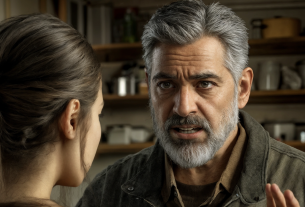
“I came back only for the children,” Pavel said, holding the kind of theatrical pause that, in his mind, was supposed to emphasize the scale of his paternal self-sacrifice.
Marina did not move. There was no surprise in her eyes, no joy, not even the expected fury of an abandoned woman. There was only a dull, impenetrable exhaustion — the exhaustion of an adult whose carefully built routine and inner peace had just been shamelessly attacked. Beside Pavel stood Nina Sergeevna, radiating the self-importance of a great peacemaker who had descended from moral heights to save a family from the foolishness of ordinary mortals.
“You could at least let him into the apartment, Marinochka,” her mother-in-law said sweetly, in that signature tone that always made Marina’s jaw tighten. “A real father has come to see his children, and you’re keeping him at the doorstep. That isn’t Christian. It isn’t humane. We all understand, of course — you’re hurt, your womanly pride is wounded — but you have to be wiser. For the sake of the little ones.”
“My womanly pride ended four years ago, Nina Sergeevna, when I was learning to sleep two hours a night,” Marina replied evenly, without moving from her place. “Now all I have left is common sense.”
Pavel sighed heavily and shifted from one foot to the other. He looked like a man who had prepared for battle only to discover that his opponent had simply failed to appear in the ring. His view of the world had always been deeply selfish, but in its own way logical. Four years earlier, he had left because he was “suffocating in routine,” because “a creative person needs space to grow,” and because the endless crying of the twins and his exhausted, unhappy wife were killing every ounce of motivation in him. He sincerely believed he had the right to pause, to search for himself.
Now, when that search had not led to any grand success, and freedom had turned into ordinary loneliness and instability, he had decided to return. In his mind, it was a heroic step. He was forgiving Marina for her past reproaches. He was magnanimously agreeing to take on the burden of being head of the family again.
“Marina, let’s not make a scene,” Pavel said, his voice confident, with a faint note of condescension. “I understand you’re angry. I gave you time to cool down. I’ve realized a lot over these years. I understood that my ambitions mean nothing compared to my children’s smiles. I’m ready to start over with a clean slate. I’m ready to be a father. Call Artem and Dasha.”
Two fair-haired little heads peeked timidly from behind Marina’s back. The five-year-old twins looked at the tall man and the elderly woman with identical, completely detached curiosity. There was no recognition in their eyes, no interest. To them, these were simply more adults interrupting their usual evening rhythm.
“Children,” Pavel’s voice trembled as he tried to make it as gentle as possible. He crouched down and stretched his arms toward them. “Tyomochka, Dashenka. Come here. It’s me. Your daddy. Daddy is back.”
Artem frowned, took a step back, and clutched his mother’s sweater tightly. Dasha simply turned away, losing all interest in what was happening, and stared at the wall. Neither of them said a word. Neither took a step toward him.
“They don’t know you, Pavel,” Marina stated with a frightening lack of emotion that cut much deeper than shouting ever could. “For them, father is an abstract idea. A photograph in an old album. You can’t simply show up and say, ‘I’m back,’ because you were never here during the years they can actually remember.”
Pavel’s face darkened. The heroic glow around him began to fade rapidly, giving way to irritation. His logic had not allowed for this version of events. He was their biological father. He had returned. He was ready to love them. Why was he being rejected?
“You turned them against me!” he hissed, standing up. “You deliberately erased me from their memory! You deprived them of a father just to satisfy your wounded pride! I knew you’d start taking revenge through the children!”
“Pasha, calm down,” Nina Sergeevna said, softly but firmly placing a hand on her son’s shoulder before turning her reproachful gaze toward Marina. “Marinochka, how could you do such a thing? Children are like sponges. They absorb everything. If their mother constantly transmits hatred toward their father, of course they’ll be afraid of him. Why are you damaging their minds? A boy needs a male example. A girl needs a father’s protection. But because of your personal ambitions, you’re raising them like orphans while their father is alive. I always told you: a woman’s strength is in forgiveness. A man stumbled — who doesn’t? He was searching for himself. But he came back, didn’t he? He came back to you, not to someone else!”
Marina listened to this lecture, feeling a familiar tight spiral of cold anger unfolding inside her. Nina Sergeevna had always known how to twist any situation so that the guilt landed squarely on her daughter-in-law’s shoulders. In her mother-in-law’s world, a man was a higher being whose mistakes were explained away by his complex nature, while a woman was supposed to provide unconditional acceptance and comfort.
“I didn’t turn anyone against you, Pavel,” Marina said slowly, carving out every word. “I simply stopped talking about you. When they were two and asked where you were, I said you were working. When they were three and stopped asking, I stopped answering. I didn’t have time to cultivate hatred toward you in them. I was too busy earning money for speech therapy, for orthopedic appointments, for treating Dasha’s allergy, and for teaching Tyoma not to be afraid of the dark. I erased you not out of revenge. I erased you to preserve what little life force I had left.”
“But I helped!” Pavel protested. “I sent money!”
“Your transfers covered exactly one-third of their food expenses,” Marina replied sharply. “And even those arrived only after my reminders, each of which was followed by your lectures about how hard it was for you to get back on your feet. You were buying yourself absolution, Pavel. For a very small price.”
“Money, money — with you everything always comes down to money!” Nina Sergeevna exclaimed bitterly. “Can a father’s love be measured in rubles? Pasha couldn’t sleep at night because he worried about them. He called me so many times and poured out his soul. He missed his family terribly. But he knew you would pressure him, demand the impossible from him. He needed time to become morally stronger.”
Marina looked at her mother-in-law. The woman’s ability to justify her son’s betrayal was almost admirable. Nina Sergeevna truly did not wish evil on anyone. In her selfish logic, she was protecting her child, her Pasha. She sincerely believed that life without a man was a social stigma, and she was trying to “make Marina happy” by returning her husband to her. The fact that this husband had run away at the first sign of difficulty was a detail unworthy of attention.
“Nina Sergeevna, a father’s love is measured by presence,” Marina cut in. “You talk about forgiveness. But to forgive someone, they must first acknowledge the damage they caused. Pavel did not come here as a man who made a mistake and is ready to spend years making amends. He came here like the master of the house, deciding that his extended vacation had finally come to an end.”
Pavel looked at his wife, and in his eyes there was a complicated mixture of offense, anger, and surprise. He did not recognize this woman. Four years ago, she had been an exhausted, constantly crying girl who had begged him to stay and promised that everything would get better. Now standing before him was a grown, firm, completely independent person. And that independence frightened him most of all. He had been counting on her weakness. He had counted on the fact that being a single mother weighed on her so heavily that she would grab onto him like a lifebuoy.
At that moment, Artem tugged at Marina’s sleeve.
“Mom, are we going to watch cartoons? We agreed.”
Marina looked down at her son, and her face immediately softened.
“Yes, Tyomochka. Go to your room and turn them on. I’ll be there in a moment.”
The children instantly turned around and disappeared down the hallway, not even glancing at the frozen guests standing at the door. To them, this conversation meant nothing. Their universe was stable and predictable, and in that universe there was only one reliable adult.
Pavel watched them go, feeling a dull, helpless rage rise inside him.
“They didn’t even say hello,” he said, as if accusing the entire world. “You’ve raised them to be heartless little egoists. I’m their real father! The same blood runs in me!”
“Blood does not give you the right to love by default, Pavel,” Marina said, finally taking a step forward and closing the distance between them. There was no longer even a hint of restraint in her voice. Steel rang through it. “Children are not a function you can pause and then resume when it becomes convenient. You left because it was hard for you to listen to them cry. Responsibility felt too tight around you. You chose your own comfort. That was your right, and I accepted it long ago. But now you’re coming back for exactly the same reason. You need comfort again. You’re tired of renting a place, tired of looking for the meaning of life, tired of being alone. You realized that here, with me, everything has already been arranged. The children have grown up. They don’t scream at night anymore. They go to kindergarten. I work and keep the household running. You simply want to walk into something already built and call it your ‘fatherly duty.’”
“How dare you twist everything like that?” Pavel clenched his fists. There were tears in his eyes — tears of sincere pity for himself. In his own mind, he was a martyr who had been misunderstood and rejected. “I stepped over my pride and came to you with an open heart. I was ready to forget all your hysterics, your inability to create a normal atmosphere at home. I wanted to give the children a complete family! And you… you’re just a calculating bitch who enjoys having power!”
“Marinochka, come to your senses!” Nina Sergeevna cried, pressing a hand to her chest. “You’re sentencing yourself with your own hands. Who will need you with two children? Men these days don’t even want their own, let alone someone else’s. Pasha is your only chance at a normal woman’s life. Right now you’re feeding your pride, but in ten years you’ll howl from loneliness. The children will grow up and fly away, and you’ll be left all alone. I only want what’s best. I worry about you no less than I worry about him.”
There was no open malice in her mother-in-law’s words, but this toxic concentrate of false care, belittlement, and fear-mongering was worse than any insult. Nina Sergeevna sincerely believed that a woman without a husband was incomplete by the laws of nature. And her “help” consisted of driving Marina back into the stall, forcing her to believe in her own worthlessness.
Marina closed her eyes for a second, gathering her strength. She was not perfect. She had broken down before. She often caught herself thinking that she lacked support. There had been moments of despair when she sat on the bathroom floor, covering her face with her hands so the children would not see her tears. But she had survived all of it alone. She had rebuilt her world brick by brick. And she knew exactly the price of the “care” being forced on her now.
“Nina Sergeevna, my ‘woman’s life’ suits me perfectly,” Marina said calmly and clearly. “I am not afraid of loneliness. I am afraid of betrayal. And life with your son is a constant waiting for a knife in the back.”
She turned her gaze to Pavel.
“You say you came back for the children. Fine. I am not depriving you of your parental rights. I am not forbidding you from seeing them.”
Pavel’s face immediately brightened. He took this as surrender. Nina Sergeevna also exhaled with relief and spread her lips into a satisfied smile.
“There, you see, you can be a reasonable woman after all…” Pavel began, taking a step into the apartment.
“Stay where you are,” Marina stopped him sharply. “I’m not finished. You may see them. But not on my territory. You may take them for walks on weekends, if they agree to go with you. And they won’t agree until you become at least a familiar person to them. You will have to earn their trust from the beginning. For years. Like a stranger. You will have to prove to them that you won’t disappear again the moment you get bored.”
Pavel froze. The meaning of her words began to reach him.
“What do you mean… not on your territory? Where am I supposed to live? We’re a family!”
“We are no longer a family, Pavel. We have been divorced for three years. This apartment belongs to me. There is no place for you here.”
“That’s absurd!” he exploded, losing what remained of his control. “How am I supposed to build a relationship with them if I’m just a weekend father? That’s not proper parenting! A child needs to see his father every day, in everyday life! You’re deliberately setting impossible conditions to push me away!”
“I am setting conditions that protect the stability of my children,” Marina replied firmly. “You want to live with them every day not for the sake of parenting. You want me to cook your dinners, wash your shirts, and provide you with a comfortable home base while you play noble father in the evenings. That will not happen anymore. Your path to the children goes only through your own efforts. Without my participation and without my service.”
A heavy, dense silence settled in the entryway. Nina Sergeevna stared at her daughter-in-law in horror, realizing that her well-practiced methods of pressure had failed. In her universe, a woman could not dictate terms to a man. It broke every rule she lived by.
Pavel stood there breathing heavily. His selfish, convenient plan for returning had collapsed with a loud crack. He truly was not ready for difficulty. He wanted instant recognition of his rights simply because he had appeared. The prospect of spending weekends trying to build contact with indifferent children, tolerating their moods without his wife’s help, investing time and money without a guarantee of immediate adoration — all of it filled him with a dull, dreary rejection.
He looked at Marina. There was no challenge in her posture, only absolute certainty in her right to protect her own territory.
“You’ll regret this,” he said quietly, with a hidden threat. “When they need real support, when the teenage problems begin, you’ll come running to me. But it will be too late. I’m not going to humiliate myself and chase after them. If children are raised by a mother in such a way that they don’t respect their father, that is your fault and your burden.”
And there was all of Pavel in that sentence. He had instantly found a way to shift the responsibility. He justified his future inaction by telling himself that he had been “rejected and unappreciated.” In his own head, he remained a noble hero denied the chance to perform a great deed by treacherous circumstances and a vindictive wife.
“As you wish, Pavel. That is your choice,” Marina said, stepping back and taking hold of the door handle. “Goodbye, Nina Sergeevna. All the best to you.”
“God will judge you, Marina,” her mother-in-law said mournfully, pressing her lips together as she turned away. “You are crippling your children’s fate with your own hands. You will remember my words, but there will be no way back. Come, Pashenka. There is nothing for us to do here. Where there is no love and no womanly wisdom, no family can be built.”
Pavel threw one last look of righteous fury into the depths of the apartment and stepped out onto the stairwell. Marina closed the door and heard the lock click.
She leaned her back against the cold surface of the door and slowly exhaled. Her knees trembled slightly from the tension she had just endured. This had not been merely an argument. It had been the final battle for her independence, and it had drained a great deal of strength from her soul. She did not feel happy. She felt endlessly sad at how ordinary and predictable human weakness could be.
Marina walked down the hallway and looked into the children’s room. Artem and Dasha were sitting on the carpet, absorbed in the colorful figures moving across the screen. Their world had not shaken. Their safety remained untouched.
“Mom, who was that?” Dasha asked without taking her eyes off the screen.
Marina hesitated for a second. She was tempted to tell the truth, to launch into complicated explanations, but she looked at her children’s peaceful faces and realized that they did not need that truth right now. They did not need a wounded, selfish man pretending to be a father for the sake of his own comfort. They needed stability.
“Just some acquaintances, sweetheart,” Marina answered calmly, sitting down beside them on the carpet. “They got the wrong door.”
She wrapped her arms around both children, feeling the warmth of their small shoulders. The drama was over. Ahead of them was an ordinary, difficult life — but it belonged entirely to them. There was no longer any room in it for other people’s games of nobility and staged self-sacrifice.
Her husband had returned for the children.
But it turned out the children did not need him at all.
And that was the most honest ending this story could have had.