Marina pressed the intercom button three times, but no one answered. She called Vera, but Vera rejected the call and sent a message instead: “The key is under the mat. I’ll be there in an hour. Please go in.” It was a strange request from someone who was supposed to meet her sister at the train station.
The key really was under the mat. Marina picked it up, turned it in the lock, and pushed the door open. In the hallway stood two pairs of unfamiliar slippers. An unknown coat hung on the rack, and on the floor lay an open suitcase with clothes half-unpacked.
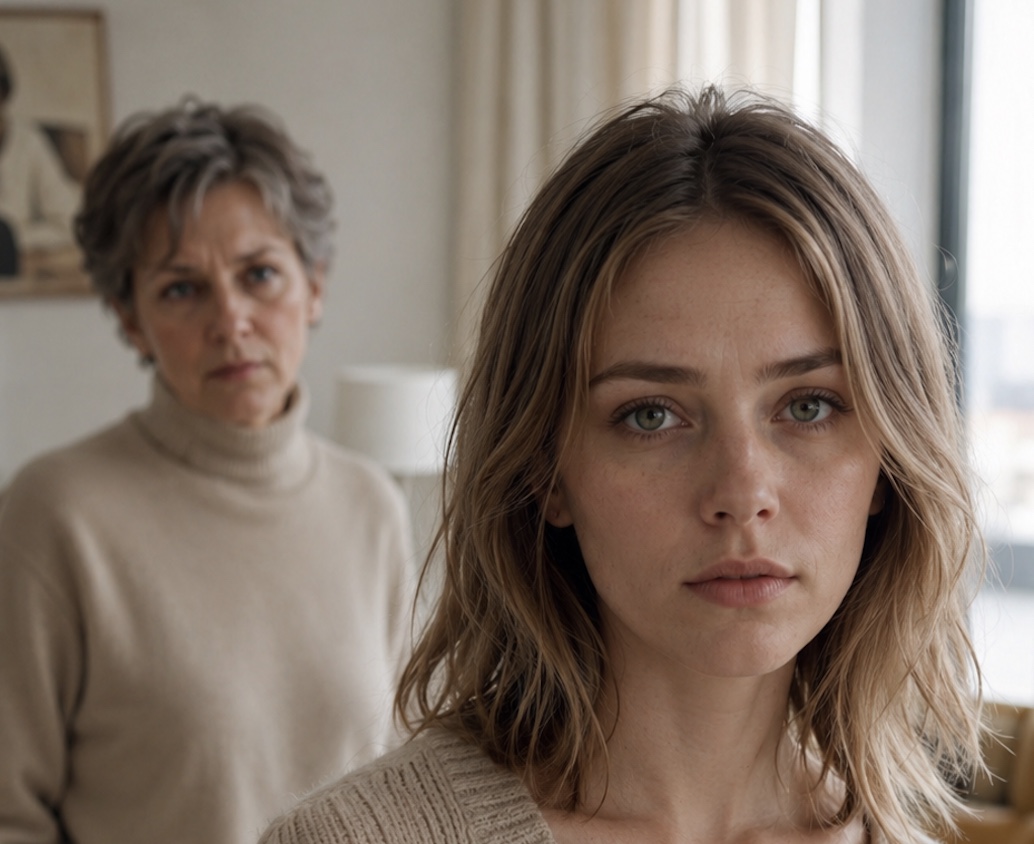
From the kitchen came the sound of running water. Marina put down her bag and walked down the corridor. At the kitchen table sat a woman of about fifty-five in a beige house robe, drinking kefir from a large mug.
“Hello,” Marina said. “I’m Vera’s sister. And you are?”
The woman looked up, examined Marina from head to toe, and took another sip.
“Tamara Grigorievna,” she answered without getting up. “Anton’s mother.”
“Nice to meet you. Are you visiting?”
“I’ve come to live here.”
Marina leaned against the doorframe. For a moment, she was not sure she had heard correctly. Then she smiled softly, the way she always did when a situation still seemed possible to resolve without unnecessary words.
“Live here is a strong way to put it. How long are you staying?”
“Permanently.”
A teenage girl came out of the room, wearing short shorts and a T-shirt with the words “Don’t touch” printed on it in Cyrillic. She was chewing an apple and looking at Marina with no interest at all.
“This is my daughter, Dasha,” Tamara Grigorievna said. “Say hello, Dasha. This is Vera’s sister.”
“Uh-huh,” Dasha nodded and sat down across from her mother.
Marina slowly looked around the kitchen. On the windowsill stood someone else’s vitamins and jars of supplements. New magnets had appeared on the refrigerator, ones Vera definitely had not bought. On the drying rack was dishware Marina had never seen before.
“Tamara Grigorievna, could you please tell me something? Does Vera know you’re here?”
“Anton decided everything.”
“That is not an answer to my question. Does Vera know?”
Tamara Grigorievna looked at her daughter. Dasha shrugged. Tamara Grigorievna finished her kefir, placed the mug in the sink, and turned around.
“Listen, Marina, or whatever your name is, I am not required to report to you. Anton gave us the keys. Anton brought us here. If you don’t like something, talk to Anton.”
“I will. But first, I want to understand the scale of this. Have you already put your things in the closets?”
“And where was I supposed to put them? On the floor?”
Marina walked into the hallway and opened the door to Vera’s room. The wardrobe was half-filled with someone else’s clothes. On the bedside table lay reading glasses, a notebook, and a remote control for a television Vera had not bought. The television was on the dresser, new, still with a sticker on it.
In the small room that had once been Vera’s office, there was now an inflatable mattress covered with a checked blanket. Earphones, a phone charger, and a teenage magazine were scattered across it.
Marina took out her phone and called Vera.
“Verochka, explain to me calmly, please. What is going on here?”
There was silence on the line for about five seconds.
“Marinka, forgive me,” her sister said, her voice thin and strained. “Anton brought them here three days ago. He said it was temporary, just while repairs were being done. But yesterday Tamara Grigorievna said there were no repairs and that they were staying.”
“And you kept quiet?”
“I didn’t keep quiet. I talked to Anton. He said I needed to show respect to his family. He said that since we’re getting married soon, this is our shared home.”
“The apartment is registered in your name?”
“Of course.”
“Then why did you call me only yesterday and not the very day they showed up?”
“Because I thought I could handle it myself.”
Marina closed her eyes. She knew that tone. Vera always sounded like that when she felt guilty for someone else’s behavior. She had inherited it from their father — that endless readiness to believe people would come to their senses.
“All right,” Marina said. “Don’t come here. Don’t show up at least until tonight. I’ll handle it.”
“Marinka, please, just no scandal.”
“Vera, I’m not making a scandal. I’m solving a problem.”
Marina returned to the kitchen. Tamara Grigorievna was washing her mug. Dasha was scrolling through something on her phone. It was around ten in the morning, and the sun was already high. July had no mercy.
“Tamara Grigorievna, let’s talk,” Marina said, sitting at the table. “I don’t need a conflict, and I’m sure you don’t either. But I need to understand the situation.”
“I’ve already explained everything.”
“No. You said three words and sent me to Anton. But Anton doesn’t live here. You do. So I’m talking to you.”
Tamara Grigorievna dried her hands with a towel and turned toward Marina. There was no hostility in her face. There was something else. Indifference. Complete, polished indifference — the kind people have when they are used to someone else deciding everything for them.
“My son is marrying your sister,” Tamara Grigorievna said. “We will be one family. I will live close to my son.”
“Close means in another building. Or in a hotel. Or in your own apartment. As far as I know, you have a two-room apartment.”
“How do you know about my apartment?”
“My sister told me.”
“And why is Vera telling strangers about my property?”
“I’m not a stranger. I’m her sister.”
“So what? A sister is not the owner.”
Marina felt her patience begin to melt around the edges, but she kept her voice steady.
“Tamara Grigorievna, I’ll try one more time. You moved into someone else’s apartment without the owner’s permission. Your son has no right to hand out keys to property that does not belong to him. Vera is the owner. You are not registered here, not officially residing here, and she did not personally invite you.”
“Anton invited us.”
“Stop. Anton has no such authority.”
“He is my son.”
“That’s a wonderful description. But it doesn’t give him the right to control his fiancée’s apartment.”
Dasha looked up from her phone and stared at Marina defiantly.
“Who are you to tell us what to do? You came from another city and started ordering everyone around.”
“Dasha, I’m speaking to your mother. When I need your opinion, I’ll ask for it.”
“I’m not going to wait until someone asks me.”
“You’ll have to. You’re sixteen. Wait until the adults finish.”
Dasha flushed and opened her mouth, but Tamara Grigorievna placed a hand on her shoulder. Silently. Dasha fell quiet, though she continued to glare at Marina.
“Fine,” Marina said. “I see a peaceful conversation doesn’t suit you. Let’s wait for Anton. Can you call him?”
“Anton is busy.”
“Then I’ll call him myself.”
Marina dialed Anton’s number. The rings went on for a long time before he finally answered.
“Yes?”
“Hello, Anton. This is Marina, Vera’s sister. I’m in Vera’s apartment. Your mother and sister are here. Please explain to me what is happening.”
“What’s unclear? They came. They’ll be living with us after the wedding.”
“With us — meaning who exactly?”
“With me and Vera. We’re getting married, in case you forgot.”
“I haven’t forgotten. But Vera’s apartment is a two-room place with a small office. There’s no room here for four people.”
“We’ll figure it out. This is our family matter.”
“Anton, listen to me. Your mother has her own apartment. A two-room one. Why does she need to live in someone else’s?”
Anton was silent for a moment. Then he answered, and from his voice Marina could tell he was smiling. The kind of smile people wear when they are sure the person they are speaking to cannot change anything.
“We decided to rent out that apartment. The income will be split between me and my mother. And we’ll all live here. Vera agreed.”
“Vera did not agree.”
“She didn’t object.”
“Not objecting and agreeing are two different things, Anton.”
“Listen, Marina, this is none of your business. You came for the wedding, so deal with wedding matters. We’ll handle our living arrangements ourselves.”
“I see.”
Marina ended the call. She looked at the screen for several seconds. Then she put the phone in her pocket and turned to Tamara Grigorievna.
“So the plan is this: you rent out your own apartment, split the money with your son, and live for free in my sister’s place. Is that correct?”
“It’s a family decision.”
“Whose family? Vera found out about this ‘decision’ after the fact.”
“Anton knows what he’s doing.”
The doorbell rang. Marina flinched. She was not expecting anyone. Tamara Grigorievna got up and went to open the door, moving confidently, like the mistress of the apartment, as if it were her hallway, her lock, her threshold. On the doorstep stood a young woman of about twenty-five. Blonde hair, denim jacket, backpack over one shoulder. She smiled at Tamara Grigorievna and handed her a bag.
“Tamara Grigorievna, here, as you asked. I brought the bedding and towels.”
“Thank you, Polinochka. Come in, don’t stand there.”
Marina stood in the corridor and watched as the unfamiliar Polina took off her sneakers and placed them neatly against the wall. She watched her pull another bag out of her backpack — groceries this time. She watched her go into the kitchen, open the refrigerator, and start arranging yogurts on the shelves.
“Excuse me,” Marina said. “And who are you?”
Polina turned around. Her smile froze for a second, then bloomed again — smooth, automatic.
“I’m Polina. Dasha’s friend.”
“Dasha’s friend,” Marina repeated. “Dasha’s friend brings bedding to Anton’s mother in my sister’s apartment?”
“Tamara Grigorievna asked me to help with the move.”
“With the move,” Marina nodded. “Good. Very interesting.”
Tamara Grigorievna stood nearby, looking away. Dasha smiled — briefly, almost invisibly.
Marina turned to Polina.
“Polina, how long have you known Anton’s family?”
“About five years.”
“Five years. Do you know Vera?”
“No. We haven’t crossed paths.”
“How curious. You’ve known the groom’s family for five years, but you’ve never once met the bride.”
Polina did not answer. She placed the last yogurt on the shelf and closed the refrigerator. Marina noticed how Tamara Grigorievna looked at Polina — quickly, appraisingly, almost tenderly. That was not how one looked at a daughter’s friend. That was how one looked at a backup option.
“Tamara Grigorievna,” Marina said quietly. “She isn’t really Dasha’s friend, is she?”
“What nonsense are you making up now?”
“I’m not making anything up. Polina is your plan B. The one you would rather see beside your son instead of Vera. Or am I wrong?”
Dasha jumped up.
“Are you crazy? What plan? What ‘B’? Polina is my friend!”
“Sit down,” Marina said. “Sit down and be quiet.”
“I won’t be quiet in my own home!”
“This is not your home. This is my sister’s apartment.”
Polina stood by the refrigerator, twisting an empty bag in her hands. Tamara Grigorievna sat at the table and folded her hands in front of her neatly, as if she were at an interview. Dasha stood by the wall, her face twisted with offense.
Marina looked at them and felt something hot and heavy rising inside her. Not hurt — anger. Pure, clear, unmixed anger.
“I’m going to tell you how things will be,” Marina said. “And I’m going to say it only once.”
“You are not in a position to set conditions,” Tamara Grigorievna replied.
“I am exactly in that position. The apartment belongs to Vera. Vera is my sister. Vera asked me to solve this problem. And I will.”
“What about Anton?”
“Anton is not the owner. Anton is a guest who was trusted with a key. He abused that trust. End of discussion.”
Tamara Grigorievna smirked faintly, only one corner of her mouth moving.
“You think it’s that simple? We already live here. Our things are unpacked. Anton has made a decision.”
“Anton made someone else’s decision about someone else’s apartment. That is not a decision. That is self-will.”
“Pretty words. But Vera won’t say anything. She’s soft. She’ll swallow it.”
Marina felt her teeth clench. There it was. That was what they had been counting on. Vera’s gentleness. Her inability to say no. Her fear of hurting people. Her cursed delicacy, because of which anyone who wanted to could use her.
“Vera won’t say it,” Marina nodded. “I will.”
She went to the wardrobe in the hallway, opened it, and began pulling unfamiliar clothes off the hangers. Dresses, blouses, sweaters — everything fell to the floor. Then she took an empty suitcase from under the bed and started packing.
“What are you doing?” Tamara Grigorievna stood up. “Stop this immediately!”
“I’m packing your things. You’re leaving.”
“I am not going anywhere!”
“You are. In fifteen minutes.”
Dasha rushed toward the suitcase and tried to pull the clothes back out. Marina caught her wrist — not painfully, but firmly.
“Don’t touch it,” Marina said. “Step away.”
“You have no right—” Dasha began.
“I do. Step away from the suitcase.”
Dasha backed off. Her eyes were wet, not from pain, but from helplessness. She was not used to being told no like that — without yelling, without persuasion, simply as a fact.
Polina quietly moved toward the door.
“Polina, wait,” Marina called after her. “You’ll help carry the things too. Since you brought them here, it makes sense that you take them back.”
“I’m not getting involved in this.”
“Then get out. Before you become an accomplice. Get out.”
Polina looked at Tamara Grigorievna. The older woman waved her hand — go. Polina slipped into the hallway, and a second later the front door slammed shut.
Marina continued packing. Methodically, without rushing. From the bathroom — toothbrushes, shampoos, hand cream. From the kitchen — vitamins, kefir, the unfamiliar mug. From the small room — the inflatable mattress, the blanket, headphones, magazines.
Tamara Grigorievna stood in the bedroom doorway and watched. She did not move. She did not try to stop her. She was waiting for Anton — that was clear from the way she kept glancing at her phone.
“You can call your son,” Marina said without turning around. “But by the time he gets here, you’ll already be on the landing.”
“You will regret this.”
“Not today.”
Tamara Grigorievna called Anton. She spoke briefly, angrily, in a whisper. Marina heard fragments: “come now,” “she’s throwing us out,” “scandal.” Then Tamara Grigorievna put the phone away and straightened.
“Anton will be here in twenty minutes.”
“Excellent. That gives you just enough time to get dressed.”
Marina carried the first suitcase out onto the landing. Then the second one — the one that had been standing in the hallway from the beginning. Then the bag with the bedding Polina had brought. Then the television — she took it off the dresser and placed it by the elevator.
Tamara Grigorievna changed her clothes. She stood in the hallway in the very coat that had been hanging on the rack and stared at Marina. Her face was unreadable, but her hands trembled slightly.
“You are making a mistake,” she said. “Anton won’t forgive this.”
“Anton is not my fiancé. And if Vera has any sense, soon he won’t be hers either.”
“Vera is nothing without him.”
Marina stopped. She placed the bag on the floor. Then she stepped close to Tamara Grigorievna.
“Repeat that,” she said quietly.
“What?”
“Repeat what you just said about my sister.”
Tamara Grigorievna was silent. Then she looked away.
“I meant something else.”
“No. You meant exactly what you said. And I will remember it. Now get out.”
Dasha went first — silently, teeth clenched, backpack over her shoulder. Tamara Grigorievna followed, but she paused at the threshold and turned back.
“Vera will find out how you treated her future family.”
“Vera knows how her future family treated her.”
Marina closed the door. Turned the lock twice. Leaned against the wall and exhaled — long and slow. Her knees were trembling slightly, but her head was clear, like glass freshly washed.
Twelve minutes passed. Then the doorbell rang — long, insistent, irritated. Marina opened the door.
Anton stood on the threshold. Behind him were Tamara Grigorievna with a stone face and Dasha with red eyes. Their things were piled near the elevator.
“What do you think you’re doing?” Anton said.
He entered without asking permission. He went into the room, looked at the empty wardrobe, the empty dresser, the empty small room. Then he returned to Marina.
“Put everything back.”
“No.”
“I said put it back.”
“And I said no. This is Vera’s apartment. Your mother and sister were here without her consent. I asked them to leave. They left. The matter is closed.”
“What do you mean, closed? Vera is my fiancée!”
“Your fiancée, not your slave. A fiancée is someone you consult, not someone whose home you fill with tenants without asking.”
Anton stepped toward her. He was a head taller and broader in the shoulders. His eyes burned — not even with anger, but with something more primitive. Wounded pride. Someone had told him no, and he did not know what to do with that no.
“You’re sticking your nose into something that isn’t your business.”
“My business is my sister.”
“Vera has me. She is my wife.”
“She is not your wife yet. And judging by today, she may never become your wife.”
“Are you threatening me?”
“No. I’m stating a fact.”
Anton took another step. Marina did not move back. She stood straight, looking him in the eye, and there was neither fear nor challenge in her gaze — only calm, measured readiness for whatever came next.
“Leave this apartment,” she said. “Take the things and drive your mother and sister to your place. Or to their own two-room apartment, the one you’re so eager to rent out.”
“Shut up.”
“No.”
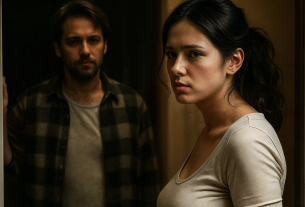
Anton grabbed her by the shoulder and jerked her toward the door. Marina hit her back against the wall. The seam of her sweater tore at the sleeve. Anton pulled her again, harder. Marina fell to one knee but immediately got up. Her cheek burned — he had struck her with the back of his hand.
“You just hit a woman,” Marina said. “In an apartment that doesn’t belong to you. Before your wedding to her sister. Congratulations.”
Anton froze. His hands were still raised, his fingers clenched. He looked at his own hand, then at Marina. At the torn sleeve. At the bruise already beginning to darken under her cheekbone.
“I didn’t mean to,” he muttered hoarsely.
“Of course you didn’t. No one ever means to. It just somehow happens.”
Marina walked past him to the door and threw it open. Tamara Grigorievna was standing on the landing and had seen everything — the door had been open the whole time. And she had said nothing. She had not stopped her son. She had not cried out. She had simply stood there and watched.
“Out,” Marina said to Anton. “All three of you. Now.”
Anton left. He moved heavily, as if his legs had become unfamiliar to him. On the landing, he turned around.
“I’ll talk to Vera.”
“Talk. But I’m warning you: Vera will see this bruise. And this sleeve. And I will tell her every word that was said here. Every single one.”
Marina closed the door. Locked it with two turns. Then she took out her phone and photographed herself — the bruise, the torn sweater, the scrape on her knee. She sent the photos to her own email. Then she sat down on a stool in the hallway and called Vera.
“It’s done,” she said. “They’re gone. The apartment is free. Come tomorrow morning. Not today — tomorrow. I need to clean up.”
“Marinka, what happened? Your voice sounds strange.”
“I’ll tell you everything tomorrow. Come then.”
“Marina, did he touch you?”
Marina was silent for three seconds.
“Come tomorrow, Verochka. I promise I’ll tell you.”
She ended the call and pressed the phone to her chest. In the kitchen, the clock Vera had hung there last year was ticking — round, wooden, with a painted owl on it. Marina looked at the owl and thought about how their mother and father had died six years ago, and since then Vera was all she had. And someone had decided he could walk into Vera’s home, scatter his belongings around, live on her territory, and then hit her sister for asking him to get out.
Marina stood up, went into the kitchen, and began washing the unfamiliar mug they had forgotten to take. She washed it, dried it, and placed it by the door. They could collect it later.
The morning was bright, warm, unbearably summery. Marina opened the door to Vera at seven o’clock. Vera stepped inside, looked at her sister, and froze.
“It was him?” she asked.
“Yes.”
Vera raised her hand and carefully touched the bruise on Marina’s cheekbone. Then she looked at the torn sweater, which Marina had deliberately not changed so Vera would see it.
“Tell me everything,” Vera said. “From the beginning.”
Marina told her. About Tamara Grigorievna in the robe. About Dasha with the apple. About the unfamiliar things in the wardrobe, the television on the dresser, and the vitamins on the windowsill. About Polina, who had brought bedding and arranged yogurts in the refrigerator. About the phone call with Anton — “rent out the apartment, split the income.” About Tamara Grigorievna’s words: “Vera is nothing without him.” About how Anton grabbed her by the shoulder, jerked her, and hit her. About how Tamara Grigorievna stood on the landing and watched.
Vera listened silently. She did not interrupt, gasp, or cry. Her face changed slowly, the way the weather changes in the mountains. First confusion. Then disbelief. Then something hard and unfamiliar — something Marina had never seen on her sister’s face before.
“Give me his address,” Vera said.
“You know his address.”
“Yes. I know.”
Vera turned and walked out. Marina followed — without asking, without stopping her. They reached the corner and turned onto the next street. Anton’s apartment was a five-minute walk away. He had rented it nearby on purpose, to be closer to Vera.
Vera rang the doorbell. Anton opened it, wearing sweatpants and a wrinkled T-shirt. He did not have time to say a word.
Vera slapped him across the face. The sound was dry and sharp. Anton recoiled.
“Vera, wait…”
She hit him again — an open-handed strike to the nose. Fast, precise, with all the strength in her thin hand. Blood rushed from his nose. Anton clutched his face and bent forward.
“Vera!” Tamara Grigorievna shouted from inside the apartment.
Vera stepped in. She moved quickly — not running, not walking, but striding like someone who had something important left to do and not a single extra minute to waste.
Tamara Grigorievna was coming toward her down the hallway. Vera saw an armchair standing by the wall — light, on small wheels — and shoved it aside. The chair rolled down the corridor and slammed into Tamara Grigorievna’s legs. The older woman gasped and grabbed the wall.
Dasha rushed out of a room, saw Vera, and stepped back.
“Sit down,” Vera told her. Her voice was quiet, even, completely unrecognizable.
Dasha sat.
Vera turned to Anton. He was standing there, pressing a towel to his nose. Blood dripped onto his T-shirt. His eyes looked confused, frightened, almost childish.
“There will be no wedding,” Vera said.
“Vera, you don’t understand…”
“I understand perfectly. You gave the keys to my apartment to your mother without my knowledge. You decided to rent out her apartment and put the money in your pocket. You brought people into my home whom I had not invited. I told you I disagreed, but you didn’t hear me. And when my sister tried to stop it, you hit her. I understand everything, Anton. I understand so well that it makes me sick.”
“I lost my temper. With Marina — it was an accident.”
“An accident is when you drop a cup. When you hit a woman, that is a choice. Your choice.”
“I love you.”
“No. You love my apartment. And a obedient wife who will feed your family and keep quiet. You will not get that anymore.”
Vera slipped the ring off her finger — simple, silver, an engagement ring. She placed it on the shelf in the hallway, beside unfamiliar keys, unfamiliar gloves, and the unfamiliar life they had tried to fasten onto her without asking.
“Vera,” Tamara Grigorievna said, straightening up and rubbing her bruised knee. “Anton is a good boy. He got carried away. Any normal woman would understand.”
Vera looked at her.
“Tamara Grigorievna, do you know what the worst part is? It isn’t that he hit my sister. It’s that you stood there and watched. You could have stopped him. You could have said, ‘Son, enough.’ But you stood there. Because you enjoyed that moment like a sadist. Because if he had broken Marina, then later he would have broken me too, and you would have lived in my apartment for the rest of your life while renting yours out to strangers. That is all your love is. That is your whole ‘good boy.’”
Something flickered in Tamara Grigorievna’s eyes — something like the realization that the wall she had been leaning on had just collapsed.
Vera turned to Dasha.
“And as for you, Dasha, I’ll say one thing. You’re sixteen. You still have time to grow into a decent human being. But if you follow the example of these two, you won’t.”
Dasha sat quietly. She looked at Vera the way people look at someone they are seeing for the first time, even though they have known them for a year.
Vera left the apartment. She walked down the stairs without waiting for the elevator. She pushed open the heavy entrance door and stepped outside.
Marina was standing by the steps. She was waiting, hands in her pockets, bruise on her cheek.
Vera came up to her. Stopped. Looked up at her — she had always been half a head shorter. Then she pressed her forehead against Marina’s shoulder and began to cry. Briefly, for one breath, for one exhale. No words, no explanations. She simply let go.
A minute later, she straightened. Wiped her face with the back of her hand. Looked at Marina.
“I’m hungry,” she said.
“So am I,” Marina replied.
“Shall we go have breakfast?”
“Let’s go.”
They walked down the street together, shoulder to shoulder. Vera said something about pancakes. Marina replied something about scrambled eggs. And they both laughed — suddenly, loudly, so loudly that a man with a dog and a woman with a stroller turned to look.
Anton came out of the entrance three minutes later. He followed them slowly, holding a towel to his face, with a broken nose and broken plans. He saw their backs. He heard their voices. He wanted to call out. He wanted to catch up. He wanted to say something — explain, ask, promise.
But he did not dare.
The sisters turned the corner. Their voices faded. The towel was soaked through. Anton stopped in the middle of the sidewalk and stood there for a long time — alone, with blood on his T-shirt and silence in place of a future.
And above the city, the sun was rising — indifferent, July-bright, belonging to no one.