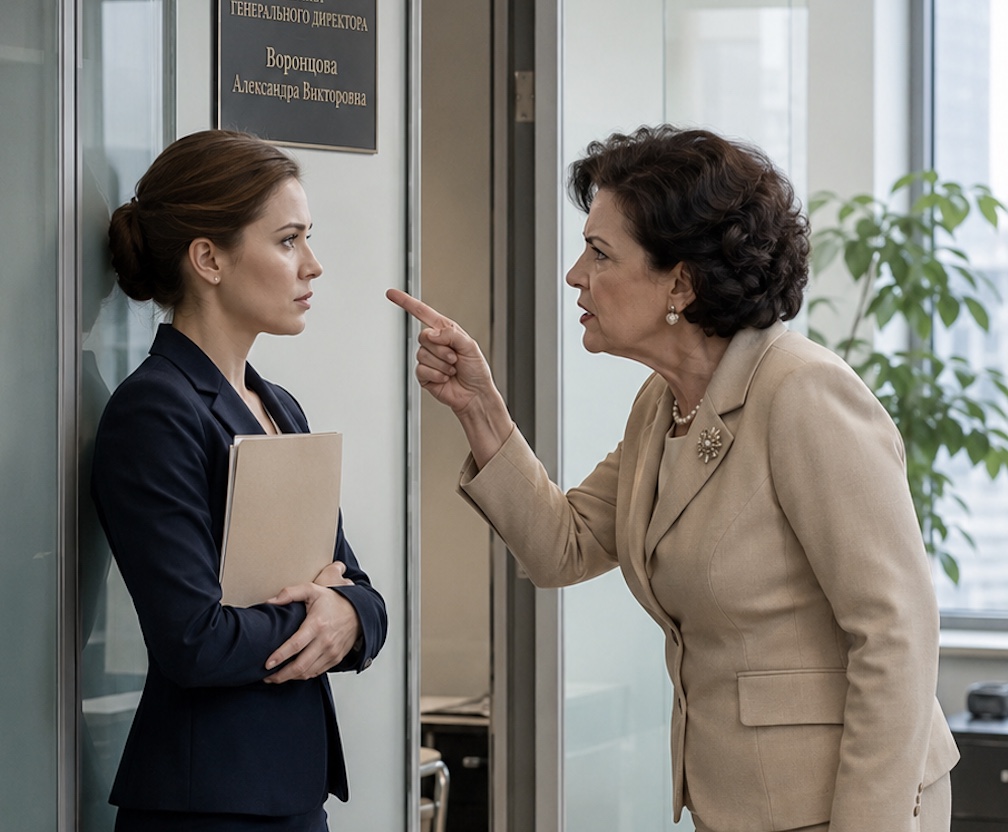
“Remove her from every position and cut off her access to the accounts,” Valentina Pavlovna told her son at the door of the general director’s office. “Today. There is no reason to keep feeding this freeloader near your company.”
Artyom Sokolov did not even glance at the employees who had frozen near the printer and by the meeting room. He stood beside his mother in an expensive suit, phone in hand, looking at Marina as if everything had already been decided.
“Marina, put the folder on the counter and go home,” he said. “I’ll deal with Lansky myself. You’ll be temporarily removed from the documents before you make a mess of things.”
Marina stood three steps away from them, holding a work folder and a gray mug from the office kitchen. She wore an ordinary badge, but Valentina Pavlovna did not even look at the name on it. To her, her daughter-in-law had always been nothing more than her son’s wife — a convenient woman kept close enough to help.
“We are family,” her mother-in-law added, louder now so everyone around could hear. “And in a family, a wife does not get in her husband’s way. Artyom is the man. He should decide who sits near the accounts.”
The door to the general director’s office opened. Lyudmila Sergeyevna, the director’s assistant, stepped out with a tablet in her hands. She quickly assessed the corridor, paused briefly on Artyom, and then said calmly,
“Marina Evgenyevna, they are waiting for you. Igor Borisovich has already joined the meeting.”
Valentina Pavlovna straightened. Artyom frowned, as though someone had used the wrong title for the wrong person.
Marina placed the mug on the counter and adjusted the folder in her hands.
“Thank you, Lyudmila Sergeyevna. I’m coming in.”
Artyom stepped toward the door with her, but the assistant immediately blocked his way.
“Artyom Viktorovich, you are not on the participant list.”
“I am the commercial director,” he snapped. “And Marina’s husband, in case you forgot.”
“The participant list includes positions,” Lyudmila Sergeyevna replied. “Your position is not listed there.”
Marina turned to her husband. She spoke quietly, but everyone in the corridor heard her.
“Artyom, you are not coming in behind me. And you are not going near the company accounts either until the review of your latest contracts is finished.”
Valentina Pavlovna smirked the way she usually did at family dinners when she wanted to show Marina that she had forgotten her place.
“A review? Who do you think you are, little girl?”
Marina looked her straight in the face.
“The general director of Severnaia Liniia LLC.”
At first, her mother-in-law let out a short laugh. Then she turned to her son, expecting him to put his wife back in her place. But Artyom said nothing. He was staring at the sign on the office door, a sign he had seen many times and, for some reason, had never truly read: “General Director. Marina Evgenyevna Sokolova.”
“This is some kind of game,” he finally said. “Lansky is the one in charge of your documents.”
“Igor Borisovich is the corporate lawyer,” Marina replied. “He does not remove me from my position at your mother’s request.”
“Don’t embarrass me,” Artyom hissed under his breath.
“You are embarrassing yourself,” Marina said. “First you brought your mother into the office, and then you allowed her to give orders about my work in front of everyone.”
She entered the office, and the door closed. Behind the glass remained Artyom with his phone in his hand and Valentina Pavlovna, who only a minute earlier had ordered her daughter-in-law removed from what she believed was someone else’s company.
Marina and Artyom had been married for eight years. Throughout all those years, Valentina Pavlovna behaved as if her son had been stolen by respectable people and returned to her with an unsuitable wife. She did not scream every day. She acted more carefully: with a remark at the dinner table, a sigh in the hallway, a “woman-to-woman” piece of advice, or a late-night phone call to Artyom.
“Our Artyom is used to a different level,” she would tell Marina in front of guests. “You should try to keep up. A man beside an ordinary woman quickly loses his ambition.”
At first, Artyom laughed it off and said his mother was simply “old-fashioned.” Later, he began repeating her words himself. When Marina argued with him about work, he waved her off: “You’re good with paperwork, but I understand people.” When she stayed late at the office, he grumbled: “Don’t act like the provider. Someone still has to take care of the home.” When Valentina Pavlovna showed up unannounced, he asked Marina not to make a scene: “Mom is elderly. She needs to feel involved.”
For a long time, Marina did not challenge their family myth. According to that myth, Artyom was the face of the company, the future owner, and the main negotiator, while she was the wife who helped him with documents. In a way, it had even been convenient that her mother-in-law never interfered with reports or contracts as long as she considered Marina a “paper mouse.”
Severnaia Liniia LLC had existed long before the marriage. Marina’s father, Evgeny Andreevich, had founded the company with two partners. Later, the partners left the business, her father stepped back from management, and one hundred percent of the company passed to Marina. She had worked inside the business even before the wedding. She knew the warehouse, procurement, regular clients, weaknesses in contracts, and the people who kept everything running.
Artyom came into the company later. Back then, Valentina Pavlovna herself had asked Marina to help her son.
“You are his wife,” she had said in the soft voice she used only when she needed something. “Artyom needs a platform. He has drive. A man without a serious business withers.”
Marina hired him as commercial director. Not out of weakness, but out of hope that her husband would truly find his place. For the first few months, he tried. Then he realized Marina was always nearby — ready to check a contract, correct the numbers, smooth over a conflict with a client, and rescue negotiations at the last moment.
By the spring of 2026, his self-confidence had become dangerous. He promised clients discounts the company had never approved. He tried to process payments without Marina’s signature. He brought into the office an acquaintance of Valentina Pavlovna and introduced him as the “family financial adviser,” even though the man held no position at the company.
That was when Marina spoke firmly for the first time.
“There are no family advisers in this company. There are employees, contracts, and responsibility.”
Artyom took offense. Valentina Pavlovna decided her daughter-in-law had “grown arrogant.” On the morning of June 10, 2026, they did not come to the general director’s office by accident. Artyom had warned security in advance that Marina might have “problems with her pass,” and Valentina Pavlovna had arrived to support her son and publicly put Marina in her place.
Inside the office, Igor Borisovich Lansky stood up to greet Marina.
“Did you hear what happened in the corridor?” she asked, placing the folder on the desk.
“I heard the last part,” the lawyer replied. “Enough to understand.”
Lyudmila Sergeyevna closed the door and remained by the desk with her tablet. Marina did not pretend nothing had happened. For too long, the company had tolerated Artyom out of respect for her, and at home she had tolerated Valentina Pavlovna out of respect for the marriage. Today, those two worlds had collided at the same door.
“Step by step,” Marina said. “Artyom Viktorovich’s access to client banking is restricted until the review of his latest contracts is complete. Every payment he tried to process without approval goes back to the finance department. Only employees and invited visitors are allowed in the work area. Valentina Pavlovna is not an employee of the company.”
Igor Borisovich nodded. He had warned Marina more than once that family requests in business sooner or later ended in trouble. Today that trouble had arrived on its own, wearing a pearl brooch on a jacket and saying, “We are family.”
Half an hour later, Marina stepped out of the office. Artyom was standing by the wall, rapidly typing a message to someone. Valentina Pavlovna sat on the visitor sofa with her purse on her lap. When she saw her daughter-in-law, she rose first.
“Well? Finished playing boss?” she asked. “Now call your husband and apologize. You spoke in front of people, so you can correct it in front of people too.”
Marina stopped in front of her.
“Valentina Pavlovna, you are leaving the office. You are not an employee, and your visitor pass was issued at Artyom’s request. That request has been revoked.”
“I am the mother of the commercial director.”
“There is no such visitor position in this company.”
Artyom stepped forward sharply.
“Marina, don’t push it. Mom is worried about me. You could have said this without making a spectacle.”
“It should have been resolved at home without a spectacle,” she replied. “But you brought your mother to my office door and allowed her to order you to cut off my access to the accounts. Now it is a workplace matter.”
His mouth twisted.
“Since when is everything a workplace matter to you?”
“Since you decided to use family to seize power in the company.”
Marina removed Valentina Pavlovna’s visitor pass from the lapel of Artyom’s jacket and handed it to Lyudmila Sergeyevna. Her mother-in-law wanted to say something else, but a security officer was already standing nearby. No one grabbed her or threw her out noisily. They simply showed her to the elevator, and that made the humiliation even sharper.
“Your company won’t last long without Artyom,” she said as she left.
Marina looked at her husband.
“We’ll test that at work, not in the corridor.”
Artyom did not go home immediately. He appeared that evening with his mother, even though he had sent Marina a message during the day: “I’m not sleeping at home tonight.” Valentina Pavlovna entered first, took off her jacket, and placed her purse on the kitchen chair with such confidence that it seemed she had come not to her daughter-in-law’s apartment but to the family headquarters.
“Sit down,” she told Marina. “This is a serious conversation. Before you and Artyom completely ruin everything.”
Marina remained standing at the kitchen entrance.
“You already had your conversation this morning. In front of the employees.”
Artyom poured himself water and put the glass on the table. He was trying to remain calm, but irritation gave him away.
“Don’t turn Mom into the enemy. She spoke harshly, I agree. But essentially, she was right. You’ve taken too much upon yourself.”
“What exactly?” Marina asked. “My position, my company, or my accounts?”
Valentina Pavlovna pressed her lips together, but quickly switched to a conciliatory tone.
“Marina, you are an intelligent woman. No one is taking anything from you. Artyom simply needs his proper standing restored. A man cannot walk around the office asking his wife for permission at every step.”
“He was not asking for permission,” Marina said. “He wanted access to company money. Those are different things.”
“Money again,” Artyom cut in. “You talk as if I’m some stranger.”
“This morning, you spoke about me as if I were someone else’s possession.”
He struck the table with his palm. Not hard, but enough for the conversation to shift into his familiar form of pressure.
“Enough! I’ve lived with you for eight years. I’m not some boy off the street. Everything we have is family property.”
Marina slowly removed her thin silver watch and placed it on the edge of the table. Artyom had once called that watch “too modest for the wife of a commercial director.” Valentina Pavlovna had added that taste did not come to everyone, even if they were lucky enough to marry well.
“We will discuss family property separately,” Marina said. “The apartment was registered to me before the marriage. The company belongs to me. I put your personal belongings in the room. The documents that were on my home desk are there too.”
Artyom looked at her sharply.
“You touched my things?”
“I removed them from my workspace at home. You can pack the rest yourself.”
“Are you throwing me out?”
“You wrote yourself that you were not sleeping at home. I simply stopped pretending this was an ordinary family argument.”
Valentina Pavlovna sprang to her feet.
“So this is gratitude. My son brought you into a decent family, gave you a position, gave you his surname, and now you are packing his bags.”
For the first time that evening, Marina smiled — tiredly, without triumph.
“Valentina Pavlovna, Artyom did not give me my position. He got his through me. And I will no longer use your surname as a reason to stay silent.”
Artyom looked from his mother to his wife. He was used to Marina smoothing over such conversations. Asking them not to fight. Steering the discussion away from the main issue. Today, she steered nothing away.
“Tomorrow you come to the office and restore my access,” he said, quieter now. “Without that, I cannot work.”
“Tomorrow you come to the office as an employee, using your own pass, and answer questions about the contracts. No more family shortcuts.”
“You’ll regret this,” Valentina Pavlovna said. “You won’t manage alone.”
“That is exactly what you are testing today,” Marina replied.
The next day, June 11, 2026, Artyom arrived at the office later than usual. He did not greet the security guard with his usual broad phrase, did not throw a joke at the secretary, and did not stop at the reception desk with the air of a man everyone needed. His pass opened the turnstile and the general floor, but it did not let him into the finance department. He was not admitted to the banking limits meeting room either.
He went to Lyudmila Sergeyevna.
“Where is Marina?”
“In a meeting,” she replied.
“Tell her to restore my access.”
“Requests are submitted in writing.”
“I am her husband.”
Lyudmila Sergeyevna looked up from her monitor.
“That is not grounds for access to documents.”
Several employees heard that sentence. No one laughed. No one exchanged overly obvious glances. But Artyom understood: the old respect had cracked, and not because of Marina. He himself had placed himself in the position of a man who came for work authority through his mother.
By lunchtime, he knocked on the general director’s office door. Truly knocked, instead of throwing it open the way he used to.
“Come in,” Marina said.
Artyom entered and stopped at the desk. This time, he did not sit without being invited. On the desk lay contracts, a laptop, and Marina’s gray pass — the very pass he had wanted security to “check” on the morning of June 10.
“We need to talk,” he said. “Without employees and without Mom.”
“Talk.”
He ran a hand through his hair.
“I didn’t know everything was registered to you.”
“You did not want to know.”
“That is not the same thing.”
“It is the same to me. For eight years, you heard your mother call me a freeloader. You saw her manage my weekends, my home, my time. Yesterday, she came to manage my work, and you stood beside her and nodded.”
He sat in the chair now, no longer pretending to be the owner of the office.
“I thought you were exaggerating. You always control everything.”
“Because someone had to check what you promised clients.”
“I worked too.”
“You did. And then you decided you could remove me from every position because your mother said so.”
Artyom tightened his grip on his phone.
“She lost control. She thought you were humiliating me.”
“No, Artyom. She thought you were finally taking what she had long considered yours.”
He remained silent for a long time. There was no repentance in that pause, only an unpleasant realization: the old scheme had failed. He could no longer call in his mother, raise his voice, and expect Marina to start fixing everything again.
There was a knock at the door. Lyudmila Sergeyevna looked inside.
“Marina Evgenyevna, Igor Borisovich is waiting for confirmation regarding the review of Artyom Viktorovich’s contracts.”
“Thank you. In five minutes,” Marina said.
Artyom tensed.
“Are you firing me?”
“I am reviewing the documents. If there are no violations, you leave quietly. If there are violations, the lawyer will handle it.”
“You’re speaking to me like I’m a stranger.”
Marina closed the folder.
“This morning, you spoke to me like I was unnecessary.”
On June 12, 2026, Artyom wrote the resignation letter himself. Not elegantly, and not with his head held high. At first, he tried through Valentina Pavlovna to send Marina “normal terms”: access to clients, keeping his office, and a general wording that he was leaving “for family reasons.” Marina agreed only to a quiet departure without a scene and without the right to take work materials.
Valentina Pavlovna came to the office after lunch. This time, she was stopped on the first floor. She demanded Marina, then Lansky, then “any adult person who understands that family is more important than paperwork.” Security called Lyudmila Sergeyevna, who came downstairs herself.
“Valentina Pavlovna, Marina Evgenyevna is busy.”
“Tell her I am not leaving.”
“Then you may wait in the waiting area. You are not allowed into the work premises.”
“Who are you to give me orders?”
“An employee of the company,” Lyudmila Sergeyevna said. “Unlike you.”
Her mother-in-law sat in the waiting area for nearly forty minutes. Her purse stood beside her, the pearl brooch shining on her jacket, but the old grandeur was gone. Employees passed by and greeted people politely. Not her. They greeted those who worked there and had the right to go farther.
When Marina finally came out, Valentina Pavlovna stood up and immediately attacked.
“You got what you wanted. Artyom is leaving.”
“He wrote the resignation himself.”
“You forced him.”
“He brought you to my office door himself.”
Her mother-in-law looked at her with the same hatred she had shown the day before when she demanded that Marina be cut off from the accounts.
“You were never a wife to him. You were always a boss.”
Marina did not argue loudly. There were enough people in the lobby, and she had no intention of staging another performance for the employees.
“I was a wife for eight years, Valentina Pavlovna. You and Artyom simply decided that a wife is someone without a right to anything of her own. No right to work, to a home, to boundaries. Yesterday, you came to the wrong address. This is not your apartment, and it is not your son’s company.”
“You will be alone.”
“Better alone than under your management.”
That was enough. Not as a clever line, but as a decision no longer open for discussion. Valentina Pavlovna left the office without her son beside her and without any chance of passing beyond the security desk.
That evening, Artyom came to collect his things. This time, without his mother. In the apartment hallway stood two travel bags: shirts, belts, documents, sports clothes, and a box with the cufflinks Valentina Pavlovna had given him for an anniversary.
He saw the bags and gave an unpleasant smirk.
“You moved fast.”
“On the morning of June 10, you wanted to remove me from every position after one conversation at the door. The bags are gentler.”
He wanted to answer sharply, but exhaustion took over. Artyom went into the room and spent a long time gathering small things: chargers, books, a shaving kit, ties. On the shelf remained a photograph from a corporate exhibition. In the picture, he stood in the center of the Severnaia Liniia LLC stand, smiling as if everything around him belonged to him.
Marina took the photo out of the frame and put it into the desk drawer. She did not tear it up or throw it in the trash. She simply put it where things belonged when they no longer controlled the present.
Artyom came out into the hallway with his bags.
“Are you really filing for divorce?”
“Yes.”
“Because of Mom?”
“Because of you. Your mother spoke, and you agreed.”
He looked at the door, at the bags, and then at Marina. For the first time in a long while, he could not find a phrase that sounded like an order.
“I thought you would run after me,” he said almost quietly.
“You were used to thinking that.”
“And if I admit I was wrong?”
“Admit it. It will not return either my office or my trust to you.”
He picked up the bags and left. Valentina Pavlovna was waiting for him outside in the car. From the window, Marina saw her mother-in-law immediately begin explaining something quickly, waving her hand. Artyom stood beside the car and listened. Exactly the same way he had listened to her outside the general director’s office when she had ordered him to cut Marina off from the accounts.
Only now he was no longer listening to a plan for seizing someone else’s power. He was listening to explanations of why that plan had failed.
On June 13, 2026, Marina arrived at the office earlier than usual. At the security desk, there was an envelope. Inside was Artyom’s pass: black plastic, gold letters, an old photograph with a confident gaze.
“Artyom Viktorovich handed it in last night,” the guard said.
Marina thanked him, took the envelope, and went up to her floor. Lyudmila Sergeyevna was already at her desk and, as usual, asked whether they should start with coffee or contracts.
“Contracts,” Marina said. “Coffee later.”
At the door of the general director’s office, she pressed her gray pass to the reader. The door opened at once. Marina entered, placed the envelope with Artyom’s pass in the bottom drawer, and closed it. On her desk lay her thin silver watch. She put it on and opened the first contract.
Behind the glass, the office gradually came to life. People turned on their computers, answered clients, and coordinated shipments. No one was waiting for Artyom. No one was looking for Valentina Pavlovna. No one was asking anymore who the real owner was.
Her mother-in-law’s order had failed. Access to the accounts remained exactly where it belonged. And the general director’s office once again became the place where Marina worked — not the place where she had to justify herself.